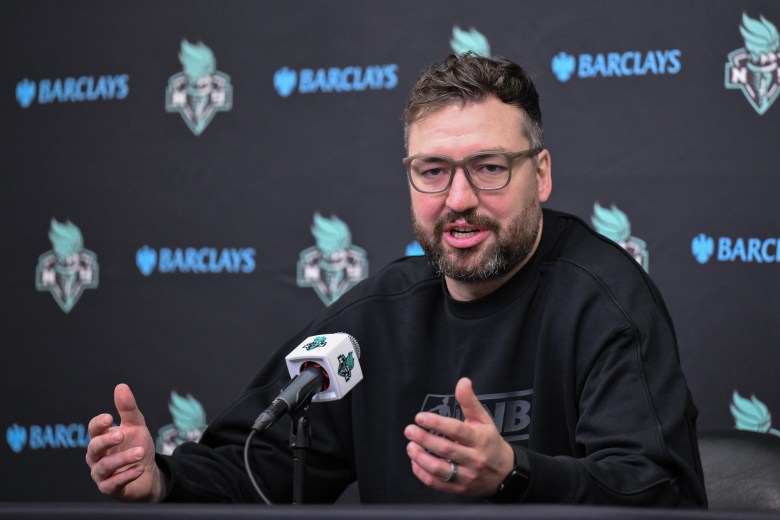
NEW YORK — Less than two minutes into our interview, New York Liberty head coach Chris DeMarco uttered one of the most famous underground jokes that have come out of WNBA circles over the years. It took me by surprise.
He used the term MNBA to refer to the NBA, the league he had worked in for way over a decade.
The joke opens a conversation about why, in men’s professional sports, their gender isn’t placed in the title of a league. It’s a joke that reveals how women’s sports have been othered for most of modern history. And in order to strive toward equality, shouldn’t the gender of men be used in the title of a league for men?
To be clear, this interview took place over a full day before Saturday Night Live cast member Kam Patterson used this reference on Weekend Update while reacting to the dramatic breakup between (M)NBA star Klay Thompson and rapper Megan Thee Stallion.
I wanted to know how DeMarco knew that terminology.
“I’ve been here now four months, and we interact a lot with players in the community and everything,” DeMarco said in response. “So is it like a running joke right now, or something?”
DeMarco wouldn’t tell me when he first learned the joke or if he saw it on a social media post. He also didn’t tell me that, as a lover of comedy, if it really made him laugh. What he did tell me, however, was the fact that this was the first time he’d uttered the joke in a more public setting and on the record with a writer.
I kept pushing him, wanting to know exactly when he learned this joke and what he thought of it. He interrupted. “I just immerse myself in everything WNBA, and so is my staff,” he said.
This was a moment that represented the fact that it’s just as important that DeMarco is proficient in the nuances of WNBA culture in addition to knowing the tendencies of the league’s players and coaches. “I almost feel like people need a degree in sociology to cover the WNBA,” former player and now media member Layshia Clarendon said on The Athletic’s No-Offseason podcast.
What about to coach in it?
DeMarco’s hiring is a result of history repeating itself. As over the past few seasons, an influx of (M)NBA coaches have come into the W, bringing (M)NBA tactics, and as a result, have put into question the relevance of the coaches who built the WNBA into what it is today. While these coaches who came from the (M)NBA aren’t all men, over 57% are.
2026 marks the first season since 2021 when there were more men in head coaching roles in the WNBA than women. 2026 also marks the first season since 2020 without a Black woman serving as a head coach in the league.
Are women head coaches in the WNBA dealing with a glass escalator problem? That I’m not so sure about, but it’s worth keeping an eye on.
With more money and mainstream attention, does the WNBA have to give up its identity of what always made it a unique and diverse league? Especially amid Caitlin Clark’s recent appearance with country music star Morgan Wallen, there have been questions lately about whether what the WNBA has become known for — more liberal politics and social and political activism — will fade into the background.
Listen now to The IX Sports Podcast and Women’s Sports Daily
We are excited to announce the launch of TWO new podcasts for all the women’s sports fans out there looking for a daily dose of women’s sports news and analysis. Stream on Spotify, Apple Podcasts or anywhere you listen to podcasts, and make sure to subscribe!
Those aren’t mutually exclusive. Just because (M)NBA coaches are spreading their knowledge and wisdom with the WNBA doesn’t mean those coaches don’t also have to learn as well. It’s osmosis.
Let’s return to DeMarco, shall we? It’s become clear that he wants to be a part of breaking a cycle where fewer women are being hired as decision makers in the WNBA space. He wants his coaching staff, and in particular the three women on it, to feel empowered to speak up.
“I want my staff to want to come in here every day and want to be heard and have a voice and allow them to grow into themselves as coaches,” he said.
He also understands what’s intrinsically special about the league he’s now working in. He appreciates how the WNBA functions in society and the impact it makes on young people of all genders and walks of life. This is something that is much more apparent than in the league where he came from. It’s refreshing to him.
But, he’s also aware of the backlash he received publicly on the internet and privately inside league circles about how he’s coaching a professional women’s basketball team without having ever coached organized women’s basketball.
When DeMarco was introduced to the New York media market back in December, he was asked about the thought he’s given to coaching women, something he hadn’t really done a lot of prior to accepting the job.
He knew it was something he enjoyed, especially after he got to coach a lot of young women in different iterations of Basketball Without Borders, the global development and community relations outreach program that has introduced international talent to both the WNBA and (M)NBA. Cinnamon Lister, the senior manager of NBA International Operations, had a feeling DeMarco would gravitate toward coaching women. “I told you,” she said to him.
But in his answer to the question at the press conference, he explained that he was going to read all of the books that he could on the league and the New York Liberty. One of his assistants, Addi Walters, revealed to me that DeMarco really is an avid reader. He wasn’t just saying this during his press conference. “He’ll read books about anything,” she said.
His comment during his presser was earnest, but it was one that also revealed that DeMarco didn’t really understand at the time that part of the WNBA’s history is that it hasn’t properly been covered and documented like the other men’s pro sports he’s familiar with.
The IX Sports reached out to New York Liberty fans to check their temperature about their initial reactions to the hire. This was a text exchange between two of them.
We hired new coach.
No way. Who?
Chris DeMarco Warriors assistant coach. Also men’s coach for Bahamas national team lol.
Urgh. A man.
I know. Not happy.
Among longtime fans of the team and the league, his hire was met with criticism. But this feeling wasn’t just limited to people on the outside. Folks inside the WNBA space felt similarly. Before she was officially hired, New York Liberty player development coach Kristen Mann didn’t have a positive reaction to DeMarco’s hiring at first.
“I think even for me, that was my initial reaction as well,” she told The IX Sports. “Oh, here we go, another guy. At the same time, we don’t know who interviewed for the job. We don’t know what their whole process was.”
Breanna Stewart even explained in the team’s Liberty Unlocked video series that it was up to her and all of the Liberty’s returners to make sure all of the new staff members understood the culture that she worked hard to help create.
“I think it puts pressure on the returners, the players who have been in this franchise, so that everyone knows the standard,” she said.

Jan. 1, 2026, was when DeMarco and his first hire, assistant coach Will Sheehey, began their odyssey in learning the style of play associated with the WNBA and its players. The two spent hours in the basement of the Barclays Center in the basketball operations compound, poring over hours and hours of film of the Liberty from the 2025 season and film of other women’s leagues around the world, including Australia’s WBL, Euro Cup, and Euro League.
Some days, they focused on certain actions. One day could be pick-and-roll day, another they could be looking at post-ups, and then on another day they could be watching film of a free agency target. They had a free agent board hung up in their offices.
Sheehey watched these games at two-times speed each day so he could get through as many as possible. Sometimes, that amounted to anywhere between four and six women’s professional basketball games in a single day of work.
They used Hudl SportsCode, a software very popular among college and professional sports teams, to help log offensive and defensive possessions. Hudl creates folders and allows users to save clips that can then be shared with other coaches or staffers. Sheehey and DeMarco used it to find patterns about different players and teams across the league.
They paid laser-focused attention to how different teams drew up sideline out-of-bounds plays, and if those other tactics could work with the Liberty and their projected personnel. When DeMarco and Sheehey saw something that intrigued them from an international team outside of the WNBA, they clipped it and put it up on a larger screen to watch together.
The questions they considered were: How could it work for the Liberty in 2026, and if not, is there a way the Liberty could counter it in 2026?
“We wanted to learn our players the best so that we’re designing an offense and defense around them,” Sheehey said. “We want to make sure that we’re highlighting their tendencies first. So we would watch all of our games from last season, and then we start watching each individual team again. We watch the Mystics. We saw what our team did, and then we would then watch them again for a free agent. Which players do we like? Which players do we not like?”
This quick ripping of game film impressed assistant coach and former WNBA player Courtney Paris. She was one of the later coaches to have been hired, and once she arrived in Brooklyn this past February, league rookies DeMarco and his two assistants, Sheehey and Walters, knew what was going on.
“Becoming Caitlin Clark” is out now!
Howard Megdal’s newest book is here! “Becoming Caitlin Clark: The Unknown Origin Story of a Modern Basketball Superstar” captures both the historic nature of Clark’s rise and the critical context over the previous century that helped make it possible, including interviews with Clark, Lisa Bluder (who also wrote the foreword), C. Vivian Stringer, Jan Jensen, Molly Kazmer and many others.
“You can tell they really were committed to learning this league and the players in this league and the players outside of this league,” Paris said.
People like Paris, Mann and head of player development Andrew Wade have been working behind the scenes to fill in the gaps for the half of the Liberty’s coaching staff that comes directly from the (M)NBA.
Wade explained his process for filling in the gaps. It’s based around informing the coaches new to the league about what worked in the past and what hasn’t for the Liberty’s core group of players. Often, the same plays previously had different names.
But also, it’s about filling them in on player personnel. Wade has been involved in the WNBA since 2019, and he’s seen the league’s modern evolution up close. And as a head coach for the offseason league Unrivaled, he has coached a lot of players from other WNBA teams.
Let’s take the Indiana Fever, for example. Wade knows what Caitlin Clark and Kelsey Mitchell looked like while playing together in 2024 and what actions head coach Stephanie White put the duo in when they played a lot of minutes together. Clark was hurt for the majority of 2025, so there wasn’t much recent film that the other coaches could cram in of those two in the basement offices at Barclays Center.
He also saw up close at Unrivaled how Aliyah Boston became a different player entering the 2026 season. She has what Wade called a “two-foot stop into her shot,” which she didn’t have previously.
“She changed her footwork on her shot, and it was a left-right last year,” he said. “So, little details like that. It’s not gonna save the day, but it just adds more context into our game prep and to why players perform the way they do.”
WNBA institutional knowledge isn’t just about learning the players and how the coaches coach them. Learning the league also means understanding who the players were before the Million Dollar contracts and charter flights.
The beauty of the WNBA being 30 years young is that many of the league’s primary sources are still alive. DeMarco made sure he met and got on Zoom calls with Liberty legends Kym Hampton and Sue Wicks, two players from the earliest iteration of the franchise who are often seen at games cheering the team on. When Teresa Weatherspoon visited Liberty training camp to prepare for her WNBA broadcasting gig with Amazon Prime Video, DeMarco made sure he spoke to her as well.
He’s gotten to know Hampton. They bonded on set for a Shake Shack social media campaign where the two made and got to taste the “Liberty Cake Shake.” They both struggled to say the shake’s name on camera. They couldn’t stop laughing. It’s a tongue twister.
Once the team gets into a regular season rhythm, DeMarco plans on inviting specific New York Liberty alumnae to practice and to games so that they can impart wisdom on the 2026 team. It’s a no-brainer, especially in a season where the WNBA community is celebrating Year 30.
But also, learning the league means understanding the quirky traditions that players have developed over time. Enter Paris, who recently told me that something she had to explain to DeMarco was the significance of the half-court shots in the practice or shootaround before a game.
(M)NBA players shoot only based on fines — more on this soon — but in the W, the players always shoot a half-court shot. And they either split or earn the money that comes from making it. She noted how much of a big deal that is to the women of the WNBA and how much small details like that do matter.
“That’s such a small thing, but that’s a difference between how things are done in their league and our league,” she said. “You’ll find that in a lot of different ways, from basketball-wise, to the different needs, to our bodies, to everything. And I think he’s very aware of that, and he leans on (former players) to figure that out.”
DeMarco conducts most practices with what looks like a black Fox 40 whistle. But when he participates in practice, which is often, he takes the whistle off. Sometimes he participates in sprint drills alongside the players, which are run toward the end of practice. And then other days, he participates in actual basketball drills.
A few minutes after 2 p.m., as a Friday afternoon practice was winding down, he wanted to get in on the action. While in his all-black WNBA vintage pull-over sweatshirt, black pants, and a pair of seafoam sneakers, he received the ball from Wade way beyond the 3-point line on the left wing. He took one dribble and shot a three right over the outstretched arms of one of the Liberty’s practice players.
He missed badly and then went to high-five Callie Wright, one of the team’s coaching associates, slapped Sabrina Ionescu’s hand, and then hesitated before running toward another pass from Wade. He caught the ball again in the same spot, dribbled once, bent his knees and shot while elevating off his toes. That one was closer. It bounced off the rim.
Just two minutes later, DeMarco got back into the action. He participated in a one-on-one drill from the opposite end of the practice court. He ran to receive the handoff from Mann, and then he dribbled while being guarded by player development coordinator Noah Shy. DeMarco lost the handle while he tried to go up for a shot.
He knew who was watching. He had a smile on his face as he walked back to stand next to Liberty developmental player Marine Fauthoux. Ionescu was quite impressed. Apparently, he’s improved from when the two worked out together during the offseason, where he “got cooked.”
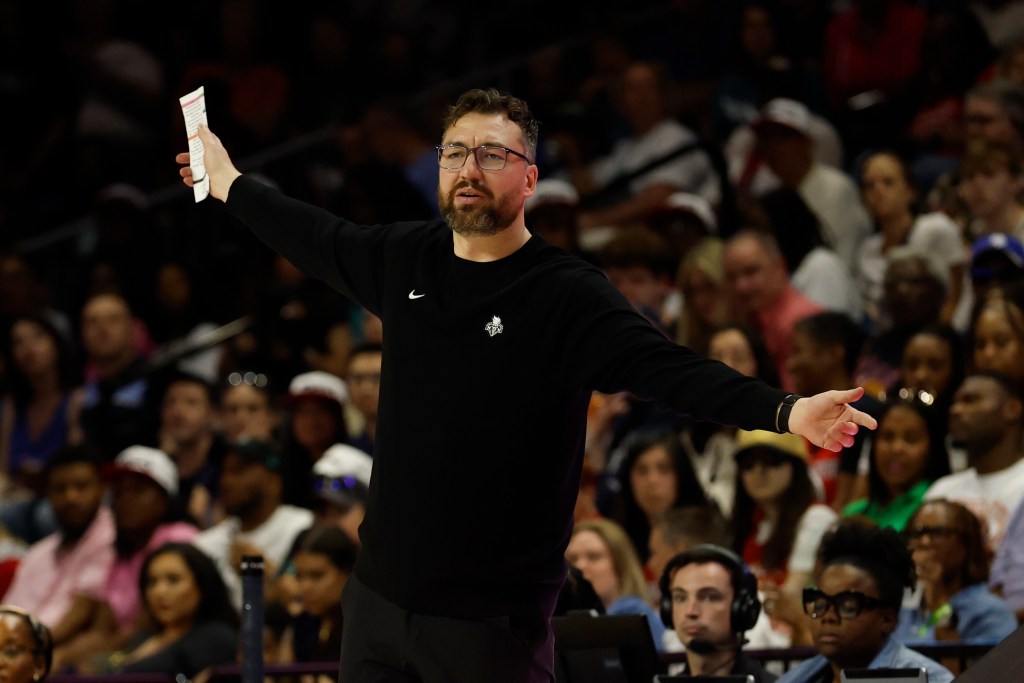
“You guys see him during the conditioning drills, running with us, or just getting out there and trying to score on us,” Jonquel Jones said after a practice. “So he brings a light-hearted energy to the team, but then he’s also really firm on where we’re supposed to be when we’re supposed to be there. So it’s like a perfect balance of light-heartedness, but also strictness or seriousness.”
That balance is how DeMarco achieves accountability. A public example of this has been DeMarco fining his players when they’re either late or don’t box out properly following free throws. Stewart has not only addressed this on her podcast but also during the Liberty’s league mandated national press conference days before the start of the season.
“He’s all about fining people and stuff,” Stewart said with DeMarco in the room with her. “And if you’re late and doing things. He still owes (Betnijah Laney-Hamilton) money.”
A cacophony of laughter erupted between Stewart, DeMarco and Laney-Hamilton, who was sitting between the two for this Zoom press conference. The three of them were giggling and in their own world.
I asked for clarification on this. Laney-Hamilton explained that she took a charge in practice and tumbled. And that, in her book, she deserves a reward to help compensate for some of these fines.
“If we are going to get fined, that’s fine, but we have to have some rewards as well,” she said. “I have not been paid yet. I just want to put that on the record.”
The way DeMarco handles these humorous but also quite awkward moments is by laughing or countering the players’ frustrations with a smile. Rookie Pauline Astier was asked about the fines following the Liberty’s 100-82 win Thursday night against the Portland Fire.
Astier didn’t use her words, but communicated something. She gestured with her eyebrows and threw her neck to her left in accordance with the idea that the fines are frustrating. DeMarco turned to her with a smile. “No, no, but you could get the rebound, and then it will be fine,” he said to her.
This is the osmosis at work. This is the welding of WNBA and (M)NBA culture into something new. It’s not about neglecting one or the other. Think about it another way. It’s just like one of the most famous songs that I used to sing when I was a Girl Scout. It’s a song about making new friends and how holding newer and older relationships at the same time isn’t some sort of contradiction, but rather a natural progression in life.
Your business can reach over 3 million women’s sports fans every single month!
Here at The IX Basketball and The IX Sports, our audience is a collection of the smartest, most passionate women’s sports fans in the world. If your business has a mission to serve these fans, reach out to our team at BAlarie@theixsports.com to discuss ways to work together.
There was an elephant in the room during the late afternoon when DeMarco and I were sitting in cushioned fold-up chairs on the practice court at Barclays Center. No, it wasn’t Ellie. She wasn’t eavesdropping like only a diva like her would. It was a different kind of elephant.
I wanted to know what he thought of the backlash and overall conversation about male head coaches from the (M)NBA coming to the WNBA. I acknowledged how tough a question that was, but also how uncomfortable it is. He was judged before he even began the job, which is a plight that many women in so many different lines of work can relate to.
He paused and asked for some clarification before answering. He understood the importance of the conversation and why it needed to be had. Why the elephant had to be addressed.
“I think my biggest thing is one, I’m a basketball coach, and what I love to do is get on the floor, be a part of it, get to know players, and develop players,” he said. “That’s why I’m here. I’m passionate about it, but also the players have built this league, and they’ve built this platform, and I’m honored to be a part of that. I’m honored to be here, and all I’m trying to do is continue to grow it and continue to develop these players, and at the end of the day, that’s my goal.”
This conversation is something that can’t be avoided. It can’t be ignored or shoved to the side. When it’s avoided, it gets worse. Just look at Phoenix Mercury head coach Nate Tibbetts, who drew immediate criticism from the women’s basketball world because he was branded from the jump as a “girl dad.”
As a result, he wasn’t taken all too seriously initially. Instead of Tibbetts explaining to media members how much he was bought in on the WNBA and loved learning the league’s history, he was shoehorned into a stereotype and, as a result, didn’t really feel welcomed across the league at first.
“When I took this job, there wasn’t a lot of people that were excited or welcoming, to be quite honest,” Tibbetts said back in October during shootaround before Game 4 of the 2025 WNBA Finals.
Satou Sabally, who has now been coached by Tibbetts and DeMarco, had some thoughts about those who are concerned about men coming into the WNBA from the (M)NBA.
“I would say question the character, don’t question the gender,” she said. “I think it’s important to know who they are as a person. (Tibbetts) is a family guy, respects women, has two little daughters. Chris has been around basketball for so long and has been around really big characters. So we are all big characters. And I think that was something important that he brought into dealing with a lot of personalities.
“And that is what women bring to the game. We’re different, and everyone brings their own little flair to it, and he really embraced it. We had a dinner, and he just really encouraged me to be myself and bring things to the table that we want to address. So he’s really opening up the floor for discourse, and it’s not just putting a gender on us but creating an open level. I would say people that are so outraged sometimes by new coaches, you don’t know a person. Chill a little bit.”
Rebecca Allen, who is one of the franchise’s longest-tenured players on the 2026 roster, was also coached by Tibbetts and now DeMarco. She agrees with Sabally, and she views (M)NBA experience as something that can help the WNBA continue to grow.
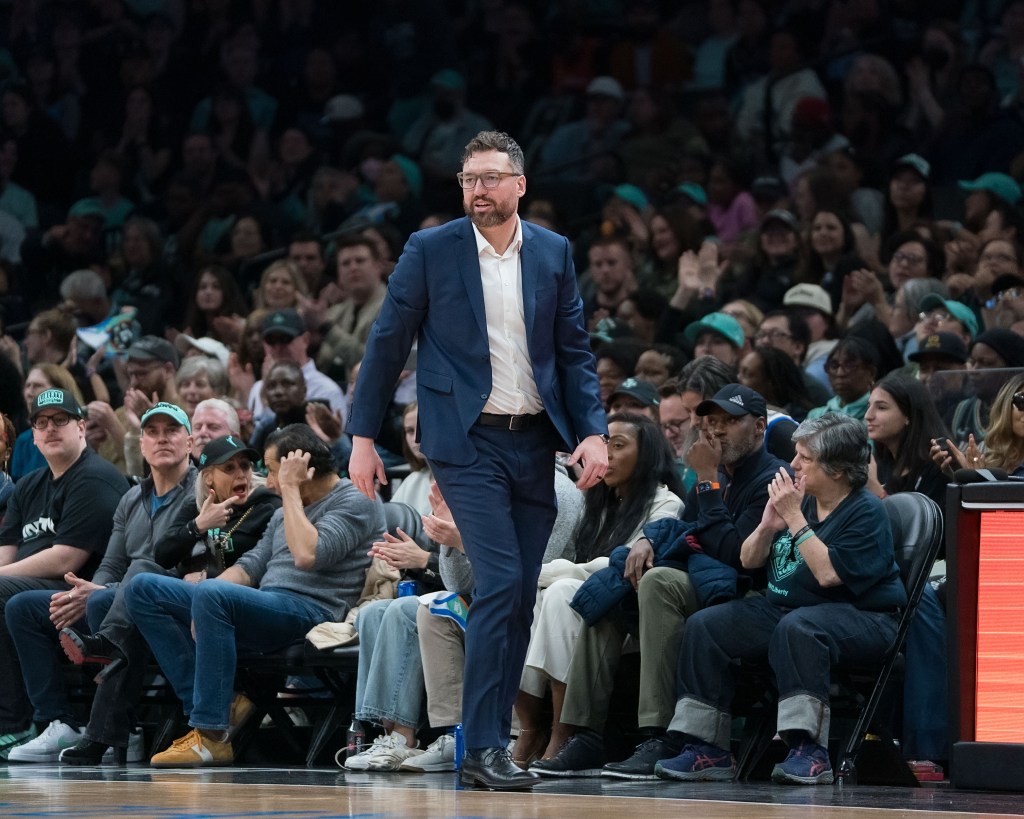
Allen was also coached by someone else around a decade ago in New York who came from the (M)NBA and is responsible for changing the WNBA for the better. Bill Laimbeer, amid all of his antics, was always intentional about who was on his staff. There’s a whole other conversation to be had about why most of his former assistants, sans Cheryl Reeve and Sugar Rogers, aren’t still coaches in the league.
Addressing the elephant begins with intention and continues when it isn’t ignored.
Walters, Paris and Mann are examples of this intentionality. As is the addition of two former college players turned coaching associates in Wright and Ana Haklicka.
When Walters first came out of college after playing at Stetson University and Cal State Bakersfield as a shooting guard, she reached out to hundreds of people in the (M)NBA coaching world. Sure, she’s the daughter of former (M)NBA player Rex Walters, but she still had to network the old-fashioned way: cold emailing. DeMarco was one of five people to respond to her emails. He gave her a platform to talk about basketball and eventually teach it to players on the Bahamas men’s national team.
“He was all about the right things,” Walters told The IX Sports. “And all about just giving people an opportunity in untraditional spaces.”
Walters runs the Liberty’s defense.
During New York’s first preseason game against the Fever, DeMarco told his staff that if he was going to get ejected by the officials after getting a technical previously, then Paris would be running the team.
“Oh, I think he’s serious,” Mann told Paris at the time. “I think he will intentionally get kicked out, just so that you can get reps at being a head coach.”
‘Rare Gems’ is out now!
Howard Megdal, founder and editor of The IX Basketball and The IX Sports, wrote this deeply reported book. “Rare Gems” follows four connected generations of women’s basketball pioneers, from Elvera “Peps” Neuman to Cheryl Reeve and from Lindsay Whalen to Sylvia Fowles and Paige Bueckers.
If you enjoy Megdal’s coverage of women’s basketball every Wednesday at The IX Sports, you will love “Rare Gems: How Four Generations of Women Paved the Way for the WNBA.”
DeMarco also wants Paris not to just work with bigs because she was one. He believes there’s so much the team’s guards and wings could learn from her, too. He specifically pointed to her footwork as a player as something that everyone on this Liberty team could learn.
Mann has been given more responsibilities in New York than she had previously with the Connecticut Sun. DeMarco asks her about who in Europe could be a WNBA player and who maybe isn’t. He trusts her. She played pro basketball for two decades.
“I think they demand a room,” DeMarco said about the three main women on his coaching staff. “I think different personalities, but very smart in their own right, the way they handle situations, the way they teach. I’ve told them many times how lucky I am to have them. I lean on them every day.”
In his journey learning not just the basketball of the WNBA but its culture too, DeMarco has observed what makes the WNBA a bit more accessible than the (M)NBA. When he’s out on the street waiting for a light to turn green or walking his dog Parker, an energetic Hungarian Vizsla who does tricks, fans approach him.
They ask him if he coaches the Liberty, and then they continue to hype up what to expect inside Barclays Center during the crux of the WNBA season.
This is what DeMarco loves almost as much as coaching. He loves meeting new people and having genuine interactions. He sees so much value in young kids getting to meet star players like Sabally, Ionescu, Stewart or Jones, who will give them the time of day.
DeMarco thinks about the young people who are having a tough time and maybe don’t have families who can provide support. He thinks about the way those young people can gain some self-confidence through watching a WNBA game or meeting a player or a coach.
He loves how intimate the Liberty fan community feels. “It just feels like you can touch it here,” he said. “And that piece, to me, is so important.”
Next time, I will have to ask DeMarco if he knows the phrase “The WNBA is so important.” It’s another grassroots mantra that was coined by longtime women’s basketball commentator Arielle Chambers to explain the WNBA’s impact on communities across the country.
It’s definitely one he would agree with if he doesn’t know about it already.