Welcome to The Next: A basketball newsroom brought to you by The IX. 24/7/365 women’s basketball coverage, written, edited, and photographed by our young, diverse staff, dedicated to breaking news, analysis, historical deep dives and projections about the game we love.
Subscribe to make sure this vital work, creating a pipeline of young, diverse media professionals to write, edit and photograph the great game, continues, and grows. Paid subscriptions include some exclusive content, but the reason for subscriptions is a simple one: making sure our writers and editors creating 24/7/365 women’s basketball coverage get paid to do it.
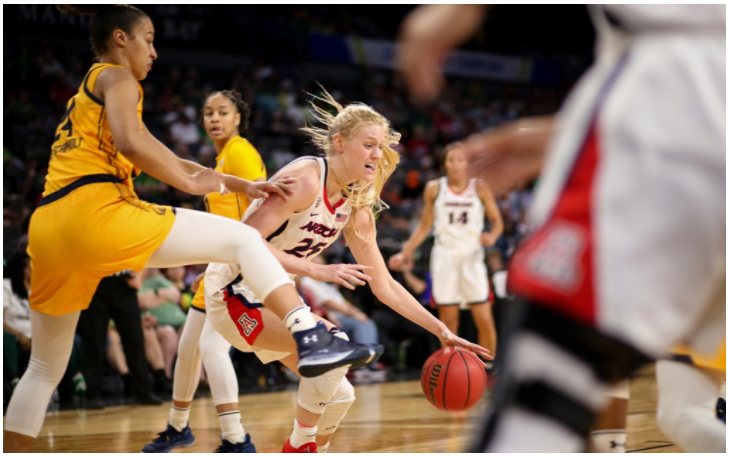
Arizona and California at the 2020 Pac-12 Women’s Basketball Tournament in Las Vegas, Nev. on Mar. 6, 2020. Photo by Evan Brown of Arizona Athletics.
What happens when one of the best leagues in women’s college basketball unilaterally puts restrictions on its programs that prevent them from taking the court to play until at least Jan. 1, 2021? That’s the question facing Pac-12 coaches right now after their conference became the only Power 5 league to postpone the beginning of winter sports competition until at least the new year.
While coaches are unanimous in their public support of the Pac-12’s decision to postpone the season’s start date, that doesn’t mean some aren’t concerned about how it affects their ability to compete with those who are already practicing.
“My initial thought was, of course, a little bit upset,” Arizona head coach Adia Barnes said. “Because I thought we had a huge disadvantage because I’m talking to my friends in the SEC and they’ve been practicing for like 10 weeks, like on the court and stuff. So I did think that was a little bit of a disadvantage. And then I saw half the Pac-12—like ASU, Colorado, a lot of teams—were practicing. So I did think that was a little bit of a disadvantage.
“But then when I looked at the flip side, a lot of places are starting up, then stopping again,” she said. “So I felt we’re doing stuff safe. The right way. And is a month gonna be do-or-die? No. But, you know, from a competitive standpoint, of course, you think about that.”
As Barnes alluded to, it’s not even a level playing field within the conference, even between schools located in the same state. Some schools haven’t even brought players back to campus while others have been posting videos of practice for almost a month.
In June, the NCAA laid out the path for schools to start bringing their student-athletes back to campus. How that path was forged was ultimately up to each institution’s leadership and local governments’ rules and regulations.
What that meant is that some schools, including ASU and Colorado, were back fairly quickly. Others, like USC, allowed their players to come back for strength and conditioning activities but had only a few were able to take advantage of the opportunity.
The University of Arizona started its reentry plan in June before halting it later that month before any basketball players had returned. The decision was made not by state authorities, but by those at the university who were concerned about the increasing number of cases and hospitalizations in the state of Arizona. While the Sun Devils were practicing 90 minutes up I-10 in a county with even higher infection rates, the Wildcats were not even on campus.
Then, there were those like the California Golden Bears and Stanford Cardinal who didn’t attempt to bring their student-athletes back at all. ESPN reported that Stanford is considering an Olympic village type living situation when the Cardinal finally brings those athletes back to campus.
“We’re gonna try to maximize whatever we can do,” Stanford head coach Tara VanDerveer told Mechelle Voepel. “Conditioning and weight training, and you’ll hope (to) get on a court. Right now, we’re not allowed to go inside a gym. Maybe we have to get some outdoor courts to figure out a way to get people to do some skill work. California is very strict.”
Other institutions are very guarded when talking about the issue at all. When contacted for comment from ASU head coach Charli Turner Thorne about how the reentry process was progressing for her team, an Arizona State spokesman said that she was not authorized to speak about COVID-19. All information must come from one of a few authorized individuals within the ASU Athletic Department or via their website.
The time away presents different challenges for different teams. Arizona is an experienced team that features one of the best players in the country in Aari McDonald. The senior guard could have gone to the WNBA Draft in April but came back to school after the NCAA Tournament was canceled.
Along with fellow senior Sam Thomas and junior Cate Reese, McDonald was set to lead the Wildcats back to the tournament for the first time in over 15 years. They have a real shot at making a deep run with some suggesting this team is capable of reaching the program’s first-ever Final Four.
Now, they face the possibility of losing a non-conference season that was supposed to include games against Texas, Gonzaga, and Arkansas. While some coaches in other conferences are saying that they expect the season to start late, no one has yet taken the steps that the Pac-12 has. How it will affect the non-conference slates of the league’s members is still an unknown.
The final members of the team were trickling into town when Barnes spoke to the media on Aug. 14. The players in Tucson were finally able to get together for some movement work at the Cole Athletic Center earlier that day.
Getting up to full speed will take time simply because the conditions of lockdown differed for the players depending on where they lived, especially on a team with seven international players. Reintroducing the athletes to practice needed to be taken slowly for safety reasons.
For that reason, Barnes was not as concerned about the postponement of the season.
“For us, when I look at the big picture, it’s not really a lot of time,” Barnes said. “We would have three weeks of phase-in. And then we would have slowly been on the court because we don’t know what the players have been doing this whole time. So it’s a really slow process.”
For a team like USC, it meant yet another loss of momentum. The Women of Troy, led by Pac-12 Freshman of the Year Alissa Pili, were on their way to the WNIT when the season ended last year. Pili and fellow freshman Endyia Rodgers showed that the future was bright for head coach Mark Trakh and his team.
Then everything stopped.
“There are realities in life,” Trakh said. “And that happened and we just have to come together, support each other and continue to be optimistic and hopeful. That’s really all you can do right now.”
His optimism is fueled by knowing the potential of the group, both as players and young women, once they can get back together.
“You haven’t seen your family in a while,” he said. “I’m looking forward to seeing all of them. And, from what I understand, they miss each other.”
For Cal head coach Charmin Smith, the hurdles are even taller. It’s not just about a family getting back together. It’s about incorporating a large group of new family members.
The Golden Bears were looking forward to welcoming the No. 6 recruiting class in the country. After only a few months on the job, last November Smith and her staff signed a class that included three five-star players and another four-star.
Changes have come fast since the end of the 2018-19 season. Kristine Anigwe graduated. That was expected, but no less challenging.
Just after that, former head coach Lindsay Gottlieb took a job with the Cleveland Cavaliers. Then, several promising players transferred out. Those definitely were not expected.
It seemed like things had evened out, though. Not only did Cal put together a stellar recruiting class, but they got some big wins throughout the 2019-20 season and made other some top teams sweat even in losses. The final game of the regular season was a road win over a Top 20 Arizona team.
Then, like for everyone else in college basketball, it was over. Almost everyone held out hope that things would be under control by summer. Surely it would be safe to play by basketball season.
Having the season postponed became just one more change that Smith and her team had to adapt to. For her, it’s one that seemed inevitable.
“For me and for our team, we expected this,” Smith said. “I think following the virus and where we stand in this country with our reaction to the virus, it’s no surprise that we’re not really in a position where we can play contact sports right now. So it’s very disappointing and frustrating, but definitely not a surprise.”
They’ve had to make due with Zoom calls instead of getting that young group of promising players integrated in person and on the court.
That’s not what Smith is most concerned about right now, though. Like most coaches, just being back with her team is the dream now.
“I just want to be able to give a player a hug,” Smith said.