Welcome to The Next: A basketball newsroom brought to you by The IX. 24/7/365 women’s basketball coverage, written, edited and photographed by our young, diverse staff, dedicated to breaking news, analysis, historical deep dives and projections about the game we love.
Subscribe to make sure this vital work, creating a pipeline of young, diverse media professionals to write, edit and photograph the great game, continues and grows. Paid subscriptions include some exclusive content, but the reason for subscriptions is a simple one: making sure our writers and editors creating 24/7/365 women’s basketball coverage get paid to do it.
How will the Dream adapt with Chennedy out, Cheyenne Parker in?
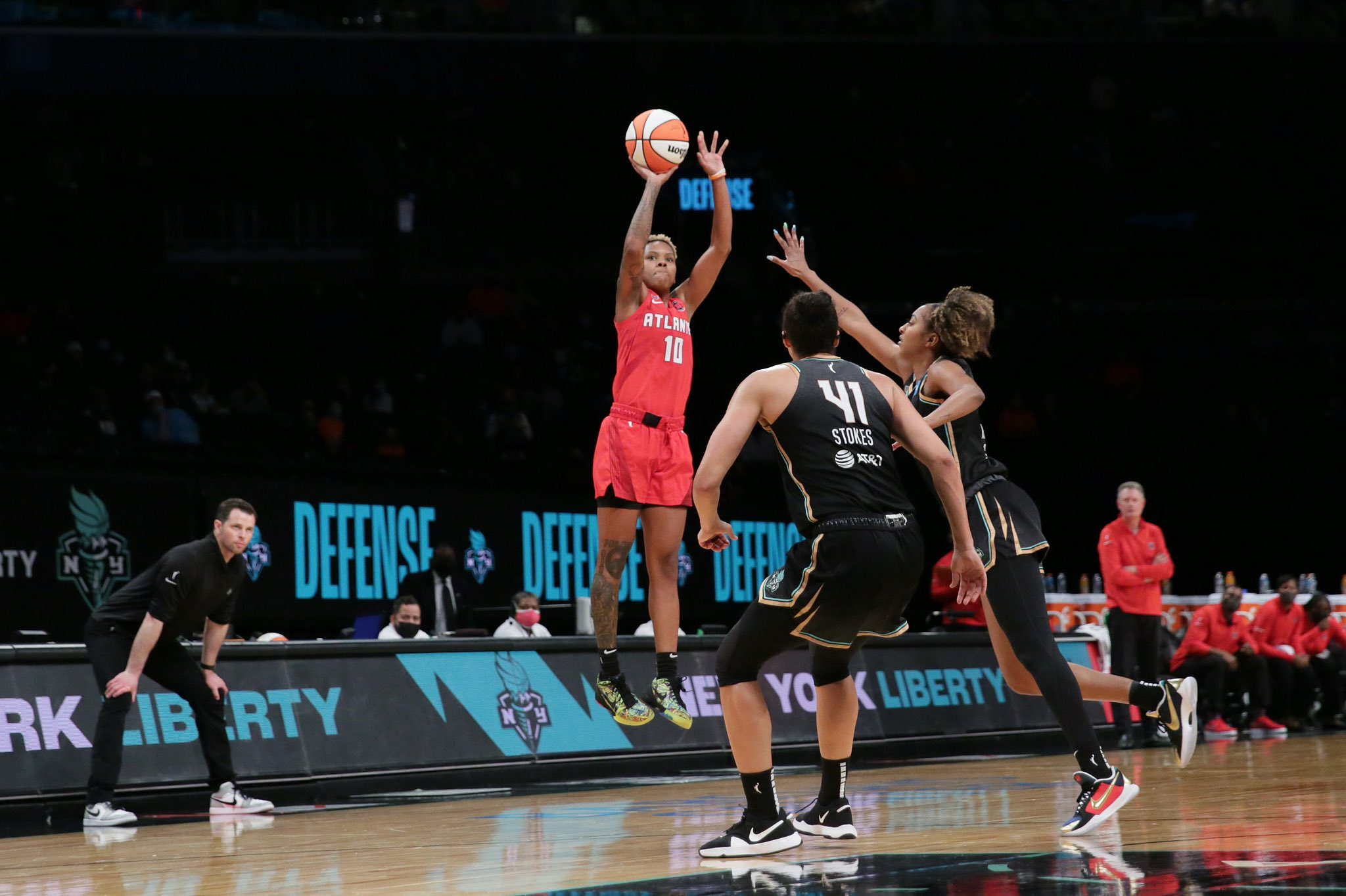
Last season, the Atlanta Dream were a different team when Chennedy Carter was off the floor.
Different did not mean better.
Carter will miss time for the second straight year after she hyperextended her right elbow in last Saturday’s contest against the New York Liberty. Though she will not need surgery, the recovery period will likely stretch through most of June. The injury marks another tough blow for one of the league’s most exciting young stars, and the Dream will be worse off for it. That said, Atlanta is in a much better position to adapt than it was last year. And though one window has closed, another one is about to open.
After contracting the coronavirus and missing Atlanta’s first six games of the season, Cheyenne Parker has been cleared to make her Dream debut on Friday against the Minnesota Lynx. Parker had a breakout season in the bubble, averaging career-high figures in points (13.4), rebounds (6.4) and assists (1.5) while becoming a more versatile offensive weapon on the Chicago Sky, but she will need time to adjust after missing weeks of practice. Let’s do a quick Q&A on what her return means for Atlanta Dream.

Where does Parker’s offensive value come from in the post?
Like most of the league’s bigs, the lion’s share of Parker’s damage is done around the hoop. At 6’4, Parker possesses a rare combination of skills that leave her with enough grace and touch to abuse lumbering bigs and big enough to punish agile wings, feeding into interim coach Mike Petersen’s dream of a no-weakness lineup.
Though she will get plenty of work at the rim, her post play is a rung below the league’s upper echelon of bigs. Parker is much more likely to face a player up than back one down, and once she gets down low, the fleet-footed forward often favors the left shoulder rather than the right. She is, of course, capable of spinning in either direction, which is more than Atlanta’s other posts can say for this season.
“We already have great bigs that spread the floor, play hard, set good screens so just to have a little bit more of a scoring aspect, it will help a great deal,” Parker said. “It’ll put a lot of pressure on the defense because our guards are so impactful that they have to focus somewhere, so it will give us all more opportunity to just get good scores.”
How will her outside shot transform Atlanta?
This start was something of a worst-case scenario for Atlanta’s pick-and-pop dreams. The team’s best stretch forward, Shekinna Stricklen, has battled knee trouble all year. Its typically reliable spacer, Tianna Hawkins, has missed her first 14 long-range attempts, even as she finds other ways to contribute. And of course, Parker has been completely M.I.A. Her return will open the floor for everyone.
“We have a lot of opportunities for the pick and pop or the roll and rise, just creating more space for our guards to finish,” Parker said. “I’m very excited to have more opportunities on the perimeter this season and to continue to expand my game.”
Last season was Parker’s first as a stretch big, and she didn’t disappoint, knocking down 47 percent of her outside shots on 1.6 attempts per game. Those shiny figures certainly attracted Atlanta’s shadow-front office, but her rapid development suggests that those 1.6 attempts could in fact be the floor, not the ceiling, for her outside attack. In Atlanta’s versatile offense, her value is going to begin on the perimeter.
She can post up and space the floor. Is that it?
No, that is not it. Parker can also put the ball on the floor or catch dishes from the dunker’s spot if she has to create for her team.
The Dream have been relying upon Crystal Bradford to create as their positionless maestro, but Parker’s return brings the size that Bradford simply can not. At 6’4, Parker and Billings are the tallest players on the roster, but none of the traditional forwards or bigs on the roster are this comfortable putting the ball on the floor:
Parker should also fit right in defensively. In fact, the Dream’s bigs have provided most of their value on the defensive end of the court with their size and mobility, and her game is no different there.
“I want to be able to guard every position on the floor,” she said. “I want to be able to handle that as well as being able to guard the best post player that’s in the game. You know, it’s something that I pride myself off of as a basketball player.”
What are the limitations to watch out for in Atlanta?
Parker has never been a great passer, and that will limit some of Atlanta’s movement on the offensive end. Though she averaged a career-high 1.5 assists last season, her turnover rate was almost twice that figure. Alongside a more concerted effort to go right, the next logical step in her development in the post would come as a playmaker.
Given the high octane nature of the Dream’s offense, the low-octane nature of Parker’s passing, and the relative inefficiency of a post touch, I wouldn’t expect the team to feed Parker in the post any more than the Sky did last year. But her mere presence on the floor can shape Atlanta’s offense to score from the inside or outside.
Who will benefit most from her return?
Aari McDonald called Cheyenne Parker an “automatic assist.” I think she’s right.
McDonald’s rookie season has been a mixed bag, as it usually is for rookie point guards that don’t get extended minutes and are in the middle of obtaining their Master’s degree. But she is the exact type of player that could thrive alongside Parker, fitting the bill as a crafty passer and driver who could find Parker for dump-offs or kickouts, and for whom Parker could help space the floor given her smaller stature.
Courtney Williams is taking it personally
The Dream are having fun, and no one is having more of it than Courtney Williams.
After dropping 31 points, 12 rebounds, seven assists and a game-winner against New York last Saturday, Williams said that her motivation came from her teammates.
For as loose as Williams looks on and off of the basketball court, a closer eye (namely Petersen) knows that many hours went into refining one of the league’s best jump shots. Yes, let’s talk about practice. That’s the only way she’s able to get all these shots off.
Three components that make up a Courtney Williams jumper. The first is her speed: Williams darts around screens with intent. After contracting the coronavirus last season, Williams’ rhythm and agility were miles behind the peak they’ve hit this year. In 2021, it doesn’t seem like anybody can catch her.
“She does a great job of coming off of screens hard, whether it’s a ball screen, an off-the-ball screen, a dribble handoff or a gap, right, she just cuts hard,” Petersen said. “And so if you can cut hard, and you can stop fast and you can elevate, [you’re] really hard to guard.”
For as fast as Williams comes around those screens, there’s one skill she’s obtained even more mastery of — stopping. As Petersen has said, the most underrated skill in basketball is the ability to “stop in a hurry.” There’s almost no one who can recover fast enough when Williams plants a foot down.
The last step comes with her elevation and footwork. Once you’ve watched enough Williams film, you can tell just by watching her feet and her hands whether the shot is going in. Williams is a bouncy player, and when she lands with balance, the shot almost always finds the bottom of the net.
The Dream’s frontcourt is creating space for Williams to elevate, with the more traditional bigs setting strong and wide screens and the more mobile wings taking enough attention away as a perimeter threat.
For Williams, it’s all about getting comfortable and finding her rhythm. She’s leveling up with every quarter and every game she plays. Six years into her WNBA career, Courtney Williams is making the leap. She’ll need to stay sharp as the clear number one option in the weeks ahead.
For the WNBA super nerd, or the subscriber who wants their money’s worth, keep reading
If you’ll allow me, I’d like to take the next few paragraphs to put on my Nekias Duncan hat and dig into the super-minutiae that comes with watching every shot Courtney Williams has taken.
If teams want to stop Williams, they should look toward the baseline. Let’s first check the math on this. This season, Williams is shooting 3-for-14 (21 percent) from what I’d classify as the baselines, while she’s making 47 percent of her other mid-range jumpers. In fact, over the past two seasons, nearly all of Williams’ makes from the baseline have come off of catch and shoot opportunities, or opportunities when she was already in the corner. Now, is this just random luck? I think not.
While she takes and makes difficult shots, Williams doesn’t have the same success rate when her footwork is leaning or unbalanced. The shots where she finds herself fading to the left or right aren’t really working — she needs to have her body directly in line with the hoop.
Plain and simple, the baseline is where her best traits are neutralized. Let’s start with her stopping ability. Williams can stop on a dime, and that helps her because the defense doesn’t know when or where she is going to pull up. That asset is even more valuable in Williams’ hands, as she has one of the most diverse shot charts in the WNBA.
However, the closer Williams gets to the baseline, the more predictable her stopping point becomes. As she elevates, there is almost always a big coming over to help, minimizing the threat of her elevation and drive if defended correctly. That’s all on display in both of these actions against New York.
These aren’t unlucky misses, and an elite defender like Sami Whitcomb certainly can force Williams into these bad shots. If New York had adjusted quicker, these possessions could’ve been the difference between a win and a loss.
Like Williams said after she hit the dagger, she’s got ice in her veins. Some of these shots may fall. But I wouldn’t be surprised if teams keep forcing her to the baseline.