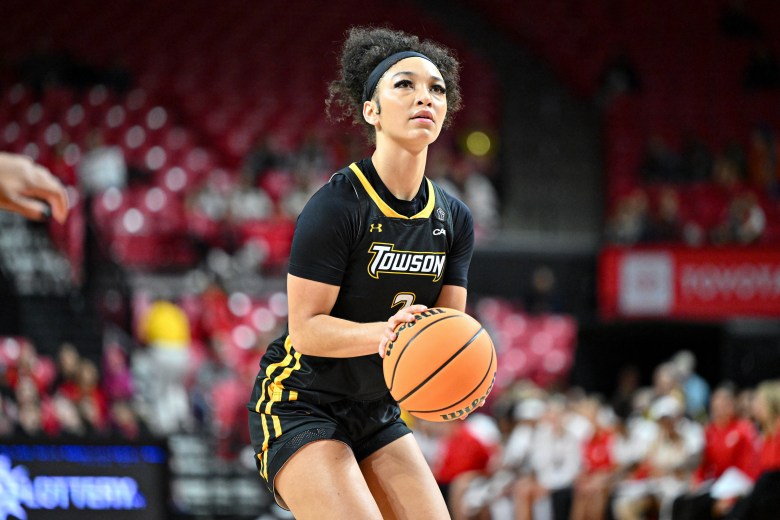
When asked about India Johnston Towson’s fourth-year head coach Laura Harper didn’t hesitate.
She responded with a smile, but there was a firmness in her voice, the kind a schoolteacher uses to stop side conversations cold. Harper leaned her 6-foot-4 frame forward, lowered her head and made her position clear. Forget diplomacy.
“Let’s be clear, she is the best player in the conference,” Harper said of the 5’8 senior guard when asked what makes her one of the best players in the CAA during the postgame press conference following Towson’s Jan. 2 win over Campbell.
Mic drop.
When you’ve stood ten toes down beside the first player you had to re-recruit through every uncomfortable rep, the quiet grind, the hard conversations, and every unglamorous moment, certainty stops being opinion and becomes fact.
That was Harper at the microphone. No qualifiers. Just truth, stated plainly.
“I challenge her every single day to play both sides of the ball, and she’s doing that now,” Harper continued. “So now that she’s able to affect the game offensively, obviously that’s her strong suit, but she’s also getting stops for us. I think now it just puts her in all the conversations with any and everyone in the conference.”
Through change, injuries, triumphs, and heartbreak, Johnston has been the one constant, anchored when everything else shifted. In an era where players move from school to school like chess pieces, Johnston chose to stay, to invest, to grow, cementing her Towson legacy as one of the winningest players ever to wear the black and gold.
Sixty-seven wins into her career, Johnston is four victories from matching the program’s all-time mark and five from claiming it outright.
“It’s a blessing, and I’m grateful to even be a part of that conversation,” Johnston told The IX Basketball following a 63-55 win over Northeastern on Feb. 8.
The game sped up around her. Johnston didn’t.
Some players don’t need the spotlight. That’s Johnston. She gleams in the quiet moments, cashmere-soft jumpers floating, her presence announced, her respect earned.
The commitment paid off. She became the 20th women’s basketball player in program history to reach 1,000 career points, a milestone made even more remarkable by the patience it required. After scoring just 375 points across her first two seasons, her game and her moment fully arrived.
Johnston’s impact showed up first in the people closest to her, the teammates in the trenches every day, the ones who shared the quiet bus rides, the long airport walks, and the unspoken understanding that forms when a season grinds on while celebrating everybody else.
During a festive weekend, that love boomeranged to Johnston in full.
Johnston smiled as she cradled a white commemorative 1,000-point ball, posing patiently for photos before a game against William & Mary on Feb. 6. Towson junior guard Thalia Shepard slipped into the frame, photobombing her teammate, grinning, and within seconds the moment became a group photo, arms around shoulders, laughter spilling out, joy shared.
Two days later, after senior day ceremonies against Northeastern, the scene shifted. With moist eyes, Johnston hugged her teammates and trainers, emotion lingering longer this time, the weight of years and reality of her impact settling in.
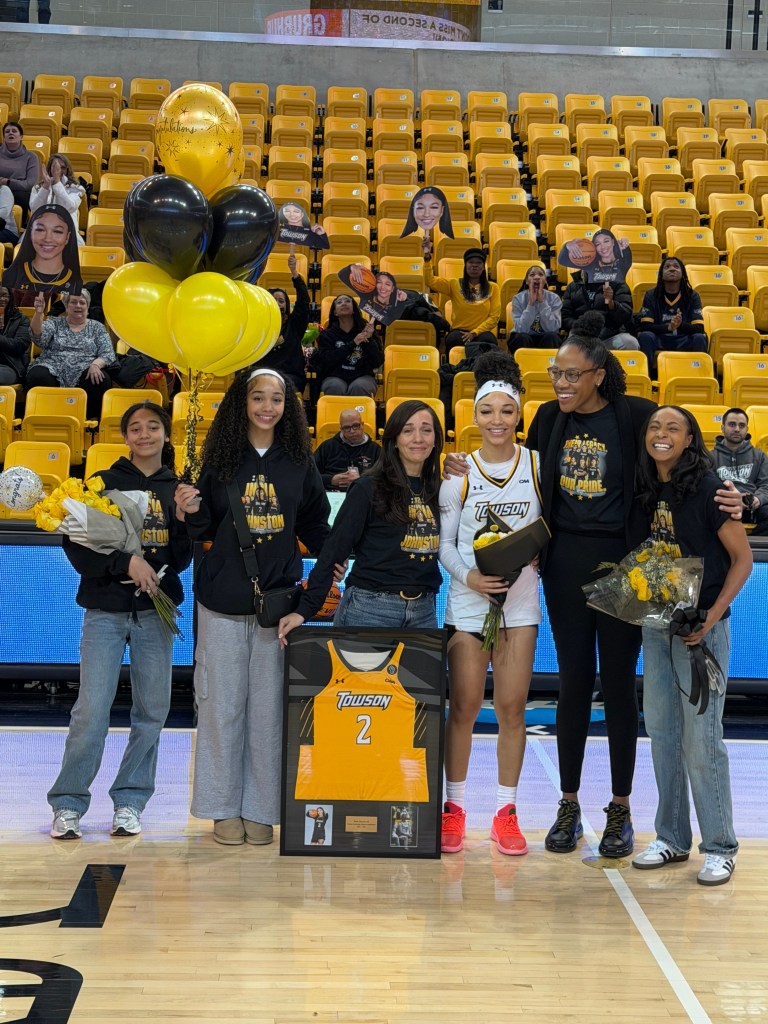
But the truest moment came away from the floor following the game. Johnston dropped into a squat to meet a young family member eye to eye, her ponytail pulled high like Elsa from Frozen. In that instant, the gym faded. Records, ceremonies, and noise, none of it mattered. Johnston’s gaze never left the little girl. Her attention was complete as she briefly played with the girl’s ponytail.
That was the point, too.
Johnston embodies everything that is positive about college athletics. She’s loyal, durable, and dependable. Johnston’s superpower has been her availability, as she has never missed a game, appearing in 120 contests, the third-most in program history. If she plays in six more games, she will have played the most games in Towson history.
Her 160 career three-pointers rank fourth in Towson history. Johnston’s name won’t be found scattered across every career leaderboard, but in many ways, that makes her career stand out even more. She’s 11th all-time in program history with 1,136 career points.
This season, Johnston embraced a new role as Towson’s sixth woman. For anybody else, coming off the bench could have been a disruption. Instead, it became another form of leadership.
After starting Towson’s first nine games, she has come off the bench in 14 of the Tigers’ last 15, a stretch in which Towson is 10-5. Johnston has been a spark — her career-high 26 points fueled a 15-point rally in an overtime road win at Maryland Eastern Shore, followed by 24 points in a win over Hofstra. She scored a career-high 31 points in a road loss to William & Mary this past Sunday.
Johnston has embraced the challenge. Her usage rate is 25.1%, up from 21.0% last year, meaning that more Towson possessions are ending with the ball in her hands. In addition, her assist rate is 18.6% this season, slightly up from 17.7% last year.
Whatever the team needs — energy, steadiness, or timely shot-making — she has delivered.
“Accepting my role, my team believes in me, my coaches believe in me,” Johnston told reporters following the Campbell victory. “I am just doing anything I can to help us win. I put the work in, and I trust what I do. So, shout out to the team for keep calling my number, but I’m thankful.”
Johnston, who earned Preseason All-CAA honors at the start of this season, is fourth in the CAA in scoring at 14.5 points per game.
Johnston’s road to becoming one of Towson’s best players, though, wasn’t easy. It began with immediate change. She was recruited to Towson by former coach Diane Richardson, who accepted the Temple job before Johnston ever stepped on campus.
Harper became emotional during the postgame press conference against Northeastern when asked about Johnston’s journey and their bond.
“She was my very first recruit here in Towson, so there’s no words,” Harper reflected. “When I got the job, she’s the first person I went to go and secure. I didn’t think she was going to stay. She’s had four different years here at Towson. And when you think about the landscape of intercollegiate athletics, she’s had four different realities of where college women’s basketball has gone, and she’s adapted. She’s stepped up to any challenge that we’ve asked her as a staff. So yes, I get extremely emotional when it comes to this class … When you think about Towson, you think about legacy, you think about my tenure here, it starts with India.”
Last season tested Johnston in ways winning never had.
Towson endured a challenging campaign, finishing with 12 wins as injuries forced Johnston out of her comfort zone. Instead of coming off screens, she was facilitating the offense. Rather than flinch, Johnston leaned in. Leadership often requires stepping into uncomfortable spaces because others are depending on you. Even while leading the Tigers in scoring at 12.5 points per game, Johnston never stopped showing up or learning.
She still managed to enjoy some nice moments. The bursts of brilliance were there last season: 24 points to lift Towson past Elon in the CAA tournament, a fourth-quarter takeover against Delaware at home, and a cold-blooded game-winner on the road at UNC Wilmington.
Before that season, Johnston had only known winning. Towson won at least 20 games in each of her first two seasons, including a trip to the CAA title game during her freshman year when she averaged 15.4 minutes per game. She arrived from Caravel Academy as a two-time Delaware Player of the Year and Gatorade State Player of the Year, carrying a quiet fire and a relentless work ethic.
As the program shifted, Johnston became its steady heartbeat. The name circled on scouting reports. The voice in huddles. The example in practice. The reliable spark on game nights. Quiet leaders like Johnston prove that influence isn’t about volume, but presence, the kind that earns respect from opponents.
“She’s a phenomenal player,” Drexel senior guard Amaris Baker told The IX Basketball. “She can shoot the leather off the ball, and she stays composed throughout the whole game. She’s definitely at the top of the scout, and we have to do whatever we have to do to stop her. … She can shoot it and facilitate for her team.”
Johnston didn’t ignore the realities of modern women’s basketball. She chose how to respond to them.
“To be honest, every year, you contemplate what’s best for you and your future,” Johnston said to The IX Basketball after the win over Northeastern. “At the end of the day, it’s a business, and those thoughts to leave were there. Obviously, there’s options all over the world, but I’m big on loyalty. I committed here my freshman year, so I had one goal, and that’s to win a CAA championship. I just stayed, sticking through and staying loyal to my team and coaches.”
Before a game against Monmouth, Johnston lay flat on the court, staring up at the bottom of the SECU Arena overhead scoreboard as the team trainer stretched her back from side to side and the Tiger band played. It wasn’t dramatic. It was necessary. The kind of quiet maintenance that rarely appears in highlights but makes everything else possible.
While teammates moved around her, Johnston stayed still, caring for her body the same way she’s prepared her career: patiently, deliberately, without complaint.
Long before the adversity and the emergence, those closest to the recruiting process saw exactly who Johnston was becoming.
“Her dedication and just watching her when we were recruiting her, how she put in extra time in the gym, and how she wanted to be such a team player,” Richardson told The IX Basketball. “She comes from a great family. We enjoyed the recruiting process with her, and she’s a well-mannered young lady and good for the program. And obviously, she spent all four of her years there and built a legacy there.”
For Johnston, leadership wasn’t about becoming someone else. It was about expanding her natural humility into encouragement and voice. Her growth wasn’t always captured in the box score, but it was felt. In huddles. In high-fives. In the way she leapt off the bench, clapping and beaming as true freshman Jill Watson’s first collegiate basket dropped during a road win against Hampton last week. In the steady presence of someone stepping into who she was called to be.
She credits her resilience to her faith, marked by a small tattoo on her lower left arm, and to the grounding presence of her family. Her mother, Megan, remains a constant source of comfort and strength, a reminder that even the most self-reliant leaders draw power from their roots.
Johnston’s journey underscores a simple truth: leadership isn’t forged only in triumph, and it doesn’t always roar. Sometimes it whispers, revealed in the courage to keep leaning in, trusting the work, and showing up faithfully, even during storms.
So, when Harper leaned forward at the podium and said it plainly, it wasn’t bravado. It was recognition. By then, Johnston’s work had already spoken.
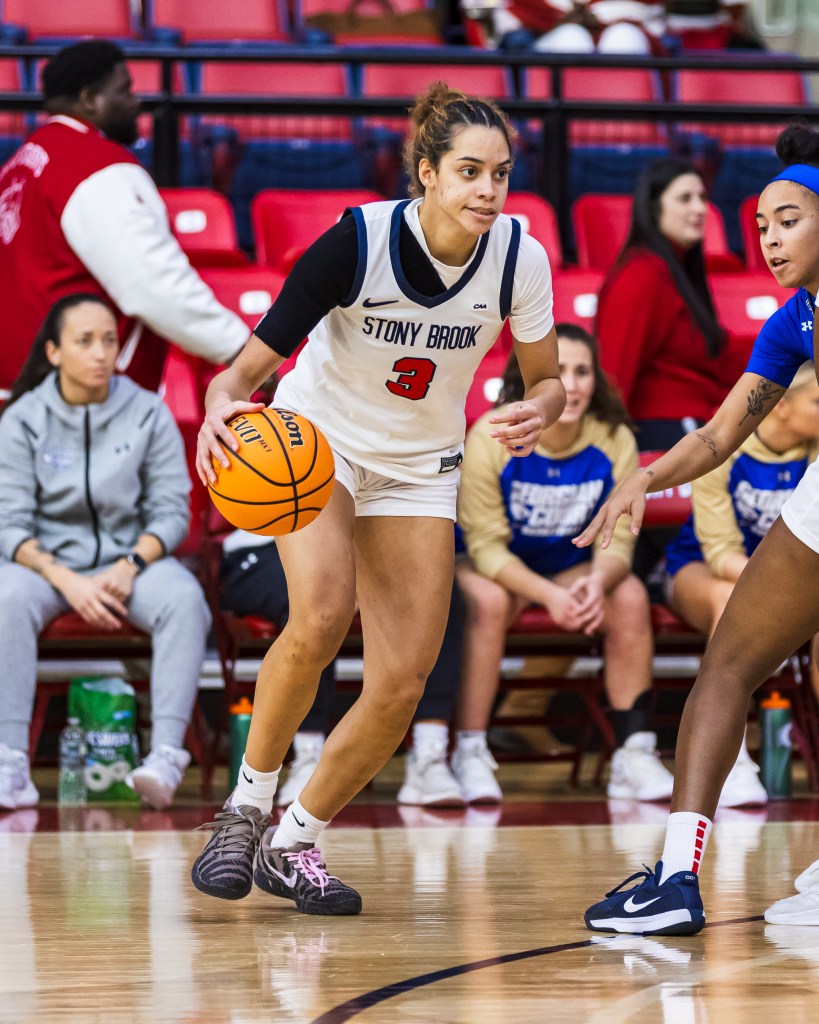
Stony Brook’s chemistry is rooted in trust
Somewhere between early losses, late-night grocery runs, shared rides, and practices that felt harder than games, Stony Brook’s players stopped feeling like strangers, even with 10 fresh faces still learning each other. It started feeling familiar, like a team that trusted the work, trusted each other, and trusted what came next.
As the shot clock resets and legs burn, Stony Brook leans into what it knows: defend together, talk through mistakes, move on fast. No panic. No pointing. Just five players who believe the next stop matters more than the last miss.
Stony Brook has surprised everyone except itself this season. Picked to finish 12th out of 13 teams in the CAA preseason poll, the Seawolves sit in second place at 9-3, two games behind College of Charleston. After opening CAA play with a road loss at Hampton, Stony Brook has won nine of its last 11 contests, a stretch that began with a road overtime win against a William & Mary team riding a six-game winning streak.
On paper, it shouldn’t have come together this quickly. New faces. New roles. New accents. New expectations. Yet the Seawolves became a team shaped by transition, bonded by trust, anchored by defense, and unified by growth across borders, roles and belief.
“We knew what we were capable of,” Stony Brook junior guard Janay Brantley told The IX Basketball. “The vibes are really good. Every day, everybody comes with energy. We have a lot of international students, and that really helps our game, creating relationships outside of basketball. It allows us to perform better on the court. It’s bigger than basketball, and it’s going to last a lifetime.”
With 10 new players, Stony Brook didn’t become a team in the standings or the film room. It happened off the court. Chloe Oliver’s car became a gathering point, turning routine grocery runs into group trips where conversations lingered longer than the errand itself.
Summer nights ended crowded around a screen, watching Love Island, laughing at nothing in particular, learning who needed quiet, who needed noise and who always stayed a little longer. Those small routines mattered.
Familiarity existed, too.
Oliver and Caitlin Frost had already shared a court back home in Canada, a quiet head start that eased the transition before the season ever tipped. Though Oliver is from Montreal and Frost hails from Les Coteaux, Quebec, they won a championship together at Champlain College Saint-Lambert, carrying shared history into a new locker room. Frost arrived at Stony Brook from Saint Bonaventure.
“I had already played with her before coming to college, so that was just awesome,” Oliver said. “I knew what she was good at, and she knew what I was good at. We complement each other. Knowing what we accomplished together back home, it just meant a lot to have her here.”
When Diaka Berete arrived from Jackson State, another Canadian voice in a new locker room, the bond widened naturally. No explanations needed. Just shared background, shared understanding, and an immediate sense of comfort. Though Berete was born in Toronto, she spent part of her childhood in Guinea, West Africa, where her parents are from.
“That just developed me,” Berete said. “It made me a better person, made me disciplined, and set me apart from a lot of things. That’s part of my story. That’s why I’m the person I am today, because I spent four years of my childhood in Africa.”
In a year defined by change, those connections allow that trust show up every day in practice, where competitiveness runs high, and frustration is part of the process. Defense isn’t polite here. It’s demanding. It’s loud. It’s relentless. Players talk about “kills,” three stops in a row, as if they’re currency earned through effort and attention.
Coaches push details until they stick. Hands are active. Feet move. Communication never stops. When it works, it feels collective. When it doesn’t, nobody points fingers. The only question is what comes next.
“Learning to play with new people, growing into a new program and learning a new role has been really fun,” Frost said to The IX Basketball. “My style fits very well with how (head) coach Joy (McCorvey) wants us to play. Playing for Coach Joy has also allowed me to develop on the defensive end and be more defensive-minded.”

Off the court, the pace slows. Some players color. Others go for long walks. Some find quiet through faith, grounding themselves before the next demand arrives. Family remains close, whether through daily calls, memories of driveway games with Brantley beating her older siblings, or Berete’s pride in being a first-generation college graduate, carrying something bigger than themselves.
These are the places where perspective lives, where the game stops being everything without losing its meaning.
That balance explains why overtime feels fun instead of heavy, why setbacks don’t linger, and why a preseason ranking never defined them. They learned early how to sit together after hard days, how to move forward after losses and how to be present without performing. Basketball brought them together. The ordinary moments made them a team.
And eventually, the results followed a tough preseason slate highlighted by a win over Rutgers, a triumph that marked Stony Brook’s fifth in program history against a Power Four opponent.
“The best thing about nonconference is we figured it out,” Berete said. “It took a few losses to do it, and when we did, that’s what made us better in conference. Nonconference builds you up and gives you tough skin. We didn’t have it all together. We didn’t have the connectivity or communication we have now. But non-conference built us up for this.”
The foundation hasn’t been scoring runs or headline moments. It’s been a suffocating defense, built long before the standings reflected it. For opponents, clean looks are rare, and comfort is even rarer.
Brantley was a freshman when No. 1 seed Stony Brook lost in the CAA championship game to seventh-seeded Drexel in 2024. Oliver joined the Seawolves last season, when she and Brantley suffered a first-round tournament loss. This year, with Berete and Frost joining the roster, things feel different, and Stony Brook plans to extend its stay in Washington, D.C. next month.
At Stony Brook, defense is measured in stops, not slogans. And sometimes, in cookies earned by hitting specific defensive benchmarks.
Stony Brook’s defense and its late-game composure didn’t appear overnight. It was practiced. Repeated. Trusted. Built through shared stillness and collective accountability. Those elements were on display during a 68-60 road win over Monmouth last Friday as Stony Brook limited the Hawks to nine fourth-quarter points on 3-of-14 shooting.
“We have a tougher mindset and more pride on the defensive end,” Oliver said. “Last year, we had good defense, but we weren’t taking pride in our one-on-one defense. This year, defense has been key in games and practice. We have goals to hold teams under their scoring average, sometimes below 50 points.”
Stony Brook had held nine consecutive opponents below 60 points, including a stretch where four straight teams were held under 50, until Monmouth finished with exactly 60 last week. The Seawolves’ defense has been at its best late in games, holding Hofstra scoreless for the final 2:50 on Jan. 30 and limiting Monmouth to two points over the final five minutes on Feb. 1.
They are second in the CAA in scoring defense at 56.2 points per game, yielding 5.8 fewer points than last season, when they finished fifth in the conference.
In the win over Monmouth, Brantley and Berete combined for 38 points. Brantley leads the Seawolves in scoring at 12.8 points per game, and Berete adds 10.7 points. In addition to leading Stony Brook in rebounding at 7.3 per game, which is fourth in the CAA, Frost averages 8.9 points per game.
Another newcomer from Pego, Spain, Sandra Frau Garcia, a UIC transfer, stuffed the stat sheet with 15 points, six rebounds, and four assists. She is second in the CAA in assists per game (4.6), another reason why Stony Brook is in position for a double bye in next month’s tournament.
“On offense, we’re sharing the ball way more than last year,” Oliver observed. “We’re putting people in good spots to get their shots and have an opportunity to positively impact us. We have a lot of versatile people on our team and a lot of people who can score, so it just makes us hard to guard.”
Somewhere between early losses and late-night workouts, between cramped apartment kitchens and beach days where no one was allowed to feel like the new kid, ten fresh faces stopped feeling new.
In garages in Montreal with cones on the floor and drills pulled from YouTube. In coaches’ offices with doors left open. In practices that felt harder than games. Trust formed quietly.
The standings tell you Stony Brook sits near the top of the CAA. They do not tell you how strangers chose each other first and bloomed when nothing was guaranteed, and no one was watching.
“We’re all fighting at the end of the day in practice,” Brantley said. “We’re fighting for that goal, and we know what we have to bring every day if we want to achieve it.”
Somewhere along the way, the unfamiliar became familiar. And now the results simply reflect it.
‘Nice & Smooth’ fueling Elon’s rise
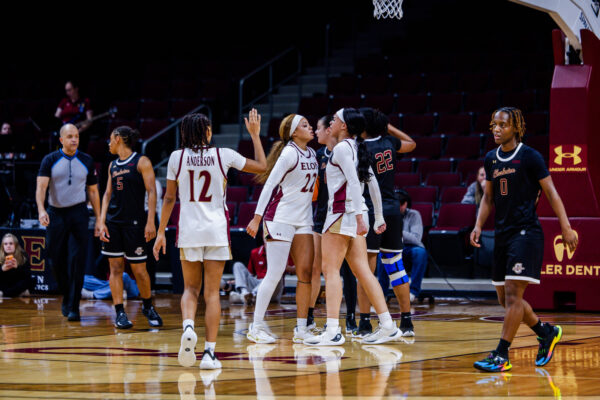
Laila Anderson and LaNae’ Corbett’s synergy surfaced during a recent Zoom call. When asked about what makes this Elon women’s basketball program special, both leaned forward and began answering at the exact same moment.
They stopped, laughed, and waved for the other to go first.
It wasn’t rehearsed. It wasn’t performative. It was instinct, the kind forged through chemistry, trust, and a locker room where connection runs deeper than the stat sheet. Of course, they spoke in unison. They’ve been in rhythm all season.
As Elon’s top two scorers and most electric playmakers, they’ve earned the nickname “Nice and Smooth.” Corbett is “Nice,” a powerful presence who finishes with touch around the rim and disrupts everything defensively. Anderson is “Smooth,” all fluid footwork, a silky release and boundless energy that seems to slide rather than sprint.
“You hit the nail on the head with that one,” Anderson said, grinning. “In practice, we’re giving it our all defensively, then working through the plays on the offensive end. The chemistry just keeps building in practice and carries over into the games. We just keep building it with everybody. That’s kind of how it happened.”
They lead the team in scoring, Corbett at 11.6 points per game and Anderson at 9.3, and in many ways, they set the tone. Watching them play off one another, you’d swear they’d grown up in the same driveway instead of spending just a few months together.
Corbett arrived this season from conference rival Hofstra and immediately found her rhythm. Anderson, now in her second year at Elon, plays with the ease of someone who knows exactly where she belongs. Together, they’ve kept the Phoenix firmly in the hunt for a top-four seed for next month’s CAA Tournament in Washington, D.C.
But every duet needs a conductor.
While Corbett and Anderson glide, junior point guard Maraja Pass guides, steadying the tempo, organizing the chaos, and making sure the music never stops. Pass leads the team in assists and is sixth in the CAA (3.3) and is tied for the team lead in steals per game (1.4).
Pass has started 55 consecutive games for Elon, which is amazing considering what she endured last season.
Pass is healthy and enjoying her best season at Elon. A year ago, she shuffled slowly after games, battling pain caused by an extra bone in her foot. Surgery followed. Recovery required patience. Now she’s running faster, walking better, and embracing the responsibility of directing Elon’s show.
“I’ve grown a lot in maturity,” Pass said. “I’m focused on making the best play, not just a play. The game has slowed down for me. I see things developing off screens and within our sets. And as a leader, I’m not afraid to speak up anymore. As a freshman, I was scared to say anything. Now, I know when my team needs me to step up, especially in big moments.”
She didn’t expect that call to come just two games into the season, when Jayda Angel, last year’s CAA Rookie of the Year, suffered a season-ending injury against North Carolina.
Angel’s absence forced adjustment, but not panic.
“The biggest thing was just trying to figure out who we were going to put in the starting lineup,” veteran head coach Charlotte Smith said. “It wasn’t about replacing Jayda because I didn’t want anybody to feel pressure to be Jayda. Who’s going to step up and be yourself and fill in the gaps? We felt like we had enough firepower and inside play to make up for the scoring.”
The Phoenix’s off-court bonding has fueled their on-court chemistry, helping them navigate that early adversity. They hung out nearly every day during the summer, pool days, dinners, apartment visits, bible studies, building a level of comfort and trust that now shows up between the lines.
“We are so close off the court, it makes it easy to fight for somebody you’re close with,” Pass said. “When we’re all out there fighting for each other, it’s hard to beat us.”
One of their regular gathering spots was the Schar Center, Elon’s gleaming basketball home. Spirited pickup games. No coaches. No cameras. Just work. Chemistry forming. Relationships forging. No one slacking. No one scrolling. Just movement with purpose.
“We really made an effort this summer to get everybody involved,” Corbett said. “I don’t even think our coaches know how close our bonds are. We all have different personalities, and we support each other’s differences. Everybody’s just their authentic self.”
That glue shows up everywhere.
Lately, Elon’s freshmen, Tamia Watkins and Ashanti Fox, have shined. Between them, they won four consecutive CAA Rookie of the Week awards from Jan. 19 to Feb. 9. Watkins leads the team, averaging 5.2 rebounds per game, and her 5.7 rebounds per game in CAA play rank the highest of any rookie in the conference.
With Fox playing a key role, Elon averages 28.2 bench points per game, ranking first in the CAA and ninth nationally.
Howard transfer Tyana Walker has been steady, leading Elon with 32 3-pointers. Walker and Pass have been the only two players to start every game. Memphis transfer Quinzia Fulmore averages 6.0 points and 5.0 rebounds per game. She had 10 rebounds in a win over Towson on Feb. 1.
A week later, Elon enjoyed a day on the glass to remember in a 75-52 victory over William & Mary on Feb. 8. The Phoenix hauled in 48 total rebounds, marking their highest total in CAA play this season. The Phoenix grabbed a season-high 25 offensive rebounds. The 27-point win margin also marked its largest in a conference game this season, and the program’s largest since defeating Charleston 90-41 in 2020.
Watkins had 10 rebounds against the Tribe while Corbett grabbed eight and Walker hauled in seven.
Different roles. Different paths. Same rhythm.
Which brings it back to that Zoom call.
When asked what makes Elon special, Anderson didn’t hesitate.
“I would say what Maraja just said with how our chemistry is outside of basketball,” Anderson said. “It means a lot, having people you can go to have regular conversations. That carries over on the court, and that’s why I feel like we’re jelling so much because of that.”
This time, Corbett let her finish.

Drexel’s Grace O’Neill Leading the Way
There’s some truth to the rumor that Grace O’Neill is to Drexel’s campus what the Rocky statue is to Philadelphia: permanent, familiar, always right where you left her.
She’s been orbiting the Dragons’ program since her cousin wore the uniform, long before she ever pulled one over her own shoulders.
She first watched her cousin, Meghan Creighton, who ranks second in Drexel history with 557 assists, suit up for the Dragons when O’Neill was in third grade. She was in the locker room celebrating Drexel’s 2013 WNIT championship before she ever dreamed of leading the team herself.
Now she is the only player in program history with 600 points, 600 rebounds and 350 assists, the statistical footprint of someone who has touched nearly every possession.
Two years ago, when Drexel won the CAA tournament, ankle braces, a blue knee sleeve, and white bandages wrapped around her shoulder kept her upright in the championship game. When it mattered most, she kept the Dragons steady with late free throws and a refusal to bend as they beat Stony Brook.
“From the moment she stepped on campus, she was the person that was going to fight for everything she’s gonna get,” head coach Amy Mallon said to reporters following a win over Elon. “She wanted to be your point guard. She wanted to be your leader from day one. She’s pretty special, because Grace was part of my first recruiting class, and when I got the position here, she was my first commitment.”
Trying to get inside O’Neill’s head is an exercise in patience. She gives you a grin, not an explanation. The read happens before you see it. The pass leaves her hands before you realize there was a window. Eventually, she offered a glimpse into the simplicity behind the precision.
“My passing? I think part of it comes with knowing where the ball is supposed to go,” O’Neill said. “That comes with experience, knowing what type of plays Amy’s calling and what we’re looking to see. I think knowing where the cutters are going to be if a team’s switching, we’re looking for the slips. I think that really helps me, just understanding the game in general helps me make better passes.”
A finance major with a marketing minor who will graduate in June, O’Neill has already mapped out her next move. The point guard who studies defensive rotations will soon study operating rooms. She interned with Stryker in its joint replacement division and will return to the Delaware Valley as a sales associate, trading scout reports for product portfolios while keeping the same meticulous preparation.
While others watch games for entertainment, O’Neill dissects them for leverage.
“Preparing for a game, we have a huge emphasis on the scout,” she said. “We do about 45 minutes of scout film as a team, and then we get a couple pages of notes. We have a very intense quiz after shootaround for every game. It’s extremely competitive, so we’re studying all the time for the teams we’re playing and the strategies we’re going to use.”
She still has all the answers. The difference now is that the locker room she once watched as a child is watching her. What began as orbit has become ownership. And like that statue on the museum steps, she is no longer just part of the scenery. She is part of the silhouette.
CAA crossovers
Hofstra has won two of its last three games. All of the Pride’s CAA wins have been on Sundays.
In handing league leader College of Charleston its first loss of the conference season, Monmouth led for the final 30 minutes and got gritty efforts from everybody, including a career-high seven assists from Gigi Gamble, the Hawks’ leading scorer.
In the same game, outstanding Charleston guard Taryn Barbot scored her 1,500th career point.
Earning CAA co-Player of the Week honors, UNCW guard Rori Cox led UNCW to a win over North Carolina A&T with a career-high 33 points in the 69-64 victory. It was the Seahawks’ first conference win since Jan. 2.