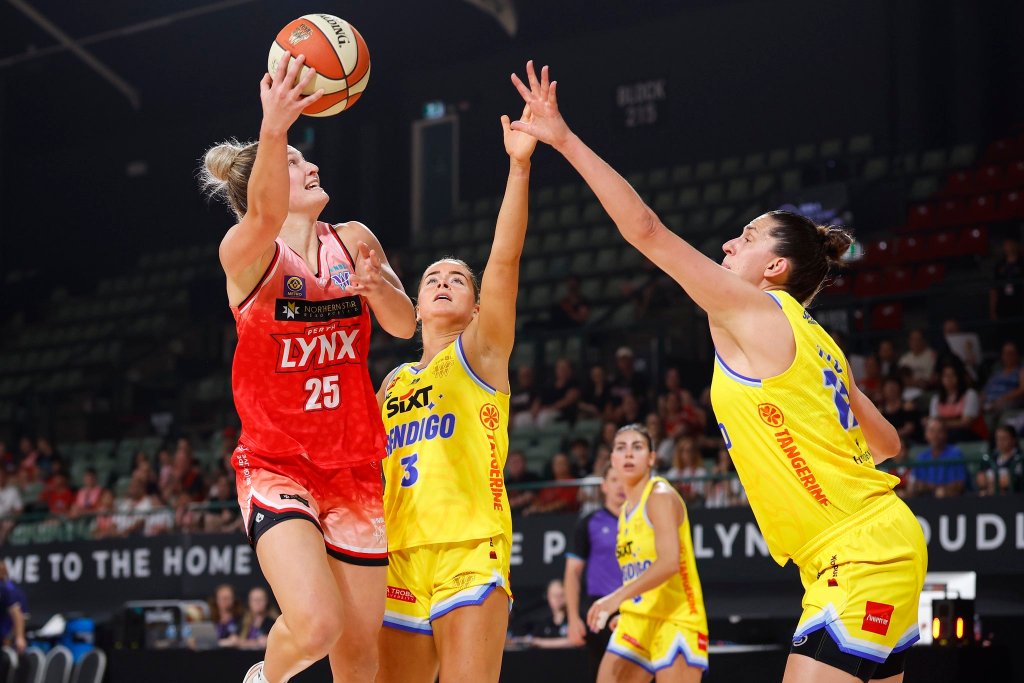
With 15 seconds on the clock and her team down one, Paige Bueckers had the ball in her hands. The Dallas Wings point guard was no stranger to high-leverage possessions, currently leading the league in fourth-quarter scoring.
Dribbling down the right side of the court directly in front of her team’s bench, she dished to forward Jessica Shepard, who turned and drove toward the rim. Met immediately by a pair of Atlanta Dream defenders, Shepard was trapped and forced to fling a cross-court pass to forward Awak Kuier.
Kuier hoisted an awkward jumper as the clock ticked down that missed. Shepard’s contested tip-in attempt on the rebound rolled off the rim, handing the Wings, arguably, their most heartbreaking loss of the season.
“I was looking to get it back,” Bueckers admitted postgame. “I definitely could have kept it, gone to the rim, and tried to create something in the paint. Looking back, I should have kept it and tried to make a play.”
In that scenario, conventional coaching wisdom dictates calling a timeout to draw up a set piece for your best player. But Wings head coach Jose Fernandez has consistently opted against it, preferring to let his team operate in flow rather than giving the defense a chance to set up.
“There’s always going to be an armchair quarterback going, ‘Hey, we should have done this, we should have done that,’” Fernandez said.
He pointed to Atlanta’s sideline out-of-bounds (SLOB) defense as his main rationale for letting the final seconds play out, praising the Dream as “the best in the league” in those sets.
But the tracking data tells a different story. According to Synergy Sports, Atlanta actually allows a league-worst 51.2% field goal percentage on SLOB possessions. By prioritizing flow over a set play, Dallas didn’t avoid Atlanta’s defensive strength; it potentially bypassed its greatest weakness.
The loss dropped the Wings to 4–3 in one-score games this season. While Fernandez’s trust-the-flow philosophy has paid dividends at times, too often that “flow” simply devolves into stagnant spacing, leaving the Wings scrambling for a quality shot as the clock runs out.
There is no clearer example of this than Dallas’ 112–110 overtime win against the Seattle Storm on June 22. On paper, it stands as one of the team’s signature victories of the season.
Listen now to The IX Sports Podcast and Women’s Sports Daily
We are excited to announce the launch of TWO new podcasts for all the women’s sports fans out there looking for a daily dose of women’s sports news and analysis. Stream on Spotify, Apple Podcasts or anywhere you listen to podcasts, and make sure to subscribe!
In reality, it was a victory rescued purely by the individual brilliance of one of the league’s best players.
Down six with less than a minute and a half remaining in regulation, Dallas turned the game over to Bueckers. The Wings created 3-point opportunities off screen actions for Bueckers on back-to-back plays to tie the game, and she hit a third three off a similar action in overtime.
Yet, when Fernandez did use his timeouts late in that game, those screening actions disappeared. Coming out of a late fourth-quarter timeout tied with Seattle, the call was essentially to clear the floor, let Bueckers isolate, and watch her hit a difficult turnaround jumper over a contesting defender.
In overtime, up one out of a timeout, the directive was once again “Paige, go make a play.” When she drove into a waiting Seattle defense, her layup was blocked at the rim. Guard Azzi Fudd saved the opportunity by executing a post move on another isolation play on the ensuing inbounds.
Without Bueckers’ elite shot-making capability to pull emergency buckets out of thin air, the Seattle game is a loss. And relying on a superstar to constantly invent something out of nothing isn’t a sustainable strategy.
If skipping timeouts leads to chaos, taking them hasn’t guaranteed a cleaner look for the team, either. Look no further than Dallas’ 86–83 victory over the Connecticut Sun on July 2.
Bueckers was in the middle of another fourth-quarter takeover, scoring 11 points in the frame to erase a late deficit. With 1:07 remaining and a crucial possession on the line, Fernandez called a timeout to draw up a set piece.
“Becoming Caitlin Clark” is out now!
Howard Megdal’s newest book is here! “Becoming Caitlin Clark: The Unknown Origin Story of a Modern Basketball Superstar” captures both the historic nature of Clark’s rise and the critical context over the previous century that helped make it possible, including interviews with Clark, Lisa Bluder (who also wrote the foreword), C. Vivian Stringer, Jan Jensen, Molly Kazmer and many others.
Bueckers served as the inbounder, found Odyssey Sims coming off a double screen, and got the ball back on a handoff. The Sun defended the ensuing pick-and-roll action with Shepard well, forcing Bueckers to pass crosscourt to Sims.
Sims drove on Kennedy Burke and got summarily blocked. Bueckers appeared to be curling back around the play for a pass back, and with 17 seconds remaining on the shot clock in a tie game, there was certainly time to trigger a secondary action. On the sideline out-of-bounds that followed, Bueckers inbounded again. Fudd received the ball off another double screen and executed a free-throw line pull-up jumper to put the Wings on top.
While the possession was saved by Fudd, it underscored a recurring theme in the Wings’ after-timeout (ATO) execution; when opponents aggressively deny the initial entry pass to Bueckers or take away her first look, the play collapses into secondary isolations rather than flowing into counter-actions designed to get her the ball on a reset.
Instead of using timeouts to create clean, quality looks for the league’s leading fourth-quarter scorer, Dallas too often settles for broken plays, relying on second-chance points and scramble plays to paper over the cracks.
None of this is to say that isolating your superstar is inherently flawed. There is a legitimate, undeniable logic behind wanting to put the ball in the hands of a generational talent and clearing the floor. When Las Vegas Aces head coach Becky Hammon drew up a last-second game-winner for A’ja Wilson in the Finals, she famously summarized the approach in postgame interviews: “Give the ball to A’ja, and get out of the way.”
When you have a superstar who leads the league in fourth-quarter scoring, trusting them to make a play in high-leverage moments isn’t bad coaching; it’s fundamental to the game. But there is a vast difference between deliberate, floor-spaced isolation and leaving your best player stranded on an island against a defense loaded against them.
The disconnect for Dallas isn’t the desire to rely on Bueckers; it’s the lack of structural support around her when opposing defenses sell out to stop her. In high-leverage late-game situations, opposing scouting reports are simple: wall off the paint, blitz the pick-and-roll, and make anyone else beat you. When Dallas operates in unscripted flow or runs static isolation out of timeouts, it forces secondary players into reactive, stressful reads late in the shot clock.
‘Rare Gems’ is out now!
Howard Megdal, founder and editor of The IX Basketball and The IX Sports, wrote this deeply reported book. “Rare Gems” follows four connected generations of women’s basketball pioneers, from Elvera “Peps” Neuman to Cheryl Reeve and from Lindsay Whalen to Sylvia Fowles and Paige Bueckers.
If you enjoy Megdal’s coverage of women’s basketball every Wednesday at The IX Sports, you will love “Rare Gems: How Four Generations of Women Paved the Way for the WNBA.”
That dynamic has manifested in a string of hurried, low-percentage decisions: trapped drives, crosscourt passes into traffic, and rushed jumpers as the buzzer sounds.
It isn’t a critique of player IQ or effort, but rather a reflection of roster readiness and clarity of the team’s identity. It’s helpful for a young team still building chemistry under pressure to have defined options A, B, and C on the floor. When a timeout isn’t used to organize spacing or dial up counter-actions, secondary players aren’t being given the blueprint to succeed when the defense forces the ball out of Bueckers’ hands.
Trusting Bueckers is a step in the right direction. But to turn one-score heartbreakers into repeatable execution, especially as the postseason nears and the stakes get higher, Dallas must build a late-game structure that empowers the four players standing next to her as well.
The ultimate takeaway from Dallas’ 4–3 record in one-score games isn’t that Fernandez’s trust-the-flow philosophy is entirely broken, nor is it that Bueckers needs to take every single shot. It’s that in the WNBA, talent creates the opportunity, but late-game execution determines the ceiling.
Right now, the Wings are surviving on individual greatness and second-chance scramble plays. But as the stakes rise and scouting reports deepen, relying on Bueckers to pull magic out of thin air on broken possessions is unsustainable.
What needs to happen next for Dallas is a commitment to building and owning its identity.
For Fernandez, that means moving past the false choice between unscripted flow and static isolation. It means installing a dynamic ATO menu that uses counter-screening, motion triggers, and secondary actions. If opposing defenses sell out to blitz Bueckers, the Wings must give their secondary players a clear, rehearsed blueprint to execute rather than leaving them to make panic reads against a resetting clock.
Trusting Bueckers was Step 1, and it brought Dallas back into relevance. Step 2 is building an offensive system around her that turns late-game chaos into predictable, repeatable success. Until the Wings bridge that gap, their season will continue to hang on the edge of the final whistle.