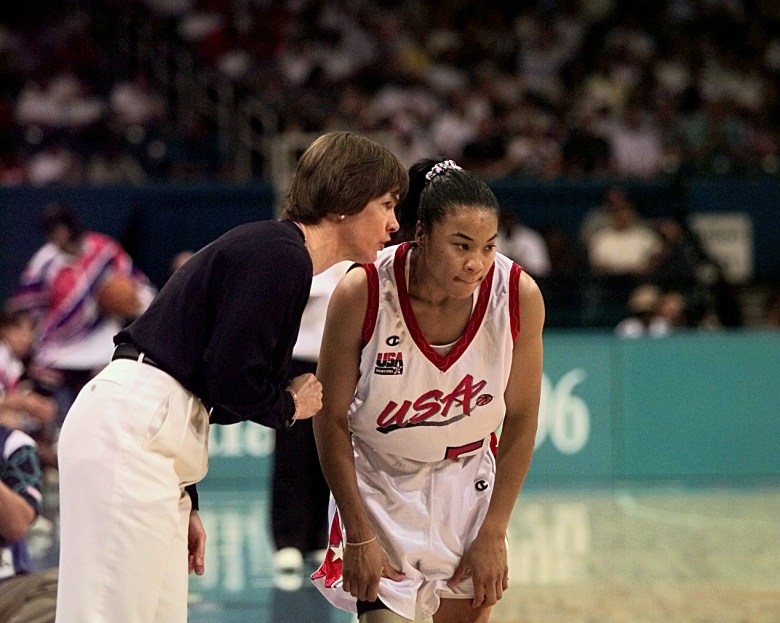
Tara VanDerveer became the first college coach in history to step away from her program for a full year to coach the 1996 U.S. Women’s National team, which would compete in the Atlanta Olympic Games on home soil. VanDerveer also took the job well aware that the U.S. team was a trial run for the restart of a women’s professional league in the United States.
Last month, it was announced that the 1996 Women’s Olympic Team will be inducted into the Naismith Hall of Fame. This excerpt from the 2026 book “Life’s Work: How Tara VanDerveer and Stanford Women’s Basketball Changed the Sport” by The IX Senior Contributor Michelle Smith details what was happening at Stanford in the 1995-96 season while their head coach was away coaching Team USA.

One of the first tasks of the 1995–96 season for the Tara VanDerveer-less Cardinal was facing off against VanDerveer and the U.S. National Team as part of their long exhibition schedule in the run-up to the Olympic Games.
Team USA’s plane landed in San Francisco two days before tip-off, and VanDerveer immediately arranged a workout for the national team with the Stanford strength and conditioning coach.
The following morning, she learned that the Cardinal had signed three of her top guard recruits to letters of intent. She got a haircut and went to her favorite Mexican restaurant. She visited with friends. Her Stanford team came to watch the national team practice that evening. Game day, however, was game day.
VanDerveer felt out of place in the visitors’ locker room. There was a catch in her throat as she gave the national team the scouting report on her own college players. It felt a bit like a betrayal. She gave acting head coach Amy Tucker some advice: “Take care of the ball. Don’t let us run.”
A sold-out crowd at Maples Pavilion greeted VanDerveer as she walked out onto the floor. They cheered loudly for their coach, as well as Jennifer Azzi and Katy Steding, who were also experiencing a homecoming as the former Stanford stars on the US roster.
As the game began, VanDerveer noticed her Stanford players whipping their heads around when they heard her shouting instructions at the national team players. But they were unfazed. Even with VanDerveer occupying the opposing bench, coaching a roster that included Lisa Leslie, Sheryl Swoopes, and Dawn Staley; a full gym at Maples Pavilion; and the Cardinal facing one of the deepest, most talented women’s basketball teams ever assembled, Stanford was within six points at halftime.
Both teams were running the same offense. Stanford was VanDerveer’s test case for the national team’s offense. At that moment, the Cardinal were running it better than Team USA. “We knew what they were going to do, and they knew what we were going to do,” Tucker said.
VanDerveer came out of the locker room after halftime, walked by Tucker on the Stanford bench, and warned, “We are going to put the hammer down.” Assistant coach Angela Taylor looked at Tucker with confusion and asked what that meant. Tucker responded, “Just wait and see.”
In the second half of the exhibition, the U.S. team turned up the defensive pressure on the Cardinal, stifling point guard Jamila Wideman in the backcourt and disrupting Stanford’s ability to run their half-court offense.
“They basically woke up,” VanDerveer said of Team USA.
Cardinal guard Charmin Smith later recalled bringing the ball up the floor against Teresa Edwards, one of her idols. “I crossed her up, got the basket, and blew the layup,” Smith said. “That’s what I remember.”
The U.S. team defeated Stanford by 37 points with a second-half runaway, and VanDerveer left her team behind, not to return until Thanksgiving break, when she met up with Stanford on the East Coast for their season opener at the University of Massachusetts. The season-opening game was not an auspicious start to the program’s new reality.
VanDerveer attended Stanford practice in Massachusetts the day before the game, trying to figure out where she fit in as a bystander. She went to dinner with the team that night, hosted by the family of Massachusetts native Wideman.
On the day of the game, Thanksgiving Day, VanDerveer sat awkwardly in the press area, close to the bench. And she did not sit quietly. She didn’t notice the reporters who were staring at her. One of the UMass officials told her she couldn’t cheer in the press box or she’d have to move. She moved closer to the Stanford bench.
That only made things worse. “I was yelling and acting crazy,” VanDerveer said. “I just wanted them to do really well. I was so invested. I remember Amy turning around and mouthing to me, ‘Shut up.’”
The Cardinal lost that game 65–56, marking the program’s first season-opening loss since VanDerveer’s arrival in 1985. The next day, she read a story from a reporter who criticized her lack of decorum at the game. That stung a little bit. She knew she would have to change her approach to being a spectator of the program she’d built from the ground up. “Those were still my players out there, and I wanted more than anything for them to play well. And they weren’t.
VanDerveer invited the players to come to her hotel room later that evening as they absorbed their disappointment over the loss. They didn’t talk X’s and O’s. They talked about perseverance and resilience, and about how they shouldn’t let one game define them.
Guard Kate Starbird felt like she could relate to VanDerveer in a different way that season. She described it as a release of tension. “When she was coaching us, you were always trying to impress her, and when she came back that year, it wasn’t exactly informal, but it was a different interaction,” Starbird said. “It felt less emotionally charged and more like a mentor relationship than a coach. If she gave you
feedback, you would internalize it in a different way.”
VanDerveer was back in the stands in Lubbock, Texas, over the Christmas break, and Tucker pulled her aside for a conversation before the game. Tucker understood how hard it was for VanDerveer to be a bystander. But it was confusing to the players to hear VanDerveer’s frustration. “I told her, ‘You cannot sit as close to the bench’,” Tucker told VanDerveer. “You need to move up or you need to be quiet, because they don’t need to hear your voice.’ It didn’t happen again.”
Unfortunately, the Cardinal also lost that game at Texas Tech that day. VanDerveer was 0-for-2 as a spectator. “I was beginning to think I was bad luck,” she said. Hiccups aside, after a largely successful preseason that included wins over No. 21 Old Dominion, second-ranked Tennessee, and national power Texas, the Cardinal tore through the Pac-10 schedule with an 18–0 record that included two nail-biting wins over UCLA and another over Washington.
The Cardinal cruised through their first two NCAA matchups to advance to the regional in Seattle, where VanDerveer watched from the stands, burning off her own pregame nerves by stopping into the press room to watch the Academy Awards with reporters.
Stanford won a two-point thriller over Alabama in the Sweet 16 and then knocked out Auburn 71–57 to reach a fourth straight Final Four. After the Auburn game, the team cut down the nets accompanied by the family of forward Naomi Mulitauaopele, who brought drums and sang Samoan war chants. Charmin Smith hopped in to play drums for a bit, while Vanessa Nygaard ran up the bleachers to jam with the Stanford band, a piece of the net hanging out of her mouth.
The season ended the following weekend in Charlotte at the Final Four, with an 86–76 loss to Georgia in the national semifinals. VanDerveer watched from the stands with her sisters Heidi and Marie, and Marie’s husband and two children. She went down to the locker room after the game to see the team. They were “low, almost angry,” VanDerveer later described.
They had come to win and had come up short. The loss was disappointing, but the spirit of wanting more was what VanDerveer wanted to see heading into next season.
Readers at The IX Basketball can use the code IXLIFESWORK to get 20% off the book.
Listen now to The IX Sports Podcast & Women’s Sports Daily
We are excited to announce the launch of TWO new podcasts for all the women’s sports fans out there looking for a daily dose of women’s sports news and analysis.
Stream on Spotify, Apple Podcasts, or anywhere you listen to your podcasts and make sure to subscribe!