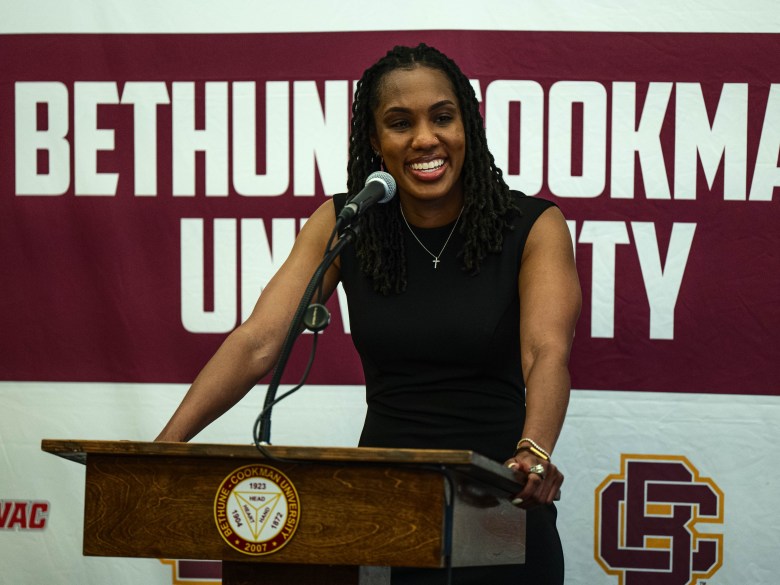
A short stroll across Bethune-Cookman’s iconic quad transported Demetria Frank back onto the sacred soil she once walked.
Music blared from portable speakers, and laughter bounced between reddish-brown brick buildings accented by white trim and classical columns.
At the same time, the succulent scent of ribs, a symphony of smoke and spice, hung in the humid Daytona Beach air. The wafting aroma of chicken drifting off the sizzling grills curled around clusters of smiling students draped over picnic tables and folding chairs, balancing full plates of food, their conversations rising and falling like a familiar hymn.
Surrounded by sun-faded T-shirts and the easy rhythm of HBCU life, Frank is home. This patch of grass was her social heartbeat during her time with the Wildcats from 2007-12. Now, in a full-circle, time-travel moment, she was walking the same ground with potential recruits as Bethune-Cookman’s eighth head women’s basketball coach.
“I had a visit the other night, and our SGA (Student Government Association) has done a really good job of putting together just some different events for Spring Fest,” Frank told The IX Basketball over Zoom. “They had a barbecue last week. And, so I went out there … and it was nostalgic … to just be in that space again. I’m well beyond their age now, but to kind of stand amongst them and just be in that space again, and kind of think about, yeah, I was your age. I was doing the same thing, like you’re doing. There was a lot of community and connection there.”
That sense of community and connection isn’t confined to the quad.
For Frank, there has always been another kind of home on Bethune-Cookman’s campus: Moore Gym, located less than two miles from the Atlantic Ocean. Inside this venerable facility constructed in 1937, walls probably whisper to one another in the darkness, having witnessed everything, including when ESPN’s First Take broadcast from the historic venue last fall.
Every day, Frank walks past the iconic Mary McLeod Bethune statue and into the same gym where she once united a community, pulled teammates together, learned how to lead and started to understand what it meant to be the one others looked to.
Now, as the Wildcats’ head coach, she’s back in that same building where she graduated as the program’s all-time leader in free throws made (854) and steals (422), intent on doing it again—this time from the first seat on the bench, building another generation of young women who will one day call this place home, too.
While food, music, and camaraderie joyfully bring people together, she is looking to do the same through hoops.
“The biggest thing for me is just prioritizing people — my players, my staff — making sure everybody feels seen,” Frank said. “As a leader, I want to be really intentional about cultivating meaningful relationships. I think love has to be in our locker room and in our culture. When people know you genuinely love them, they’ll run through a wall for you.”
Listen now to The IX Sports Podcast and Women’s Sports Daily
We are excited to announce the launch of TWO new podcasts for all the women’s sports fans out there looking for a daily dose of women’s sports news and analysis. Stream on Spotify, Apple Podcasts or anywhere you listen to podcasts, and make sure to subscribe!
Community and connection are at the heart of her philosophy of elevating the Wildcats into the Southwestern Athletic Conference’s (SWAC) upper echelon. Frank shared that her six pillars of success are integrity, connection, passion, servanthood, gratitude and faith.
Moore Gym is also where Frank became an elite-level coach under her former coach, turned colleague, mentor and friend, Vanessa Blair-Lewis. Blair-Lewis helped guide the Wildcats through one of the most successful stretches in program history. During her tenure on staff, B-CU recorded three 21-win seasons, captured two Mid-Eastern Athletic Conference (MEAC) regular season championships, and secured the program’s first MEAC Tournament title and NCAA Tournament appearance in 2019.
Frank was part of a similar success when she followed Blair-Lewis to George Mason. Following her arrival at George Mason in 2021, Frank helped guide the Patriots to three consecutive 20-win seasons, highlighted by a historic 27-6 campaign in 2024-25 that marked the winningest season in program history. That year, George Mason captured its first-ever Atlantic 10 Tournament championship and earned the program’s first NCAA Tournament appearance.
So, when she saw the Bethune-Cookman coaching opening, Frank knew she was ready. She also understood how difficult the conversation with Blair-Lewis would be.
“In my eyes, I was going to be Coach Blair’s assistant for a really long time,” Frank said. “We’d had such a good run that I honestly thought that was the plan. So going to her and saying I wanted to do something different was new for both of us. But she was super supportive.
“She told me it was like going to the fair. You play all the games, you collect your tickets, and at some point, you have to trade them in for a prize. She said I’d accumulated a lot of tickets over the years, and now it was time to cash them in for the opportunity I thought was worth it. This job at Bethune-Cookman is me trading in my tickets.”
Frank’s growth has also continued. In addition to serving as an associate head coach last season as the Patriots claimed a share of the Atlantic-10 title, she was also selected to attend the prestigious Next Up Coaches Conference, designed to support the advancement of top minority coaching talent.

Bethune-Cookman has long been a place where strong women set the standard, starting with its founder, Mary McLeod Bethune, herself. Frank carries a different kind of challenge than Bethune, but a familiar mandate: build something where others see limits. The Wildcats haven’t had a winning season since 2021 and won only seven games last year.
“She aligns with our mindset and goal of building a championship culture, bringing with her a true love for our program and our university,” Bethune-Cookman Director of Athletics and former NBA player Reggie Theus said of Frank in a press release. “Her growth in her time away from campus made her an easy choice to lead our women’s basketball program back to the success she enjoyed as both a player and a coach.”
Reclaiming the program’s place among the SWAC’s elite is bigger than the scoreboard because it’s about living up to a campus legacy forged by a Black woman who refused to settle for less.
Equally important to Frank is the increased visibility that she witnessed firsthand working under Blair-Lewis. She’s not afraid to acknowledge the importance of representation, especially now in the SWAC, where nine of the 12 head coaches are Black women, serving as powerful role models for their programs.
“You didn’t see many Black female coaches back then, so I didn’t look at coaching and think, ‘That’s what I want to do,'” she said. “I always told people I wanted to own a rec center — that felt like my way to give back because I’ve always had a servant’s heart. Coach Blair really planted the coaching seed in me. Seeing what she did for me and so many other young women, this has been a dream come true so far.”
Frank’s journey is a manifestation of dreams coming true, and it lives at the intersection of leadership and access. A first-generation college graduate from Miami, she is the daughter of Derek Frank, who turned down a basketball scholarship to join the military, and Donna Howard, who held everything else together so their kids could chase opportunities their parents never had.
Now, as a head coach at her alma mater, Frank is determined to be for her players what she didn’t always see growing up: visible proof that someone who looks like them can lead, win and lift others as she climbs.
“Super emotional,” Frank said when asked about what it means to be the first in her family to graduate from college. “We always say you can’t be what you can’t see, and not even realizing that I could do something so special for my family. Being the first in my family to do it, I hope that I inspired my other family members to do it as well.”
Frank remembers her mom being a “bucket of tears” when she dropped her then-17-year-old daughter off at college. When she played, Frank was a tenacious defender with quick feet and larceny in her heart. By the time Frank left Bethune-Cookman, she had become the program’s second all-time leading scorer with 1,567 points and led the nation with 4.25 steals per game as a senior, earning All-MEAC honors twice.
“Becoming Caitlin Clark” is out now!
Howard Megdal’s newest book is here! “Becoming Caitlin Clark: The Unknown Origin Story of a Modern Basketball Superstar” captures both the historic nature of Clark’s rise and the critical context over the previous century that helped make it possible, including interviews with Clark, Lisa Bluder (who also wrote the foreword), C. Vivian Stringer, Jan Jensen, Molly Kazmer and many others.
More than a decade later, Frank was hired five days before the transfer portal opened. It’s been a whirlwind of recruiting, hiring staff, making long phone calls and sharpening her vision for the Wildcats. Soon, she’ll see some of those same tears from parents entrusting their daughters to her and her staff.
Frank’s first roster at her “dream job” was closer to a pickup run than a Division I depth chart. More than a century after Bethune started the school in 1904 with $1.50 and five girls, Frank’s own rebuild with two players, 6’2 junior forward Mya Johnson and 5’6 senior guard Keiara Gregory, and a belief in what Bethune-Cookman can be again resembles a modern version of that same audacious faith.
One of the three players she initially inherited entered the transfer portal shortly after she was hired, leaving Frank and her staff to rebuild almost from scratch just as the portal opened.
“I’m starting this journey with two players on my roster,” she said. “But again, I’m home, so I’m happy, and there is no challenge too big for me here. I am a firm believer that God put me in this position for a reason. As much as the landscape changes, I have to remain the same, because that’s what I’m rooted in.”
She wants the Wildcats to play fast, with space and pace, and to be cerebral on offense. On the other end, they will play a pack-line defense, stay connected and create the kind of controlled chaos that defines Bethune-Cookman’s identity.
Building that foundation requires strong bonds. For Frank, support from the athletics department and those key relationships are the point. Wins will matter, but the kind of place Bethune-Cookman will be is just as important to her. Frank wants it to echo the days when she played, where fans shouted, danced, clapped and packed Moore Gym.
“Relationships are really important to me,” she said. “I do understand in this landscape the transactional piece, and when that is necessary, it has to be applied, but I can’t operate that way all the time. I feel so supported with this administration and this community. They’ve done a really good job of supporting me in this climate to attract some good talent. So, I want to give them a shout-out. They’re on board with what’s going on in this landscape.”
During the Zoom call, Frank wears a maroon Bethune-Cookman hoodie, the school’s script stretched across her chest like it once did on her practice gear. Walking through the quad now doesn’t feel new. It feels timeless, like a memory she has stepped back into.
From those cookouts to the quiet corners of that gym, Frank is excited about the chance to rebuild Bethune-Cookman basketball so that it mirrors the campus that has always lived in her, a place where players are fed, seen, developed and valued. A Bethune-Cookman home they’ll hear in “The Marching Wildcats” band on game nights, feel in the handshakes in the hallway, and hugs across campus, and carry with them long after the lights go out in Moore Gym.

Khadijah Rushdan Returning Home
The internet loves the X-ray meme, where a bulldog sits where the heart should be. If you ran that same image on Khadijah Rushdan, the bulldog would be replaced by the familiar, jagged silhouette of her home state of Delaware, a small, easily overlooked sliver on most maps that means everything to her.
That’s why being named Delaware State’s head coach is special for Rushdan. It’s a return to the state that raised her, the courts in Wilmington that hardened her edge, and a program she now feels responsible for lifting back into the MEAC’s upper echelon.
“It’s personal to be able to come back to my home state and to help do some things that haven’t been done in a really long time,” Rushdan said to The IX Basketball over Zoom. “All my family is still in Delaware, so my mom, my dad, my brothers, my nieces, my nephews, uncles and aunts. My best friend and his family went to Delaware State. So, there’s a lot of familiarity.”
The family group chat is about to be popping, especially now that Rushdan, arguably one of the top five women’s basketball players ever from The First State, has returned home. She was the first athlete in Delaware high school history — in any sport — to earn first-team All-State honors five times, having played varsity when she was in eighth grade.
She scored her first basket at 5 years old, competing at the West Center City rec center against players three to four years older than her. She remembers being the first girl drafted in the all-boys league.
Her greatest memory may be outdueling Hall of Famer Elena Delle Donne in a state championship game at the Bob Carpenter Center, the place wall-to-wall with red — students, parents and old heads who’d watched her grow up in Wilmington gyms. Nearly 5,000 people roared with every touch.
That night was Delaware in a snapshot: small, close and impossibly loud. By the end of her high school career, Rushdan had scored 2,464 points, won three state Player of the Year awards and earned McDonald’s All-American honors.
“A lot of my experiences,” Rushdan said. “A lot of the people who helped and developed me as a young woman, not only just as a basketball player, but again, as a young woman, are still there. There’s a level of support, and there’s an emphasis for me to give back to the game, to give back to this place that gave so much to me.”
Delaware is the second-smallest state in the country behind Rhode Island. The intimacy and East Coast grit give Delaware its identity. Yet, beyond the sandy beaches, tax-free shopping, and Interstate 95 slicing through Newark and Wilmington, hoops is the sacred language bonding everybody.
It’s a way of life.
Playing ball in Delaware on simmering asphalt courts — some with no nets and grass growing between concrete cracks — was where the strong survived. Beyond a decent jumper, the real currency was toughness. A hard stare, a permanent scowl, a willingness to take a hit and return for more. In that cauldron of competition, Rushdan and so many other girls played every game like they couldn’t trust there would be a tomorrow.
“It’s important in that regard to just be able to provide that visibility and to be someone from Delaware, right?” Rushdan said. “Small Delaware, right? Where is that? You know what I mean. And so, to be able to put this place on the map where I want to hopefully create an environment that people want to come to and be a part of.”
That sense of obligation meets a harsh reality in Dover. It’s also what’s fueling Rushdan.
Delaware State hasn’t enjoyed a winning season since 2007-08, and it hasn’t won more than eight games in any of the past six seasons. The Hornets were winless during the 2021-22 season, finishing 0-24. Since Ed Davis left the program as the all-time winningest coach with 178 victories in 2012, the Hornets have cycled through five coaches in 13 years, combining for 90 wins.
Your business can reach over 3 million women’s sports fans every single month!
Here at The IX Basketball and The IX Sports, our audience is a collection of the smartest, most passionate women’s sports fans in the world. If your business has a mission to serve these fans, reach out to our team at BAlarie@theixsports.com to discuss ways to work together.
The MEAC is tougher than ever since Hampton, Savannah State, North Carolina A&T, Florida A&M and Bethune-Cookman departed, so Rushdan knows she has her work cut out for her.
Norfolk State’s recent run, Howard’s surge and solid work at places like Maryland Eastern Shore and Coppin State have raised the standard in a league that’s always been gritty and guard-driven. Norfolk State was a No. 13 seed in the 2025 NCAA tournament while Howard was a No. 14 seed in this year’s tournament, proof of the MEAC’s recent enhanced national profile.
Rushdan fits right in with the coaches, as seven of the eight who lead MEAC programs have less than two years of experience leading their respective programs. Only Howard coach Ty Grace is the seasoned auntie of MEAC head coaches, having led the Bison for over a decade.
To get Delaware State into the championship conversation, it means matching that edge every night.
However, before she’s coached a game, Rushdan has already claimed her first win: convincing sophomore guard Amya Scott to pull her name out of the transfer portal and bet on Delaware State again. It wasn’t easy, but as the conversation unfolded with the MEAC All-Rookie guard who plays as fearlessly and with as much heart as Rushdan did, they found a common ground.
Scott’s return, along with Mahogany Cottingham’s recovery from injury, gives the Hornets a real foundation. Also coming back for the Hornets is 6’1 sophomore forward Anise Geiger. Scott and Geiger have winning in their DNA, having led their respective Philadelphia high school programs to success in the city and statewide.
“There was a lot of uncertainty, and that happens any time you have a change in leadership,” Rushdan said. “For me, it was about expressing my vision to (Scott). She was on the MEAC All-Rookie team, so there’s a ton of potential there.
“We talked about how my staff and I could continue to elevate her game, but also about the buy-in it would take on her end — things were going to look a little different. It was a very honest, transparent conversation about what she needed and what I needed from her. We figured out we were aligned, and it ended up working out.”
Rushdan is used to success and confronting adversity head-on thanks to three ACL surgeries. Those experiences and others will guide her as she leads the Hornets’ program.
She played for Hall of Fame head coach C. Vivian Stringer at Rutgers, where she finished her career with 1,288 points, 21st in program history, and helped the Scarlet Knights reach an Elite Eight, a Sweet 16 and five NCAA Tournaments.
She was taken with the 15th pick in the 2012 WNBA Draft by the Los Angeles Sparks, and played one season there and one in Israel before embarking on her coaching journey.
“She was such an advocate for not allowing us to settle, no matter what type of adversity came our way,” Rushdan said of playing for Stringer. “It was always about taking it on with your chin up and your chest out. You don’t ever let anyone see you cry. It’s not that you don’t feel it, but you present yourself like, ‘I can handle whatever.’ Going through what I went through — injuries and being a point guard for a legend — it was always about finding ways to persevere and never quitting, never giving up.”
Like many first-year head coaches, Rushdan’s mind is a cluttered chaos right now.
She’s shuttling between Milwaukee and Dover while her son finishes the school year, toggling from bedtime routines of reading to transfer-portal calls, learning her players, and installing the pillars that will define Delaware State women’s basketball.
‘Rare Gems’ is out now!
Howard Megdal, founder and editor of The IX Basketball and The IX Sports, wrote this deeply reported book. “Rare Gems” follows four connected generations of women’s basketball pioneers, from Elvera “Peps” Neuman to Cheryl Reeve and from Lindsay Whalen to Sylvia Fowles and Paige Bueckers.
If you enjoy Megdal’s coverage of women’s basketball every Wednesday at The IX Sports, you will love “Rare Gems: How Four Generations of Women Paved the Way for the WNBA.”
For a kid who grew up daring to be the first girl drafted in an all-boys league, it’s fitting that Rushdan’s blueprint at Delaware State is built on D.A.R.E.: discipline, accountability, respect, and excellence. It’s a motto that pushes her players to be their best selves on and off the court.
“I am very relationship driven,” Rushdan said. “So, my thought process behind that is being people first and standard always. And what that simply means is I lead by investing in the person behind the player, right? What that comes with is coaching with clarity, consistency, and care. A lot of that personal investment really emphasizes and puts a light on the standard. It doesn’t diminish it; if anything, it elevates it.
“So, I say dare to be, dare to be whatever it is that we want. Dare to be accomplished, dare to be unleashed. Dare to be anything that you really want to be. But it’s going to come with those pillars of the discipline, the accountability, the respect, and the excellence.”
Rushdan’s coaching career started with three seasons as an assistant at St. Elizabeth High School in Wilmington. She then accumulated extensive experience over the last decade as an assistant coach at Marquette, North Florida and La Salle. She most recently completed a three-year stint at Marquette in the Big East, leading the program to NCAA and WBIT bids, outperforming projections on multiple occasions.
“We are excited to welcome Khadijah Rushdan back to Delaware as our new head coach,” Delaware State athletics director Tony Tucker said in a press release. “Khadijah’s impressive background as a player and her successful coaching experience make her the perfect fit to lead our women’s basketball program. This is another great addition to our athletic department that reflects our commitment to excellence.”
The same edge that carried her through all-boys leagues, state title games, and fierce Big East battles is what she wants Delaware State to lean on now. That mindset isn’t abstract for Rushdan; it’s wired into her from years of bumping elbows in packed Wilmington gyms, breaking ankles on steamy blacktop courts, draining jumpers in tiny cinderblock-walled clubs and surviving Stringer’s unforgiving practices.
“We want to be up‑tempo, transition first,” Rushdan said. “Score in the first six seconds, then flow into ball‑screen continuity, share the ball, get paint touches. Defensively, we’re going to pressure the ball and be aggressive, but smart — taking calculated risks and not playing in a lot of scrambles.”
The schedule will offer its own emotional loop. Delaware State visits Rutgers next season, giving Rushdan a chance to walk back into Jersey Mike’s Arena on the opposite sideline, this time with the Hornets’ logo stitched across her chest. It’s something she takes pride in.
When Rushdan was on Delaware State’s 356-acre campus recently, she took time to savor the beauty of the surroundings and appreciate the latest journey in a distinguished career.
“I was walking around the campus in gratitude,” Rushdan said. “I had not been to Delaware State in a while. Again, I’m from there, so I had been to the campus before, but to be, I guess, essentially, in a different position, right? I am excited about the opportunity, but I felt the responsibility to help get this place back on track. There’s the excitement of the challenge, and then there’s the gratitude of just being able to be in a place that I call home, that you know I was going to be a part of to help build something special.”
Rushdan knows getting Delaware State “back on track” won’t happen overnight. It will mean stacking recruiting wins like Scott’s, carving out space in a tougher MEAC, and convincing a campus that has seen too many resets to believe again. But Rushdan has been here before, in different uniforms and different gyms, leading teams with her will and a boulder on her shoulder.
With the same jagged outline of Delaware beating under her polo, Rushdan’s goal is to get Memorial Hall to resemble that night at the Bob, loud, packed and painted in red with one of the state’s greatest players returning home to fix one of its most fragile programs.
With purpose, diligence, and action, Rushdan believes she will elevate the Hornets in meaningful ways that everyone in Delaware and across the MEAC can feel.
HBCU coaches on NCAA tournament expansion
The long-rumored expansion of the NCAA basketball tournaments became a reality on Thursday, as the committee approved adding eight teams beginning in 2027, bringing the total to 76. This is the first expansion on the women’s side since 2022, when it went from 64 to 68 teams.
For programs from traditional one-bid leagues like the SWAC and MEAC, it won’t necessarily impact how they operate. Still, from a big-picture perspective, the expansion serves as motivation and an opportunity.
“We want to grow into that space where we’re not limiting ourselves to this one seat only, and we’re pretending that no matter how good we are, we’re only good enough to play the number one seed every time, or the number two seed,” Texas Southern head coach Vernette Skette told The IX Basketball during a phone call. “If we do the work, it gives us more opportunity to be seen, and it doesn’t feel futile.
“I like that it’s expanding. I think anything that comes to expansion is good when it comes to women’s basketball, because ultimately, not just us in a selfish capacity, but the game everywhere, is growing, and more eyes are on it.”
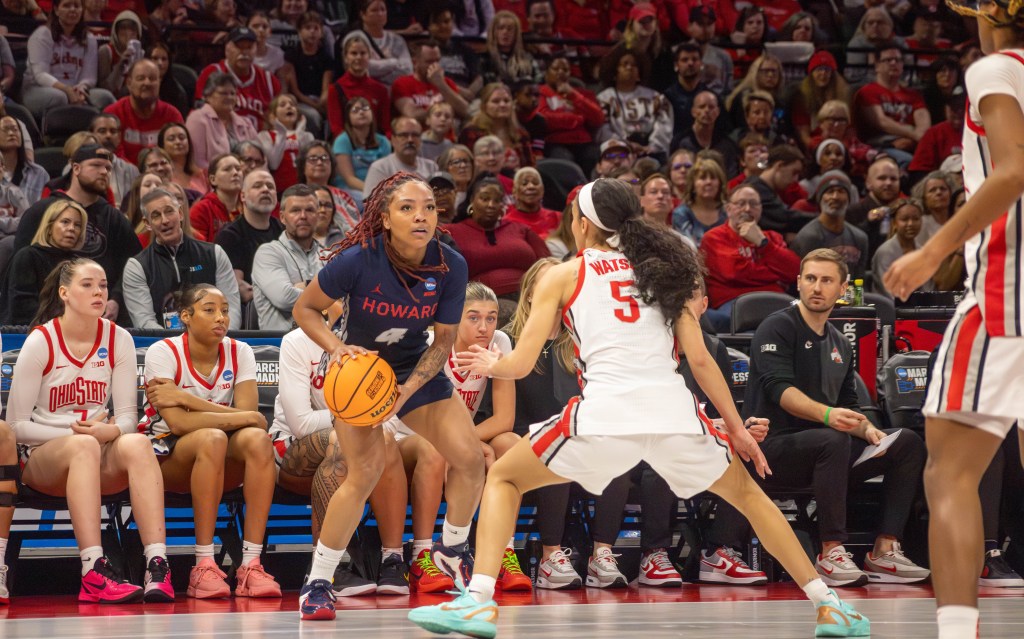
Using the last three years as an example, in a 76-team tournament, Southern would’ve still played in the newly rebranded March Madness Opening Round. Jackson State was a No. 14 seed in 2024. Meanwhile, Norfolk State was a No. 13 seed in 2025, and Howard was a No. 14 seed this past year. So, from an impact standpoint, the MEAC champion still would have avoided an opening round game.
On some levels, that seems cool, but now that financial units are attached to the number of games being played, there could be a shift in thought. Since units were introduced on the women’s side last year, the SWAC earned four units thanks to Southern playing two NCAA tournament games both years.
The Jaguars won a First Four game in each of the last two years before losing to the No. 1 seed. Meanwhile, the MEAC earned two units because Norfolk State played at Maryland in 2025 and Howard played at Ohio State in 2026.
“There is a benefit to playing in the first round,” Norfolk State head coach Jermaine Woods said to The IX Basketball on a phone call. “If we’re going to be in the tournament, put us in the First Four, and not as the 16 seed. At least in the First Four, we got a chance to win a game. We could win and make it to the next round. So you got two opportunities to play in the postseason.”
Maryland Eastern Shore head coach Malikah Willis feels different.
“I think it’s a horrible idea,” she said of tournament expansion via text message. “It takes away from the competitiveness and gives a watered-down mentality. The change should be a capped allotment for the Power Four. Mid-major conferences deserve multiple bids.”
In a revenue-sharing and NIL world, every dollar a school generates helps.
The women’s funds entering the season totaled $20 million, and those units are paid out on a three-year rolling basis. The first-ever women’s basketball units valued at $15 million from 2025 were first distributed this past spring. Units earned this year will be paid starting next year and are $20 million divided by 264.
The payments to each conference next year will be the total number of units from the 2025 and 2026 tournaments. So, for example, the SWAC earned two units each from the 2025 and 2026 tournaments, meaning that units paid out to the SWAC in spring 2027 will total four. Whatever the SWAC earns in the 2027 tournament would then be added on top of those four to be paid out in 2028.
The value of each unit drops until the funds’ total value reaches $25 million in the third year, and then they’ll steadily increase at the same rate as other DI funds. The $25 million in funds would equal 41% of the revenues from the women’s basketball broadcast agreement.
“Anytime you can get some additional funding is always good,” Southern head coach Carlos Funchess said. “That funding not only comes to Southern University, but also to our conference. Expanding the tournament is a plus and shows that you are legit. You can play with some of these mid-major schools, especially on a neutral court, and have the opportunity to win some of these games. For us, the last two years, it sent a message to other conferences that the SWAC can play good basketball.”
Woods also believes that more teams in the tournament could create a ripple effect, possibly leading more MEAC and SWAC programs to compete in the postseason.
Over the last three years, North Carolina A&T, Grambling State, Texas Southern, Howard, Coppin State, and Maryland Eastern Shore have each won a WNIT game. Alabama A&M competed in the WBIT this past season, and North Carolina A&T participated in 2025. Expansion is an opportunity to increase HBCU participation.
“Hopefully, we can get more than one team in the WBIT, which is also NCAA sponsored,” Woods shared. “I just look forward to more postseason opportunities. I think the expansion is good, but it probably won’t benefit our conference. We’re fighting for that No. 13 or No. 14 seed. But in reality, is it a better seed? It looks better for your conference, but there’s not that much parity in women’s basketball. I still think the winnable game is that First Four. You get a chance to compete against a quality opponent from a comparable conference and get a win, and then move on.”
Howard head coach Ty Grace experienced both sides. The Bison won their first NCAA tournament game in program history, beating Incarnate Word in a First Four game in 2022. Even though there wasn’t a financial unit attached to that game, winning was significant for the Bison program at the time. Since then, Howard has developed into one of the best HBCU teams in the country, culminating in it receiving its highest seed in program history at No. 14.
“I believe there was absolutely value in both,” Grace shared with The IX Basketball over text. “The (First Four) game gave us an opportunity to win our first NCAA tournament game because we did not have to play the No. 1 seed first, where the odds were heavily stacked against us. The 14th (seed) showed our strength in scheduling and capability to win those games and make a legitimate case in the seeding selection.”
The overall consensus was that while expanding the tournament is good for women’s basketball, the extra eight spots wouldn’t directly benefit schools from one-bid conferences. Yet, it also sends a signal to programs that if they continue investing in their programs, then one day it’s possible for two programs from traditional one-bid leagues to participate in the NCAA tournament.
The coaches aren’t content with playing in the March Madness First Four, although they understand the current reality. They believe, with the support of the conference commissioners, that they can build programs that will consistently be considered for higher seeds than No. 15 and 16.
“As our league keeps getting more competitive and with commissioner McClelland fighting for us, the SWAC is emerging,” Skeete said. “I don’t think we should be locked into the First Four or an automatic 15 seed. Seeding should be based on record and strength of schedule so that we can get in the mix like everyone else. Southern’s resume over the last few years shows we’ve earned more than a play-in seed, and as we keep proving we’re a formidable opponent, those things are going to change.”