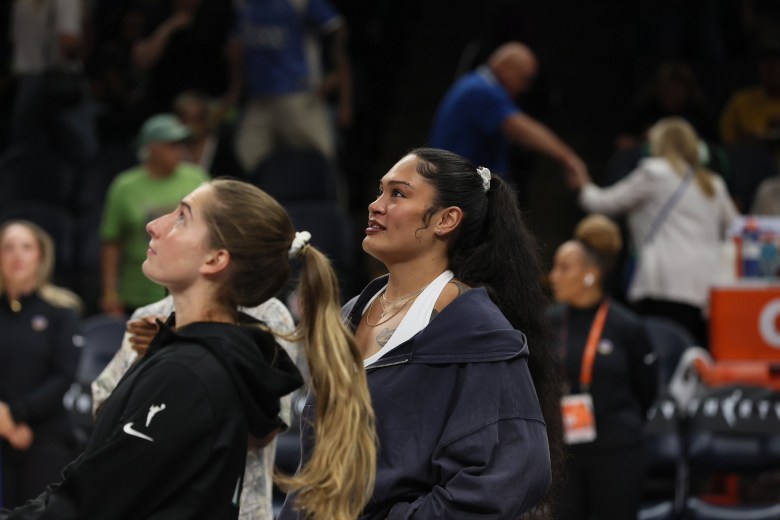
CHICAGO — Before every Chicago Sky game, Maddy Westbeld runs through a full warm-up. She practices her shooting against Sky assistant coaches. She sits down with those coaches to watch video and gets valuable feedback on how to improve her game.
Then she changes into street clothes and sits down at the end of the bench to watch her teammates play.
Westbeld is one of the WNBA’s 25 developmental players. Starting with the latest collective bargaining agreement (CBA), each team has two roster spots for developmental players, in addition to their 12 standard spots.
Athletes with no more than three years of service are eligible for the developmental slots. They are part of the team, but have limits on how often they can play in games. Players get a stipend, travel and train with the team. Teams have players who can step in when an injury happens.
“Something that we’ve always struggled with was the volume of games, the cadence of games, and then experiencing injuries and not having bodies available, not even just for games, but for practices,” said Nneka Ogwumike, Los Angeles Sparks player and WNBPA president. “It’s given us an avenue to be able to tap into our own reserves if we so need to. And I would hope that developmental players feel like it’s a good opportunity to be able to not just develop but also be available in a way where you’re not just sitting at home and waiting for a call.”
In the past, when a WNBA team’s player suffered a major injury, general managers would need to sift through players who weren’t on contracts with other teams, and hope to find someone with familiarity with the team and coach.
“It obviously allows the players to be around the team, create the chemistry, so we’re not going after a player that’s not familiar with who we are or what we do or what we run or the culture or the climate of the team,” said Sky GM Jeff Pagliocca. “I think having two spots that are available obviously can bail you out of injuries or contract situations, depending on what’s going on. But I think it’s a great opportunity for players because there’s a lot of great women that don’t have the option of being here because of the roster sizes.”
In the past, those players who had not made a team by the end of WNBA training camps would then need to keep training and looking for basketball competition to their skills sharp, all on their own dime. Then, when they did get that call, they had to quickly get up to speed on a new playbook and new teammates.
Last season, the Sparks had several transactions over the course of the season as they dealt with injuries. Alissa Pili was signed to three separate seven-day contracts before she was given a rest-of-the-season contract.
“I think it’s a step in the right direction for having more players, so you can get away from those hardship contracts. Those are tough,” Sparks coach Lynne Roberts said.

“Becoming Caitlin Clark” is out now!
Howard Megdal’s newest book is here! “Becoming Caitlin Clark: The Unknown Origin Story of a Modern Basketball Superstar” captures both the historic nature of Clark’s rise and the critical context over the previous century that helped make it possible, including interviews with Clark, Lisa Bluder (who also wrote the foreword), C. Vivian Stringer, Jan Jensen, Molly Kazmer and many others.
This season, the Sparks signed Pili to a developmental contract in early July.
“It’s a great opportunity for there to be two extra spots on a team, and for it to be more of a safety net,” Pili said. “With us being able to do everything with the team, I feel like that’s so much better, and it helps a lot. Like as a team and as a player, being in that position, it could be tough sometimes, but I think it’s all about perspective and the way you approach it and go about it, and kind of use it to really develop yourself.”
Every developmental player the IX Sports spoke to mentioned how being on a team with some of the league’s best helps them grow. Westbeld spoke of Skylar Diggins in Chicago, Pili brought up Ogwumike in Los Angeles, while Shay Ciezki and Marta Suarez (who was elevated to a rest of season contract on August 3) spoke of Kahleah Copper and Alyssa Thomas for the Phoenix Mercury.
“A huge benefit of this is just watching how these players practice, play, how they go about getting ready for games, even how they recover,” Suarez said.
“It’s a really special opportunity to get to learn from them every day throughout the season,” Ciezki added.
Sky coach Tyler Marsh said that development is about so much more than what happens on the court. Developmental players being a part of the team is a huge help with that.
“I learned a long time ago, my first year in the G League, that development isn’t just the time that you get on the court,” Marsh said. “It’s time spent in the locker room. It’s time spent in the film room. It’s time spent in the weight room. It’s time spent with your teammates. It’s time spent learning the league and learning how to approach each day, how to conduct yourself each day. Those things are just as important as skill development. And so we create room and time for basketball, you have to make sure that you create room and time and space and communication for all the other stuff as well.”
Teams don’t treat developmental players differently. They get the same kind of gear, work in practice and social media spotlights. The biggest difference is how often they can appear in games.
Each player can appear in up to 12 games, and each team is allowed no more than 24 appearances by developmental games per season.
One measure of the program’s success has been how many players have moved from developmental contracts to full, rest-of-season contracts. Chloe Bibby, Kate Martin, Suarez, Aicha Coulibally, Taylor Thierry, Jordan Harrison, Alicia Flórez, Justine Pissott and Marine Fauthoux all went from a developmental slot to a standard contract.
Coulibally is a perfect example of how a team can be helped by bringing a developmental player onboard.
In large part due to Rickea Jackson’s season-ending injury, Coulibally played in nine games for the Chicago Sky as a developmental player. When the Sky were given an salary cap exception because of Jackson’s injury, the Sky could sign Coulibally and immediately lean on a player who had already been a part of the team.
She moved into the starting line-up when Azura Stevens was out, and scored a season-high 13 points in a win over Los Angeles on August 6.
Since it is just the first year of the developmental contracts, the WNBA, players and coaches are all still figuring out the best way to make it work. There’s no substitute for game play in helping players get better. Coaches and players agreed that they need more games.
“It’s such a small sample size,” Marsh said. “In theory, the development contracts are good and give more opportunity, which is always helpful. It’s always good to have players that are kind of learning your system to be able to implement them when needed. But I would like more than 12 games and make changes to the kind of the parameters around them of how they’re counted towards the total allotment of games.”
In 2027, the WNBA will expand to 50 games from this season’s 44. It’s important for the league to consider those extra games when updating rules for the developmental players for next season.
But the other thing players and coaches agreed on was that the developmental contracts are a net good for both teams and players.
“I get to represent the city, and I get to get better every day, no matter what capacity,” Westbeld said.
‘Rare Gems’ is out now!
Howard Megdal, founder and editor of The IX Basketball and The IX Sports, wrote this deeply reported book. “Rare Gems” follows four connected generations of women’s basketball pioneers, from Elvera “Peps” Neuman to Cheryl Reeve and from Lindsay Whalen to Sylvia Fowles and Paige Bueckers.
If you enjoy Megdal’s coverage of women’s basketball every Wednesday at The IX Sports, you will love “Rare Gems: How Four Generations of Women Paved the Way for the WNBA.”