It makes sense that the only way the Los Angeles Queens were going to eliminate the New York Heights in this inaugural WPBL postseason was to score in their final turn at-bat in a winner-take-all game and win the highest-scoring game in league history. After all, of the eight head-to-head games between the two teams this season, five, including the final two games of their best-of-three semifinal series, were decided in the victor’s last at-bat.
Monday night’s Game 3, the first double-elimination game in WPBL history, bore a strong resemblance to Saturday’s Game 2, but with the fates of the two teams reversed and the run totals slightly inflated. In the earlier game, the Queens battled back from an early five-run deficit and sent the game into the top of the seventh tied, only for New York to score twice in that inning and seal the victory. On Monday night, the Heights battled back from an even larger deficit, seven runs, to send the game into the top of the seventh tied, only for LA to score four times in that inning and win the series with a 15-11 victory.
Game 3 was a game of near-constant action, featuring five home runs that drove in a combined 12 runs, each team scoring in four of their seven turns at-bat, and a total of 26 runs, 27 hits, 12 walks, and five batters hit by pitches. Despite all that, it was ultimately decided by the disparity in sharpness of the last two pitchers out of each bullpen.
Rep The IX Sports at your next game!

Shop the logo collection or special “Women’s Sports are Front Page News” collection now on Shopify.
For the first four innings, the Queens would jump ahead, and the Heights would claw some but not all of their lead back. It started right away, as Heights starter Rakyung Kim, starting on just one day’s rest after throwing 50 pitches in Game 2, walked LA leadoff hitter Samaria Benítez on five pitches, gave up a single to shortstop Ayuri Shimano, then surrendered a towering three-run home run to Queens captain Ashton Lansdell, all before recording the first out.
The Heights got two of those three runs back in the bottom of the first in similar fashion. Leadoff hitter Natsuki Yonetani reached base (on a would-be fly out that Queens right fielder Amira Hondras lost in the setting sun but was officially ruled the first triple in league history), and captain Denae Benites hit her 13th home run of the year (regular and postseasons combined) to once again inch ahead of home run rival Kelsie Whitmore of the Firebells (who is at 12).
Game 2 hero Claire O’Sullivan, who started the game at designated hitter, replaced Kim on the mound in the second inning, and she and Queens starting pitcher Michelle Roche, returning on three day’s rest after her winning effort in Game 1, both worked in an out of trouble to exchange zeroes in that frame.
The Queens got to O’Sullivan in the third, however. After DH Caitlin Eynon led off with a solo home run to make it 4-2, the bottom of the order pushed another run across. That happened when, wtih one out and runners on the corners, Heights shortstop Emi Saiki tracked a pop-up behind second base onto the outfield grass, called off her teammates, then tripped on the slope of Robin Roberts Stadium’s turtleback field, allowing the ball to drop for an RBI single. O’Sullivan then hit Benítez, who was standing as close to home plate as the batter’s box would allow, with a pitch to load the bases and bring up Shimano.
On a 2-0 pitch, O’Sullivan laid a strike right over the plate, and Shimano crushed it the other way for the first grand slam in WPBL postseason history. That blew the game open at 9-2, but no lead is safe in the WPBL, particularly not against the New York Heights.
New York immediately got three of those runs back in the bottom of the third with considerable help from the Queens and, in the Queens’ opinion, first-base umpire Steve Berardino. With one out, Roche punked first baseman Kylee Lahners. Third baseman Val Perez then hit into an apparent double play but just beat out the pivot throw at first base, at least according to Berardino (due the recurrent technical difficulties on the ESPN broadcast, more on those below, the play was only seen live by those in the stadium). Center fielder Claire Eccles then beat out a slow roller to the right side by an apparently similar amount to put runners on first and second with two outs. Second baseman Madison Willan then appeared to hit into an easy, inning-ending fielder’s choice, but Shimano’s short throw to second went wild, plating Perez. Saiki then singled home Eccles, and Willan scored on a wild pitch: 9-5 Queens.
Saiki replaced O’Sullivan on the mound with two on and none out in the top of the fourth and stranded both runners. Then O’Sullivan’s double in the bottom of that frame plated a leadoff single by Benites to drive Roche from the game after 83 pitches (18 more than she threw in Game 1) and make it 9-6 Queens.
The Queens added on in the top of the fifth. Maggie Foxx, who entered the game for Samaria Benítez when the latter suffered an apparent left knee injury on Saiki’s third-inning single (Foxx took over in right field, pushing Amira Hondras to second base, see below for more on Benítez), drew a one-out walk. Shimano, who went 5-for-5 in the game, singled. The two then scored on a double by Lansdell and a sacrifice fly by catcher Jamie Mackay, respectively.
Once again down by five runs, the Heights stormed back against Shimano, who replaced Roche on the mound, with two outs in the in the fifth. After Willian drew a leadoff walk and Saiki singled, Yonetani hit into a 6-4-3 double play. With first base open, two outs, and a runner in scoring position, Queens manager Eric Young opted to intentionally walk Benites. London Studer made him pay with a sky-scraping opposite-field double to the wall in left center. Because there were two outs, Benites was off with the crack of the bat and able to score all the way from first just ahead of the relay throw home. Shimano then hit O’Sullivan with a pitch to put two on for Kylee Lahners, who dropped down to one knee to launch a game-tying three-run home run down the left-field line. 11-11.
And so it would remain into the seventh. In the top of the sixth, Saiki, in her third inning on the mound, worked around a one-out single. In the bottom of that frame, Young turned to his rotation ace, Ayami Sato, who the Heights touched up for six runs in Game 2 and hit hard in three of their four confrontations this season.
The decision to turn to Sato was a fascinating one. Against any other team, Young likely would have called on relief ace Meggie Meidlinger, but it was Meidlinger that the Heights beat in Game 2. The Heights are the only team that has gotten to Meidlinger all season, scoring multiple runs off her on three occasions and handing her her only two losses, one of those coming on Saturday. With Meidlinger having pitched in each of the first two games of this series, it’s understandable that Young might have had hesitations about going back to her in this game given that history.
However, the Heights had also hit Sato hard, and Sato had thrown 45 pitches just two days earlier. After Game 1, Young was upfront about intentionally avoiding Sato in that game and starting Roche instead because of the Heights’ familiarity and success against Sato.
Yet, coming into this season, Sato was one of the league’s signature players. A three-time Women’s Baseball World Cup Most Valuable Player, the 36-year-old Sato was the second-overall pick in the WPBL draft, LA’s Opening Day starter, and it’s clear that the other players in the league revere her. With Roche done, Shimano having surrendered the lead, and the quality of his alternatives dwindling, Young put his trust in a talented veteran who had experience in big spots, and he was rewarded.
Sato worked a 1-2-3 bottom of the sixth. Then Henley turned to her lefty closer, Claire Eccles, who picked up the win in Game 2 and hadn’t allowed a hit in 4 2/3 innings over her previous two pitching appearances.
On this occasion, Eccles only allowed one hit, but that single (by Shimano, of course) was incidental compared to the four walks and two hit batters that surrounded it. Eccles just couldn’t find the strike zone, but having also largely run out of high-leverage alternatives, Henley’s best hope was that Eccles could limit the damage and the Heights’ irrepressible offense could pull out one more comeback.
Neither happened. The Queens scored four runs in the top of the seventh, three of them forced in by Eccles on a hit-by-pitch and a pair of walks (the fourth came in on a sacrifice fly by Sato in just her second at-bat of the season). The inning, which started and ended with Foxx at the top of the order, went: hit-by-pitch, single, walk to load the bases, hit-by-pitch to break the tie, sacrifice fly, fly out, walk to reload the bases, walk to drive in a third run, walk to drive in a fourth run, fly out.
It was an anticlimactic way to end an otherwise thrilling ballgame. It also felt unfair to Eccles, who entered this season having not pitched in a year only to find success in the role and emerge at the end of the season as a seemingly dominant reliever. In a league with more pitching depth, Eccles wouldn’t have stayed in to give up all four of those runs, and the bottom of the seventh would have had more suspense.
As it was, Sato made quick work of the two stars at the top of the Heights’ order in the bottom of the seventh, getting Yoentani to fly out on three pitches and striking out Benites by getting her to swinging through a perfectly placed pitch up and in. A two-out double by Studer proved that the Heights never go quietly, but that was all they’d manage in the inning. O’Sullivan popped out to LA first baseman Sarah Edwards, Sato got her redemption, and the Queens claimed their spot in the first championship series in WPBL history.
That best-of-five series, between the Los Angeles Queens and San Francisco Firebells, will start tomorrow night, Wednesday Sept. 16, at 7 p.m. Eastern.
Listen now to The IX Sports Podcast and Women’s Sports Daily
We are excited to announce the launch of TWO new podcasts for all the women’s sports fans out there looking for a daily dose of women’s sports news and analysis. Stream on Spotify, Apple Podcasts or anywhere you listen to podcasts, and make sure to subscribe!
Injury News
As mentioned above, Queens second baseman and leadoff hitter Samaria Benítez suffered an apparent knee injury chasing after Emi Saiki’s single into right field in the third inning. Because of the issues with the broadcast, I didn’t get a good look at the play, but it appeared that Benítez twisted her knee on the sharp downward slope behind the infield dirt of Robin Roberts Stadium’s turtleback field. From what I could see, she didn’t make contact with the ball or another player but went down hard, stayed down, and was clearly in a great deal of pain. Benítez was eventually carted off the field, and she reappeared for the postgame celebrations in a wheelchair with her left knee bandaged. Unfortunately, the Queens were unavailable for comment after the game.
Heights manager Rocky Henley told reporters after the game that righty Jacqui Reynolds was unavailable in this series due to a hamstring injury. Henley said that Reynolds tested her leg by throwing “about 10 pitches” in the bullpen prior to Game 3. Per Henley, Reynolds said she was “75-80% [and] would not be able to get to first or cover a bunt, and I didn’t want to take that chance.” In a bitter irony, Reynolds was no longer having any issue with the sore shoulder that sidelined her earlier in the season. Reynolds and closer Jaida Lee (right ankle) were inactive for this game.
Notes
- This should have been a triumphant night for the WPBL, but technical difficulties on the ESPN broadcast, as well as Benítez’s injury, cast a dark cloud over the experience for the many fans watching from home. Throughout the first six innings, the broadcast repeatedly lost both audio and video, often returning with just one working camera, no scorebug, and sometimes with the audio and video (when both were working) unsynchronized, at least initially. In those first six innings, the broadcast dropped out 25 times (yes, I counted).
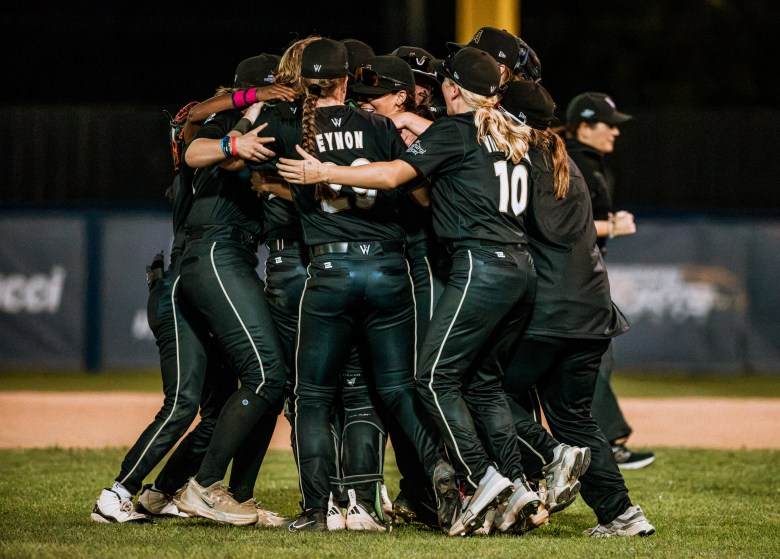
Among the moments fans at home missed were Benites’s home run swing, two full at-bats in the bottom of the first, four at-bats in the bottom of the fifth, the play on which Benítez was injured (which was a run-scoring single for the Heights), the close call on the would-be double play on Perez in the third inning, an across-the-diamond double play turned by the Heights in the top of the fourth, an RBI double in the bottom of the fourth, Ayuri Shimano’s single in the top of the third, and the hit-by-pitch ahead of Lahners’s home run in the fifth. I had not previously witnessed any similar issues with the broadcast this season. Those involved must be mortified to have had them crop up during the most important game in league history to this point. To their credit, there were no more interruptions after the sixth inning. - In sharp contrast to the Firebells, whose celebration on the field after winning their semifinal against the Hunters was almost indistinguishable from that of a regular-season game, the Queens’ celebration at the end of this game was more emotional and more closely resembled the team scrums we’re used to seeing in such moments. This was a taxing series, and emotions ran high for both teams, leading to a bit of carping among the players. It was thus heartwarming to see the celebrating Queens and often tearful Heights exchange embraces with one another after the game, as both teams lingered on the field to congratulate one another and salute the fans.
- Despite being the home team in this game, the Heights took the field in their sky blue alternate jerseys and gray pants, not their home pinstripes. I asked the five members of the team who attended the postgame press conference, collectively, whose decision that was, and they, almost in unison, answered, “not ours.” Added Henley, “you might want to ask the league about that.” It was very clear that the Heights were not happy about the choice.
- Eccles explained her history with pitching after the Heights’ Sept. 4 win over the Firebells: “With the [Canadian] national team, I started out as a P.O. [pitcher-only]. And I felt really good for that time, and then I kind of went downhill, struggled a little bit with pitching and the mental game of it.
“I played softball in university, and obviously I’m not a pitcher in softball, so I played a lot of outfield … And then I realized I just needed a break from pitching for a while. Then only recently [I] have kind of picked it up again. But with the national team, I’m just an outfielder. At the World Cup qualifiers earlier, I wasn’t even considered a pitcher. So, I think it’s nice, because there’s more games in this league and more opportunities, so I felt like it was a good time to get my confidence back. … Those outings that I had earlier this season were the only ones I’ve had in a year.” - Finally, with the Heights eliminated, I asked several of them to reflect on this first season of the WPBL. Here’s Val Perez’s response:
“I’d say playing with people from all across the world adds new nuances … language barriers, and culture differences, and that kind of thing. And so, as we’re building that team camaraderie, as we’re learning each other’s tendencies and the way that you go about your game, and how you prepare, and how you recover … there’s just a lot of factors that we’ve never had to deal with, because we’ve never had the opportunity to play with this many people. Usually they’re “the enemies,” right? We’re playing against them, if it’s on a national level, or if it’s at a women’s tournament … but the merging of all the different countries and dispersing everybody on different teams allowed us to deepen our love for the game and our appreciation for the different cultures and the way they appreciate the game. And that was really exciting for me to learn and to respect that.
“At the same time, this is the first time we’ve seen how many people throughout the league, as players, improve on their stats, and people like [gestures to Denae Benites] killing it in the game, just putting up unreal numbers, and its just testament to what happens when you give us an opportunity to play ball every day. I mean, we’re not playing three or four times a year, we’re playing every single day for … weeks … and the talent level is just going to continue to rise and blow people’s minds. I’m really excited for the growth of this league.”