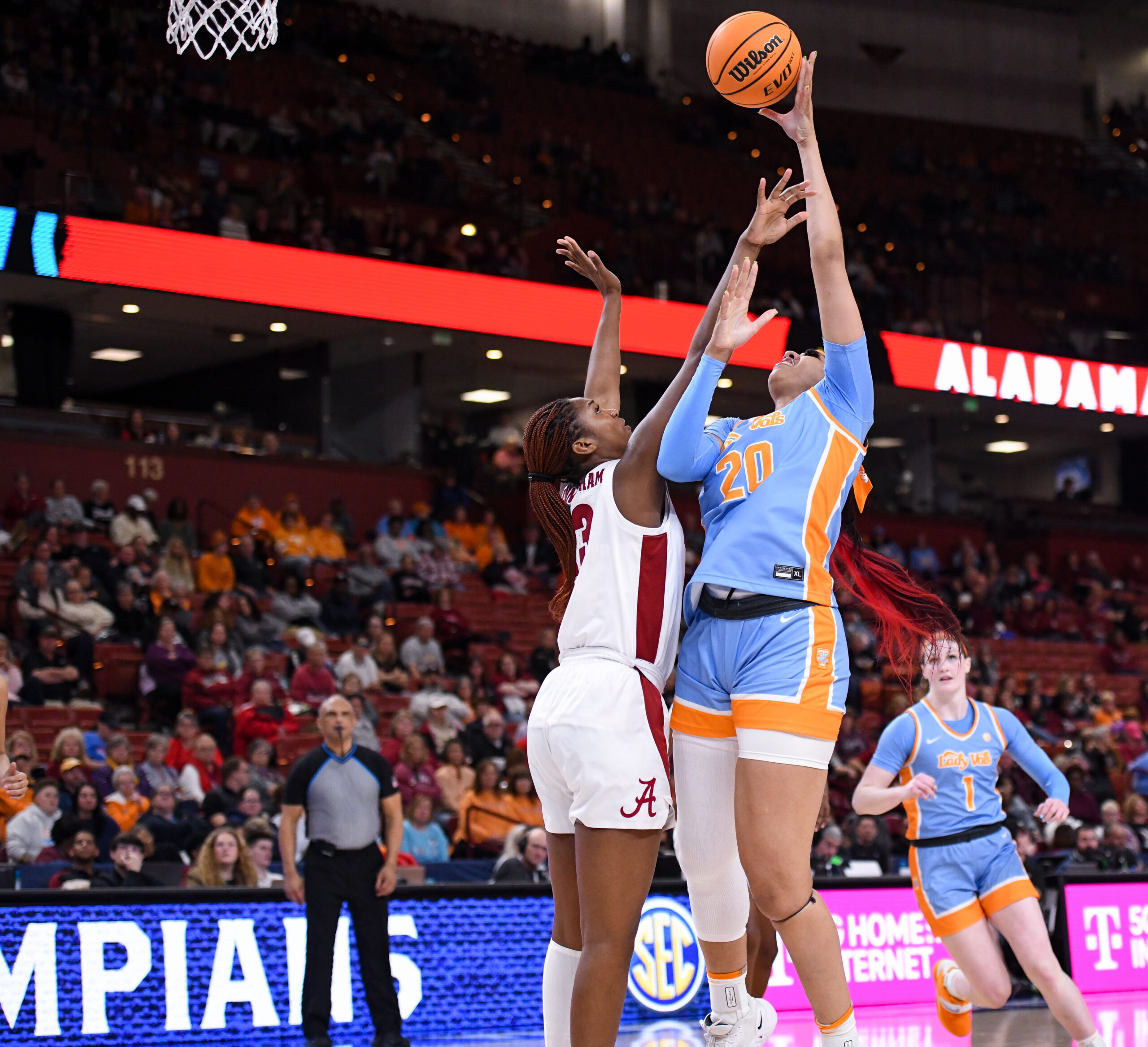
On Tuesday, Tennessee fifth-year Tamari Key announced she would retire from college basketball and would not take her COVID year with the Lady Vols. And although Key won’t put on the orange jersey again, fans are grateful for the time they had, as this season alone wasn’t a guarantee.
“Thank you for an amazing five years and all the unconditional love and support that you have shown me. I have found a forever home and family here,” Key wrote on social media.
Key’s news comes just a day after Tennesse fired head coach Kellie Harper, and a week after the Vols’ lost in the second round of the NCAA Tournament to NC State. Key played her final minutes of college hoops just 10 minutes away from her hometown of Cary, North Carolina, in front of scores of her supporters.
Although Key ends her career on her own terms, her last two years begged the question of whether she’d get to make that decision at all.
A year on the bench
Just nine games into the 2022-23 season, the Lady Vols announced that the 6’6 Key would miss the remaining season due to blood clots in her lungs. And although she was expected to make a full recovery, Key’s timeline back on the court remained unclear.
“It was scary at the time. It was just the unknown of what my next steps were, once I got diagnosed,” Key told the media ahead of Tennessee’s NCAA Tournament departure. “So we just kind of took it one day at a time.”
Key spent the summer in and out of training but was officially cleared to play in October. According to Key, since she hadn’t fully played over the summer, she spent much of the early regular season getting her legs back. Throughout November, Key averaged just over 4.5 minutes per game.
Finding patience
Looking back on the years, Key emphasized the importance of patience, which she lacked and dug deep to find.
“I think [patience] is gonna be my ongoing thing in life. Whatever life throws at me, it’s [about] patience. I’m still not a patient person,” Key told The Next during March Madness. “Just giving myself grace, relying on my teammates, us having each other’s backs, the coaches having our back helps.”
Key told The Next that, aside from losing a relative in middle school, fighting to return to basketball was her biggest challenge in life.
And her diagnosis didn’t allow a quick return. She not only spent a whole season out, but even when she was cleared to return, she had to climb back slowly. Key started in 14 games, averaging just over 15.5 minutes per game.
“You then put yourself in her shoes and you think about having to deal with the emotions, not just of a diagnosis in that moment but wanting to be somewhere and it taking so long to get there. That’s hard,” Harper told the media earlier this month. “And I am so proud of her and her fight. And she just came back every day. She never got too down.”
Despite her dogged work to get back on the court, Key struggled to achieve her career-high junior year levels, where she averaged 10.5 points, 8.1 rebounds and 3.5 blocks per game. This season, she averaged about half of her junior season statistics.
However, Key’s presence in the paint was always felt. Harper called her a “mistake eraser,” while teammates noted how impactful her mere presence was on both ends. On the defensive end, her blocks scared opponents away, and on offense, she was a reliable target.
A leader in the locker room
On top of her health, Key also watched two of her closest teammates graduate last year: her girlfriend Jordan Horston and her close friend Jordan Walker. “It was hard. Those were my girls last year,” Key said.
But it didn’t take long for Key to adjust to her new team and find chemistry. Although Key never thought of herself as a leader, she found that part of herself at Rocky Top.
“I think growing up, I didn’t really want that [leadership] role. But getting here, realizing I am a leader, and being okay with it and knowing that my voice matters on the team,” Key said.
And in Key’s absence on the court, her teammates and coaches always noticed how she kept her head up, whether she was working out solo on the sidelines or cheering them on. When the Vols described Key to The Next, “sister” was often the word that came to mind.
“Off the court, she’s just the big sister. She’s a leader,” junior Kaiya Wynn told The Next. “She laughs with us. You can tell she really loves being here.”
And now, after a season that defined her grit, Key retires as the storied program’s top shot-blocker and a forever sister.
The decision and what comes next
Earlier this month, Key told The Next she wasn’t sure if she’d return to Knoxville, Tennessee. Although she wasn’t sure regardless, the news of Harper’s departure may have played a deciding role in her ultimate choice.
Harper’s predecessor originally recruited Key, but she decided to stay and play for Harper when she took over. The two spent the same five years at Rocky Top together and developed a close bond.
Key did not explicitly mention the 2024 WNBA Draft in her announcement. Instead, she wrote that she is “embarking on the next chapter of her life.” Her next steps are unclear, but after five years watching Harper — including a year learning from the sidelines — she hasn’t ruled out coaching.
“I would say ‘Absolutely not’ before last year. But then I was kinda like, ‘Maybe!'” Key said about a coaching future.