Welcome to The Next: A basketball newsroom brought to you by The IX. 24/7/365 women’s basketball coverage, written, edited and photographed by our young, diverse staff, dedicated to breaking news, analysis, historical deep dives and projections about the game we love.
Subscribe to make sure this vital work, creating a pipeline of young, diverse media professionals to write, edit and photograph the great game, continues and grows. Subscriptions include some exclusive content, but the reason for subscriptions is a simple one: making sure our writers and editors creating 24/7/365 women’s basketball coverage get paid to do it.
We are proud to announce a collaboration with Pivot Analysis to bring you a simulated 2020 WNBA season, based on the schedule as originally written. We’ll be reporting on it, and speaking to league figures out the sim season, as we await the return to play. See the full results, box scores and standings, continually updated, here.

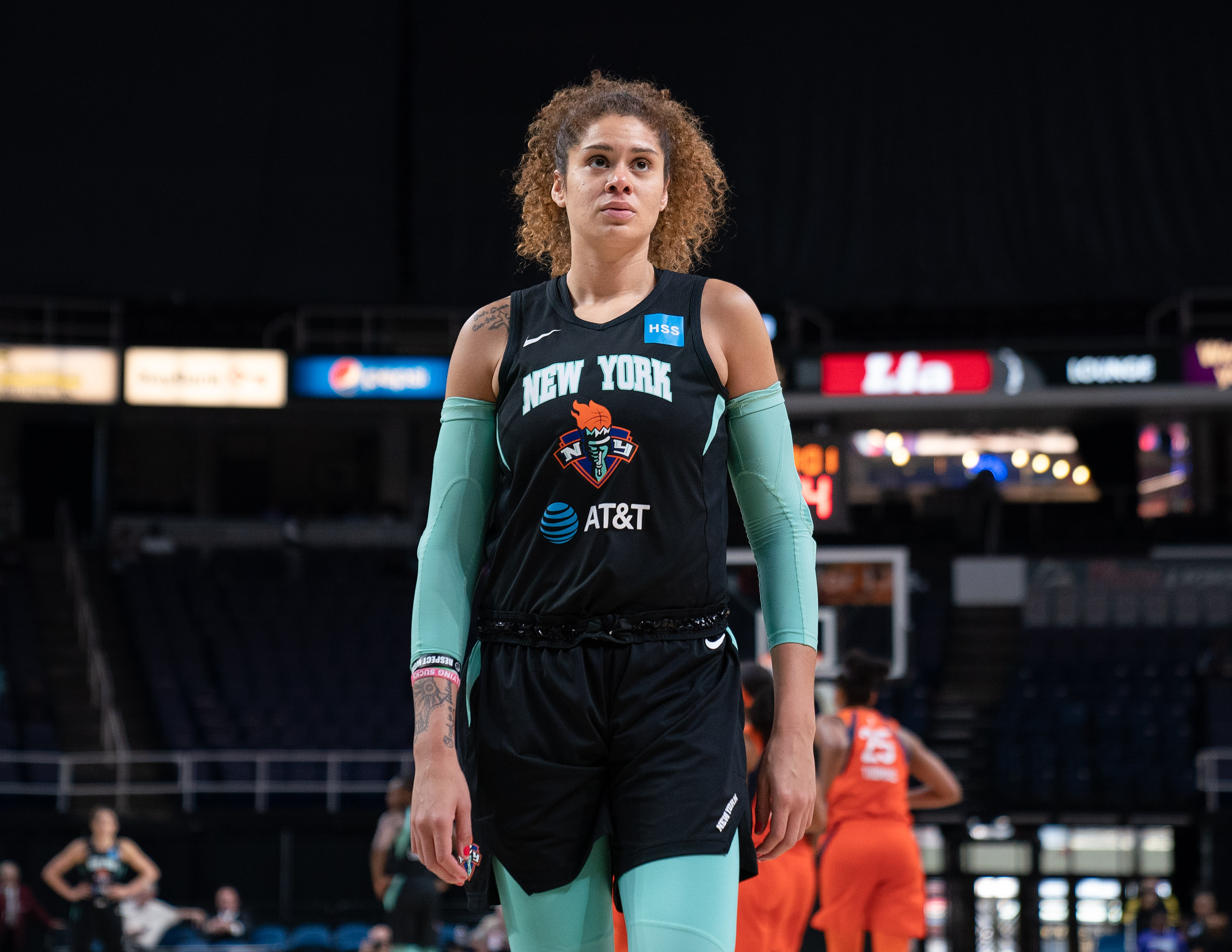
Amanda Zahui B. in a 2019 preseason game against the Connecticut Sun. (Photo Credit: Chris Poss)
As the second-youngest team in the league, which includes a roster half loaded with rookies, growing pains were always eminent for the Liberty. The team’s mean average age of 24.35 explains a third worst-ranked defense and clear struggles to finish games.
To the lazy eye, New York sitting in last place with a 4-16 record, appears discouraging. A complete roster overhaul, new logo, new franchise player, and now: last place.
But, there’s been an improvement in a few metrics that prevented New York from appearing competitive in 2019. Tina Charles’ last season on the Liberty and most topsy-turvy year in the WNBA carried over to the entire roster.
There were moments when some of the individual pieces on last year’s team proved themselves. (Such as Marine Johannés’ perfect shooting, Amanda Zahui B. reminding talent evaluators and coaches that she can pick-and-pop at a high level, career-high performances from Bec Allen and a deserved All-Star appearance for Kia Nurse.)
With all else being equal in the model, where do we see the most improvement? When a franchise replaces the trio that committed the most turnovers in the league, that number was bound to go down, and it did. Overall efficiency increased as well, even albeit a hair. In 2019, the Liberty averaged an effective field goal percentage (EFG%) of 46.1, which placed them at 10th overall. In this 2020 model, New York’s EFG% increased by 0.48 percent to 46.32.
Why not a larger increase, especially with a promise for more three-point shooting? Well, a facet of the simulated results is the Liberty you see here on paper doesn’t necessarily match the Liberty that Head Coach Walt Hopkins and General Manager Jonathan Kolb have described. Three-point shooting attempts have decreased for a team that will be reliant on spacing? I was a little confused.
The Liberty are more competitive
While the Liberty have lost 14 games in Pivot’s model, it’s worth examining how they’ve lost and by how many they’ve lost. In New York’s first 20 games in 2019, the Liberty lost 12 games, five of which were in double digits.
Within the universe of this model, this post-draft roster lost a game in double-digits in 14 percent of the games they lost. They fell to Connecticut twice in game three by 19 points and then in game 15 by an even 20. Within the first twenty games of last season, the Liberty lost by double-digits in around 42 percent of their losses.
The translation for all of that is, when you add Sabrina Ionescu and five other sets of fresh young legs to the returners from last season, New York becomes so much more competitive. Twelve of their 14 losses were determined by nine points or less.
While their -6.69 Net rating determined by Pivot wasn’t by any means spectacular, what it indicates matters. Under Katie Smith, the Liberty averaged a -8.5 Net rating, and in the universe of the simulation, that rating increases by 1.81.
Also, another reason for New York’s sluggish results of last season fell upon the rate at which that group turned the ball over. The Liberty racked up around 15 turnovers per game in 2019, but with Ionescu and Layshia Clarendon as the primary ball-handlers, who are both natural point guards, Pivot has the team ceding the ball over a hair over 11 times.
Also, assist to turnover ratio (AST) increases from 1.27 a year ago and pops out of the simulator at 1.48. For New York, a 27 percent decrease in total turnovers is coupled with a 16.5 percent increase in AST.
Generally, these improvements aren’t stark. But the model does speak differently than how the simulation’s current standings read.
Sticking to the ‘New Era’ game plan on offense
Bec Allen taking some pregame warm-up shots. (Photo Credit: Chris Poss)
The Liberty’s offense does improve, exponentially increasing its ranking by 8.4 percent. The shift of last season’s 95.4 ratings to the predicted 103.38 ratings is reasonable when considering who is on the floor. In 2019, it was widely proven that the Liberty played better when Bec Allen was on the floor.
Pivot has Allen playing over 26 minutes per game, which takes into account an increase in usage which Hopkins has made clear is on the horizon for New York.
But here’s what’s puzzling, the simulation has Allen attempting a bit over 3.25 long balls per game, falling behind Sabrina Ionescu with 3.6 for second-most attempts. She also produces a surprisingly low three-point shooting percentage of 35.38.
So while Allen’s numbers remain confusing, here’s what isn’t: the Liberty aren’t shooting the multitudinous level of three-balls that were expected from this revamped roster.
Pivot has the Liberty attempting under 18 threes a game, and that’s less than their 19.6 per contest last season. Ionescu ranked 20th in the league overall with all of her teammates falling below that mark. The number one overall draft pick also ranks 8th in free throw attempts, 7th for both points per game, and field goals made. And the model also predicted Ionescu to finish atop the league in field goal attempts.
On this model, Allen is underperforming and Ionescu could be overperforming, but Jocelyn Willoughby, Allen’s rookie counterpart in skill and benevolence, is performing exactly how I expected her to.
In under 22 minutes per game, Willoughby is averaging almost 10 points, shooting over 43 percent with under four rebounds and 2.5 assists. According to the model, she’s making 80 percent of her free throws. (Remember: Willoughby scored almost 30 percent of her points during her senior year at Virginia from the line.)
Defense still remains a challenge
When the Liberty traded Tina Charles, it was almost a given that the defense would take a hit. How are the Liberty going to ball with some of the league’s most dominant post players? While Walt Hopkins does have an Elizabeth Warren-esk plan for that, Pivot didn’t really know how to include it.
According to the model, they struggle. New York’s defensive rating balloons from 103.9 last season to over 110 with the new roster.
What was most surprising about the predictions of the simulation for New York on defense was the lack of production out of Kiah Stokes, whose role on this team remains unclear. She’s listed to block 0.05 shots per game. How? She’s playing around 16 minutes per game.
Part of the reason to keep Stokes instead of waiving her or trading her was to harness her defensive prowess, was it not? With a new player development staff that doesn’t consist of Bill Laimbeer, Stokes could be poised for a return to the 2015 form where she averaged two blocked shots per game.
The silver-linning defensively for New York falls to Amanda Zahui B. and a 14.8 percent decrease in personal fouling.
Zahui B. remains 8th in the league for defensive rebounding and she leads the team with 5.5 per contest. If it’s because of Zahui’s numbers in addition to more Allen on the floor, the Liberty are collecting defensive boards at a higher rate than they were in Westchester last season.
The simulation has New York’s defensive rebounding increasing by over two whole rebounds from last season’s 25.5. The Liberty were by far the worst last season when it came to fouling. That number within this simulated universe shrinks from over 20 a game to a smidgen under 18.
While an actual season is set to tipoff in late July, Pivot’s modeling serves as a preview as to how the Liberty can actually improve.
It might not be obvious at first, and the model might have needed to account a bit more from the Walt Hopkins “New Era” system, but this simulation produces an idea of how the tree begins to grow in Brooklyn via Bradenton, Florida this summer.