NEW YORK — For women’s college basketball players, fewer moments are dreamt of more than being picked in the WNBA draft. No matter where they’re drafted, being selected creates a rare opportunity for players to prove themselves in one of the most difficult leagues to be a rookie.
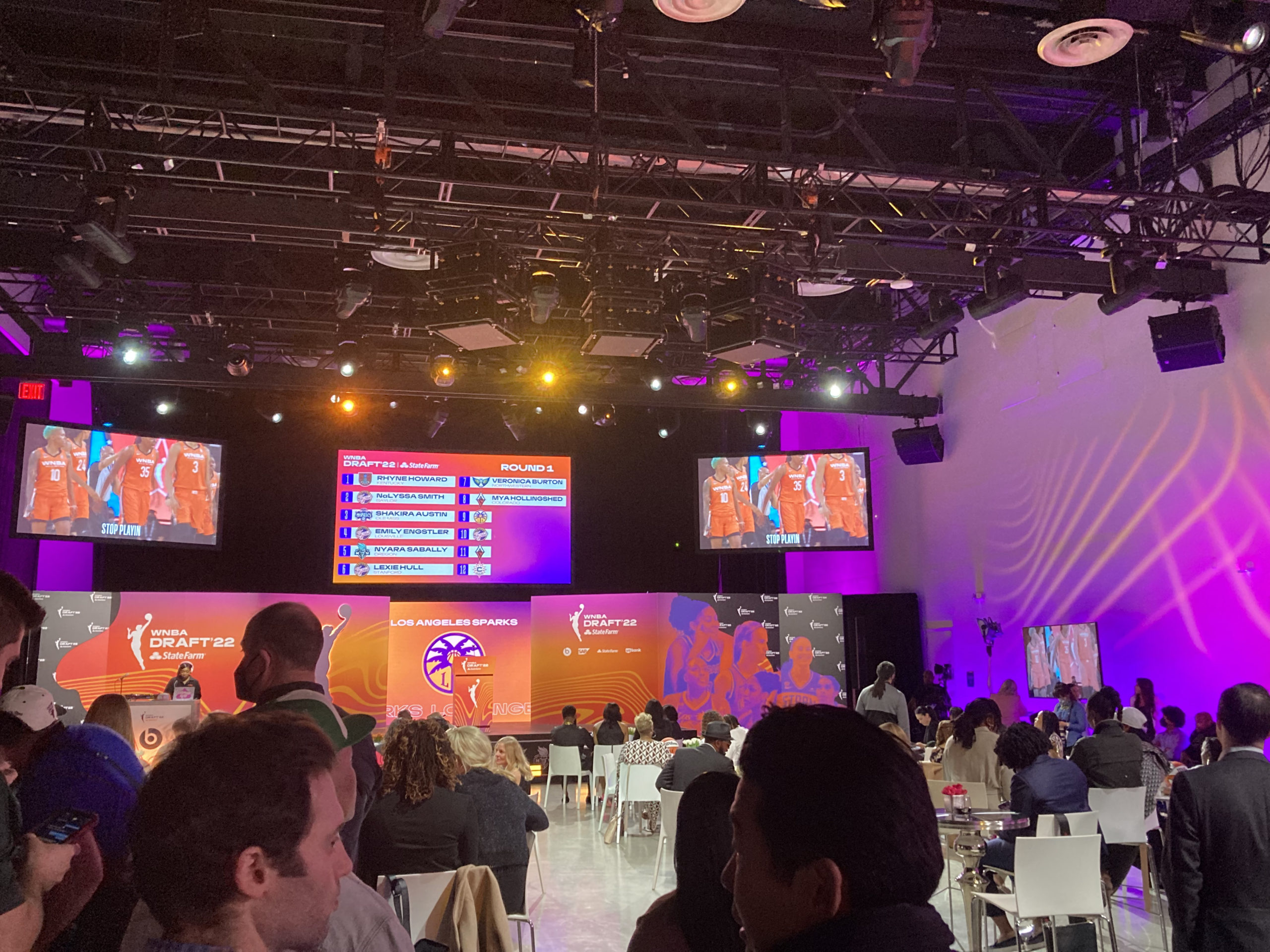
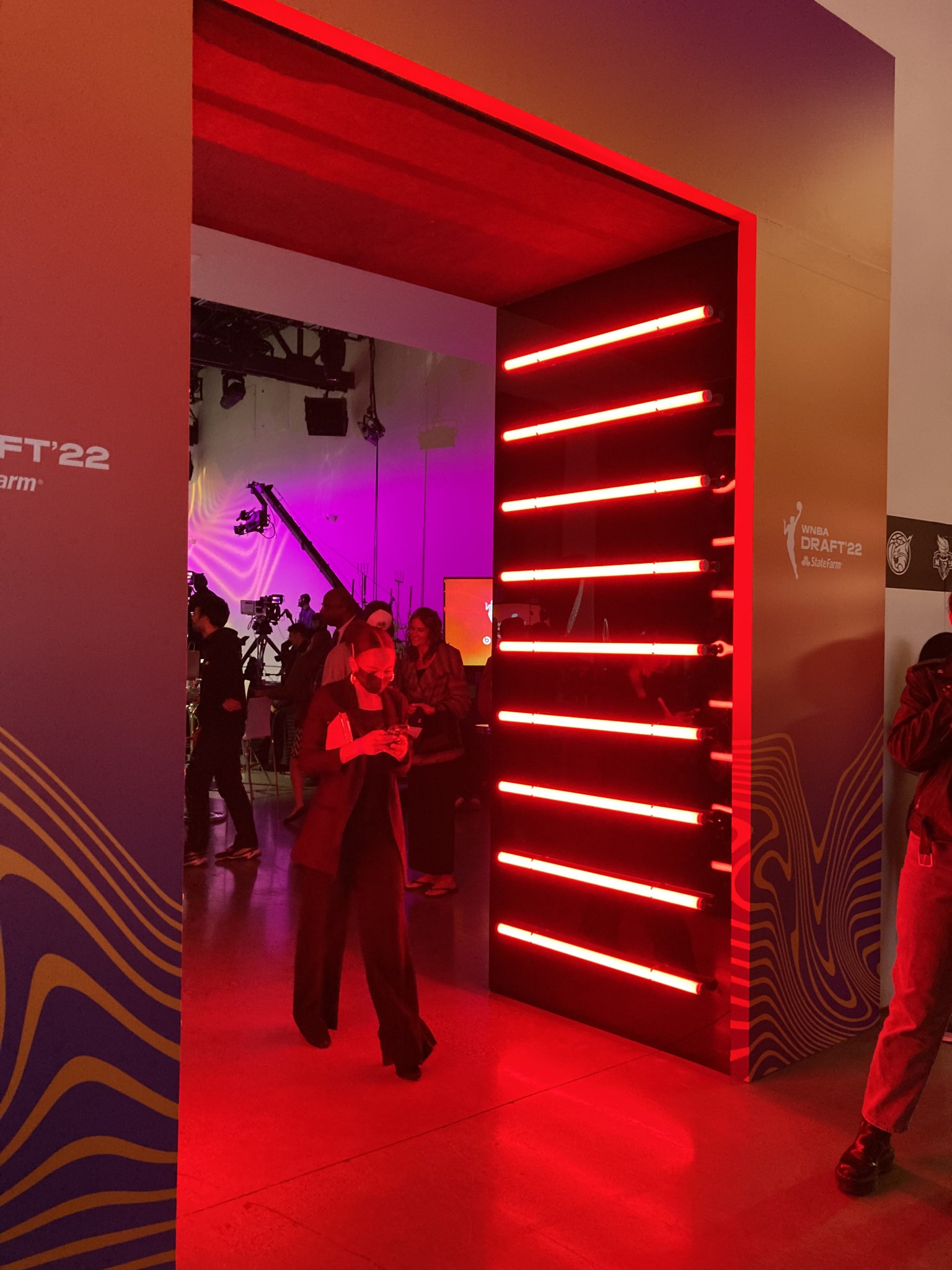
The 2022 WNBA Draft took place on Monday, April 11 at 7 p.m. in New York City at Spring Street Studios. The intimate venue was decked out to the nines, with enough LED lighting for a decently-sized night club and WNBA signage plastered from floor to ceiling. The space was split into two rooms, separated by a short tunnel of red lights.
One room was dedicated to the draft stage, which was flooded in orange, purple, and pink lights. Enormous TV screens dotted the room, each displaying a list of draft positions and the team that owned each one. A smaller elevated stage for TV personnel sat in the middle of the room, lit up by a massive spotlight.
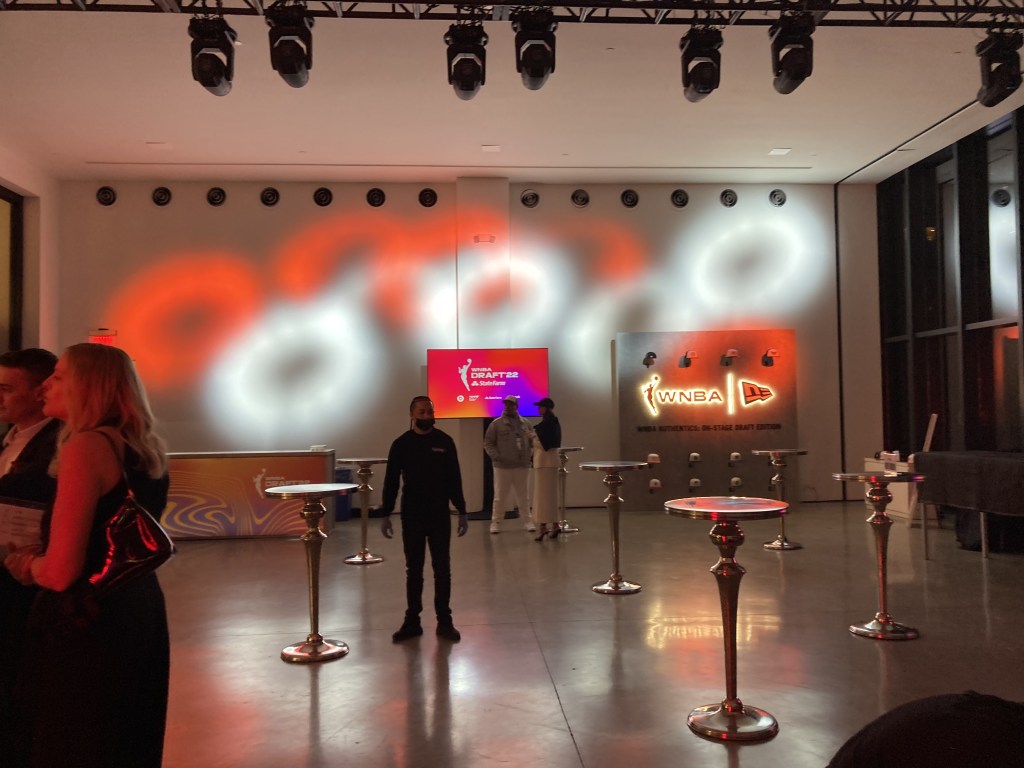
The second room was filled with metal tables at the perfect height for casual socialization, as well an arcade basketball hoop and a couple of stations for guests to take photos. As players, WNBA representatives, and media alike came together in one place, conversations, excitement, and anticipation of the 2022 Draft class kicked into full gear.
Ahead of the Draft itself, Commissioner Cathy Engelbert addressed the media at her first in-person Draft press conference. Engelbert was quick to address the current state of Phoenix Mercury Star Brittney Griner: her health and well-being, as well as the WNBA’s role in the effort to bring her home. Griner is currently detained in Russia awaiting trial after a drug charge was taken against her in mid-February.
“We’re trying everything we can,” Englebert said. “[We are] working with her legal representation, her agent, elected leaders, … everybody in our ecosystem to try and find ways to get her home safely and as quickly as we can.”
The commissioner also announced a league-wide philanthropic project, which will be spearheaded by the Phoenix Mercury. It is inspired by Griner’s own efforts in the Phoenix area, which have centered around providing resources and support for homeless people in the Valley, well as advocacy for the LGBTQ+ community.
The commissioner also addressed the current state of the league, and the many projects the league plans to tackle in the coming years. At the top of priority list: league-wide stability and longevity, generating and maintaining momentum, and demonstrating that the WNBA and all of its franchises can produce successful products.
Engelbert sounded cautious when asked about major league changes and expansions, including projects to increase player pay, the number of available roster spots, and the number of host cities. The commissioner repeatedly emphasized the importance of changing the league’s economic model before tackling either bringing the league into new cities or shifting player salaries. “If we’re in a different economic model in a couple of years because I get my way … we will absolutely take a look,” Engelbert said. “I think everything will be on the table in a couple of years, in fact, I expect that.”
The league also looks to establish a more consistent and long-term digital media strategy: “Especially as we draw in younger fans, digital native fans, Gen Z fans, they want that [digital] experience there too,” Engelbert said. The commissioner also described how part of the recent capital raise will go to hiring the necessary technical staff to improve the league’s digital products and the overall fan experience. “Disrupting the valuation model for women’s sports, as you know, has been a big focus of mine,” she said. “We’re looking at how to change every fan touch point.”
With Engelbert’s speech as a backdrop, the Draft itself finally came into full view. Regardless of where the league is now or where it will be in the future, the 2022 Draft will be one of the most important evenings in the careers of many of the players eagerly anticipating their names to be called. As the attention shifted in the room to the main stage, however, it became clear that the 2022 Draft was not just for celebrating the new crop of prospective WNBA players.
The Atlanta Dream wasted little time to get into the action, as they quickly used their first pick to select Kentucky guard Rhyne Howard. As Howard’s name was called, the front room exploded into cheers, as lights flashed and a highlight reel of Howard’s time at Kentucky took over the many screens in the room.
As the newly crowned No. 1 pick made her way to the stage, however, it was hard to ignore the second room, which despite having the privilege of witnessing a new draft class begin to take shape, seemed to be missing in action. The same pattern continued through the first round: as the Fever picked up Baylor’s NaLyssa Smith, and the Mystics snagged Mississippi’s Shakira Austin, the crowd’s attention, whether intentionally or not, was divided.
The gravity of the Dream’s No. 1 selection couldn’t have been more clear to Howard, however. “I don’t even have words for right now,” she explained in the media room. “I’m still kind of shaking, but it’s super exciting … and I’m thankful for everyone that’s been on this journey with me.”
As the draft powered forward, front offices clamored to get their top picks from the 2022 pool. The first surprise of the night, for the room at least, came at the fourth pick, when the Fever selected Louisville’s Emily Engstler. This time, a small chorus of gasps accompanied the clapping and cheering from the live audience. A pair of attendees towards the back of the room chest bumped in celebration, their excitement fueling more cheers in that corner of Spring Studios.
Following her selection, Engstler spoke about how much her year with Louisville meant to her and her career in the sport. “It probably was the reason my draft stock went all the way to number four,” Engstler reflected. “Going there has taught me so much on and off the court and I’m going to bring that with me into the league.”
Nyara Sabally’s selection by the New York Liberty was particularly emotional; Sabally made several stops through the crowd, as she embraced friends and fellow teammates, including fellow Oregon player Sedona Prince, that had come to support the new No. 5 pick.
The audible gasps made their return in full force for the Fever’s picks at No. 6, Stanford’s Lexie Hull, and No. 10, Baylor’s Queen Egbo, as well as for the Aces’ No. 8 pick of Colorado’s Mya Hollingshed. All three were not among the twelve prospects invited to the in-person draft.
As the Sun’s No. 12 pick in Nia Clouden made her way down the stage, signaling the completion of the first round of the draft, the tone in the room changed quickly and dramatically. With few remaining in the group of twelve invited prospects, the league opted not to announce the names of second and third round draft picks to the Spring Studios crowd if the athlete was not present in person.
All of sudden, there were very few, if any, cheers coming from the audience in attendance. The Aces picked LSU’s Khayla Pointer with little fanfare, while UConn’s Christyn Williams went to the Mystics with hardly a peep from the once enthusiastic crowd. It wasn’t until the Dream selected Naz Hillmon, who was present on the draft floor, that the music faded and attention once again shifted to Commissioner Engelbert as she announced the Dream’s No. 15 pick.
This would continue for the rest of the second and third rounds. Even as Jackson State’s Ameshya Williams-Holliday made history as the first player from an HBCU to be drafted to a WNBA team in 20 years, her selection came and went as unceremoniously as the rest of the picks in the third round. Macee Williams became the first ever player from IUPUI to be drafted, as she went at No. 32 to the Mercury, while Jasmine Dickey’s No. 30 selection by the Wings became the first Delaware draft pick since Elena Delle Donne in 2013. Even the final draft pick of the night, No. 36 Kiara Smith to the Connecticut Sun, was completed without notice from most of the crowd, many of whom had left the venue after the conclusion of the second round.
The lack of parity in the experiences of invited and uninvited players could not have been more obvious, but it wasn’t all that surprising either. Engelbert’s comments ahead of the draft demonstrated the league’s success-focused mindset, and its heavy focus on players at the top of the league. From focusing on expanding to new cities over expanding roster sizes, to relying on bonuses and in-league internships to boost player pay, to inviting just 12 players out of 108 who declared for the 36-person draft, the league has chosen highlighting individual success over providing equitable experiences for all of its players.
In a league that is just 25 years old, having missed in-person drafts since 2019 due to the COVID-19 pandemic, under new leadership and with expectations for excellence at an all-time high, there were bound to be difficulties and problems with this year’s draft. Yet, when almost half of each draft class won’t make it past their first season in the league, the value of the WNBA Draft in a young player’s career cannot be overstated. Without a companion league like the NBA’s G-League, the 12-person size of a WNBA roster will make it difficult for even those who are selected in the draft to make it to tip-off.
Leaving Spring Studios for the final time that night, the stage which once appeared like a beacon of hope and potential for the nation’s newest group of young professional women’s basketball players now took on a much more melancholy tone. Ultimately, the league must decide how they want to treat and market not just the WNBA draft, but player recruitment altogether.
Monday night’s spotlight was on plenty of the league’s up-and-coming stars. But for those whose moment might have been Monday night alone, the moment, and the opportunity that comes with it, faded before the draft had even ended.