

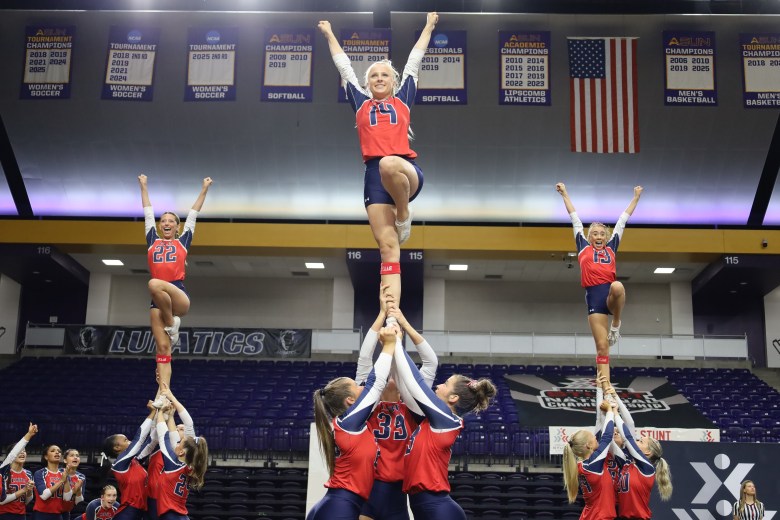
One of the most controversial moments in the history of college sports is set to arrive in about a year. It won’t look all that different from what unfolded Sunday in Nashville, but the implications will be far-reaching: a form of college cheerleading will officially become an NCAA-sanctioned sport.
For years, the intersection of cheerleading and varsity athletics has existed in a kind of liminal space. Originally designed to support men’s teams from the sidelines, cheerleading evolved into a highly skilled, and often dangerous, competitive discipline in its own right. Still, legal battles and long-standing Title IX concerns kept it from gaining full recognition as a varsity sport.
That changed this year, when all three NCAA divisions voted on making STUNT a varsity sport.
STUNT is among the fastest-growing women’s sports in the country in terms of participation, if not yet audience. It was initially framed as a response to strict Title IX requirements, a way to formalize a version of cheerleading within collegiate athletics. Organizers describe it as cheerleading stripped of its crowd-leading elements, focusing purely on competition.
“Breaking into more and more conferences will be really important. SEC or BIG XII would be incredibly cool to see,” said Purdue head coach Marshall Smith. “And with the SEC already having Kentucky and a few club teams, I think we may see that soon.”
At the collegiate level, STUNT is currently governed by USA Cheer, which hosted the national championships this season. Control will shift to the NCAA next season for a 2027 championship, marking the first time the organization has sanctioned a form of cheerleading.
“It was very clear from the very beginning under Title IX guidelines that cheerleading would not count as a sport because, I think they probably rightly figured out that it would actually work to the detriment of the expansion of other types of women’s sports, equestrian, even soccer at that time,” said Alabama professor and author of Cheerleader!: An American Icon Natalie Adams. “It’s been tried several times.”
Clearly, the sport’s rapid rise has not been without controversy.
UC Davis shuttered its successful Division I equestrian program, now fighting for reinstatement, while promoting STUNT to varsity status. Although equestrian typically carries smaller roster sizes, the university said it cost about $1.5 million annually to operate.
USA Cheer lists an NCAA STUNT budget projection around $40,000 to over $100,000 annually per school, not counting scholarships. Missouri State, one of the few Division I teams with a publicly available budget for its STUNT team, for example, has a proposed internal budget for 2026 that included approximately $40,793 in operating expenses and $40,000 salary for the head coach.
A similar situation played out at Cal Poly, which cut its swimming program in 2025 as STUNT was elevated to Division I.
“The next major growth point for STUNT is continued expansion at the Division III level and increased national visibility as the NCAA takes over the championships next year,” said Centenary College head coach Kaylee King. “With only 15 Division III varsity programs currently competing, there is a tremendous opportunity for more institutions to recognize STUNT as a valuable avenue for female athletic participation, roster growth, and competitive opportunities.”
“Becoming Caitlin Clark” is out now!
Howard Megdal’s newest book is here! “Becoming Caitlin Clark: The Unknown Origin Story of a Modern Basketball Superstar” captures both the historic nature of Clark’s rise and the critical context over the previous century that helped make it possible, including interviews with Clark, Lisa Bluder (who also wrote the foreword), C. Vivian Stringer, Jan Jensen, Molly Kazmer and many others.
To comply with Title IX, schools must provide participation opportunities proportional to enrollment across genders. But defining what qualifies as a sport has long been contentious, and cheerleading has always been central to that debate.
Competitive cheer evolved significantly beginning in the 1990s, and STUNT emerged as a direct effort to meet collegiate sport criteria. Opinions have long been divided on whether Title IX recognition would ultimately benefit the discipline.
In 1975, the Department of Education’s Office for Civil Rights classified cheerleading as an extracurricular activity, excluding it from Title IX participation counts to prevent schools from sidelining other women’s sports.
“The NCAA got the bright idea that, aha, we all have cheerleaders and pep squads, these things are mostly women,” said sports economist and Stanford professor Roger Noll. “Let’s call them a sport. Let’s have an NCAA championship in cheerleading and an NCAA championship in the kind of acrobatic gymnastics that people do at sporting events who are members of pep clubs and cheerleading squads. Let’s call that a sport, and have a national championship in it, and that way all these women that were actually now putting on the pep squads and the cheerleading teams and even giving scholarships for people to be on pep squads and cheerleading teams, all that will count towards the Title IX obligation.”
He continued: “It got laughed out of the court.”
But cheerleading in 1975 and even the 1990s was drastically different. By the early 2000s, competitive cheer was its own industry with difficulty levels matching gymnastics and other aesthetic competitive sports. Many coaches and athletes wanted equal funding and more competition opportunities that might only come with being a recognized varsity sport.
But in 2010, a federal judge ruled that cheerleading does not “count” as a sport under Title IX.
The argument for cheerleading being a competitive sport comes from those seeking stricter limits to hours of training and injury reporting like NCAA sports have. But the legitimate concerns about Title IX allowing schools to count huge STUNT rosters and call it a day in the revenue-sharing era is also a problem.
There are currently 40 collegiate STUNT teams, meeting NCAA requirements to be an emerging women’s sport.
Schools have often used rowing to pad the participation numbers, and that sport now has a roster limit of 68. But the NCAA House settlement allowed STUNT to go from 14 roster spots to 65. If a school were to pad its STUNT roster with 65 athletes, it could eliminate smaller, more expensive to operate women’s sports teams and stay compliant.
Enter the Cal schools. Though, requests to speak with the coaches at California Baptist and Cal Poly went unanswered.
Kentucky has the largest STUNT roster in the country with 61 athletes and just took down defending champions California Baptist (28 athletes) for the Division I title. The Wildcats’ traditional cheerleading team is a powerhouse, but cheerleading has always been considered a club sport.
Kentucky’s STUNT program launched in 2022 while the school was dealing with a Title IX lawsuit filed in 2019 by two former student athletes who said the school did not offer proportional athletic opportunities for female athletes.
The court found insufficient proof that enough female students wanted to compete in more Division I sports in that suit.
STUNT’s high school participation has boomed to 500,000 across the country. It could be one of the more popular women’s sports in a decade, on the rise alongside women’s flag football.
The Title IX implications are still a lot to get figured out with roster sizes and scholarship and revenue. For those in the sport, it’s a chance for cheerleaders to finally get treated with the legitimacy that other athletes do. There just has to be a balance, so that other sports aren’t caught in the crosshairs.
“As the sport continues to grow,” King said, “More people are beginning to recognize that STUNT provides a legitimate and competitive collegiate experience for student-athletes.”
‘Rare Gems’ is out now!
Howard Megdal, founder and editor of The IX Basketball and The IX Sports, wrote this deeply reported book. “Rare Gems” follows four connected generations of women’s basketball pioneers, from Elvera “Peps” Neuman to Cheryl Reeve and from Lindsay Whalen to Sylvia Fowles and Paige Bueckers.
If you enjoy Megdal’s coverage of women’s basketball every Wednesday at The IX Sports, you will love “Rare Gems: How Four Generations of Women Paved the Way for the WNBA.”

UK has never beaten CBU. CBU was the D1 National Champion in 2026. The “take down” line is not accurate.
Report on the 12 team NCAA 2027 tournament next! Committee should have finalized this week for April 30-May 2, 2027.