Welcome to The Next: A basketball newsroom brought to you by The IX. 24/7/365 women’s basketball coverage, written, edited and photographed by our young, diverse staff, dedicated to breaking news, analysis, historical deep dives and projections about the game we love.
Subscribe to make sure this vital work, creating a pipeline of young, diverse media professionals to write, edit and photograph the great game, continues and grows. Subscriptions include some exclusive content, but the reason for subscriptions is a simple one: making sure our writers and editors creating 24/7/365 women’s basketball coverage get paid to do it.
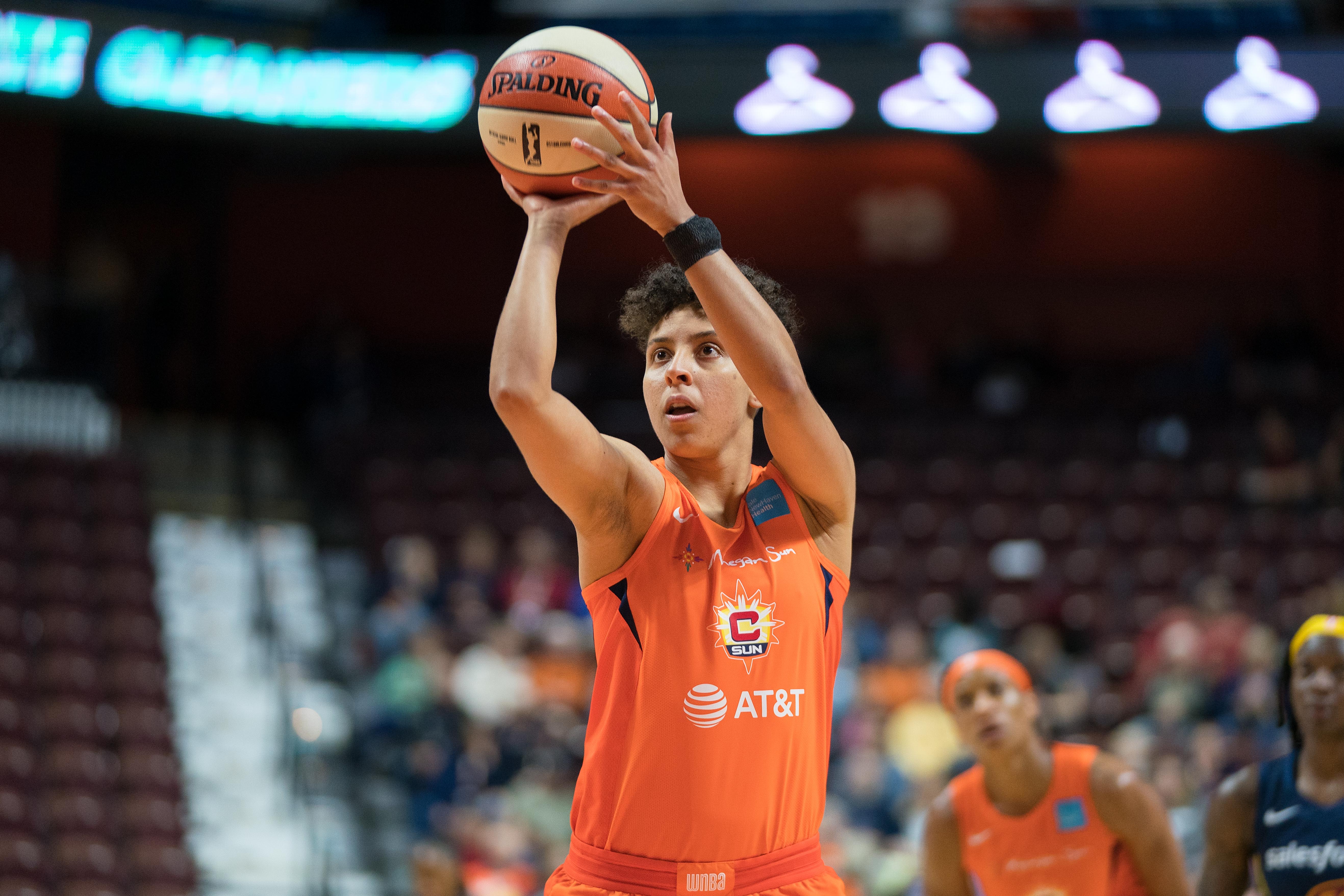
Layshia Clarendon of the Connecticut Sun shoots a free throw against the Indiana Fever on May 28, 2019 (Credit: Chris Poss).
On Wednesday, a slew of professional and college athletes — including the WNBA’s Sue Bird and Layshia Clarendon — co-signed letters to the NCAA asking the organization to “Move all NCAA championship events in 2021 out of Idaho.”
The athletes’ decision comes after Idaho Gov. Brad Little signed HB500, an anti-transgender bill, into law in late March — on the eve of International Transgender Day of Visibility. Boise State is currently set to host some first and second-round games of the 2021 NCAA men’s basketball tournament next March.
Idaho’s HB500, also known as the Fairness in Women’s Sports Act, prevents transgender girls from participating in sports consistent with their gender identity. The law states that “Athletic teams or sports designated for females, women, or girls shall not be open to students of the male sex.” Additionally, it allows for the return of gender verification, which is the process of checking peoples’ genitals to confirm their biological sex.
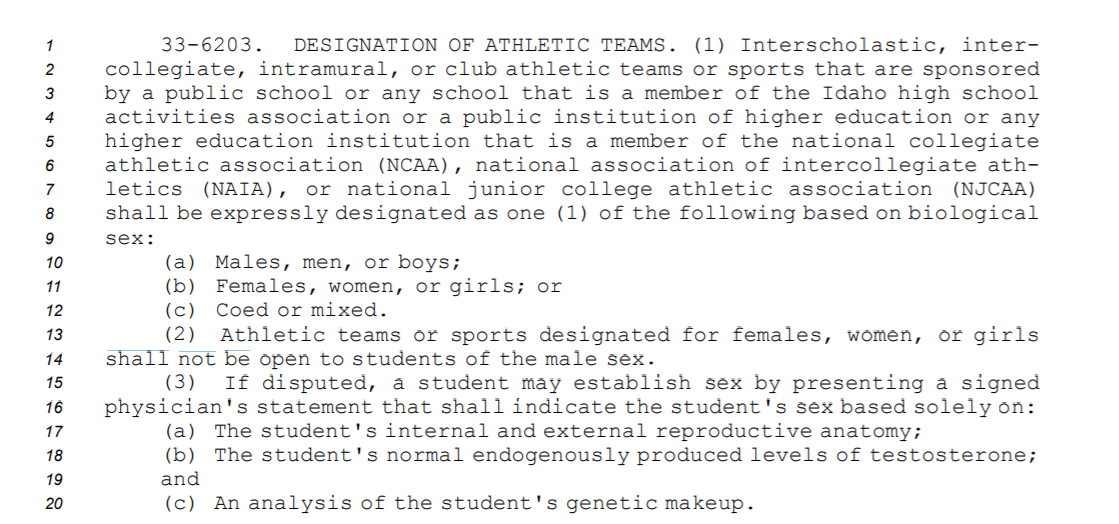
A screenshot from Idaho’s HB500 Bill, which was passed into law on March 31, 2020.
In letters addressed to the NCAA Bids Selection Committee, nearly 50 former and current professional athletes joined more than 400 student-athletes in urging the NCAA, which governs college athletics, to stand on the “right side of history.”
“As the unifying governing body of college athletics, the NCAA has tremendous power in setting the standard for how values of diversity and inclusion can be reflected in policies and practices, and inspiring athletes, teams, schools and other institutions to do the same,” read the student-athletes letter. “This is the time for the NCAA to stand with us on the right side of history, in support of the rights of all athletes in Idaho to compete in the sports they love.”
Bird and Clarendon — who are both members of the LGBTQ+ community — were joined in signing their letter by tennis legend Billie Jean King, U.S. soccer star Megan Rapinoe and Knicks guard Reggie Bullock among others.
The student-athletes’ letter, sent by over 400 college athletes, also included signatures from several women’s basketball players along with two Boise State student-athletes: Maria Lopez of the tennis team and track and cross country runner Malia Pivec.
Many advocacy groups and organizations have also criticized HB500. As the National Center of Transgender Equality wrote to Gov. Little in March:
“Despite the bill’s stated intent– to protect and promote girls’ sports—this bill would compromise access to sports for many vulnerable youths while doing nothing to support young athletes or to address real threats to girls’ sports. This bill blatantly targets an already-marginalized community in athletics and decreases their participation in sports. Transgender youth already participate at significantly lower rates and already feel unsafe in athletic spaces.”
Now, athletes are asking the NCAA to stand up for LGBTQ+ rights as it once did in 2016. In 2016, the NCAA moved seven championship events, including that year’s Division I men’s basketball tournament and the Division I women’s soccer championship, out of North Carolina in response to the state’s passage of HB-2, which banned people from using public bathrooms that don’t correspond to the biological sex listed on their birth certificates.
The NCAA “reluctantly” began rescheduling events in North Carolina shortly after the law was repealed in March 2017.
“With HB500 remaining law in Idaho, it is impossible for the NCAA to host events that are inclusive and safe for all athletes,” read the letter from student-athletes. “Failure to move these events out of Idaho contradicts the NCAA’s core values, your own policies, and guidance, and implicitly endorses Idaho’s discriminatory law.”