Welcome back to Sunday Notes, your weekly journey into trends and analysis around the WNBA. Today we’re looking at: how Rhyne Howard is blossoming, why Jordin Canada should be the frontrunner for Most Improved Player, why Sabrina Ionescu is the heel we need and the heel we deserve and Michaela Onyenwere being good. For reference, since this notebook comes out on Sundays, I define “this week” as the prior Sunday through last night.
Atlanta Dream
It doesn’t take much to see that Rhyne Howard is making a leap. Her scoring average is up two points, her shooting numbers from both 2- and 3-point range are up about 50-60 percentage points and she’s getting to the line a lot more. Altogether, that’s raised her scoring efficiency from bottom-20 in the WNBA to top-40 — an increase of 50 percentiles, per Her Hoop Stats.
Given her collegiate prowess as a two-level scoring threat and consistently good free-throw attempt rates at Kentucky, it was always safe to assume that Howard wasn’t going to be one of the worst scorers in the league. So it’s no surprise that her shooting numbers across the board have rebounded back to where they were as a Wildcat, especially her catch-and-shoot 3-pointers and her midrange pull-up game.
But the scoring question with Howard wasn’t whether she’d be an accurate shooter or a good second-side threat — it was how much of a primary shot-creator and matchup nightmare she could be. That’s where her improvements this year particularly shine, because it’s not just that more shots are going in but which shots are going in. Looking at her catch-and-shoot game from deep, she’s not just a shooter that teams have to account for off the ball, but someone who defenses now need length and hedges or blitzes to counter: per Synergy, only Jewell Loyd is taking more contested 3-pointers and hitting them at a higher rate than Rhyne Howard.
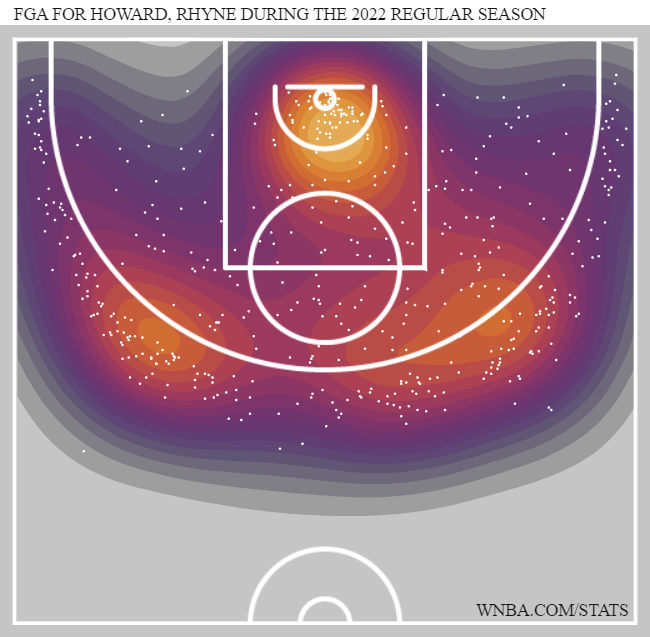
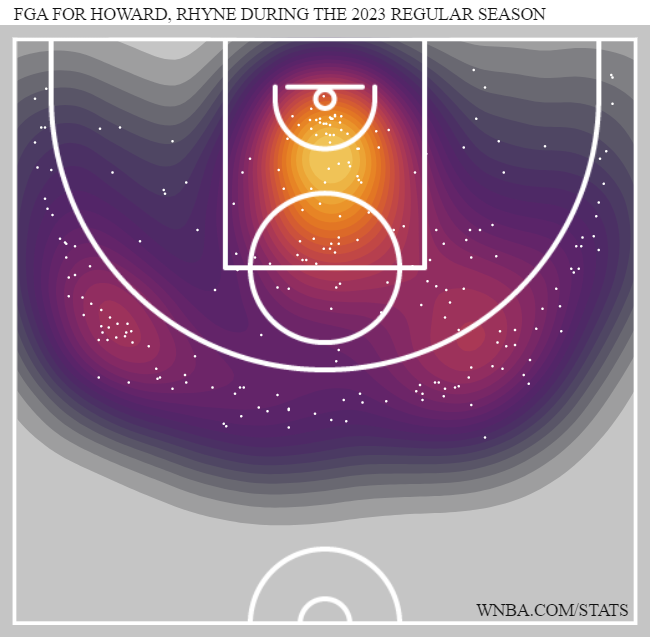
As much as Howard’s 3-point shooting has improved, it’s her midrange game that has taken the biggest leap forward. In her three years at Kentucky, Howard shot 39.1% on non-paint 2-pointers, per CBB Analytics, good but not incredibly efficient. She shot only 30.6% from there in her 2022 rookie year, but is up to 47.7% from the midrange this year, good for 10th-best in the league, per WNBA Advanced Stats. And that’s not just because the shots are falling. Howard has gotten much more comfortable at picking which mismatches to attack, from tormenting Sabrina Ionescu and Lexie Hull in the Dream’s multiple matchups with the New York Liberty and Indiana Fever to finding openings against Jackie Young, Betnijah Laney and the Mystics’ lockdown guard trio (Ariel Atkins, Natasha Cloud and Brittney Sykes).
It’s not just that Howard is draining more middys, because the middys she is taking are better shots than the ones she took last year. As Howard has become more comfortable in the WNBA, she has been trading in long 2-pointers for free-throw-line jumpers, forcing defenders to play on her terms instead of letting them dictate to her. And she is making that adjustment while still running an extremely high 3-point attempt rate for a wing creator.
It often takes prospects as many as three years to adjust to a professional level of competition, but Howard appears to be rounding into form midway through her sophomore season. Though her defensive impact has been smaller this year as compared to last, that has mostly been due to Nia Coffey’s resurgence kicking Howard up to a less defensively impactful position. But the list of qualified WNBA threes who’ve been as disruptive as Howard includes just Atkins and Sykes (depending on the assignment), Rebecca Allen and Young.
As she now rounds into star form, Howard is looking more and more like the lethal two-way perimeter mismatch that she did coming out of college. The perfect wing as the WNBA enters its Spaced Out Era.
Los Angeles Sparks
It has not been a banner year for the Most Improved Player award. The top candidates at this point probably include: Ezi Magbegor, who’s increased her usage a bit but is otherwise mostly the same player she was last year; Satou Sabally, who’s having an average season by her own standards besides being healthy enough to play starter-level minutes; and Alanna Smith, who started the season hot but has gone extremely cold as of late. But there’s one name I think stands out, and that’s Jordin Canada.
Canada is having a career year, and not just because of a minutes increase: while her usage is right at her career average, her scoring efficiency in 2023 is the highest mark she’s had since at least before college — in fact, this is the first time she’s even approached her UCLA-career 50.6% true-shooting mark at the WNBA level, per Pivot Analysis. How does a notoriously scoring-challenged player suddenly become top-50 in efficiency? See if you can spot some of the differences:
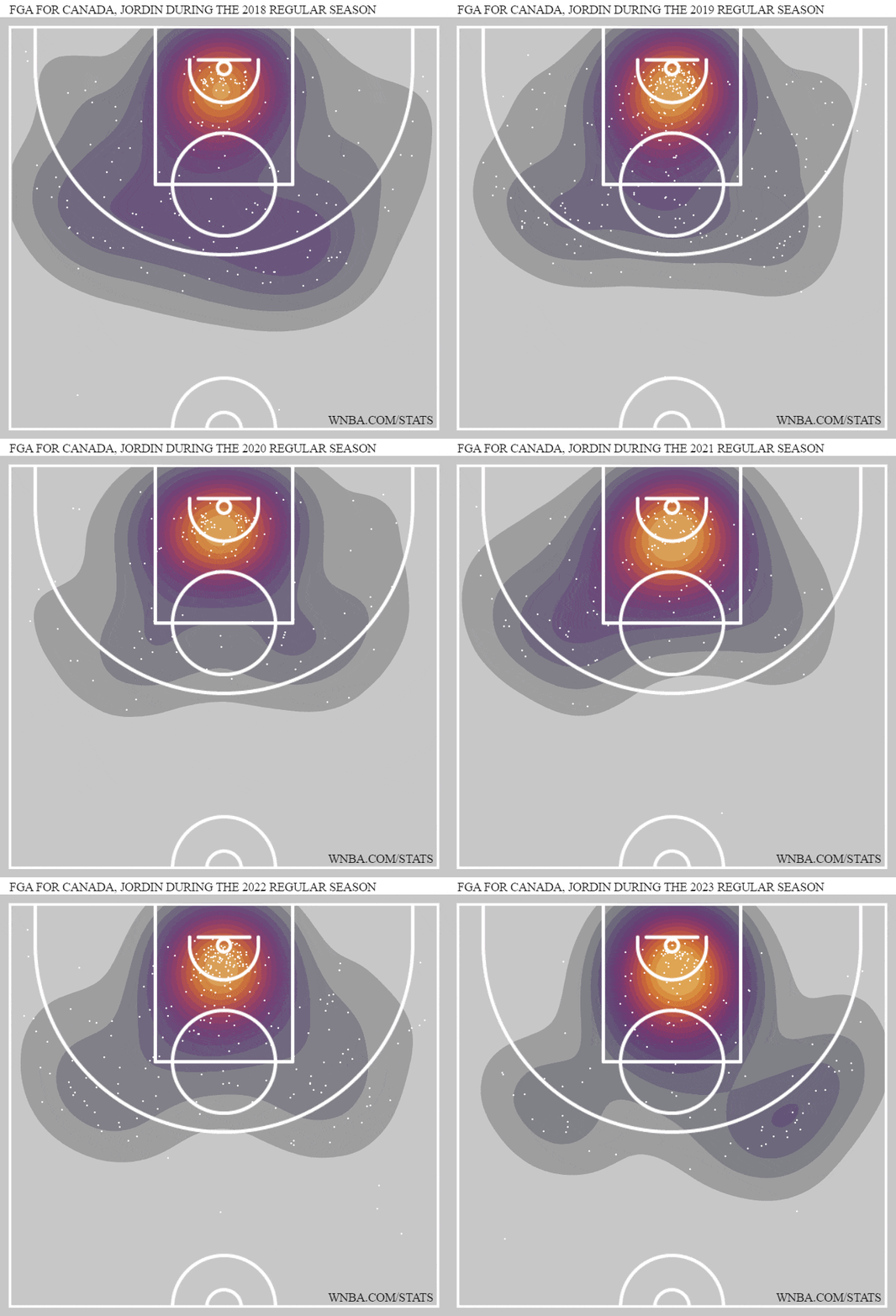
Canada’s 2023 improvements have come across the board. For starters, she’s hitting a career-high 93.5% from the line, which has meant that her consistently great ability to draw fouls is even more effective than it used to be. She is taking a career-high number of her shots within 10 feet of the basket, after concerns during her Seattle tenure about her then-decreasing rim rate. She’s hitting well above her career averages on non-paint 2-pointers, while having cut down on those least-efficient-shots-in-basketball. But most eye-popping of all, Canada is suddenly a willing and able 3-point shooter. Back in 2021, near the end of her time with the Storm, I wrote the following:
For about two-and-a-half years, Jordin Canada’s three-pointer had disappeared.
It’s not like Canada’s long-range shooting was expected to be poor coming out of college; her career mark of 33.2% at UCLA was far from special, but her accuracy improved every year. And she was coming off a senior season in which she shot 38.6% on 3.8 attempts per game. … But after she shot 22.4% on 22.6% 3-point frequency across that first year-and-a-half in the W, she discarded it. … From [the middle of her second year in Seattle] on, Canada’s 3-point rate has been 8.1% — around the 20th percentile.
Canada told The Next at the time that “the talent level is so high in the league, and I think as you come into this league, it was a hard adjustment defensively and offensively.” It seems like that adjustment period is finally over. After shooting just 16.8% on her first 173 WNBA 3-pointers, Canada’s hitting one-third of her shots from deep this year, on a 3-point attempt rate over 50% higher than her previous career average. It is absolutely wild.
She has parlayed these scoring gains into better playmaking, too. Despite the rash of injuries to the Sparks this year, Canada has been able to use her newfound on-ball prowess to actively create better looks for her teammates than ever before. She had always possessed impressive raw passing ability, but only this year has much of that ability turned into value-added playmaking.
To put all this another way: Canada has gone from an unplayably bad scorer who flashed plus playmaking to being someone whose only peers in terms of both overall offensive efficiency and volume are Alyssa Thomas, Courtney Vandersloot and Cloud. All while continuing to be a truly elite guard defender.
New York Liberty
I’m not sure how familiar you are with wrestling — and I really mean “rasslin’”, not the NCAA kind — but I hope you know what a “heel” is. If not, read this. It’s important to know because the most significant cultural development across the WNBA this season has arguably been Ionescu emerging as an excellent heel.
Like all entertainment industries, the WNBA needs heels. Heels are how you rally opponents, how you inspire passion among fans and most importantly how you sell the hell out of your sport. They are the height of entertainment, but crucially, they bring something of value to the field; you can’t make a good heel out of a bad wrestler. And it’s harder in non-rasslin’ arenas (no pun intended) to make a good heel out of someone who’s genuinely a loathsome individual, as opposed to someone who’s simply an antagonist only on the court.
For most of this era, the only truly notable heel in the WNBA has been Diana Taurasi. (Liz Cambage doesn’t count because, well, it wasn’t really an act.) The most ferocious rim protector in WNBA history was nicknamed “Sweet Syl.” Sue Bird at times seemed to want to play that heel role, but legacy media had already saddled her with the “girl next door” label before she finished her first contract.
We’ve come a long way over the past couple of decades, and in the twilight of Taurasi’s career, we especially need a new heel. And Ionescu’s resume is tailor-made for that role — one of the greatest college careers ever led to an elite prospect being a bit overhyped as a generational one, which put a target on her back from Day One. She has also been one of the game’s more prolific trash-talkers since college, and clearly relishes going head-to-head with other star guards and wings. Just this past Friday, she was revealed as the cover athlete on NBA 2K24’s “WNBA Edition,” despite perhaps not being the most deserving star in today’s game.
Ionescu gracing the cover of the next 2K is seemingly in part because of her connection to the late Kobe Bryant, who is the cover on the standard game. If the connection to Bryant was the most important factor, thus ruling out the WNBA’s reigning MVP, then there exists someone whose game looks an awful lot like Bryant’s, is nicknamed the “Gold Mamba,” is currently leading the WNBA in scoring and notably is actually the best player on their own team.
This is the key to being a great heel: you have to want it. Should Ionescu have turned down the honor from 2K just because of the optics, just because A’ja Wilson and Jewell Loyd haven’t been on a cover yet? Absolutely not. But she had to know how the WNBA community would react (e.g. tweets from Howard and Sydney Colson) and more importantly, be able to embrace that.
If there was any doubt left about whether Ionescu took offense to being a heel, Saturday afternoon should have put those thoughts to bed. Ionescu sunk two big 3-pointers within the first three minutes she played since the 2K announcement, was called for a technical foul in the second quarter after barking at the refs for not calling a foul on a missed jumper of hers and shot 3-of-3 from deep in the final frame to put away a furious Storm comeback attempt. A day after getting hate from parts of the WNBA, Ionescu dropped an efficient 20 points and eight assists against just one turnover.
And lest you forget, the same day it was revealed that fans and media each gave Ionescu the sixth-most All-Star votes among guards, and her fellow players only ranked her 19th, she put up 31 points, six assists, three rebounds and three steals on the league’s best defense. It takes a truly special talent to succeed as a heel. We should recognize and celebrate that.
Phoenix Mercury
Remember when I said Jordin Canada was the biggest breakout of this season? Well if I had to pick a No. 2 for midseason MIP, that’d pretty solidly be Michaela Onyenwere.
A Rookie of the Year being a Most Improved Player candidate two years later is a bit of an odd call, but that award is extremely misleading. Onyenwere was a rookie in 2021, the worst WNBA draft class in the Modern Era (since 2016), and won thanks to a small hot streak to start her career. She shot 44% both inside and outside the arc over her first month as a pro, then just 38.0% overall and 27.8% from deep over her final 25 games. Per Sports Reference, just seven rookies played at least 200 minutes in 2021; despite playing more than twice as much as most of the others, Onyenwere ranked second-to-last among them in pWAR (Positive Residuals wins above replacement model).
Onyenwere’s sophomore season seemed to prove that a 25-game sample was depictive of her true talent level, as she shot 37.7% from the field and 30.0% on 3-pointers in 2022.
So what makes 2023 different? Like her rookie year, Onyenwere started this season off hot from deep, hitting half her 3-pointers through Phoenix’s first eight games, despite shooting below 40% from inside the arc. But then Brittney Griner and Taurasi both missed each of the next three games. The Mercury needed others to take their place, and Onyenwere stepped up, raising her usage rate from 15.9% to 23.6% across the nine games since — the highest rate among any such stretch of her career, per Sports Reference. Onyenwere’s 3-point shooting has regressed to her career norm, but she’s developed into a player highly capable of exploiting mismatches and taking advantage of tilted defenses, leading to a 57.1% mark from 2-point range. She’s averaging 13.6 points, 4.6 rebounds, 1.1 steals and 0.9 blocks over the past nine games on some of the best scoring efficiency of her career.