On April 21, 2026, a thin veil of hazy clouds made their way through downtown Columbus, Ohio. What was at first a normal Tuesday morning became a historic moment for women’s sports fans in the city. Under the southeast corner of ScottsMiracle-Gro Field, the home of the Columbus Crew of Major League Soccer, a couple hundred onlookers awaited the announcement of the NWSL’s first Ohio-based franchise.
In that group were the usual suspects at announcements of this sort. The front office employees enjoyed a break from the indoors, the media sat in their designated row of seats, while executives and invited dignitaries stood around making small talk. Well, there was one exception to the guest list that day. Mixed in with the audience were the children of some attendees, and most of them, daughters.
One by one, speakers made their way to the lectern to read their prepared speeches about their excitement for the city, the new team’s impact in the community and referenced those same daughters as now having hometown role models through sport. After the ownership group’s on-field photo ops, all adorned with a new 2028 NWSL team scarf in Columbus Crew’s black and gold, the nearly two-year countdown to NWSL’s arrival in Ohio’s capital city began.
The addition of a top-tier professional women’s soccer team in the city was not a well-kept secret. In the 2025 State of the City address, mayor Andrew Ginther shared his goal of turning Columbus into the “nation’s capital for girls and women’s sports.” On the morning of March 4, hours before the United States women’s national soccer team suited up for the SheBelieves Cup in the same stadium, Ginther announced the IgniteHER initiative.
“IgniteHER is about lighting up our enthusiasm, our support and our investment in women’s athletics so we may cultivate a more equitable and prosperous future for our city,” Ginther shared in his address.
Almost two months later, on June 13, 2026, the weather report called for a high in the 80s across Central Ohio. At Whitehall-Yearling High School, on Columbus’ east side, a man pulled up to the gates of Mike Ferguson Field in his mid-2000s GMC SUV. It was the kind of near-summer day where a thick layer of fluffy white clouds made it feel as hot as the weather report read. The man drove up to the gate and, out of his driver’s side window, asked “what’s going on here today?” to anyone within earshot. An hour later, the Columbus Chaos kicked off their final game of tackle football in the 2026 season.
What follows is a story about community, support and friendship through sport. That and two opposing athletes who are far more than a jersey number or position. People will get hurt. Lives will be saved. Tables will be flipped.
Warm-Ups
Women’s tackle football in Columbus is not a new phenomenon. From 1974 through 1988, the Columbus Pacesetters played the first organized women’s tackle football in the city. They were part of the National Women’s Football League and one of its founding teams. In 14 seasons, Columbus won three consecutive championships from 1979 to 1981.
“We have young lady fans, young women, youth in the stands wanting to do exactly what we’re doing,” owner and coach Chelsea “CJ” Johnson told The IX Sports. “We’re able to do it because of the exposure of those women that did it courageously before us, and so it’s always a constant reminder that this isn’t new, this is not taboo, it is a continuation story of something that we should be always rolling out that red carpet for the next young lady.”
Today, in the capital city, there are two professional women’s teams playing in two different leagues. The story of those two sides are complicatedly intertwined, but here is a quick rundown. The Chaos formed in 2021, and after the 2025 season, players and leaders within the Chaos left and started the Columbus Mystic. So, that made the 2026 Columbus Chaos a practically brand new team, roster-wise.
Before that Saturday, the Chaos’ season did not go according to plan. In Division II of the Women’s Football Alliance (WFA), the Chaos had a 0-5 record. Good for last in the Central Region. The team gave up 233 points and scored 14 without ever once taking the lead against sides from Cincinnati, Baltimore, Maryland and a pair of Michigan-based teams. On the opposing sideline that night were the Lansing Legacy, the top team in the conference with a 5-0 record. When Columbus drove up to Lansing one month prior, the Legacy blanked the Chaos 42-0.
Regardless of the outcome in Whitehall that night, the season would end in four quarters away. That did not stop the speculation and hope on the sidelines. A rumor floated around about another team and a potential disqualification. The story goes that this unnamed team would soon be barred from the playoffs due to issues with fees, which meant the Chaos would make it into the playoffs. Johnson debunked the story that sounded more like wishful thinking. There was no possible way for the Chaos to add more games to their schedule. The only results on the line were bragging rights and a number one in the win column. It also gave the Chaos one more chance to move the team in the right direction.
There were around 80 people in the crowd for the final game for Columbus’ final game of the season. A lot of those were family members of the players on the field. The Chaos do what any other small business does to get traction. They work with local businesses, like the Jimmy John’s franchise in Whitehall, for sponsorships. That night, two kids had a sandwich-eating contest at halftime, with the competition equipment provided by the shop. The other way is through social media.
In previous years, a local news channel did a story about the Chaos and the Columbus Sports Commission included them in an article. Outside of that, there is a loyal group of photographers who attend games and share pictures and videos across platforms. The team itself posts irregularly on Instagram to its 1,600 followers. Without the resources to hire a full-time social media manager or marketing department, online is the best available option to get the team’s name out to the city.
The day after the game, June 14, or “614 Day” to celebrate Columbus using its area code as inspiration, the Columbus Crew and NWSL Columbus posted to their roughly 282,000 Instagram followers, “Happy 614 Day.” It included a graphic that featured multiple sports teams in the area. The Crew, NWSL Columbus, Columbus Aviators men’s football team, Columbus Blue Jackets of the NHL, minor league baseball team the Columbus Clippers, Ohio State University and two other women’s teams in the Columbus Fury and Columbus Eagles. The final two play volleyball and soccer, respectively.
“Any type of joined efforts we can do as teams together in the city of Columbus, I think, would raise every boat that’s floating in this water,” said Johnson.
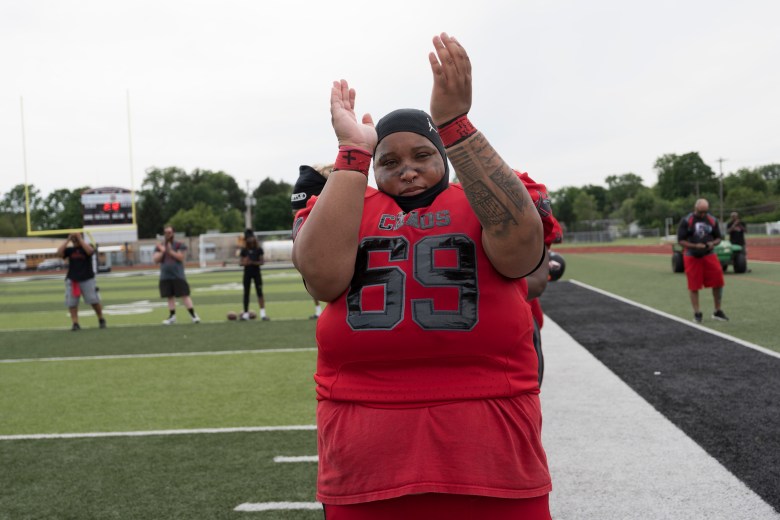
On the west end of the stadium on that late spring night, Chaos players were arm’s length apart from each other. They stood in neat and uniform lines. Defensive lineman Connor McClemore, No. 69, is easily distracted. It is the lineman’s first year on the team but even so, everyone knows McLemore. When they see a friend, they run out of warm-ups to greet them with a hug. This happened a few times that night.
When the Chaos huddle up for their pregame team talk, McLemore directs people where to go with positivity and an air of authority. While the rookie is not an official team captain, it never looks or feels that way. Their leadership by example comes as no surprise.
Connor
Labels make people feel comfortable about another person. When someone introduces themselves, what they do for a living is usually not too far behind. The usual strategies for getting to know somebody do not work for Connor McLemore. Sure, they are a football player. They are also the president of a semi-professional men’s football team in Northeast Ohio, The Falls Rapids of Cuyahoga Falls. McLemore travels from the Columbus area to around Akron so often that once, as McLemore was drowsy trying to get back home on the interstate, a police officer pulled them over. They did not get a ticket because the police officer recognized McLemore simply from driving the route so often.
McLemore is also a photographer, videographer, editor, and rugby player. Even with all of that, it does not scratch the surface. Suffice to say, labels do not work on McLemore.
“I taught myself how to play music by ear, I was like ‘well, that seems kind of cool,’ McLemore told The IX Sports. “So I learned how to play the upright bass by myself, I learned how to play the cello by myself, I was playing the violin, but I was bored with violin, so I tried every other string instrument, tried all the wind instruments.”
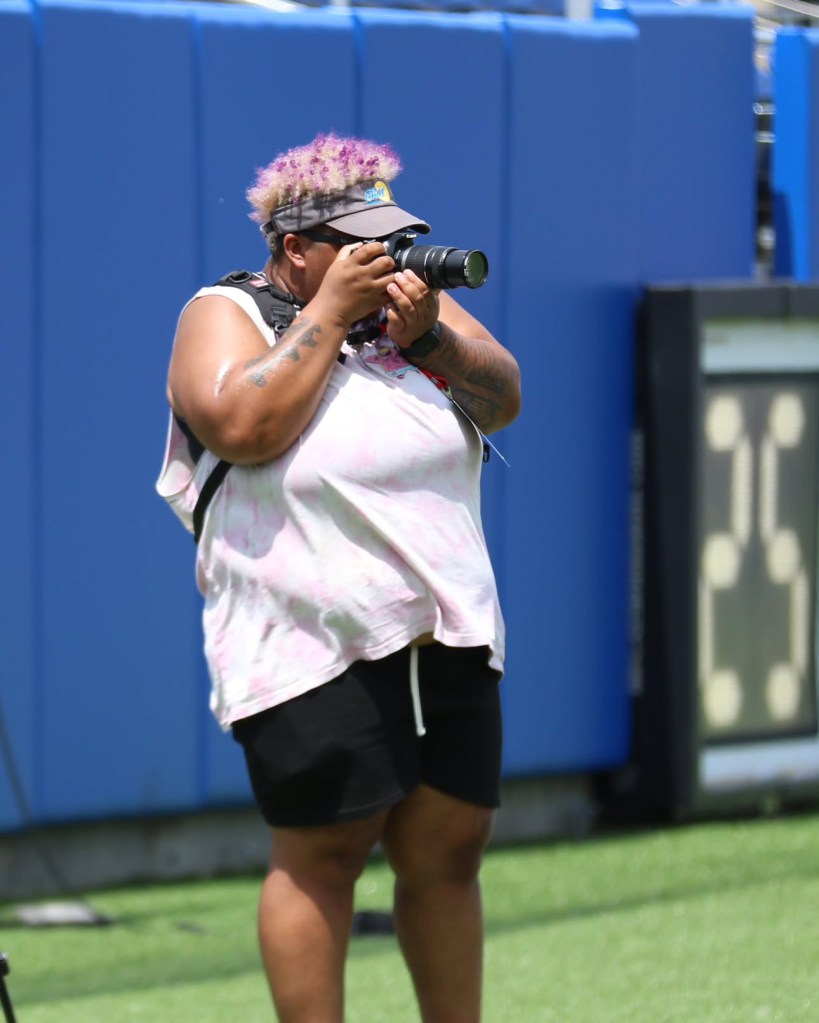
Then there is their full-time job. McLemore has been known to hop around from one job to another. That is the ADHD in full swing. If something interests McLemore, they are more than likely going to pursue it. Like the photography and videography. While working as a security guard in Cleveland at Cleveland Browns Stadium, McLemore had their camera and was snapping pictures around the stadium. That turned into the opportunity to take pictures on the sidelines at games.
Media is the goal for McLemore at the moment, but McLemore is also a licensed behavioral therapist. They love working with people and thought that making money at the same time was a good plan. McLemore’s twin sister, Cameron, has Autism Spectrum Disorder, so there was already plenty of on-the-job training in their lifetime together. It is a job that McLemore loves and they excel with anything having to do with people.
“My very first client, he was nonverbal, wasn’t potty trained, and he was six years old, and by the time I was done working with him, two years later, he was talking in full sentences, potty trained, independently dressing himself, able to ask for what he wanted to ask, tell us what was wrong, like he was able to, like communicate functionally,” said McLemore.
The patient’s turnaround amazed his mother, asking how that could happen. McLemore even had a video of their first interactions to share to see how far he came. Part of it is consistency, but another part of it is McLemore’s superpower, which really is not a superpower at all. No, McLemore does not treat anybody differently.
Cameron is a great example. In McLemore’s family, nobody treated their twin any differently. “She just looked sometimes like if you touch her she might punch you,” said McLemore. “Everybody treats it like it’s a disease. It’s a disorder, but it’s like ‘there’s something wrong,’ and there’s nothing actually wrong. Their brains just work a little different, that’s it.”
In the fall of 2025, McLemore became a teacher at a school that focuses on adults with special needs. Specifically, those 18-years old through early twenties. Teachers are assigned a specific person and work with them throughout the school year. McLemore worked with a student who had something of a history with his previous teachers. This student with Down syndrome resorted to throwing objects and told teachers that he could not write or learn like other students.
One day, he threw a Red Bull can at McLemore, an escalation of the prior days when he cleared everything off McLemore’s desk. The laptop, the paperwork, the writing utensils. All of it on the floor. It all culminated on a day when McLemore was prepared not to take any of his attitude. On that day, the student flipped their entire desk over. So, McLemore did the same thing.
“I just looked at him for a second, I was like, ‘I’m gonna match your crazy today.’ So I flipped my desk, and I didn’t say anything, I just flipped it,” said McLemore. He began to clean up his school supplies, then McLemore and the student had a chat.
“Why did you flip your desk?” asked McLemore.
“I was scared.”
“Of what?
“To do work.”
“That’s valid. You could just tell me you’re scared, frustrated, or nervous and you need a break instead of flipping the desk. I’ll acknowledge the break more than I’d acknowledge you flipping the desk, because now I’m gonna make you pick up the desk, clean up, and still do the work.”
Within the first days of class together, McLemore broke through what others had taken from him for years. McLemore talked to him like a person, not a report of past offenses and disruptions. The kind of conversations between students with special needs and the people in their life are easy to imagine. They are difficult situations that last a lifetime but sometimes it sounds like an adult talking to a toddler. Within the system, it is following a script.
“I talk to them in a normal voice. I’ve never raised my voice, I’ve never yelled at him, I’ve never done anything, I talked to him like he’s an adult, like we’re adults and having a conversation. We’re telling me what you need and I can help you, and he’s just taken to that,” said McLemore. “My lead teacher, he’s like ‘I can’t believe this is the same kid.’”
For the rest of the school year, he did the work that was expected of him every day. When he needed a break, McLemore and the student would sit in the school’s sensory room until he was ready to get back to work. Once, when McLemore went out of town for a rugby tournament and missed work for a week, they returned to their student working solely on a laptop instead of writing out his assignments.
“I said, ‘What are you doing that for?’ He’s like, ‘because I can’t write,’” said McLemore. “I said, ‘Put the laptop away. I might have been gone for a week, but no way you forgot how to write in a week, brother.’ My lead teacher was like, ‘What do you mean?’ I said, ‘Look at this notebook he works in. He’s playing with y’all.’”
Listen now to The IX Sports Podcast and Women’s Sports Daily
We are excited to announce the launch of TWO new podcasts for all the women’s sports fans out there looking for a daily dose of women’s sports news and analysis. Stream on Spotify, Apple Podcasts or anywhere you listen to podcasts, and make sure to subscribe!
First half
Lansing got on the board early in the game and after a missed two-point conversion, the Legacy held a 6-0 lead. Expectations headed into the final game of the season were not high when the rest of the season is considered. It was another game where the Chaos would be a free practice session for the opposing side. This is the part of the game where the Chaos are defeated. Except it surprisingly was not close to over.
Pitted in their defensive half of the field, Columbus quarterback Sydney Carey stepped back and threw a ball up into the air that only wide receiver Lyrik ‘Big Baby” Easley could catch, and she did. A 48-yard reception gave the Chaos momentum that turned into a touchdown to tie the game.
Then something crazy happened — Columbus took the lead.
In the Columbus red zone, the Chaos tried to run it up the middle and got stopped by Lansing’s goal-line defense. On the next play, Carey kept the ball herself and found a hole in the defensive line to give the Chaos a 12-6 lead. Instead of a field goal attempt, Carey scrambled to the left on the next play and found Adeyah Davis for a six-yard conversion completion in the corner of the end zone.
After five games in which Columbus scored 14 total points, the Chaos had 14 in the first half and held the team’s first lead of the season. On top of all of that, it came against the No. 1 team in the Central Region standings. A turn of fortunes does not begin to describe how unexpected it was to the fans in attendance. Those loyal family members, friends and local fans who watched the team struggle throughout the entire season. It was less of a shock to Johnson and the Chaos.
“We had to kind of dial back and realize that we all have one goal,” said Johnson. “Even though we’re of diverse communities, we’re here to play as a team, and as soon as they locked in for playing with each other, I think the product of that showed on the field.”
Defensively, with McLemore in the defensive tackle position, Columbus held Lansing to 12 first-half points, not bad considering the 42 points they put up against the Chaos up in Michigan in May.
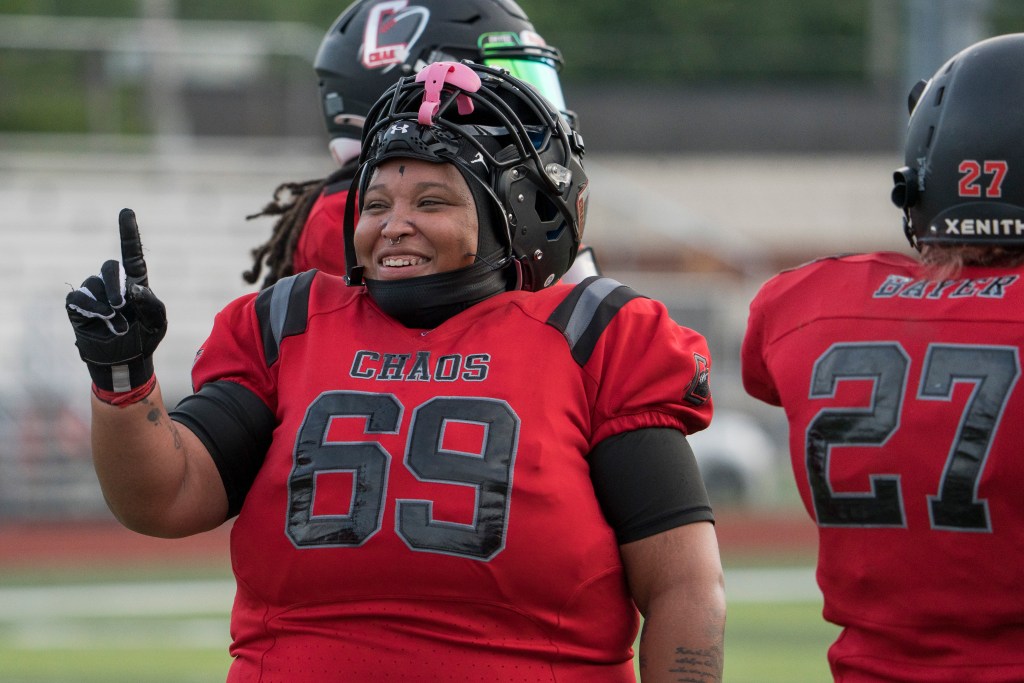
With a little over one minute left in the first half, with Columbus back on offense, McLemore stood on the sideline and looked up to the scoreboard. The tackle smiled and said “Look at the scoreboard. I’m so proud of us.” It was not a smile of excitement. McLemore’s outward show of love for their teammates was said with a contented sigh. It was a moment where all the struggle was wiped away, and there was finally potential. A light at the end of the dark tunnel that was the season to that point.
There was still another half to hold it together and attempt the impossible, but the other side had something that Columbus did not have. Lansing had Jessica Berry.
Jess
There was a threat of rain in Dublin, Ohio, on the morning of Saturday, May 16. Jessica “Jess” Berry had on ruck sack, in preparation for a long hike, but the Air Force veteran was not on a military reserve weekend. Berry was with over a hundred veterans and active duty service members from all different branches of service at the Irreverent Warriors Silkies Hike. For the uninitiated, silkies is the nickname for the military shorts issued when someone signs on the dotted line, says their pledge and heads off for military service.
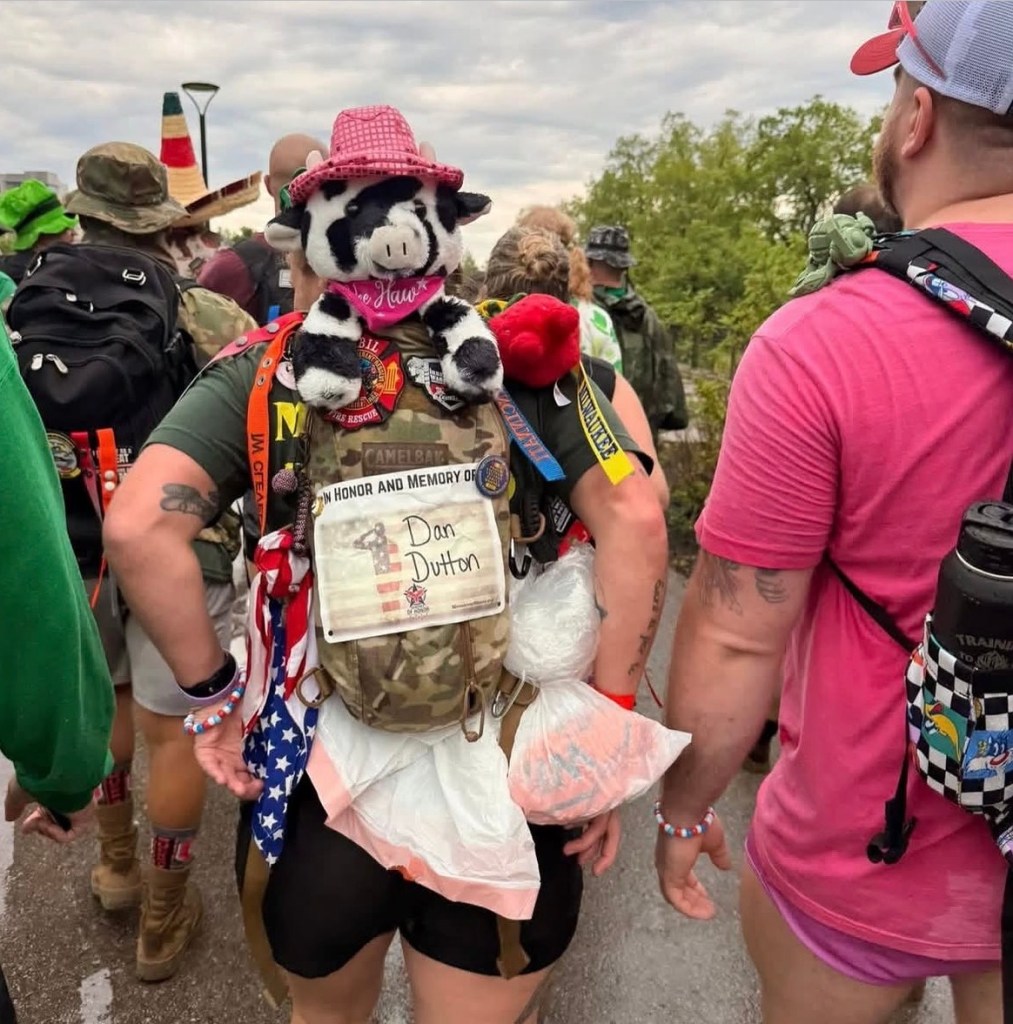
At this hike, and hundreds like it that Irreverent Warriors branches across the country put on each year, the silkies are not usually military issue. One veteran is wearing a tight pink shirt and short shorts adorned with Jigglypuff from the Pokémon video game series. Berry stands out slightly less with black shorts and a green Dropkick Murphys shirt. She has a cow stuffed animal wearing a pink hat sticking out of the top of her bag.
Irreverent Warriors hikes are only for those who serve. No non-military spouses. No kids. The only pets there were the miniature horses that a local farm brought out to the mixer that started the hike. Irreverent Warriors’ mission is clear:
“We bring veterans together using humor and camaraderie to improve mental health and prevent veteran suicide.”
At the Columbus, Ohio, edition of the silkies hike, Berry seemingly knew everyone, but not from her own military service. There is a gravitational pull, like a sci-fi movie tractor beam, around Berry. The football/rugby player has a long history of showing up to events for the first time, not knowing anybody, and leaving with friends. Even though that is a struggle for Berry, whose extrovert exterior hides a nervous and doubting introvert interior. Berry has friends from the sports that dominated her life, the Irreverent Warriors brought something different.
“I needed community, and don’t get me wrong, I have community, I have community everywhere, like with rugby and football, but I needed, I needed something more, because I was struggling with like things that siblings couldn’t handle,” Berry told The IX Sports. “Moving back home to them, it’s really hard to adapt and fit in, and that was the hardest thing that I ever experienced, is trying to fit back in to my hometown when I moved away for 10 years. Winter hit, and winter hit hard.”
Berry began going to American veteran clubs in the area. When she combined meeting veterans there with her own research, she found Irreverent Warriors (IW). Berry showed up for a meeting of the IW and sat awkwardly to the side. She did not join in the conversation or volunteer to do anything. At the end of the meeting, Berry made eye contact with the coordinator that night and the tractor beam pulled him in.
“I was ready to just go and not come back, because it’s just such an uncomfortable feeling, and I don’t like it. I just don’t like being uncomfortable,” said Berry.
That moment was pivotal to the veteran. It started a bond between Berry and the members of IW. Whenever she is traveling in the Midwest for a rugby or football game, there is usually a fellow veteran or current service member in the crowd specifically to support her. At the Lansing game in Columbus, there were two.
Outside of the fun attire, loud music and some dancing at crosswalks that may have prompted half-frightened looks from the soccer moms and dads of Dublin, the group of veterans are there for each other in ways non-military civilians may not understand.
Following the 2026 Columbus edition of the hike, someone gave another person a place to live. Another person borrowed a vehicle to help with a lack of transportation. People who were strangers before that day became friends and the tight-knit group of military service members added more numbers. They genuinely impacted each other’s lives. When the group went through a crowded Bridge Park area of the city, full of expensive shops and restaurants, the members handed out cards to share the group’s mission. All with the goal of strengthening military service members’ mental health and preventing suicide.
After signups, people grabbed free breakfast provided by the local high school military support group. There were raffle tickets to win one of a handful of gift baskets. Berry put her tickets into the Air Force basket and won, which came as no surprise.
On the back of Berry’s phone are four-leaf clovers. Some people hunt for years trying to gather this hard-to-find foliage, but Berry has a knack for running into them in her everyday life. Within the first mile of the hike, Berry stopped for a minute as the group kept moving. At that point in the hike, people began throwing things into the sombrero of the tallest guy on the leisurely walk through the Columbus suburb. At first glance, it looks like Berry and a couple of friends are frantically trying to find something one of them dropped, but it is not anything that unfortunate. Berry runs over to someone and shows them the four-leaf clover she saw when she looked down for a second. It went into the clear phone case with the others.
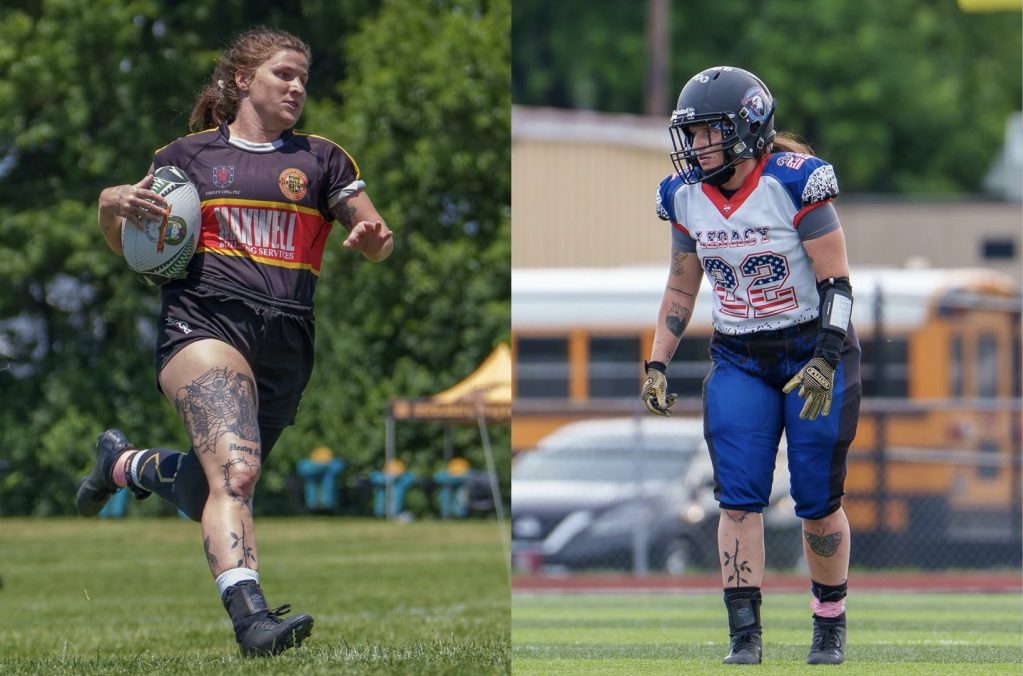
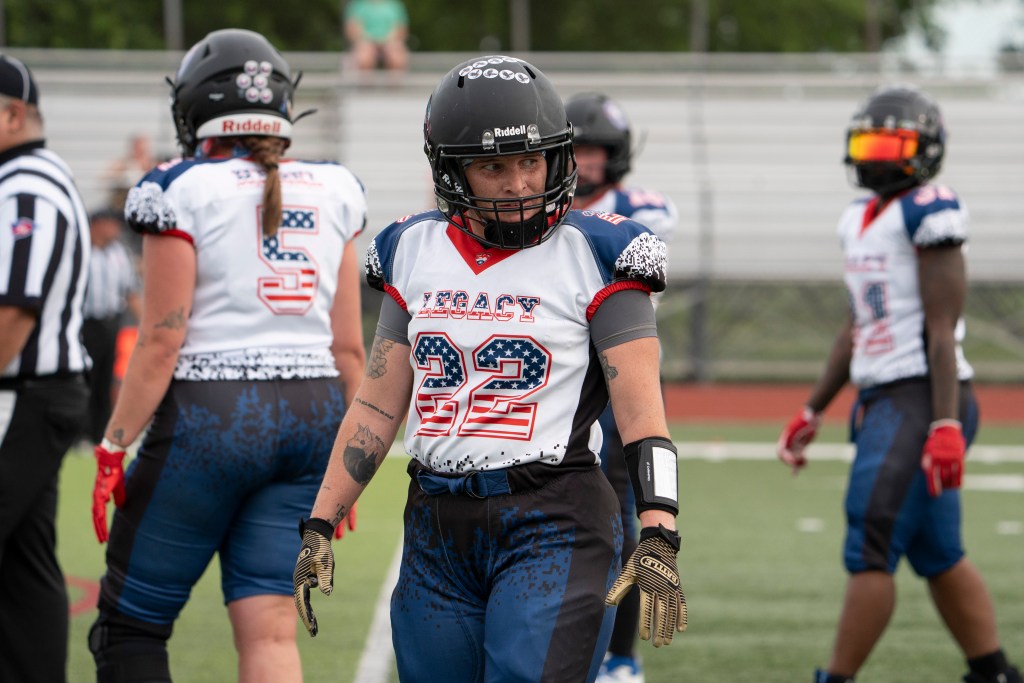
That Saturday in May was especially busy for Berry. Later that afternoon, Berry had a game in Michigan against McLemore and the Chaos. The one where the Legacy shut out the Chaos 42-0. Despite living in Perrysville, Ohio, a small town in Ashland County, Berry plays for Lansing because the coach asked her to join the team. Geographically, it makes no sense. Berry takes part in the first practice of the season and then only shows up to the games, but watch Berry play, and it makes sense why the coach is so adamant about having the linebacker on the team.
In high school, Berry pole vaulted and ran in track, played basketball for a few years and also dabbled in softball and volleyball. Rugby and football only came into her life in the last seven years. Soon after a divorce and before the completion of her time in the Air Force, Berry showed up to a Cinco De Mayo themed rugby event in Alaska, where she was stationed at the time. Playing with a group of men, everyone asked where she came from because, from the start, she excelled at the game.
Since then, Berry became something of a rugby nomad.
What does that mean exactly? Berry will play anywhere for any team at any time. Sometimes, it’s by reaching out to a team on social media to ask if they need someone for a tournament. Berry plays both rugby sevens and 15s. If social media does not work, Berry will also just show up and ask teams if they need someone. Once, Berry flew to Texas for a tournament as a rugby freelancer. At the time, she lived in Los Angeles and flew to San Diego for another tournament. Berry asked a team if they needed someone, and after she played with the Los Angeles-based side, she asked for a ride home.
Berry was only in Los Angeles for three months as an intern and had a badly sprained ankle the entire time because of a rugby match. Even so, with her time in California running out, she went on a hiking trip through the mountains.
“I should not have gone, you know, because I was in a boot, and I was like, ‘Dude, it’s once in a life opportunity, I’m gonna go backpacking six miles in the wilderness and sleep there. Oh, I’m not missing this,’” said Berry. “So it was my entire company I was with, the engineering firm, and it was like six or seven of us that went backpacking, camped out. It was pretty fun. The trek was pretty rough, not going to lie, but they didn’t leave me behind.”
The morning of the final Chaos game of the season, Berry was southeast of Columbus at Obetz, where she played in a rugby sevens tournament for a Detroit-based team she had never played with before in her life. A teammate on Lansing mentioned that they play for the club and had a game in Ohio that morning. Berry asked if she could join. The side made Berry a team captain.
Rugby Break
McLemore and Berry are best friends and have been for the last three years. The way the two met should come as no surprise. After Berry moved back to Ohio, she lived roughly an hour north of Columbus and she wanted to play rugby competitively. She had options in Cleveland, Akron, and even considered a team three hours south in Cincinnati, but she instead opted to show up to a practice for the Columbus Squirrels.
Even though this is not a new phenomenon for Berry, she still feels awkward showing up and asking to play. McLemore does not feel awkward in the slightest when it comes to getting those around them involved.
“She [Berry] was new to the Squirrels. I had been on the Squirrels for a year, and she would stand up to the side, and she would be hesitant to get in drills,” said McLemore. I’m like, ‘Hey, come here. This is so and so, this is so and so, this is Jess. She’s new. Let’s all be friends.’”
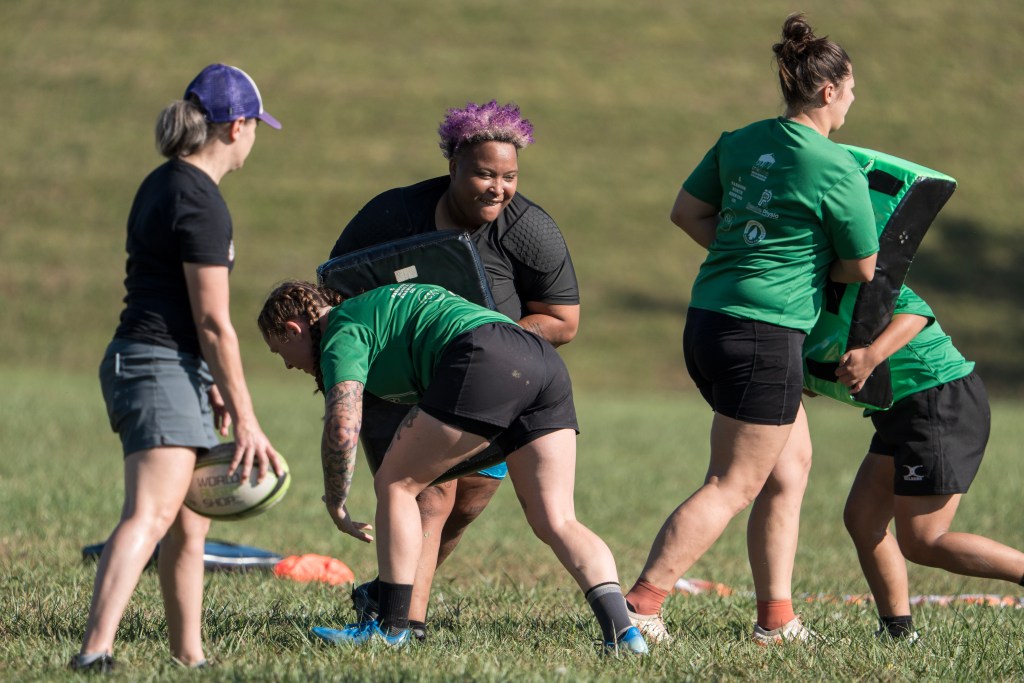
Like the Columbus Chaos, the Squirrels are a continuation of a long line of women’s sports history in Ohio’s capital city. In 1991, the Wolf Pack women’s rugby club debuted in Columbus. There was no meaning behind the name. They chose it because it was the name that was already on the used team jerseys they found.
Over time, the nickname Squirrels came into the conversation. The story goes that a key member of the group’s grandma was sick. To honor her while she was still around, they renamed the team the Squirrels because of her love of the animal.
“Who can argue with that as a reason?” said Emily Willis, then president of the Columbus Squirrels. “Her grandma was obviously super proud of them getting together and seeing things like that.”
Columbus Squirrels looks different now than it did back then. Women’s rugby groups in Columbus grew and shrank over the years, but right now the Squirrels are thriving. Willis has known both McLemore and Berry for the last four years.
To learn more about McLemore’s ability to connect with people, talk to the people in their lives. Willis can’t help but smile when McLemore’s name comes up. Most of that time spent is hearing about McLemore’s otherworldly way of connecting with people at a time when human connection is hard to come by. McLemore jumps in to help on anything within their skillset. When a teammate is going through something personal and they share it with McLemore, they are sure to get asked for updates from the athlete and not in a public “look at me caring” kind of way.
It is because of that ability, and countless others, that the Squirrels recently made McLemore the fundraising chair for the organization. Traveling and hosting teams is not cheap and the Squirrels have to get all the money to host tournaments, attend out-of-town tournaments and put together the traditional after-tournament hospitality parties that make rugby arguably the most community-focused sport.
McLemore is not only there for morale support, either. They are a fierce competitor. While McLemore was still in school, they had the choice to go into the ROTC program or play rugby, there were not enough hours in the day to do both. McLemore chose rugby as a teenager and played collegiately at the now-defunct Notre Dame College in Northeast Ohio. Now a mainstay on the Squirrels’ 15s side, McLemore is a force.
“You’re not taking them down without two or three people,” said Willis. “They’ve had things with their shoulder for ages and will pop back up and say, ‘I think it came out, but I mean, it’s back in now. It’s fine.”
Willis went on to compare McLemore to the old Irish adage “An Irishman is never drunk as long as he can hold onto one blade of grass and not fall off the face of the earth.” In this case, as long as McLemore is still standing, they will be in the game and make an impact. It will never come up as an excuse on the sidelines or on the rugby pitch, but for the last two years, McLemore has not been close to 100% healthy.
“I played this entire season with a broken foot, I played last rugby season with a torn shoulder, so like, it truly doesn’t matter,” said McLemore.
Berry is the same way. After the Irreverent Warriors hike in the rain and elements, Berry played football and rugby for the next month, working through a sinus infection. When McLemore says that injuries do not matter, it is the truth.
While McLemore and Berry are different sizes, McLemore is listed at 5-foot-5 and 285 pounds, and Berry at 5-foot-2 and 140 pounds, rugby is a game for everyone, regardless of measurement. Berry is also hard to take down, but that is because of their ability to get around opponents and run. It is not only the physical athletic ability, but the mental game.
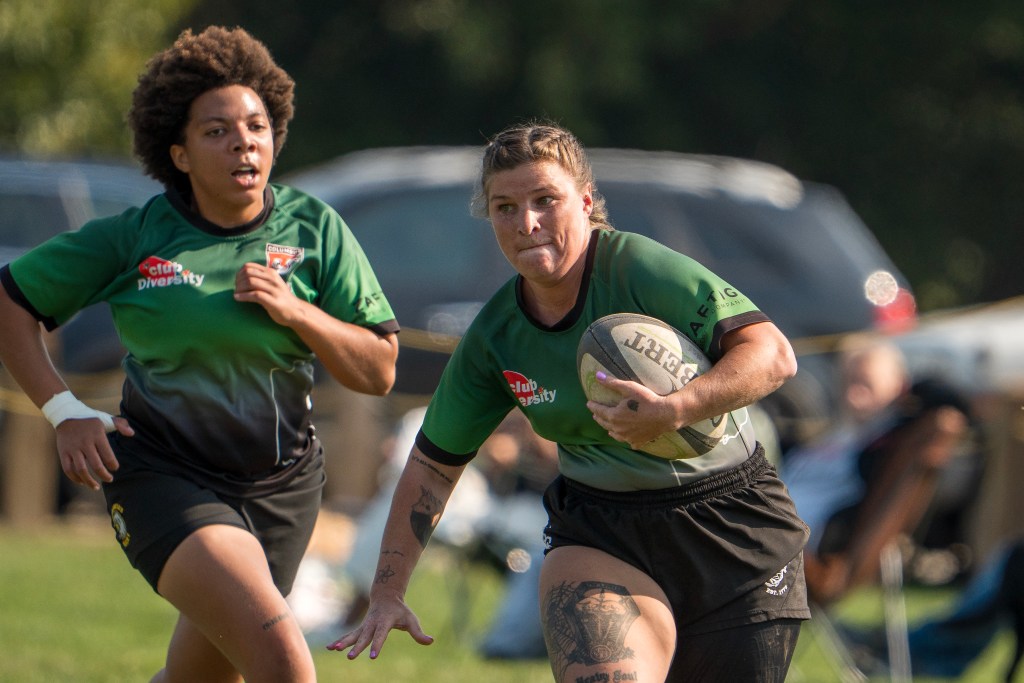
For McLemore, they communicate on the field as strongly as they do off of it. In a game like rugby, it sounds like giving teammates a heads-up on where they are standing or what is coming their way. On the football field, McLemore disarms folks before the snap as she likes to joke around with anyone on the line and even ask them what everyone’s having for dinner. Berry’s ability to jump into any team and make an impact is how she separates herself anywhere she puts her cleats.
“Rugby is like a very fluid and reactive. You react to what you see in front of you and Jess is exceptional at that,” said Willis. “You never know sometimes what is going to happen. Sometimes she’ll go and try to goose-step someone. I’m like, ‘wait, we were gonna run. Oh, okay, yeah, I see. You know, I see it.’ She’s like 40 meters (down the field), I’m like, yeah, yeah, that also works, what you just did.”
Halftime
The friendship of McLemore and Berry is evident on the field. Berry is the first to tell her friends that when a game is going on she is not going to let up, but it is not easy when the two of them match up. In one game earlier in the football season, Berry caught an interception on defense after missing two previous opportunities. When it finally happened for the linebacker, McLemore was on the field to fill in at offensive line due to injuries on the Chaos roster. McLemore’s first instinct was to cheer for Berry before they realized that they had to try and stop her.
That thought process goes both ways. The two normally only meet up on special teams. Normally, when Berry sprints down the field to try and stop the opposing kick returner, she avoids McLemore because of how difficult it is to truly get the tackle down.
Although in the first half of that final regular-season game for Columbus, Berry avoided that instinct. On a mistakenly short kickoff for Lansing, McLemore turned around as their teammate picked up the ball near the 50-yard line. At that point, Berry was already at top speed and the linebacker barreled into the back of McLemore, sending her best friend to the ground. A second later, Berry had the foot of the Chaos player who caught the ball and dragged her down to limit the damage on the return.
“I’m sorry,” yelled Berry to McLemore after the play.
“No, you’re not,” said McLemore.
McLemore was right. When Berry gets into any competitive field, there is little that can stop the gifted athlete. Berry plays every defensive and special teams snap for Lansing. She would get onto the field on offense, too, if she had the chance. Berry’s coach has brought up the idea of putting her in at running back, although it did not happen against the Chaos on the afternoon of June 13.
Second Half
“I don’t know how to catch a football,” said Berry four days before the game against the Chaos. It is the reason why Berry only steps onto the field on the defensive side of the ball. That comment foreshadowed the start of the third quarter at Whitehall Yearling High School.
The Chaos punted on the first drive of the second half and back to receive the punt, for the first time that day, was Berry. As the ball soared high into the air, Berry lined up underneath it as the Chaos defense closed in. The football barreled quickly back to Earth and bounced right off Berry’s gloves.
“I can’t catch a football, and they know I can’t catch a football, but I want to run the ball,” said Berry. “They know that I like to time it off the drop, and they didn’t want me to time it off the drop, because they don’t trust me timing it at the drop.”
Catching the ball off the drop is a key piece of rugby, but not as much for football. The closest thing to it in football is on a fumble, which is what happened on Lansing’s first possession of the game. To be fair, there was never a possession in the first place with the Berry missed punt reception attempt.
Columbus did not capitalize on the regained possession. Because of penalties, the ball eventually went back to the spot where they punted on the previous drive. The worst thing to happen to the Chaos in that game was halftime, because when Lansing regrouped, the second half belonged to the visitors.
After a 60-yard touchdown pass from Lansing put the Legacy up 18-14, the defense took charge of the game. All night, Berry had the defensive coverage role of trying to stop the 6-foot “Big Baby” Easley. Lansing combated the height disadvantage by storming the left side of the offensive line, which forced Carey to scramble, throw the ball away or get sacked. Dessiree Trevino, who also played wide receiver, was the speed Lansing used to get around the offensive line. When the Chaos tried to run on the opposite side of the line, Berry was there to bring the Chaos down.
Normally, football players try to aim for the upper body on their tackles. It is how most of them learn to bring an opposing player down. Rugby is not like that. It is a sport played closer to the ground and the focus for tackling is on the lower body. It helps curb head injuries and is safer for the athletes involved. It is part of the reason why players on the rugby field do not have to suit up in full football equipment.
Berry already has a lower center of gravity advantage at 5-foot-2. Combine that with her ability to tackle low and football players have trouble getting around the linebacker. It only happened once or twice in the game against the Chaos. Whenever Columbus had the ball, there was sure to be No. 22 of Lansing ready to pounce on anyone in her area.
The only time Columbus could get a break from Berry was if she was not on the field. It almost happened in the first half. With 9:50 remaining in the second quarter, Berry went in hard for a tackle and came out of the football scrum with a limp. It happened directly in front of the Chaos sideline, which prompted words of advice from McLemore.
“You have playoffs. Think about that,” said McLemore to Berry. “Listen to your body.”
It is already established that both McLemore and Berry have a problem with voluntarily sitting out of a game. So, the words from McLemore were from the heart, but they fell on deaf ears. If it was the other way around, there is a strong possibility of the same outcome.
In the fourth quarter, Lansing grabbed an interception and ran it 67 yards for a touchdown. The once proud McLemore from the first half said how much they wished it was rugby season. That pick-six put the Legacy up 31-14.
Leading up to that moment, Berry racked up the tackle statistics. Early in the fourth quarter, Berry was already up to eight solo tackles. Between Berry and Trevino, Columbus did not get its storybook ending.
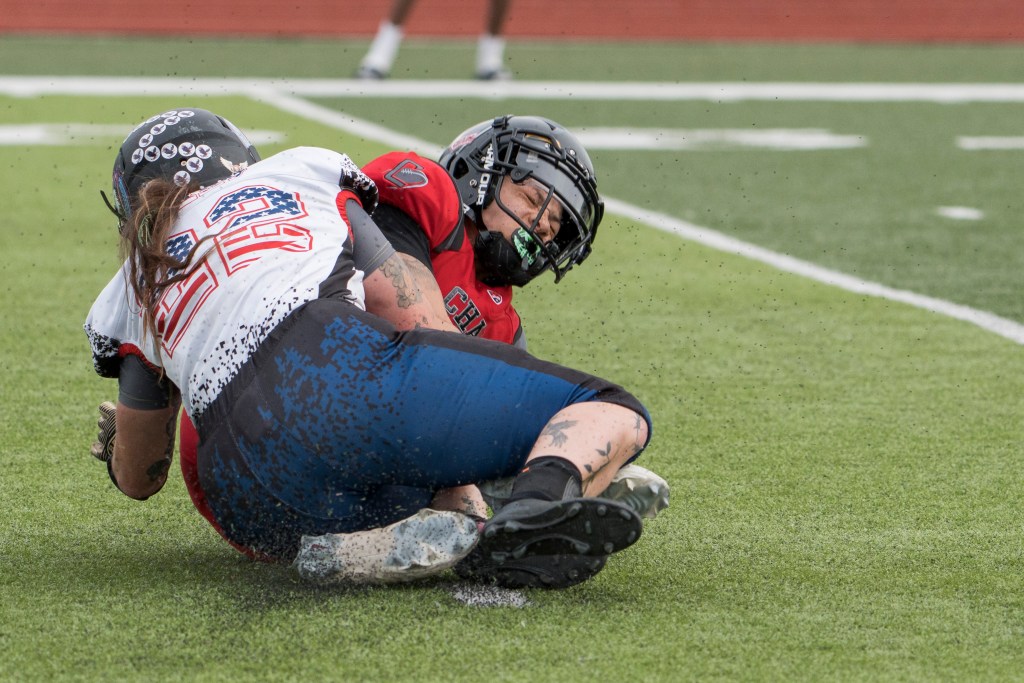
However, it was not all good for Lansing or Berry. On the linebacker’s 10th tackle of the game, her head hit the turf hard. Berry required medical attention from the trainer on the Columbus sideline. All the while, McLemore stood on the field and watched from only a couple of yards away as her friend lay there. Berry got up, but it did not look good as she slowly walked to the sideline with help from her teammates.
Two plays later, Berry was on the field again. She was still putting on her gloves as the Chaos snapped the ball. Columbus ran to her side of the field and Berry got her 11th tackle of the game on a big collision. Berry got up slowly but continued on.
“One day I’m going to get her to sit down,” said McLemore.
With 18.2 seconds remaining in the game, Columbus scored another touchdown. This time, wide receiver Adeyah Davis jumped up and battled for the ball. It popped off her hands, straight up into the air and she grabbed it for her first and only touchdown of the season. Columbus lost 31-20, but the Chaos celebrated like the result was the other way around.
Sacrifice and self-harm
Every player on the field pays to play the game. For the Chaos, they each pay $540 in fees to be on the team. The $40 goes to the league. The rest of the $500 goes to the team. That does not include their travel to away games, food or medical care. The fee gets them listed on the roster, their home and away jerseys and a helmet. If a player wants to ride the bus to an away game, it costs $40 per game. Most players opt to drive or carpool with teammates.
When Berry went down in the fourth quarter, it was not the first time the game stopped for injury. Not even close. Numerous times during the game, a player went to the ground and had trouble getting back up. A quick look at the sidelines and in their jerseys were multiple Chaos players in boots, either walking the sideline with the team or sitting on the bench. There is no medical provider sponsor to help or even an ambulance on the scene. There are trainers that the home team provides and they can help with minor knocks and relay information to the proper support staff should it escalate that far. At the end of the season, playing tackle football costs players sometimes thousands of dollars when the medical bills are included.
“The sacrifice for some seems small, but it is so huge. To be direct with it, playing football, man or woman, you’re sacrificing your body. Period,” said Johnson. “There’s a couple of things that I always annually try to remind my team that at this moment we’re not in a position to take over for, and it’s your job, and it’s your education, and it’s your health.”
Johnson, the Chaos and the WFA give athletes the chance to play the sport they love. That is the start and end of what the three provide to football players. So, each year, athletes have to decide if the sacrifice is worth it.
Sacrificing her body comes easily to Berry. She found football because she asked around for rugby teams and the person she talked to said no, but there was football. Both football and rugby give Berry the same benefit. For a long time, it was not for the love of the game. It was a way for Berry to cope with her feelings, and not in a positive way.
“Self-harm is a real thing, but it doesn’t just mean the normal self-harm tactics,” said Berry. “There was a time where I was using rugby for that, because I didn’t care, it was a way to feel the closest I could feel, I could feel anything. As long as I was feeling something, I knew that I was still alive.”
Every tournament, every team she joined at the last minute, every hit she gave or received, Berry was working through life. The time in the Air Force, past relationships, the pressure of having a normal life of a 9-5 job in an office, something Berry’s family hopes for the nomad who would rather move from one place to another than stay in the same place for the rest of her life.
Some of those pressures are still there. Berry has options of what to do next for work or where she will lay her head each night, but fortunately for the athlete who is much more than an athlete, competing has a new meaning. It is no longer there as a way to feel pain, no. When Berry is on the field chasing someone down trying to catch the ball, her brain feels some semblance of clarity.
“There’s no way that I can control my emotions and my mind in a rugby game or in a football game, but like that’s exactly where I can,” said Berry. “I think that like it has grounded me so much. Without it it would be a very scary place to be.”
Women’s sports capital
When politicians and members of the Haslam Sports Group talk about a capital for women’s sports, there are no mentions of the Chaos or the Squirrels. It is about bringing professional leagues that air their games on ESPN, FOX Sports or any of the number of streaming services. It is about stimulating the economy with ticket sales, concessions, merchandise and people visiting local restaurants and hotels.
Those are not bad things. Leagues like the NWSL, WNBA, Athletes Unlimited, PWHL, etc bring people together. Fans find friends, community and purpose. They create memories within families that could very well contribute to the development of future athletes within those leagues.
It has always been a worthwhile endeavor to support women’s sports as longtime fans of those leagues, and the leagues they were built upon, know. However, now it is also a sound investment for the franchise owners who are part of those leagues. NFL owners like the Haslams, NBA owners like Dan Gilbert in Cleveland and countless others are not joining the NWSL and WNBA out of charity. The public has spoken, and it is in resounding support of sports leagues outside of the traditional men’s outfits.
The people of Columbus who work full-time jobs, have families and lead fulfilled lives are the foundation of women’s sports. When the NWSL is in the offseason and stadiums and future training centers are sitting empty, while players return home for the winter, members of the Squirrels, Chaos, Mystic, Eagles and many other women’s sports teams are still living in Columbus. They are still part of the community and contributing.
What does supporting women’s sports and being a capital of these athletes mean for the teams at the city’s sports foundation?
For Johnson and tackle football, it is moving forward conversations from the Columbus Parks Department on options for semi-professional teams like the Chaos. Johnson feels like the city is helping overcome some of the hurdles for teams with less money and access to resources. Namely, a potential stadium option within the parks system.
“Hopefully, we really do see this to fruition,” said Johnson. “The adjustments to the public parks, because those are the facilities that are subject to my team and every other team that may be up and coming, and just really trying to make a statement within the city.”
For Willis and the Squirrels, seeing people in prominent positions talk about women’s sports at all can go in different directions. Having more money to raise the profile of the Squirrels in the community is one side of it, but over the last few years, women’s sports is also used to advance legislation against trans adults and kids who wish to exist and compete in games like rugby.
On February 27, 2026, USA Rugby announced a change to their competitive eligibility requirements that athletes can only play on a team with others of the same assigned gender at birth, which the Squirrels publicly opposed through a statement on their Instagram account. The sport’s governing body in the United States created a third division outside of men’s and women’s divisions for people of any gender.
“We didn’t actually ask for this. We asked for so many things, we asked for better facilities, facilities that are comparable to where men’s teams play, we asked for referees who have a comparable skill level to like our male counterparts, we ask for funding so that we can get our asses to these games and pay our field permits and paint our field and host socials,” said Willis. “There are so many things we have asked for genuinely that would genuinely improve like the standing and quality for the athletes that you’re talking about in women’s sports.”
Investment in these areas strengthens the foundation of women’s sports and pushes the region of Ohio closer to the goal of being a capital for the game.
Often, the conversation around bringing a professional team to the city is that kids will finally have a chance to see women playing sports at a high level. It gives those children something to aspire to from these athletes. That already happens in Columbus. On top of those 80 people in the stands were kids running the sidelines, children who watch their mom, aunt or family friend play a game she loves. The same holds true for the Squirrels, where any experience level is welcome to come enjoy the game.
The game can grow, and for some athletes around the city, that growth starts at home. Many women’s professional athletes credit growing up with older brothers as their avenue to sports. Investment in semi-professional and amateur sports in the city can change that story to seeing their own mother compete.
Rep The IX Sports at your next game!

Shop the logo collection or special “Women’s Sports are Front Page News” collection now on Shopify.
Post game
Both teams got into position for the handshake line. At the front of Columbus was McLemore, while Berry led Lansing. When the two reached the center of the field, the two best friends did not shake hands; they hugged. Berry had a lot of hugs when she walked through the Chaos line. Being close friends with someone as universally respected and loved like McLemore made Berry the most popular non-Chaos player on the sideline.
Instead of everyone going their separate ways, the two teams joined together for one big group huddle. This is nothing new in the game of women’s tackle football. Johnson used this time to not only congratulate the teams on the battle that came before it but to reinforce the sport’s foundation to each player.
“Do your part, right, do it respectfully, do what is needed of you as an athlete to remain positive in this space, because there’s so many things coming behind us,” said Johnson. “If we stay locked in and we keep playing this game with respect for the other team and ourselves, it will be as fun as walking into a Buckeye game, right? Like, everybody’s gonna.. they don’t even think twice about it. They’re like, ‘Hey, let’s go.’”
Until that day happens, players like McLemore, Berry and the countless number of athletes in the area will keep going.
McLemore grew up in a football-obsessed family with multiple former pros in their ranks, but 2026 was their first year playing on a competitive team. You would not know this by watching the first-year player close down rushing lanes and tackle those who might get through a different gap. The WFA put McLemore on the All-WFA Second Team. Berry accumulated a team-high 41.5 solo tackles, nearly 19 more than the next player. She assisted on 27 tackles and led the Legacy with three interceptions and two forced fumbles. It earned Berry a spot on the WFA’s First Team.
Now that it is the offseason for both teams, players have decisions to make. Some will return to their respective sides, while others look for another team or walk away from the game completely. Berry already has a rugby tournament lined up in upstate New York at the end of July. It is right after the WFA Championship game in Canton, Ohio, where the Legacy had a real shot of making it. Lansing’s playoff run fell short and the Central Region champions lost in the first round. Even if they did make the title game, Berry planned on leaving after the game and driving through the night to make it for the morning session.
When rugby 15s starts back up in the fall, McLemore and Berry will finally be on the same team again, a welcome sight after two games against each other during the football season. Sports is what brought the two together, but it does not dictate their friendship. A pair of best friends who knew right away that there was something special about that friendship.
“We were instant best friends,” said McLemore. “It’s just easy, there’s no expectation for us to be happy all the time. We can be sad together, we can embrace the stuff together. We just sit and we just are there, we’re just present with each other, and that’s like the biggest thing about our friendship. With some friendships, you have to show up and be happy all the time, you have to be like there for everybody all the time, and for each other. Sometimes some friendships, you have to be 100%. With our friendship, it’s like if you can’t give me 100%, I got you, like if you have 0% left, just come sit and rock together.”
“The support I don’t have to ask for, the grace that I get, and the overwhelming and unconditional love, and kind of knowing that we both need our space, and we don’t need it’s okay, we come back, and she checks on me,” said Berry. “ It’s a constant back and forth of ‘I’ve got your back,’ and I think that’s like beautiful.”
“You big softy,” said McLemore, laughing as Berry puts her head on their shoulder.
Welcome to the nation’s capital for girls and women’s sports of Columbus, Ohio.