Welcome to The Next: A basketball newsroom brought to you by The IX. 24/7/365 women’s basketball coverage, written, edited and photographed by our young, diverse staff, dedicated to breaking news, analysis, historical deep dives and projections about the game we love.
Subscribe to make sure this vital work, creating a pipeline of young, diverse media professionals to write, edit and photograph the great game, continues and grows. Subscriptions include some exclusive content, but the reason for subscriptions is a simple one: making sure our writers and editors creating 24/7/365 women’s basketball coverage get paid to do it.
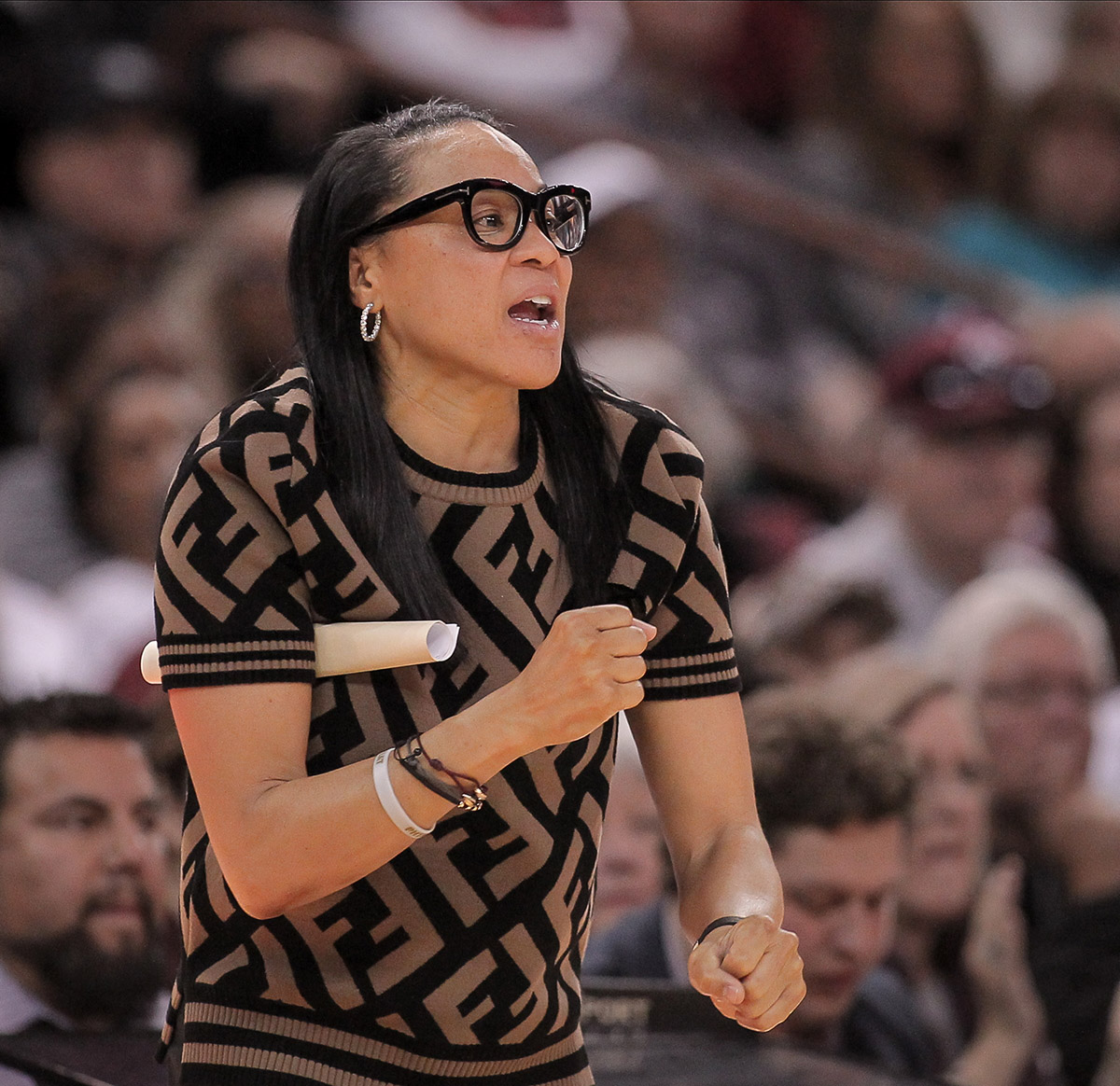
Dawn Staley. (photo courtesy of South Carolina Athletics)
‘I don’t know why people are not talking about this’
The public murder of George Floyd – following so closely on the heels of the murders of Ahmaud Arbery and Breonna Taylor – has resulted in a wave of global protests against the centuries-long inhuamne treatment of Blacks in this country.
It’s also pulled back the veil of long-standing systemic racial discrimination in businesses, retail, organizations and sports, all of which are now being taken to task for not reflecting society in its employment and hiring practices and in the demographics they serve.
It’s a different story — a success story — in the Southeastern Conference (SEC), a college athletic conference headquartered in Birmingham, Alabama.
Of the 14 schools in the SEC, six have Black female head coaches running their NCAA Division 1 Women’s College Basketball programs: LSU, Mississippi State, Auburn, South Carolina, Georgia and the University of Mississippi.
“I don’t know why people are not talking about this,” said Yolett McPhee-McCuin, head coach of the Ole Miss Rebels women’s basketball team. “This is huge. I appreciate the AD’s of the SEC who understand that diversity is important and that’s powerful to me.
“We are a representation of what our world looks like. I’m proud to be a part of this conference.”
Joni Taylor, head coach for the Georgia Lady Bulldogs, cited percentages that show most Black females are the ones playing women’s college basketball, “and so when you have Black coaches, Black female coaches that they can look to as mother-figures, role models, inspirations… I think it provides hope and encouragement and it shows you how far we’ve come.”
The coaches represent a sisterhood of success, a portrait of six successful Black women who both compete against each other as well as cheer for each other.
“It’s powerful to see Black female coaches on both sides of the bench,” said Taylor. “Don’t get me wrong, we are all fierce competitors. When we play against each other we want to win, but when that is over with, we have a camaraderie that goes beyond basketball because of a shared thing; being Black, female coaches.
“I think when you look at that as a fan of basketball, again, it speaks to how far we’ve come that you can see two Black female head coaches coaching against each other. How often does that happen? Then you can look at our conference as a whole and find six.”
In the midst of racial and social unrest, the ongoing pandemic, recruiting, family summertime activities and more, the coaches took time to share their thoughts with The Next on a myriad of topics including navigating the terrain of being a Black female head coach, the racial unrest and protests in our nation, serving as role models to all student-athletes, the call for Black student athletes to re-envision where they should go to school, how the country can move forward and more.
Coach Yolett McPhee-McCuin (photo courtesy of Ole Miss Athletics)
University of Mississippi: Coach Yolett McPhee-McCuin
One unexpected narrative that arose from the protests and social unrest — which gained steam on social media — centered on the call for Black student athletes to forego PWIs (predominantly white institutions) and move to HBCUs (Historically Black Colleges and Universities).
Coach McPhee-McCuin — who received her undergraduate degree from Rhode Island and her master’s degree from the University of Arkansas Pine-Bluff, saw the postings, understood where proponents were coming from but said, “I feel they are missing the point. I believe in HBCUs as a product. I’m glad I got both experiences.
“One, I did find value in going to both a PWI and an HBCU, but two, we really worked our asses off to get to this level and there’s six of us here. And in some conferences there are none.”
She believes students should go wherever they feel most comfortable and not be pushed to one race. “But I do think it’s important for people to go play for coaches that they can relate to.
“I had a white coach and I learned a lot of stuff from her but there are some things I didn’t get to learn from her because of the obvious,” she said. With that, Taylor emphasizes the importance of exposure.
Coach Yolett McPhee-McCuin (photo courtesy of Ole Miss Athletics)
“I remember watching Black Panther and it hit me then, wow, I’ve never seen a Black superhero. This whole time I wanted to be Superwoman or Superman and there’s nothing wrong with that, but sometimes you don’t even know what you’re missing because you’re not exposed to it.”
McPhee-McCuin recalls Black assistant coaches at opposing schools bringing their children to games, “so they could see what it looked like to have a Black woman at the helm, in leadership.”
It matters — and not just for Black players, either.
“It’s great for all of them to see us; it teaches my white players that it’s okay to see a diverse group of leaders and to be comfortable in that space,” she said. “At the end of the day they are women and want to be led. So that is powerful within itself.
“And then obviously it’s important to the Black student athletes because they can see someone in a position of leadership — whether they want to coach or not — it’s a position of leadership,” she said. “There are so many times my players tell me, ‘Coach, I was thinking about doing this. I want to be a CEO one day’ or ‘I want to Boss Up like you,’ and that means something to them because they see it.”
Mimi Reid, a redshirt junior from The Bronx, agrees.
“As women we go through struggles everyday, just the struggle of being a woman; and on top of that being a Black woman in a leadership role, you don’t see that many times,” she said. “So it’s just empowering for me to see that my coach is doing it and it makes me think; ‘why not me? Why can’t I be a success story as well? Why can’t I beat the odds?
“That’s the real meaning behind seeing Coach Yo in that light and having her as my leader,” Reid continued. “All my high school coaches were Black males. This is the first time for me to have a Black female. I’m always a strong believer that women build women up and as young ladies we are coming into a world we have no idea about.
Coach Yolett McPhee-McCuin (photo courtesy of Ole Miss Athletics)
“To have Coach Yo able to connect with us on those levels physically, mentally, it’s just a different kind of conversation that a male just can’t have with you. It’s a male-dominated world but women are stepping into these leadership roles unapologetically and I’m here for it.”
Jordan Berry, a white 19-year-old sophomore player for Ole Miss from New Orleans, said she admires Coach Yo, “not just as my coach but as a person. Every day she sets an example for us on and off the court. She values and puts so much time into the program and the community.”
“You know, Coach Yo is always pushing us every day to be the best version of ourselves as players and as people,” Berry said. “One of the main reasons why I wanted to come to Ole Miss is she has this contagious energy and competitive spirit that inspires me everyday.
Berry was drawn to Ole Miss by Coach Yo’s “contagious energy and competitive spirit”, she said, but in this moment of systemic social change, she finds herself understanding it more fully than she believes she would have in another program.
“It really has made my perspective so much more educated,” Berry said. “I’m so much more aware and I just have the utmost respect for her… She has accomplished so much as a Black female and she is really invested in making things better for the Black community. I really look up to that as a white person, as a white girl playing for her.”
While the protests were ongoing, McPhee-McCuin made sure to check in with her players.
Coach Yolett McPhee-McCuin (photo courtesy of Ole Miss Athletics)
“I more so listened. I’ve been able to have a conversation because I’m Black. I don’t need to understand what they are feeling, I’m living what they are feeling. I more so listen to my white players because I want to know how they feel about all this. This is heavy on them,” she said. “I just also support my Black student athletes, they need that right now.”
Floyd’s murder, the ongoing racial unrest and more “is heavy on me,” McPhee-McCuin said, and has prompted her to pay more attention to her mental health and wellness “more than ever before. When I tell you, sometimes I wake up so discouraged, angry, hurt… it’s important we check in and find what’s going to bring us inner peace, whether it’s logging off (social media), yoga, talking to somebody.
“I already had an appreciation of mental wellness, but I will not fail myself nor my players from the opportunity in making sure they are in a good space,” she said. “This is important right now. It’s always important but it’s even important to my white players. I wonder how they feel. This is uncharted territory and we all need to be in a space of peace so we can be our best selves.”
Coach Joni Taylor (photo courtesy of Georgia Athletics)
University of Georgia: Coach Joni Taylor
“It is something that I still pinch myself about when I wake up in the morning,” said Coach Taylor about being one of six Black female head coaches in the SEC.
“I’m grateful, I’m honored and I’m humbled and I take it as a huge responsibility to represent for all the Black coaches out there. I was just given an opportunity. There are a lot of Black coaches who have not been given that same opportunity, who have been putting in their time and paying their dues much longer than I have been,” she said.
“And so there is also a responsibility that comes with making sure – not to be perfect — but that we do as best we can to try to be successful and try to win and represent ourselves in the right way. Because the more success we have, the easier it’s going to be for that next administrator to pull the trigger and hire a Black female or a Black male head coach.”
This responsibility to those who may come after her is “not a burden,” Taylor said. “It’s not exhausting. It is what it is and I take great pride in being one of the Black female coaches to carry that torch.”
Taylor acknowledges that her position carries with it great responsibility, especially for student-athletes.
“It lets them know what’s possible for them. When I was growing up in the 90s in Mississippi, you didn’t see a Black doctor or a Black lawyer — very rarely — unless you were watching the Huxtables,” Taylor said.
“That’s the only way I knew that was possible was because I saw it on tv and there is a difference between seeing something on tv and it’s not real life versus looking in your community and seeing it actually happen and being around it,” she said.
And it is this representation that is so key for Black athletes, Taylor says.
“It shows them that ‘it’s a possibility for me, as a Black female, to be in a position of prominence in whatever career I choose’ and that wasn’t always available.”
Since the murder of George Floyd and the protests began, Coach Taylor has had several conversations with her team and convened a Zoom panel to give everyone a chance to vent.
Coach Joni Taylor (photo courtesy of Georgia Athletics)
“Our student athletes had a lot of questions and let’s be very frank; I can deliver that message to them better than someone who isn’t Black could because at the end of the day, it is not their experience,” she said. “They can have empathy and educate themselves but they can never understand what it is we have seen.”
Acknowledging everyone doesn’t have the same experiences and story, Taylor believes it was “impactful for them to call me up and say ‘talk about growing up in Mississippi Coach Joni,’ and ‘What was it like for you or what is it like being the only Black coach at Georgia? I think also for our players who aren’t Black it helps them understand and allows them to see a different side of you that they may not have considered before.”
Because of COVID-19, the team was already on Zoom and group chats, so assembling the team was easy. “I got on the horn immediately to make sure our girls were safe and make sure they were processing things the right way,” she said. The next Zoom call that we had we put a panel together and had a very diverse representation of people just to share their experiences”
Taylor stressed the importance of not putting people in boxes and understanding experiences from different perspectives.
“Everyone’s Black experience isn’t the same, just like everyone’s enlightenment as a white person is not the same,” she said. “I think the message is we have to sit down at the table and come with our heart. The hard work cannot begin until the heart changes. We’ve got to be open to acknowledging that there is some education that needs to happen for everybody, not just white people.”
Young Black athletes, Taylor believes, need to understand how far back systemic racism really goes so when they want to use their voice – “which we have told them to do -and want to empower them to do, in order to truly use your voice to affect change you’ve gotta be educated.”
This education begins with knowing their history and studying that history so when asked about it, Taylor said, students can “speak with factual information, not just feelings and emotions but factual information that helps change the perspective of other people.
“I also told our white student athletes that this is a chance for you to listen — there are going to be some uncomfortable conversations and you’ve got to be okay with that and you cannot take it personal,” Taylor said. “You’ve gotta judge your teammates by their heart and who you know them to be, not necessarily everything they tweet or retweet right now.”
What I mean by that is there are some generalizations — all cops are bad? Well, that’s not true — but sometimes that can get retweeted. Let’s not take that personal or make that about you. And like I told our Black student athletes, be careful about posting or retweeting comments that put everybody into one box because that is what happens to us and that’s why we’re in the positions that we are in. We all got categorized or generalized as one thing. Be careful when you say all white people this and all cops this because it’s just not true.”
Progress and moving forward post-George Floyd, Taylor said, will be all about educating, informing and “making sure they use their voice because it is needed. I do think this generation is going to move us further along but making sure they do it in the right way.”
LSU: Head Coach Nikki Fargas
Coach Fargas wants to use her position to instill a sense of vision and possibility in her student-athletes.
“To my players I want to bring hope and unlock possibilities. Through my career trajectory I want my rise to inspire them to rise too,” she said. “I’m about helping young women become the best version of themselves and to support them on the journey that awaits them.
“Being in this role can help reshape the perceptions of what it means to have leaders who are minorities. They will be what they see.”
The murder of George Floyd and the ensuing racial protests led Coach Fargas to think back to her great grandfather, Robert E. Lee, who played in the Negro Leagues (The Oak Ridge Bombers) because he couldn’t play in the major leagues.
“We’ve obviously stood on the shoulders of so many who have endured and have gone through — from a place of racism — so much more than I ever could imagine. There is no place for it. There should not be any excuses for it either.
“We’ve got to support each other in this challenge. It’s a challenge and we’ve got to dismantle it. We’ve got to commit to creating an atmosphere — as a woman of color — I want to create an atmosphere where our kids feel valued, that they are respected and that they do matter.
And it’s really important for us to make sure that anything that goes against that or anything that challenges the very fabric of equality and justice for all should be dealt with and held accountable for allowing it to continue.”
Coach Fargas hears the stories of her players, the family experiences, the Black experience in this country. It shapes their perspectives.
“My girls have stories of their fathers being pulled over and having to witness what that looks like and stories of brothers and nephews and cousins and everybody. They’ve been exposed to a whole lot in just the few months – and not saying everybody else hasn’t. I think everybody has.
Unlike past protests against police brutality, Coach Fargas feels a different kind of energy this time around.
“It’s hard to explain it. I feel like there is a different call to action, not only for the Black community, but for the institutions that we represent,” she said. “There’s got to be a call to action for the governing body to help, again, hold those accountable, make sure that we don’t tolerate it.”
Creating the right type of culture on campuses and being active listeners is a start.
“We always talk about the culture; we need to think about what kind of culture we are creating on our campuses and in our communities. And we have to listen to the people that we serve,” she said. “Let’s have some action items; if your demands are to eliminate hate speech and all those things that are going on right now, what does that look like?”
In order to move forward during these times of racial unrest, it’s important to educate oneself as well, she suggests, on personal biases that may not be obvious, and take time to recognize and pay attention to the mental state of mind of student athletes who are expected to “take everything that is given to you then go out there and put up buckets,” she said.
Coach Fargas has talked with her team about the climate we’re all living in and sees her team, these young athletes, moving beyond what she ever accomplished in her time as an undergraduate.
“The courage that it takes to stand up and make sure you’re heard — it’s a slippery slope as an athlete,” she said. “They are like, ‘no we are not staying silent anymore.’”
The presence of the Black women head coaches is also empowering many of the student athletes.
Nineteen-year-old LSU sophomore Domonique Davis has had Black coaches before, including her mom and her AAU coach, a Black male. Coach Nikki upped the ante.
“Having her as a head coach during this time means a lot because, from the beginning, she has shown her support behind us, she knows what it’s like growing up as a Black person,” Davis said. “That means a lot and she is constantly being there for us and making sure we can get through this time and be okay while things are happening to Black people.”
“Seeing those coaches in those positions, with the platform they have, it’s like okay I can see myself there. I think it gives a lot of Black athletes hope,” said Davis, a business management major. “We all want to play in the professional leagues of our sports but seeing that Black people can become head coaches at these schools, then it gives us another option as well.”
It’s important to Coach Fargas that she and the other coaches help serve as catalysts for change on their campuses and in the community. Change, she added, that is lasting.
“I think it is everyone’s responsibility to eliminate this mistreatment and any bigotry and racial injustice,” she said. “We can just flip that, flip the script and let’s try unity and let’s try loving on each other and having compassion.
“Why not try doing those things — because what is there to lose?”
Dawn Staley. (photo courtesy of South Carolina Athletics)
University of South Carolina: Coach Dawn Staley
The legendary Coach Staley — long recognized as the dean of women’s collegiate basketball — applauds the success of the sisterhood.
“This has all taken place because of the success of many of the Black coaches who have been in the league for so long…Nikki Caldwell (Fargas), myself, Joni (Taylor) have had great success and I just believe it opens the door for other coaches like Yolette McCuin and Nikki McCray and Terri Williams-Flournoy.
“The success we’ve had it makes it more valuable to universities like Mississippi State and Ole Miss. They know what we are capable of doing and they’re not afraid to jump out there and do something different.”
Staley said their SEC sisterhood success story is also due to the makeup of the student athletes.
“The majority of our team and the majority of our league in women’s basketball is made up of Black young bodies and because of that, it’s only right that we get an opportunity to coach those Black bodies because only we know truly how to help them navigate outside the basketball court and into the real world.”
As a young person, you want to see people like yourself in powerful positions and in positions of setting an example of what you want, Staley said. “I know our players will see things differently later on in life because of the experiences they have had with me and us.
Seeing her and the other coaches in their leadership roles will help Black student athletes in particular aspire to great heights and not feel like it’s an impossibility “because they had it. They had it.”
Staley stressed she is not saying white coaches aren’t capable — “they are, but since we’re in this movement, we are the examples of what’s good about the SEC and what’s good about women’s basketball because we look like no other conference in the country. No other conference. I mean no other.”
And it’s this reason that Staley suggests other conferences and universities of those conferences “need to look and see what Black coaches are doing in the Power 5 and one of the best conferences in the country in the SEC and hopefully this movement will spread beyond where we are in the SEC.”
Like the other coaches, Staley talked with her team as the protests and racial unrest spread throughout the nation.
“Yes, we talked. I think it’s only right for us to allow our players a safe space in which they can give u their raw emotions, raw thoughts, raw feelings,” she said. “We come together every week to share our stories of where we are and where we are moving forward.”
Personally, Staley said she is “in a great space because I see change. Change is on the horizon. As we speak I’m trying to put together a plan of action because I just don’t want to be all talk,” she said.
Dawn Staley. (photo courtesy of South Carolina Athletics)
“I want to move things beyond sports, I want to move things beyond students. I want to be a part of change here at South Carolina and hopefully we can create a model that other universities or other corporations will be able to use to advance Black people.”
Her work at South Carolina and as a leader of Black women coaches is second nature to Staley.
“I’m doing what I’m supposed to do, meaning provide opportunities, provide aspirations, provide just a different outlook and I do it through sharing my story,” she said. “It’s authentic, it’s beautiful. It’s a movement. It truly is. The thing we have been able to do here in South Carolina…our fan base is not a movement, it’s a lifestyle so hopefully we’ll be able to change lifestyles as we share our voices in the Black Lives Matter movement.
“Hopefully it will become a lifestyle for so many of our fans.”
Dallas Wings guard Tyasha Harris, who spent four years at South Carolina and won an NCAA title with Staley as her head coach, called the six Black female head coaches “amazing.”
“It’s beautiful to see that,” Harris said. “It’s like a sisterhood with them; they’re always talking, always have each others back and when we played (against) each other, they always had this bond.
It’s amazing to see especially during this time because that’s what you want to see.”
Terri Williams-Flournoy (photo courtesy of Auburn Athletics)
Auburn University: Coach Terri Williams-Flournoy
A death in the family prevented an interview with Coach Williams-Flournoy who has been at Auburn since 2012. Auburn senior basketball player Unique Thompson had this to say:
“It feels great to have to have a Coach in a leadership position that looks like me. She has shown me many times that the skin that we’re in will not stop what you have aspired to be in this life.
“It gives you a great amount of confidence and self-esteem to be able to relate to someone in a leadership position as high as she is,” Thompson said. “All in all, I do feel as though I can and will aspire to do great things because I have someone that looks like me as my role model.”
Nikki McCray-Penson. (photo courtesy of Mississippi State Athletics)
Mississippi State University: Coach Nikki McCray-Penson
A Black woman in a position of leadership always mattered. But to Nikki McCray-Penson, two months into her tenure at Mississippi State, it matters even more now.
“To be a head coach in Division 1 Athletics is, number one, a huge accomplishment,” she said. “To be a head coach in a Power 5 is even more of a significant accomplishment. But to be a Black head coach in the SEC is pretty special. Especially from where the league started to where it is now.”
McCray-Penson was previously at Old Dominion and spent nine years as assistant coach under Staley. Now, she’s a member of the sisterhood in full standing.
“To have six wonderful, amazing, Black head coaches is a true testament to the leadership of the universities and the SEC,” she said. “I’m proud, having been a student athlete in the SEC, having been an assistant coach in the SEC and now being a head coach is pretty special, especially during these times.”
When asked what her presence means to her players, McCray-Penson acknowledges that being of the same ethnicity helps, but overall players perform for caring coaches that they trust.
“The fact that players can relate to me as far as us looking the same and somewhat having the same experiences is there, but my experience back when I played and grew up is totally different than their experiences,” she said. “But we do share some things in common (both being Black) and those things are important.”
Effort, she added, comes down to trust. And that goes both ways. McCray-Penson looks at basketball players in terms of what they do, not who they are and believes it doesn’t matter who is coaching them, Black or white.
“One of the reasons why I am thankful to be at Mississippi State is it’s not about the color of your skin here, it is not about the fancy cars, it’s about who you are as a person and my experience has been great and every player I talked to — former and current — their experience has been wonderful. It goes back to who you are.
“Who you are becomes the important part, and for me, when it’s coaching any race, it’s going to be about that; who you are.”
Regarding the social media push for Black college athletes to attend HBCUs, McCray-Penson said she believes that players choose colleges based on affordability, geography, athletics, personal reasons and more “but also the relationships and the people they forge those relationships with. I do believe it is a matter of choice”, noting that she went to Tennessee because the discipline of Pat Summitt was what she needed at that time.
In a move that delighted McCray-Penson, current and former players and other supporters from Mississippi State University were very vocal and present during last week’s Black Lives Matter protest in Starkville, Mississippi, home to MSU.
“I thought the unity event they had and to see all of Starkville, all races, come together was really special,” she said. “That just goes to show you it’s a community of togetherness. I thought it was something that was really needed and very empowering.
“I compliment our president and our AD. They have really done a great job of putting things in place to show our student athletes and our staff that they are part of a movement, this is not something that is in the moment it is a movement; change is going to happen,” she said.
“It’s not going to happen right away, we know that, but there are things in place now that will forever change.”
Nikki McCray-Penson, Terri Williams-Fluornoy, Nikki Fargas, Joni Taylor, Yolett McPhee-McCuin and Dawn Staley are showing us what that change is going to look like.