

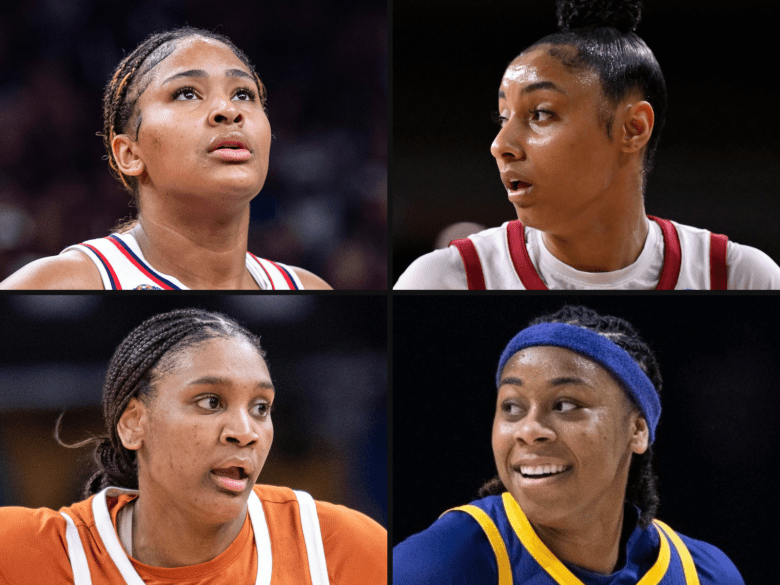
Women’s basketball is more popular than ever before. There’s a new CBA that makes draft picks’ contracts more important, and between the time we started doing this post-draft board to 2030, the WNBA will have added six expansion teams.
All of this makes draft decisions more important, but the level of talent in the college game has dropped considerably over the past year. Just two rising sophomores are on this list, compared to the eight 2026 draftees that would have been on last year’s installment, and many of the names here have either leveled off or taken a step back. Increasing the size of the league by 50% by 2030 also means that our concepts of a first division starter or a mid-rotation player are changing significantly.
This year’s WNBA draft was deeper than usual at the top end, following the historically excellent 2025 class, and these upcoming classes look to have historic star power but without the mid-round depth. Still, there are a number of interesting names who could make a leap here or there and turn into future All-Stars. And who knows which players who just missed our honorable mentions could emerge as pro-caliber role players.
What does all this talent look like all stacked together? And how does it compare to recent draft classes? That’s where our “future value” grading can help. You can find a full breakdown of the grading and the methodology here, but in we use the 20-80 scale, and these numbers translate to median career outcomes of: 40 — mid-rotation player; 45 — second division starter/average rotation player; 50 — average first division starter/worst starter on a title team; 55 — above-average first division starter; 60 — perennial All-Star; 80 — perennial MVP candidate.
So without further ado:
(Offensiveand defensive roles are per Basketball Index)
80 FV
1. Sarah Strong, big wing/point forward, UConn
Year: 2028
Height: 6’2
Wingspan: N/A
Offensive style: Shot-creator/versatile big
Defensive style: Yes
Sarah Strong is a top ten player in the world right now, and she just finished her sophomore season at UConn. She is a historic play finisher in any capacity, an elite offensive initiator and a high-level connective passer. Her unmatched combination of size, speed, strength and processing has led her to be one of the best offensive players ever in her two seasons in Storrs, putting up comedically efficient scoring numbers without getting to the free-throw line yet, a skill she hopefully learns in the future.
Strong might even be a better defensive prospect than offensive. Her feel and physical tools make her a disruptive force on the defensive end without sacrificing any fundamentals, able to defend in any scheme, fill almost any role at almost any position, and she’ll do it as well as anyone. She can defend in space, she can defend at the rim, and she can play any ball screen coverage. It’s genuinely difficult to say how good at basketball Sarah Strong can be, because we’ve almost never seen a player as good as she is at 19/20 years old.
Variance: Low
Last year’s grade: 80 FV
Change in ranking: +0
2. JuJu Watkins, wing, USC
Offensive style: Shot-creator/secondary ball-handler
Defensive style: Helper
It’s been more than 400 days since JuJu Watkins last played after tearing her ACL, but here’s a quick reminder: she may be the greatest wing prospect of all time. It starts with how effortless everything looks; Watkins’ change of pace, balance and size make her a scoring threat from anywhere. She’s unguardable in transition, knocks down pull-ups off any platform and gets to the rim and draws fouls whenever she wants.
What separates Watkins from premier wing prospects of the past is that she’s somehow the best (non-Strong category) help defender in the country while carrying the highest usage rate (37.9%) of any high major player ever. The next step is improving her efficiency and growing as an off-ball scorer, but with the best surrounding cast of her college career coming this season, that jump should follow.
Variance: Low
Last year’s grade: 80 FV
Change in ranking: +0
60 FV
3. Madison Booker, wing, Texas
Year: 2027
Height: 6’1
Wingspan: 6’5.5
Offensive style: Shot-creator
Defensive style: Wing stopper/helper
Does coaches putting young players in cognitively challenging positions matter for development? If you’re betting on Madison Booker, you’re betting it doesn’t. Where Strong and Watkins are asked by their coaches to take on just about every high-leverage offensive role possible, Booker has two: get midrange buckets off the catch and run the pick-n-roll (PnR).
In the pro-Booker column, she is exemplary at both, per Synergy, with the Longhorns putting up a true-shooting over 52% when Booker’s run a PnR in two of her three collegiate seasons and a 48.3% FG% from the midrange this year. In the anti-Booker column, she attacks very little out of second-side actions in handoffs, iso or off of screens, rarely works in the post and almost never runs actions that allow for more than a basic PnR read, while being set up for midrange shots at the expense of developing her 3-pointer. That can be made up for with greater development at the WNBA level, but it’s tougher to do at ages 23-25 than 20-22.
Regardless, Booker has a very high floor thanks to exceptional defense. She can lock down wings on the ball while disrupting their handle the whole way, deny her assignment off the ball and provide real rim protection from the weakside and paint disruption on fills and sinks. Getting that from a forward, with her wingspan, who can create good buckets in the midrange is incredibly rare.
Variance: Medium
Last year’s grade: 60 FV
Change in ranking: +2
Listen now to The IX Sports Podcast and Women’s Sports Daily
We are excited to announce the launch of TWO new podcasts for all the women’s sports fans out there looking for a daily dose of women’s sports news and analysis. Stream on Spotify, Apple Podcasts or anywhere you listen to podcasts, and make sure to subscribe!
55 FV
4. Mikaylah Williams, wing, LSU
Year: 2027
Height: 6’0
Wingspan: N/A
Offensive style: Shot-creator
Defensive style: Low activity
Mikaylah Williams is the easiest evaluation there is: she gets buckets from everywhere on the court at will, can get the ball anywhere with either her handle or passing, and generally does not play defense. Whatever else you associate with that archetype is probably correct. Is her jumper elite and unblockable? You bet. Does she get to the rim much? Of course not, but she’s good when she gets there. Does she die on ball screens? Absolutely. Is her defensive help undisciplined and prone to being back-cut? Is the sky blue?
What separates Williams from the rest of this archetype is just how elite her scoring is. Across her three seasons, per Synergy, her pull-up middy is at nearly 50% FG%, her spot-up three is over 45% 3P% and she’s hit over a third of her pull-up threes while still improving as a high-leverage passer. That’s a role 7 offensive player. But what’s the value of 7 scorer/2 defender?
Variance: Low
Last year’s grade: 55 FV
Change in ranking: +4
50 FV
5. Jaloni Cambridge, combo guard, Ohio State
Year: 2028
Height: 5’7
Wingspan: N/A
Offensive style: Secondary ball-handler
Defensive style: Point of attack
Esteemed high school prospect scout Hunter Cruse noted in summer 2024 that the recruiting class of 2024 looked very similar to the how the class of 2012 developed: big wing GOAT candidate at No. 1 (Breanna Stewart/Strong), 3-&-D undersized hyperathletic combo guard at No. 2 (Moriah Jefferson/Cambridge), and standout two-way defense-first big at No. 3 (Morgan Tuck/Joyce Edwards). That seemed like an overstatement last spring after Jaloni Cambridge didn’t hold up her end of the bargain, but thanks to a sophomore campaign that could’ve won her Big Ten Player of the Year, she has the chance to exceed that comparison.
Cambridge was arguably the best guard in the country outside Fort Worth this year, with statlines against tournament teams with elite point of attack (POA) defenders like 41/6/6/2 against Illinois, 41/7/2/1 against Notre Dame, 33/5/3/2 against Michigan State and 28/9/8/2 against Maryland, all on stellar efficiency. She improved massively in just about every offensive aspect, developing an incredible feel for getting downhill and tormenting her defender off the bounce, tightening up her handle, squaring her shoulders far better on pull-up middys and losing a lot of her hesitancy on catch-and-shoot 3-pointers. The trade-off was moving into a lower-usage defensive role as her sister transferred in and took over the POA spot, but Cambridge has been excellent as a chaser with outsized impact as a helper for someone of her height. Her physical tools, processing and movement skills suggest she should be able to develop into a plus POA defender, but she’ll still be 5’7, which places a lot of leverage on her space-creation and ability to avoid switching.
Variance: Medium
Last year’s grade: Unranked
Change in ranking: N/A
6. Olivia Olson, wing, Michigan
Year: 2028
Height: 6’1
Wingspan: 6’2.5
Offensive style: Utility wing+
Defensive style: Wing stopper/helper
Olivia Olson has cemented her place as one of the best players in the Big Ten in her first two years, spearheading a talented trio of sophomores and leading the Wolverines to arguably their best season in program history, and expanding her skill set even further. A strong wing defender who can create shots for herself and open opportunities for teammates in a variety of ways and make plays on and off the ball on both ends, Olson’s ability to do a little bit of everything makes it easy to imagine her filling a variety of roles at the next level and gives her a multitude of paths to high impact play. Though her positional versatility and ability to impact the game in so many ways, the simplest way for her to solidify her spot as a quality WNBA player is to improve her 3-point shooting. Unless that shot improves or her ability to create drives to the rim takes a massive step forward, she may be too much of a tweener to play either the three or the four.
Variance: Medium
Last year’s grade: 50 FV
Change in ranking: +7
7. Hannah Hidalgo, point guard, Notre Dame
Year: 2027
Height: 5’6
Wingspan: N/A
Offensive style: Secondary ball-handler
Defensive style: Point of attack
Hannah Hidalgo is a tremendously talented player that believes she can do anything and everything on the court, which simultaneously fuels her greatness and keeps her from playing the best basketball she can. In 2025-26 as a junior, she averaged over 5.5 steals per game, a number that no one besides Chastadie Barrs has put up in the last decade. Hidalgo has the quickest hands of any player we’ve ever seen and her uncanny ability to always make contact with the ball when she gambles for steals or blocks makes her a positive-impact helpside defender despite her miniscule size. Her combination of speed, aggression and timing make her an absolute terror to deal with for any offense at quite literally all times, with All-American level players scared to dribble anywhere near her area. But she can get overeager at times, gambling for steals that she has no chance of getting; harnessing her abilities into more traditional and fundamental defensive playmaking will help her going forward.
Offensively, Hidalgo has a ways to go. Her passing pops at times, finding teammates open all over the court and leveraging her blinding speed and body control to create advantages for others. But her scoring process in the halfcourt leaves a lot to be desired, where she frequently takes difficult jumpers that anyone would struggle to convert and dives headfirst into throngs of defenders sometimes a foot taller than she is. When she’s on, Hidalgo looks like a future Hall-of-Famer. When she’s off, her defense mostly just makes up for the empty offensive possessions she causes.
Variance: Low
Last year’s grade: 60 FV
Change in ranking: -3
“Becoming Caitlin Clark” is out now!
Howard Megdal’s newest book is here! “Becoming Caitlin Clark: The Unknown Origin Story of a Modern Basketball Superstar” captures both the historic nature of Clark’s rise and the critical context over the previous century that helped make it possible, including interviews with Clark, Lisa Bluder (who also wrote the foreword), C. Vivian Stringer, Jan Jensen, Molly Kazmer and many others.
8. Joyce Edwards, power forward, South Carolina
Year: 2028
Height: 6’3
Wingspan: 6’6.75
Offensive style: Athletic finisher
Defensive style: Mobile big
Joyce Edwards has displayed tremendous physical tools and a wide set of skills in her first two seasons in Columbia, making her an intriguing prospect on both ends of the ball. Her rare combination of size, lateral quickness, and movement in tight spaces make Edwards a nightmare for opposing bigs to match up with. Her explosiveness in these small spaces allows her to thrive around the rim, whether that’s on designed post-ups, scoring outside of the structure of the offense, or crashing the glass. Her length and rotational flexibility means she can access awkward finishing angles, forcing defenders into uncomfortable situations where they frequently foul her, and she’s flashed some ability to drive off the catch. Defensively, Edwards utilizes her quickness to defend multiple positions, showing more ability on the perimeter than the interior. While she has been good on that end, she has yet to really put everything together. Still, she has shown development under Dawn Staley and remains one of the more interesting long-term upside bets in college basketball.
Variance: Medium
Last year’s grade: 50 FV
Change in ranking: +4
9. Blanca Quiñonez, combo forward, UConn
Year: 2029
Height: 6’2
Wingspan: N/A
Offensive style: Athletic finisher/stationary shooter
Defensive style: Wing stopper
In 2020, Blanca Quiñonez became the youngest player to appear in an Italian league game when she made her professional debut at just 14 years old, and that experience showed as a freshman at UConn. She shot 66.2% on halfcourt rim attempts and 46.6% on spot-up 3-pointers (mostly open looks), per Synergy, while posting an unbelievable 7.9% stock2 rate. Quiñonez is a high-level athlete who thrives in transition, attacks closeouts, moves well without the ball and can defend multiple positions. If the jumper continues to fall and she cleans up the process by cutting down on fouls and turnovers, she could realistically be a 55 FV by this time next year.
Variance: High
10. Mikayla Blakes, combo guard, Vanderbilt
Year: 2028
Height: 5’8
Wingspan: 5’6.5
Offensive style: Secondary ball-handler
Defensive style: Chaser
Mikayla Blakes is the best off-ball mover in college basketball, and it’s not particularly close either. She’s the best cutter in the sport, an impact screener and a great spot-up shooter who uses her speed and quick processing to create openings for herself or others. On the ball, Blakes is also a skilled foul-drawer, averaging 7.9 free throw attempts per game. Defensively, she’s almost always in the right positions and does a great job staying attached to shooters. Despite leading the country in scoring as a sophomore, there are still questions that keep Blakes from ranking higher. Her size, along with her limitations as a ball-handler (see: her off-hand), lead playmaker and pull-up scorer create some uncertainty on what her upside looks like, and her screen navigation or hands on the ball would need to improve to increase the defensive usage.
Variance: Medium
Last year’s grade: 50 FV
Change in ranking: +5
11. Jazzy Davidson, combo forward, USC
Year: 2029
Height: 6’1
Wingspan: 6’1.5
Offensive style: Secondary ball-handler/athletic finisher
Defensive style: Helper/wing stopper
After coming into USC as the No. 1 recruit in the 2025 high school class, Jazzy Davidson joined Strong, Kevin Durant and Cheryl Miller as the only high major freshman in college basketball history to record at least 63 blocks and 63 steals, per Sports Reference. Davidson’s future value lies primarily in that defense, where she can provide high-level play in almost any role. Davidson especially excels as a weakside rim protector, a rarity for someone as skilled as she is with the ball in her hands on offense, her length, athleticism and timing making her a danger to opponents that want to score at the rim. But Lindsay Gottlieb also used her as a point of attack defender when needed, to great success.
Offensively, Davidson showed willingness to try just about anything. Despite shooting under 30% on 3-pointers, she took a ton of pull-up shots from beyond the arc. Her poor touch hampers her ability to score the ball, but her aggression and her court vision allow her to still make a positive impact on the offensive end, and flashes of great finishing make her upside intriguing off the ball. Seeing Davidson in a pared-down role alongside Watkins’ creation should give us a better picture of what she will need to do offensively to stick at the next level.
Variance: Medium
45 FV
12. Britt Prince, combo guard, Nebraska
Year: 2028
Height: 5’11
Wingspan: 5’11.25
Offensive style: Secondary ball-handler
Defensive style: Chaser
Per Sports Reference, only two high major players in college basketball history have ever averaged at least 17 points and four assists on 50/40/90 shooting: Kyrie Irving in 11 games and Sophomore Britt Prince in 32 games. Prince’s absurd touch on jump shots, ability to finish around the rim and overall shooting prowess made her one of the most efficient volume-scoring guards in the history of the sport. She is a high-level PnR player, preferring to walk into elbow jumpers rather than take pull-up 3-pointers or layups, though she excels at all three.
There are some offensive concerns with that, as she struggles to create separation on drives against top defenders and doesn’t get up as many threes as you would want for a shooter with her talent. Her overall offensive skillset is extremely portable, though, and she would provide positive value as a scorer in any offensive guard role you can think of. Prince is also a smart team defender who has moments of brilliance timing opposing passes and taking them the other way for easy points, and is more than capable at holding up against No. 2 scorers. If Prince can increase her 3-point volume and improve her finishing through contact, her stock will only continue to rise from here.
Variance: Medium
Last year’s grade: 45 FV
Change in ranking: +11
13. Tessa Johnson, off-ball guard, South Carolina
Year: 2028
Height: 5’11
Wingspan: 5’10.5
Offensive style: Movement shooter
Defensive style: Wing stopper
Role players on truly elite college rosters make for interesting test cases: they’re able to play the same role they’ll have in the pros, so there’s no need to ding them for being possibly unable to benefit from lower usage, but the only way to project them being better in the pros is if they can scale up into a bigger role, since maintaining that lower-usage slot means being the same player but against tougher competition. Such is the case for Tessa Johnson, who is a 3-&-D with some midrange juice in college and projects as a 3-&-D with some midrange juice in the WNBA, but almost always faced the opponents’ second- or third-toughest matchup, far below the caliber she’ll see in the W.
The “3” part of that role will certainly translate, as Johnson is a comically efficient shooter unaffected by tight contests with a great midrange jumper. Her physicality defending on the ball and her defensive help should stick as well. If she’s going to scale up, though, she’ll need to be able to hold that efficiency while taking more shots and she’ll need to improve her footwork to stick over screens and stay with shot-creators downhill.
Variance: Low
Last year’s grade: 45 FV
Change in ranking: +7
‘Rare Gems’ is out now!
Howard Megdal, founder and editor of The IX Basketball and The IX Sports, wrote this deeply reported book. “Rare Gems” follows four connected generations of women’s basketball pioneers, from Elvera “Peps” Neuman to Cheryl Reeve and from Lindsay Whalen to Sylvia Fowles and Paige Bueckers.
If you enjoy Megdal’s coverage of women’s basketball every Wednesday at The IX Sports, you will love “Rare Gems: How Four Generations of Women Paved the Way for the WNBA.”
14. Ashlyn Watkins, center, South Carolina
Year: 2027
Height: 6’3
Wingspan: 6’8
Offensive style: Roll-&-cut big
Defensive style: Mobile big
When we last saw Ashlyn Watkins, she’d dropped a grade for us on account of failing to develop much from her sophomore to junior seasons. Now she’s dropped a bit within this tier after suffering a torn ACL that by opening day will have caused a 22-month gap between games played. If she’s fully recovered from the ligament tear, she’ll remain one of the best athletes to ever play the five both laterally and vertically, a standout primary rim protector and overall helper with the ability to not only hold up on switches in space but to dominate them. She still has to step up her scoring game, because the handle and passing and off-ball movement are all great skills but only if she can improve her finishing touch or make the jumper into a consistent weapon.
If Watkins’ athleticism has noticeably diminished, she may only be a developmental slot prospect.
Variance: Medium
Last year’s grade: 45 FV
Change in ranking: +4
15. MiLaysia Fulwiley, combo guard, LSU
Year: 2027
Height: 5’10
Wingspan: 6’0.5
Offensive style: Secondary ball-handler
Defensive style: Point of attack/helper
There’s never been a player in women’s basketball history quite like MiLaysia Fulwiley — for better and for worse. On one hand, she may be the most explosive athlete ever, with blistering speed in the open court and vertical pop that allows her to make plays on defense like a 6’5 big. But Fulwiley’s inability to play with pace, make quick decisions on either end, hit jumpers consistently, or even attempt a left-handed layup is troubling. These issues increasingly seem to be caused by processing limitations, so how realistic her ceiling is remains an open question. There are still plenty of reasons to buy into that upside, but at some point it has to show up in real, tangible ways. If it does, Fulwiley has a path to becoming the second-best player in her class. If not, it’s fair to question whether her game will translate well enough to stick consistently on a WNBA floor.
Variance: Medium
Last year’s grade: 55 FV
Change in ranking: -6
16. Kymora Johnson, point guard, Virginia
Year: 2027
Height: 5’7
Wingspan: N/A
Offensive style: Primary ball-handler
Defensive style: Chaser/low activity
Here we find another example of a player whose skill set would easily translate to the pros but has seen their development plateau. Kymora Johnson still has one of the best floor games in college and is an excellent jump shooter with deep range both on and off the ball, and the combination of live-dribble playmaking and high-impact cutting remains rare. But how much she actually affects the game is incredibly inconsistent: Against the first two tournament teams she faced, Nebraska and Vanderbilt, Johnson averaged 23/5.5/6.5/3 on 64.2% true-shooting; against the next two, a far worse pair in Howard and Clemson, she averaged 10/3/7.5/2 on 36.7% true-shooting. Even within games, Johnson will sometimes go MIA for an entire half before taking over a quarter.
WNBA players can’t afford to fade in and out like that, and certainly not ones at her size who can’t defend on the ball. Part of this may be attributable to the poor offensive talent that has surrounded her in Charlottesville, and her offensive skills are exactly the kind that coaches can test in different backcourt roles, but that’s all moot if she can’t rediscover the level of consistent impact she had as an underclassman.
Variance: Medium
Last year’s grade: 50 FV
Change in ranking: +0
17. Uche Izoje, center, Syracuse
Year: 2028
Height: 6’3
Wingspan: 6’7
Offensive style: Versatile big
Defensive style: Mobile big
It only takes a few minutes of Uche Izoje to see the vision as a rotation-caliber big. She’s long, athletic, runs the floor, rebounds and defends. Right now, the main selling point is the defense: she’s a fluid mover with the footspeed and hip flexibility to toggle between multiple coverages and make plays as a help defender roaming across the court. Offensively, though, she’s still raw, a freshman last season with only two years of eligibility remaining. She doesn’t have much of a post scoring process and struggles to play through contact, which leads to jumpers on 57% of her possessions, per Synergy. Izoje’s also only a 54.5% free-throw shooter and her turnovers spike against top opponents. Given the lack of center depth in upcoming draft classes, her stock could skyrocket if the offense starts to come along.
Variance: High
18. S’Mya Nichols, wing, Kansas
Year: 2027
Height: 6’0
Wingspan: 6’0.5
Offensive style: Shot-creator
Defensive style: Low activity
S’Mya Nichols is a dynamic pick-and-roll guard who’s consistently looking to get downhill and impossible to keep from drawing fouls. Last season, her 79.9% free-throw rate was higher than any high-usage creator drafted over the last 15 years. You may assume she’s just the most gifted foul-baiter ever, but that’s far from the case; Nichols’ pace shifting and feel for angles is downright special. To go with it, she leverages the advantages she continually creates as a passer, consistently making the right reads out of ball screens. There’s real on-ball upside here, but the other skills still need to come along — namely, catch-and-shoot volume, cutting, and, most importantly, defense. Right now, Nichols simply isn’t a good defender. The question is how much of that is tied to her offensive workload, and how much is something that will remain a long-term limitation.
Variance: Medium
Last year’s grade: 45 FV
Change in ranking: +1
Honorable Mention — 40 FV
19. Chloe Kitts, power forward, South Carolina
Year: 2027
Height: 6’2
Wingspan: 6’3.5
Offensive style: Roll-&-cut big
Defensive style: Mobile big
Variance: Medium
20. Agot Makeer, wing, South Carolina
Year: 2029
Height: 6’1
Wingspan: 6’4
Offensive style: Utility wing
Defensive style: wing stopper
Variance: High
21. Madison Francis, combo forward, Mississippi State
Year: 2029
Height: 6’1
Wingspan: 6’4
Offensive style: Athletic finisher/utility wing
Defensive style: Helper/wing stopper
Variance: Medium
22. Avery Howell, off-ball guard, Washington
Year: 2028
Height: 6’0
Wingspan: N/A
Offensive style: Off-screen shooter
Defensive style: Helper/chaser
Variance: Medium
23. Katie Fiso, point guard, Oregon
Year: 2028
Height: 5’11
Wingspan: 6’0.5
Offensive style: Primary ball-handler
Defensive style: Point of attack
Variance: Medium
24. Oluchi Okananwa, off-ball guard, Maryland
Year: 2027
Height: 5’10
Wingspan: N/A
Offensive style: Slasher
Defensive style: Point of attack
Variance: Medium
25. Me’Arah O’Neal, big, Florida
Year: 2028
Height: 6’4
Wingspan: 6’5
Offensive style: Stretch big
Defensive style: Mobile big
Variance: High
26. Aubrey Galvan, point guard, Vanderbilt
Year: 2029
Height: 5’6
Wingspan: N/A
Offensive style: Primary ball-handler
Defensive style: Point of attack
Variance: Medium
Your business can reach over 3 million women’s sports fans every single month!
Here at The IX Basketball and The IX Sports, our audience is a collection of the smartest, most passionate women’s sports fans in the world. If your business has a mission to serve these fans, reach out to our team at BAlarie@theixsports.com to discuss ways to work together.

I think your grade for Tessa Johnson is misleading and inaccurate and obviously you failed to note, that she’s a top 10 nationwide 3 point shooter, 3 times SEC Champion. the leading scorer in the 2024 NCAA Championship game, named 1st team tournament and not a just a role player, but plays in a system that designed to get to the final 4. She’s been there 3 year in a row and played in 3 consecutive NCAA WBB Championships. There’s no one else in your story with that track record. You also, didn’t note she graduated in 2 & 1/2 year with a degree in phycology and in a mastered program and a senior, in the class of 2027. Do your research and please grade based on fact not glamor and the hype! Thank you.
Incredibly hard to take this seriously with the lack of Ava Heiden…