Welcome back to WNBA Notes, your journey into trends and analysis around the WNBA. In this edition, we’re looking at my draft board from 2022 for successes, failures and lessons learned.
For reference, since this notebook comes out over the weekend, I define “this week” as the prior Sunday through last night.
Tankathon Check-in
To be clear, no one in the WNBA is currently tanking on purpose (at least, the players aren’t). That being said, let’s see where our teams are right now in the lottery standings and where they project to end up. As an aside: gosh, the Aces are disappointing, huh? They enter this table for the first time after weeks of noting how unlikely it was that an A’ja Wilson-led team wouldn’t turn things around.
The chart is vaguely organized by the rightmost column.
| Team: | Games back in lottery: | Games back of No. 8 seed: | Strength of schedule remaining (out of 13)1: | Likely finish: |
|---|---|---|---|---|
| Dallas Wings | ——— | 5.5 | 2nd-strongest (12th-easiest) | No. 1 or No. 2 lottery odds |
| Los Angeles Sparks2 | 1.5 | 3 | 7 | No. 1 or No. 2 lottery odds |
| Chicago Sky3 | 5.5 | 4 | 4 | No. 3 lottery odds |
| Connecticut Sun4 | 16.5 | 8 | 3 | Bottom-two lottery odds |
| Washington Mystics | 10.5 | ——— | 8 | No. 8 seed or No. 4 lottery odds |
| Las Vegas Aces2 | 23.5 | ——— | 9 | Low playoff seed or worst lottery odds |
| Golden State Valkyries | 5 | 1 | 10 | Low playoff seed |
2. Seattle owns Los Angeles’ and Las Vegas’ pick
3. Minnesota owns Chicago’s pick
4. Chicago owns the rights to Connecticut’s pick the Sun finish worse than the Mercury
“Becoming Caitlin Clark” is out now!
Howard Megdal’s newest book is here! “Becoming Caitlin Clark: The Unknown Origin Story of a Modern Basketball Superstar” captures both the historic nature of Clark’s rise and the critical context over the previous century that helped make it possible, including interviews with Clark, Lisa Bluder (who also wrote the foreword), C. Vivian Stringer, Jan Jensen, Molly Kazmer and many others.
The 2022 WNBA Draft
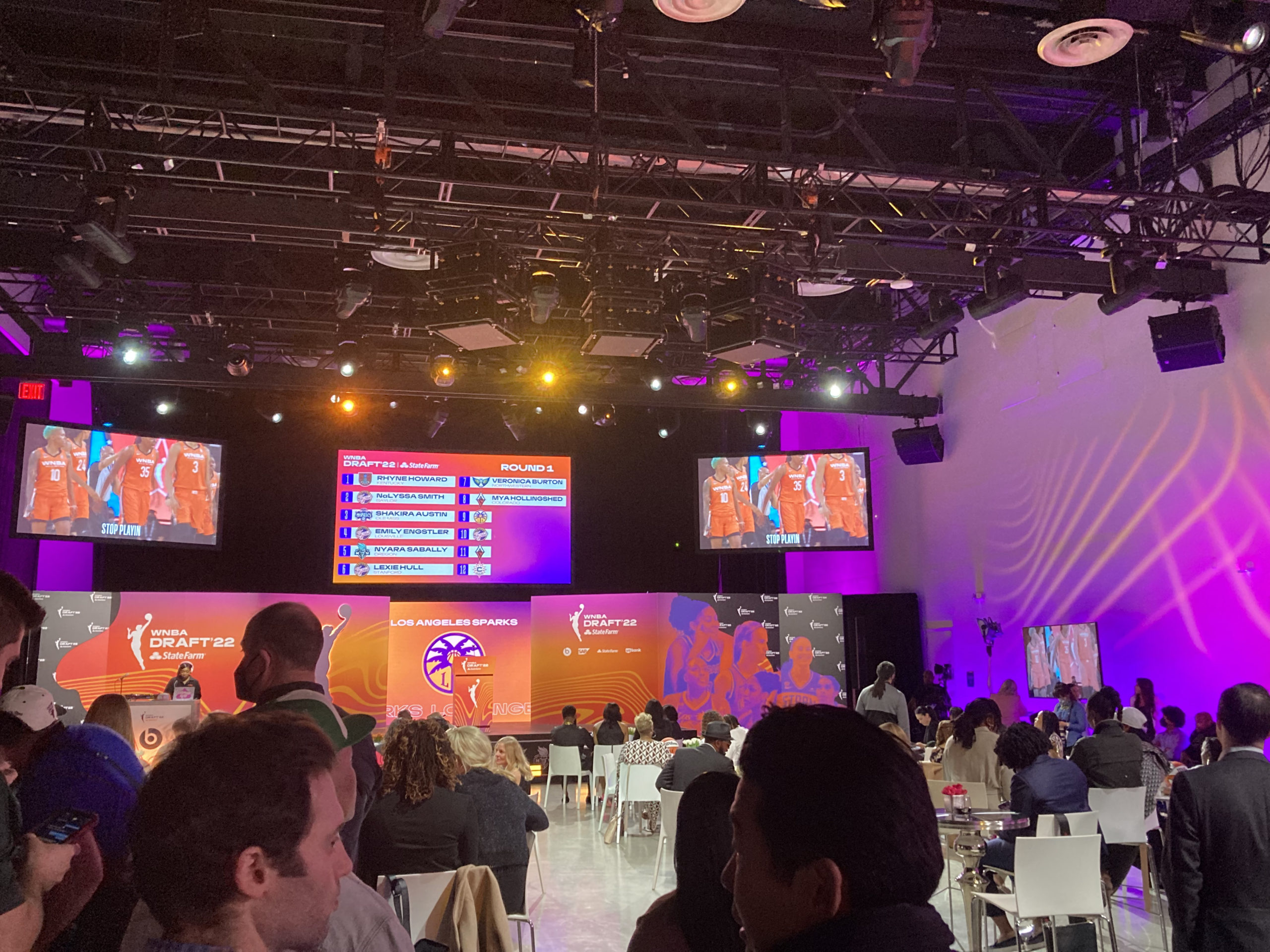
The first draft board I did with The Next was for the 2022 class. I had technically done a draft board in 2021, and although I had some solid takes — such as Natasha Mack being solidly better than Charli Collier, and Dana Evans as a lottery prospect — it wasn’t a systematized process the way it was in 2022.
I have learned a lot since that first real effort in 2022, both by adding Hunter Cruse and Lincoln Shafer to the team and by learning from past successes and failures. Reviewing past drafts, once we’re far enough along to have a handle on how players’ careers are playing out, can be beneficial both for self-reflection and transparency about how my processes have changed since.
The most obvious goof from the 2022 board was having a “65 FV” tier. The 20-80 scouting scale works so that 50 is the average, and each increase or decrease of 10 represents one standard deviation. The further from 50 you get, the smaller the pool of players, so placing someone in a half tier was splitting hairs.
Rhyne Howard would have been a 60 FV instead, and she’s ended up as either a strong 55 or a soft 60, which makes the grade a decently accurate one, but how she’s gotten there has been different than what I expected. The playmaking and the midrange game have matched the scout, and she frequently has defensive reps where she shuts down wings on the ball and provides weakside rim protection.
But what I called “settl[ing] for less efficient shots” was really an inability to get to the rim and mediocre finishing, both of which have severely limited her scoring efficiency. And she has been a defensive 60 instead of a 70 because of average ball-pressure going downhill and screen navigation that wasn’t as standout as I expected.
The biggest reason I should’ve had Howard a grade lower was because of her development arc: She was largely the same player from her sophomore year at Kentucky on, which indicated the unlikelihood that the weaker points in her game would significantly improve.
NaLyssa Smith is my biggest miss to date. I gave her a 60 FV, and she’s a soft 45 at the moment. There are a few reasons for this, the biggest being that I incorrectly translated my own notes into a grade; my notes indicated a player who was at best a defensive 55 and an offensive 50, but in her profile on the draft board, I detailed a 60 on both ends.
Part of that was overrating the importance of certain skills and underestimating others, and buying into a narrative of her appreciably developing under Nicki Collen, which didn’t actually happen to the extent I had thought. I also completely misread her defense outside the paint, which was often dreadful both off the catch and in pick-and-roll coverage.
I probably had Shakira Austin a grade too low (Lincoln would’ve had her as a 55). However, her transformation into an offensive 60 and defensive 70 under Mike Thibault, at least before the hip injuries, was an outcome that I don’t think I should have seen coming. Thibault cleaned up a lot of her bad defensive habits within her first couple of months in the W, and her post scoring improved a ton in her second season in Washington.
After that, I had two notable misses. There was Naz Hillmon, who, if we do the same thing with my “35 FV” tier that we did with the 65, I should have had as a 30. Hillmon is now probably a soft 50, but as a completely different player than she was at Michigan. Her drive and coachability have been the main things that have allowed her to go from a post-scoring big with low defensive usage in college to a roll-and-cut spacing big who’s highly active both at the level and in backline help. Even before her shooting breakout this year, the lesson afforded by her career arc in the WNBA is why I had faith in Angel Reese’s upside coming out of LSU.
There was also Lexie Hull, who was the last player on my board. Her 3-point footwork has been adjusted since she got to Indiana, increasing her utility as a shooter, and her floor game has leveraged that into an ability to attack the more aggressive closeouts that anticipate her 3-point threat, letting her make plays downhill. Her ball pressure on the drive and rotational flexibility also play up her on-ball defense in a way that I thought her lack of burst would limit. I had her as a 30 and would probably call her a hard 45 now.
The rest of my draft board includes lesser learning points here and there. I had too much faith in Emily Engstler to score off the ball when she needed far too much room to get off her threes (an issue Carla Leite has as well, to a lesser extent). I nailed Kierstan Bell being a better defender than scorer, but completely missed the idea of Nyara Sabally being a roll-and-cut big instead of a post scorer. Christyn Williams suffered a torn ACL in her would-be rookie training camp that essentially hamstrung her career (no pun intended), and Mya Hollingshed didn’t break camp for reasons that should only have been apparent in pre-draft team interviews.
I overrated Nia Clouden and Khayla Pointer for reasons I’ve since learned are insurmountable limitations: Clouden’s off-ball movement was poor, and players who make a living off jump shooting can’t be good without the ability to get themselves open; and Pointer’s offensive peripheral stats were truly awful, whether it was rim frequency, finishing or the number of floaters she took instead of stop-n-pop middys. Plus, Pointer had no ability to stabilize her shoulders in the midrange, an issue that no player has been able to overcome.
Everyone else I was fairly close on, overrating a few players — such as Lorela Cubaj — for having defined roles they could succeed in, even if those roles weren’t particularly valuable. All in all, redoing the board with the knowledge I have now would likely result in Smith and Austin switching places, Clouden and Cubaj moving down, Pointer moving off the board entirely, and Olivia Nelson-Ododa moving slightly up.
This exercise is going to be more interesting next year when it’s a conversation between me, Hunter and Lincoln about 2023, our first draft class together.
Monumental Sports and Entertainment, the group that owns the Washington Mystics, holds a minority stake in The Next. The Next’s editorial operations are entirely independent of Monumental and all other business partners.