It’s that time of the year again where we talk about the Hockey Hall of Fame (HHOF). Doesn’t matter if it’s the induction of the newest class into the HHOF or the anticipation of who is chosen to take part in the newest class, hockey fans love talking about who should be in the HHOF. In women’s hockey the conversation has been rightfully dominated by the fact that women are being kept out of the HHOF as if the HHOF was a tree house with a “No Girls Allowed” sign on it.
It’s a conversation that needs to be had until we see the HHOF treat women like the rightful members of the hockey community they are. Women’s hockey fans though also deserve to have the same normal player-focused discussions men’s hockey has, which is what this article will be focused on, a goalie who as been the most HHOF-worthy of anyone the past two years they’ve been eligible.
If women’s hockey history was properly respected and understood, passing on this goalie two years in a row would be earning non-stop articles that active players are already getting with potential HHOF resumes, not even surefire resumes. Unfortunately, this problem isn’t just contained to male-dominated hockey media. While in women’s hockey media they are mentioned it’s like mentioning Angela James in the same breath as Riikka Sallinen. Both are absolutely HHOF talents and deserve to be there. There’s a noticeable gap though that people recognize and understand even HHOF talents can be at different levels.
Let’s look at it this way: Noora Räty and Shannon Szabados are widely considered to be the best goalies to have ever played in women’s hockey. If either one was passed over in their first year of HHOF eligibility there’d be a rightful uproar from all corners of the hockey world. We’re looking at two goalies who dominated international tournaments. Noora Räty has FIVE Top Goalie honours, four All-Star Team honours, an MVP, and the only non-North American no. 1 goalie to win a non-Bronze Medal from the World Hockey Championships in nine tournaments. Then you have Shannon Szabados with two Top Goalie honours, an All-Star Team honour, and the only Canadian goalie to be the no. 1 goalie all three times at the Olympics. This is just a small taste of the individual careers which will earn them first ballot Hockey Hall of Fame status, and that’s why they’re not the goalie I’m talking about. Well, that and neither one is eligible yet.

Instead, I’m talking about arguably the only goalie to be the equal of Räty and Szabados. The player who rounded out the Golden Trio of women’s hockey goaltending. I’m talking about the best player to have ever worn the Switzerland jersey, Florence Schelling.
You can scour the current HHOF-eligible players list as well as the 2022-2023 HHOF classes for someone who was clearly top three at their position and the only name you’ll come up with is Florence Schelling. When Szabados and Räty finally enter the HHOF they’ll be considered in an elite class shared with Hayley Wickenheiser, Cammi Granato, and Angela James. Florence Schelling should be right there with them, and when the inevitable debate pops up about who was the better goalie between Szabados and Räty, Florence Schelling should be a part of the conversation also.
Why, though? Despite women’s hockey not getting nearly the amount of attention it deserves, Räty and Szabados have turned themselves into household names among hockey media and fans alike. Logically, could one could assume if Florence Schelling was at their level, then should she not be as well-known as Räty and Szabados? It’s a fair question, to which I believe the answer to be that she just didn’t play on a good enough national team to be consistently in the same spotlight as Räty and Szabados.
There’s been a very clear top three hockey powers in the women’s game from 2010 to 2021 with Canada, the USA, and Finland. It speaks volumes that Riikka Sallinen, the first non-North American player in women’s hockey to make the HHOF, is Finnish. If you look at the future HHOFer’s who played for Canada and Finland and then compare them to Switzerland’s HHOF candidates in that time period, you’ll see there’s an obvious gap. Canada and Finland have a plethora of options. Switzerland have just two in Schelling and forward Lara Stalder.
What makes Schelling worthy of the Hockey Hall of Fame in a way we rarely see anymore is her career. She’s excelled everywhere she’s been. In her first year with Northeastern in the NCAA she posted the fourth-highest SV% (0.933) on a team that only won five games. In her second NCAA season Schelling posted the second- highest SV% (0.949) beating out some other goalies you might have heard of, like Noora Räty and Geneviève Lacasse.
In Schelling’s fourth and final NCAA season she posted the highest SV% (0.950), once again beating out Noora Räty while also earning herself a finalist spot in the Patty Kazmaier nominations before ultimately losing out to Brianna Decker. Some will contend Schelling lost the Patty Kaz because her helmet was an affront to the goaltending position.
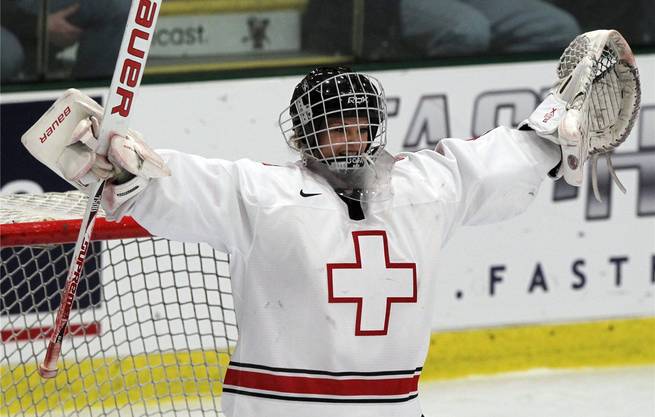
While Schelling somehow left the NCAA without any hardware, she certainly left her name in the record book: 10th in NCAA Women’s Hockey Career Save Percentage (0.940), 18th and 20th in NCAA Women’s Hockey Single Season SV% (0.950/0.949) and being the 2011-12 NCAA Women’s Hockey goalie with the highest SV% (0.950).
While post-NCAA league opportunities were scarce, Schelling made the most of her stints wherever she ended up. Right out of the NCAA Schelling joined the Canadian Women’s Hockey League with the Brampton Thunder and once again excelled. In her only CWHL season Schelling finished first in Shutouts (three), second in Goals Saved Above Average (6.6), second in Goals Saved Above Average Per 30 Shots Against (0.572), and second in Quality Starts % (0.700).
The goalie that beat her in every category she finished second in was Geneviève Lacasse playing for the Boston Blades aka the East Coast portion of Team USA. To put it into more perspective, fellow Boston Blades goalie Molly Schaus wasn’t that far off of Lacasse’s numbers and posted a 0.833 QS% compared to Lacasse’s 1.000 whereas Liz Knox had a 0.333 QS% compared to Schelling’s 0.700 QS%. And while Schelling wasn’t able to beat Lacasse’s numbers she managed to get in front of another goalie you might have heard of, Olympian & three-time CWHL Goalie of the Year Charline Labonté.
Unfortunately the realities of women’s hockey couldn’t keep Florence Schelling in North America and she went back home to Switzerland. It was there she ended up on a third-tier men’s hockey team for the next two seasons. It being a 3rd tier team in the 2010’s means unsurprisingly we don’t have much, if anything, in the way of stats. Thankfully in 2015 Schelling made a move that really added some beef to her HHOF resume when she joined Linköping HC of the Riksserien in its final season before the league rebranded to the Svensa Damhockeyligan, better known as the SDHL. The SDHL continues to attract top-tier talent and is one of the best women’s leagues in the world.
Schelling came in like a wrecking ball her first season in the SDHL, posting the second-highest GSAA and the highest GSAA/30. She finished second in GSAA with only 21 games played when all the other no. 1 goalies in the league such as Sara Grahn saw +30 games.
Schelling’s second SDHL season was a disaster injury-wise for her. She only played in 10 SDHL games yet still somehow finished third among goalies in GSAA where Schelling’s fellow goalies all played almost three times the amount of games. The 1.356 GSAA/30 that Schelling recorded in those 10 games has only been beaten once in SDHL recorded history and it was by Kim Martin Hasson. You know, the young goalie who beat the USA at the 2006 Olympics to get Sweden a silver metal.
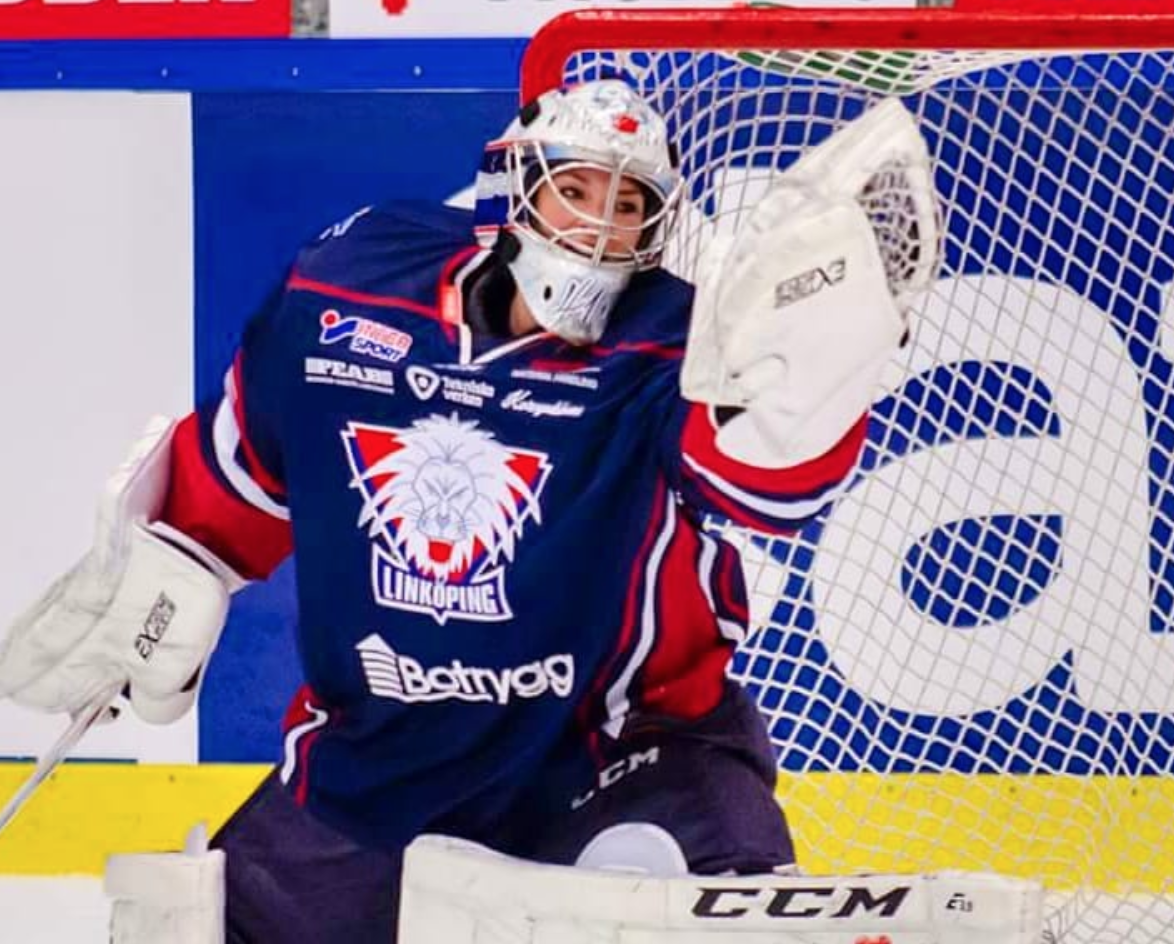
Healthy and ready for one last season, Schelling made her final SDHL year quite memorable. In 30 games Schelling had 27 wins, 10 shutouts, 0.800 QS%, 29.326 GSAA, and a 1.046 GSAA/30.
Let’s break down this final season bit by bit. First, her 27 wins are a single-season SDHL record. Not even Luleå’s current run of dominance has had a single goalie hit the 27 win mark in the regular season. It’s the same situation with Schelling’s 10 shutouts being a SDHL single-season record; she just flat out owns with a few goalies being close but no cigar. Schelling was clearly the best goalie in the LEAGUE in her final season and earned the SDHL Goalie of the Year honours.
Schelling’s 0.800 QS% has been beaten though the number of goalies who have done better depends on the games played minimum. No goalie who started 30 games has ever had a QS% that high. Lower it down to +20 games started and you get a few Luleå goalies like Sara Grahn, plus another elite goalie we’re all familiar with in Klara Peslarová.
Lastly, Schelling’s 29.326 GSAA has been beaten by only one other goalie in SDHL recorded history. Stephanie Neatby posted a 30.355 GSAA in 2020-2021, at least keeping the SDHL Single-Season GSAA Record in Linköping.
All this goes to show that despite only staying in a league for a maximum of four years, wherever Schelling landed she immediately became one of the bests. On its own this is an impressive part of Schelling’s resume, though one could hardly call it one of the best HHOF resumes of all time. Where Schelling earns that distinction is through her play on the two biggest stages in women’s hockey, the Women’s World Championships and the Olympics.
At Worlds
Schelling joined Switzerland’s senior team at 15 years old during the 2004 Worlds. She played three games and started two of them while also earning a 2-0 17-save shutout with the cherry on top being a 2.524 GSAA. Once again, her first senior tournament, at just 15 years old.
Schelling went on to play in nine more World Championships, leaving her as the career leader in games played (41), wins (20), saves (1298), GSAA (33.377), top five SV% finishes (7), and top five GSAA finishes (7). To round out her World Championship resume she’s also fifth in career shutouts (5), 10th in QS% (0.714), 2nd in WHC Appearances (10), and second in GSAA per WHC appearance. Schelling also boasts a trophy case featuring a WHC Bronze, WHC Top Goalie, and WHC All-Star team.

Switzerland earned their first-ever medal in women’s hockey on the back of Schelling at Worlds in 2012 where she posted a 0.800 QS% and whooping 9.145 GSAA with a 1.905 GSAA per 60 minutes. In the bronze medal game Schelling made 50 of 52 stops to beat Finland 6-2 with Noora Räty in the opposing net.
At the Olympics
Her Olympics resume is just as impressive and some might consider it more impressive than her stints at Worlds. Schelling played her first Olympic game at the age of 16 in 2006 and once again posted a shutout as she made 29 saves in an 11-0 win over host Italy.
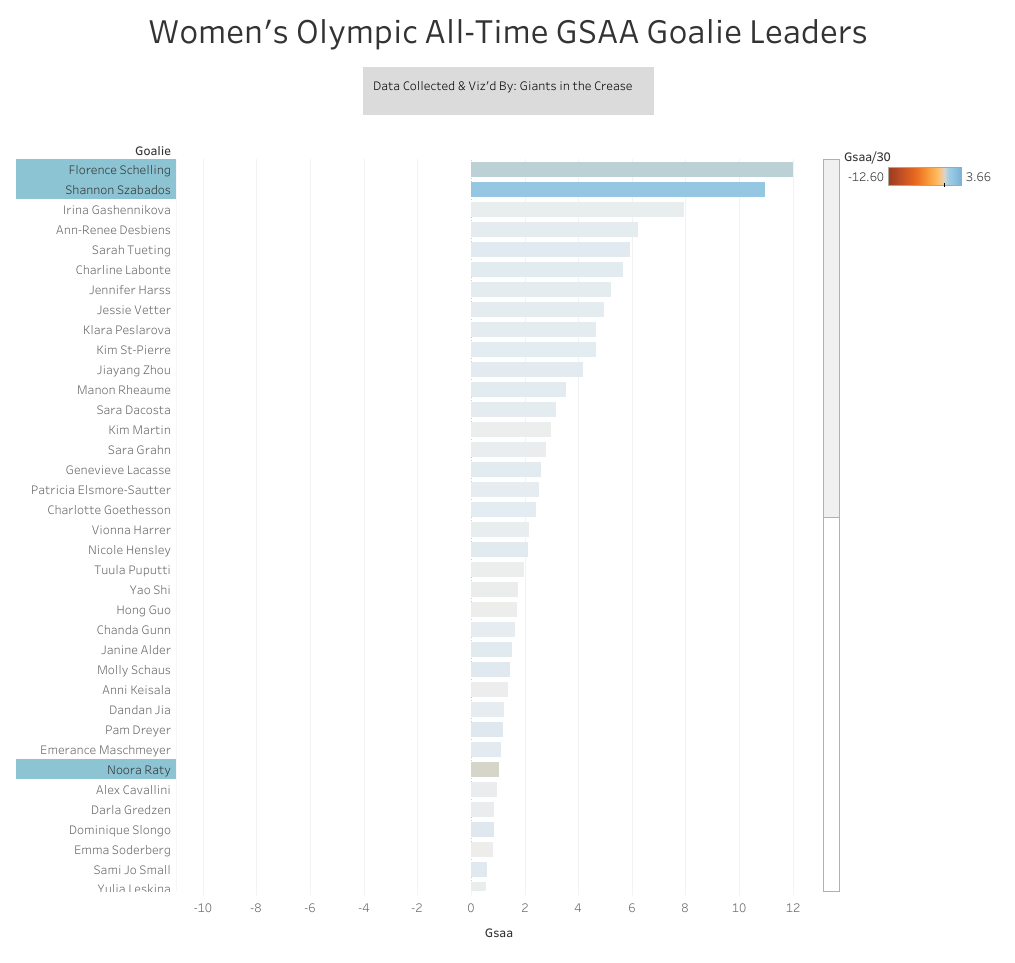
Just like in her first World Championships she shared the Swiss net, but for the next three Olympics the position was Schelling’s alone. Once again you’ll find Schelling all over the Olympic record book as she’s the career leader in wins (10), saves (591), shutouts (5), GSAA (12.002), Olympic appearances (4), and top three GSAA finishes (3). Her other career Olympic numbers aren’t too shabby either, being 2nd in games played (20), 8th in QS% (0.722), 10th in GSAA/30, and 3rd in GSAA per Olympic Appearance (3.001). Just like at the World Championships two years earlier, Schelling backstopped Switzerland to its first Olympic medal in women’s hockey in 2014. It was also Switzerland’s first hockey medal at all in the Olympics since 1948.
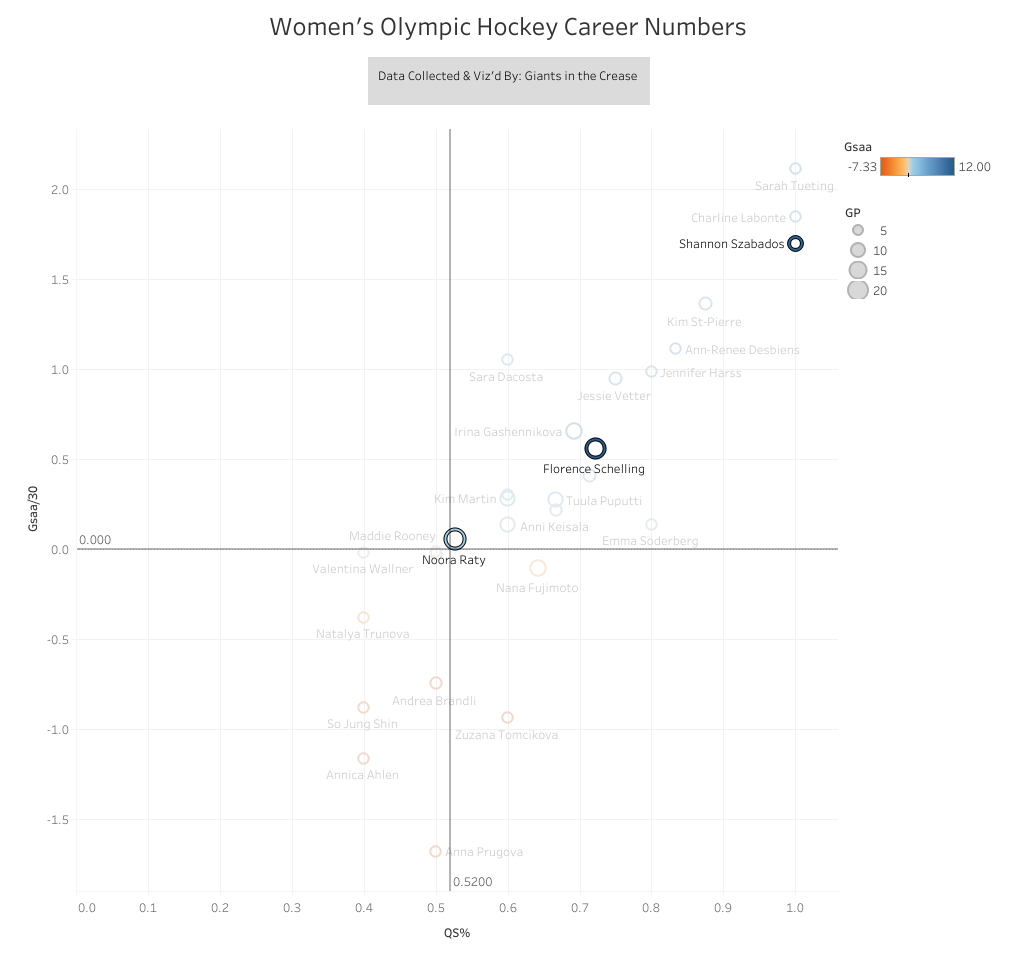
This accomplishment had Schelling sweeping the 2014 Olympic honours. She was named to the Olympic All-Star team, named Top Goalie, and she made history when she was named Tournament MVP, a first for women’s hockey goaltenders.
While Switzerland couldn’t repeat their 2014 medal run in 2018, Schelling made sure to leave with a bang, making 20 saves for a 1-0 shutout over Japan in her final Olympic game.
Measuring Up Against The Greats
Let’s say for the sake of argument that compiling these career records isn’t enough to put Schelling in the same tier as Räty and Szabados.

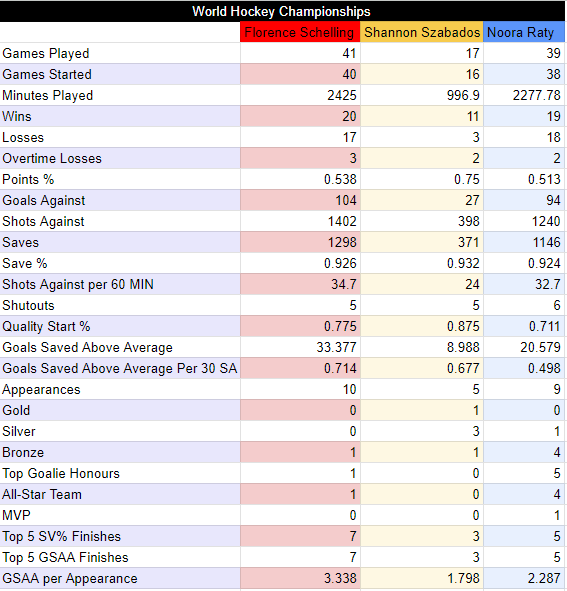
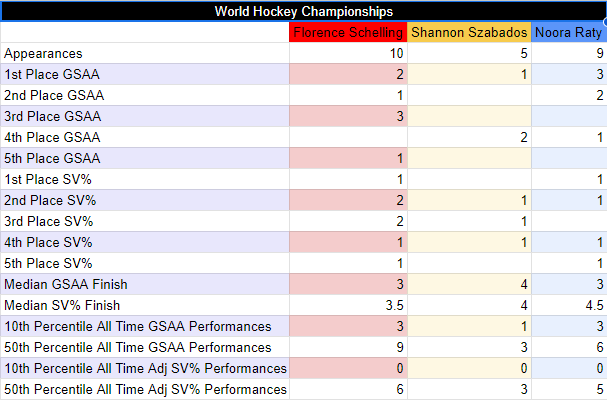
Digging further into the numbers just makes it more clear how close these three goalies are to each other. Schelling (0.775) is in-between Räty (0.711) and Szabados (0.875) for Career WHC QS%. Looking at career WHC GSAA/30 (or in other words adjusted SV%) and Schelling leads both Räty and Szabados. Schelling even leads in GSAA per a WHC appearance. She’s been in the top five for both GSAA and SV% 70% of the time in the WHC while Szabados is at 60% and Räty at 56%. When we dig even further and look at median WHC GSAA/SV% finishes, all three goalies are right next to each other. There’s barely any separation between the three of them.
The Olympics just drives the point further home. It’s pretty clear Shannon Szabados is the greatest goalie to play in the Olympics in women’s hockey, possibly the greatest Olympic goalie of any gender. It isn’t Räty who is second fiddle in this trio to Szabados: it’s Florence Schelling.
Schelling clearly has the second-best Olympic resume out of the three of them. She matches Szabados in their top five GSAA finishes. Schelling’s Olympic QS% and GSAA/30 is clearly ahead of Noora Räty’s. Schelling is right there with Szabados on Median GSAA Olympic finishes. Once again Szabados is the clear dominant one in Median SV% Olympic finishes and while there’s a noticeable gap to Schelling there’s also a gap between Schelling and Räty in Schelling’s favour.

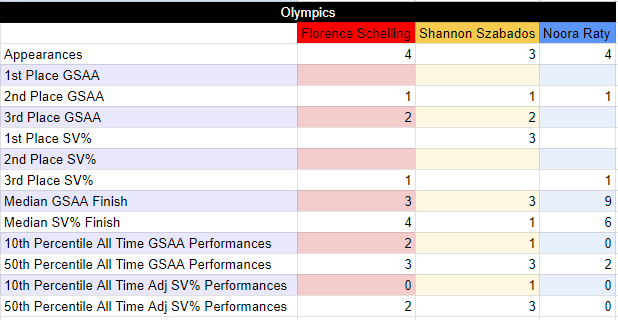
It’s clear these three goalies are so intertwined in their international careers where each one dominates in some aspects, is second best in others and third in a few it’s nearly impossible to parse out who is the better goalie. Even if you can parse out the better goalie I think this breakdown shows that any differences in who is the first, second, third, etc., best of all time is essentially a knife’s edge. These three goalies are intertwined by era and dominance. You can’t talk about one being the best without also talking about the others. You may prefer one over the others, but the fact is the differences between them are negligible.
If you believe Noora Räty or Shannon Szabados are first ballot Hockey Hall of Famers than so is Florence Schelling. If you believe Noora Räty or Shannon Szabados are the best goalies to ever be in women’s hockey than so is Florence Schelling. They’re the Golden Trio for a reason because women’s hockey has not seen a better goalie than the three of them and it’s a shame it happened when women’s hockey didn’t have nearly the amount of coverage it should have as we’re now seeing the effect of it.
To the point of Florence Schelling being the most HHOF-worthy in all of hockey, look at the current eligible players as well as the ones who were in the last two HHOF classes (2022-2023). What players are matching up with Mario Lemieux, Ray Bourque, Patrick Roy, Hayley Wickenheiser, and Angela Ruggerio? The answer is none.
If the HHOF was truly based on merit and everyone in hockey who engaged in the debates about who deserves to be in the Hall cared about seeing the best in the HHOF, we’d be seeing articles like this a few times a year at least. Hopefully this helps push the conversation in a way that in the summer of 2024 we finally see Florence Schelling announced as a HHOF Inductee.