The third season of the PWHL is almost underway. Before players take to the ice – and, inevitably, take the occasional (or frequent) trip to the penalty box – we’re preparing by visualizing trends in special teams from the 2024-25 regular season.
Activation
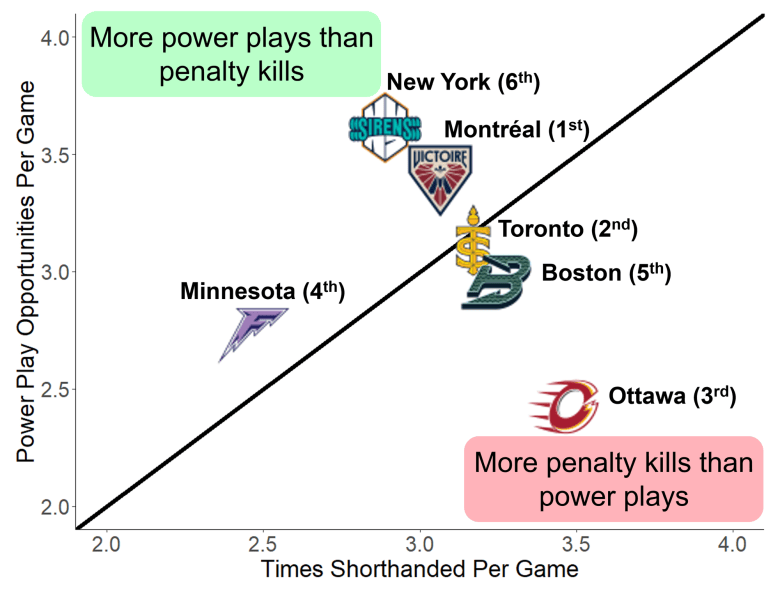
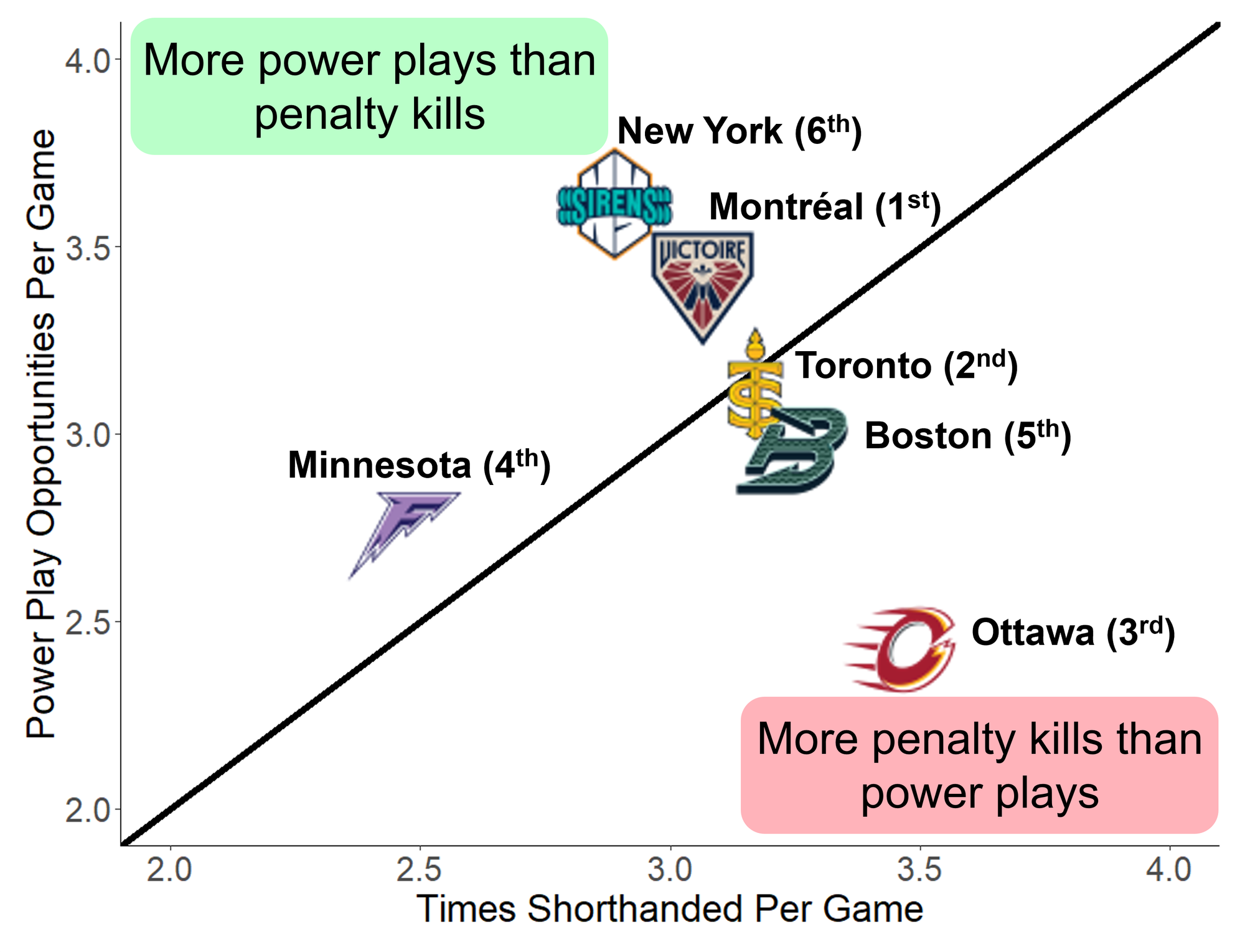
Graphing power play opportunities against times shorthanded reveals a few interesting points. With players like Tereza Vanišová bringing the intensity and racking up the PIMs, no one should be surprised that the Ottawa Charge was the most penalized team, with an average of 3.5 times shorthanded per game. However, despite Britta Curl-Salemme’s notorious reputation (as demonstrated by her three suspensions), the Minnesota Frost averaged only 2.5 times shorthanded per game – the lowest in the league.
On the other side of the coin, the New York Sirens and La Victoire de Montréal were the clear leaders in penalties drawn, both seemingly excelling at getting under their opponent’s skin or otherwise enticing them to make illegal plays. But that might be the last of the similarities between these teams, as they finished the regular season at opposite ends of the standings.
Efficacy
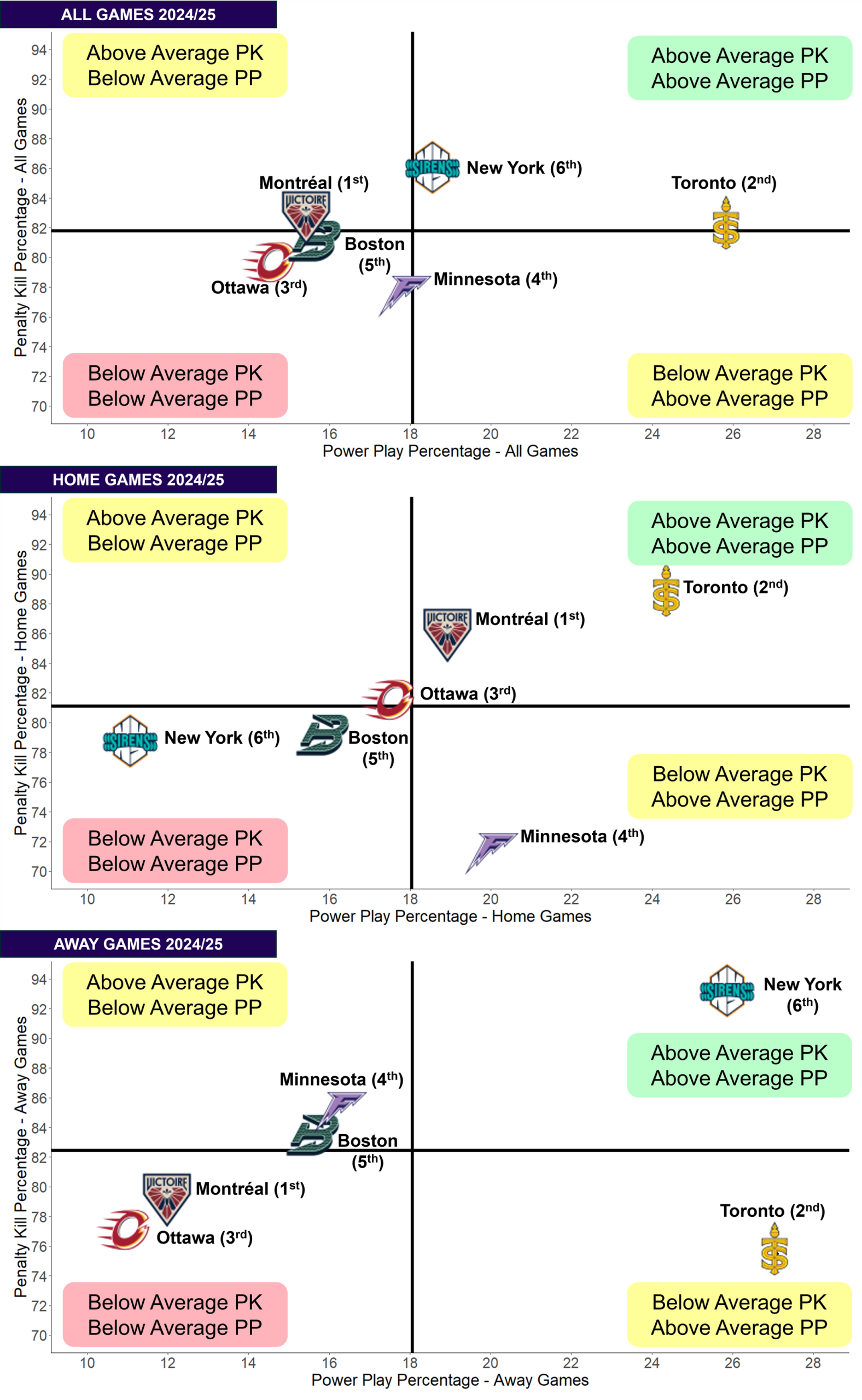
To understand special teams performance, we can compare power play percentage (proportion of power play opportunities during which the team scores a goal) and penalty kill percentage (proportion of penalties that the team kills off shorthanded without conceding a goal). In considering all regular season games, the Toronto Sceptres power play stands out for its exceptional output, which was a main storyline for the team last season. How this power play survives without producers Hannah Miller, Julia Gosling, and Sarah Nurse remains a question mark for the Sceptres in the upcoming season.
Hilary Knight rifles in a power play goal, the first goal of the 2024-25 PWHL season. Hannah Bilka has the A2 here, her first career PWHL point. Keller with A1. It’s 1-0 Boston Fleet. pic.twitter.com/mwWNAK5Z3I
— Mike Murphy (@DigDeepBSB) November 30, 2024
If we break things down further into home and away games, we see that while the power play for La Victoire was arguably underwhelming last season (especially given their talent on paper), it was particularly lacklustre on the road. Meanwhile, the Frost flip-flopped between flexing their power play in home games and penalty kill in away games, without quite finding the coordination to make both work at the same time. The Boston Fleet, however, consistently underperformed in the special teams department, an aspect of their systems they’ll likely look to improve upon with some new perspectives behind the bench.
Impact
Overall, there was not a clear link between special teams activation and regular season standings – possibly because there was minimal variability with only six teams and so much parity. An effective power play proved to be lethal for the Sceptres and likely played a role in creating some separation from the 3-way tie for points behind them in the standings. But despite having a decent (albeit inconsistent) PK and PP of their own, the Sirens seemed to struggle to make 5-on-5 hockey work. Having said that, special teams mediocrity did not prevent the Frost from squeaking into the playoffs and eventually hoisting the Walter Cup.
While special teams can be a critical element of a team’s repertoire that can shift momentum in individual games, they might not have as strong an influence on big-picture outcomes in this league (yet!). But this might all get shaken up, as player movement prompts the (re)construction of special teams units and strategies. And with penalties per game in the second season (league average of 3.06 player advantages per team per game) slightly up from the first (league average of 2.83 player advantages per team per game), this trajectory – along with the injection of new talent and dynamics – will continue to make special teams a hot topic in the PWHL.