It’s felt like a mad dash to the start of the season that hasn’t stopped even once the season got started and only now could everyone take a breath.
For some people in the PWHL, the non-stop preparation for the season has been a six-month long period. For management of the six PWHL teams, they’ve had a few months, at most, to put together staff and a team ready for opening week. For the players, the challenge was getting up to game speed after having not played any consistent hockey since March/April 2023. For management and coaching staffs, the challenge is turning a group of +20 players into a team that pulls the rope in the same direction.
The general managers and coaches came into this season as blind as can be. They had no idea how play in the PWHL was going to look, which players were going to thrive, which would struggle out of the gate, who would struggle to adapt with such a high talent floor, and what strategies would work best for the line-ups.
You know the saying “everyone has a plan until they get punched in the mouth”? That was on the minds of the management/coaching staffs for each PWHL team coming into the season. You weren’t getting a team where even 40% of the team had played together previously. You had no idea what the general play of the PWHL was going to look like. All they could do was jump feet first into the season and hope they didn’t drown before the international break.
It’s been a somewhat even start to the season for every team. No one team has pulled away from everyone else or been completely left behind the pack looking at a first overall pick already. Obviously some teams have had it easier than others such as Montréal and Minnesota whose superstars are leading the way. Then there’s Toronto who is having to fight tooth and nail for every point they’ve gotten so far, nothing easy is happening for them.
Still though in the current PWHL point system no one can feel safe when every regulation win is worth three points and quite a few games are going to overtime. That’s why PWHL management and coaches across the league are grateful for this break in games so they can take a minute to give the past month the retrospective it needs to ensure future success. During the first month of the season it’s been all about preparing for the next game and making small adjustments. This break is now allowing teams to look further ahead but also look in detail at the first month and a bit of the season. The question every team is looking at right now is what does their team need for sustained success for the next stretch of the season?
Boston
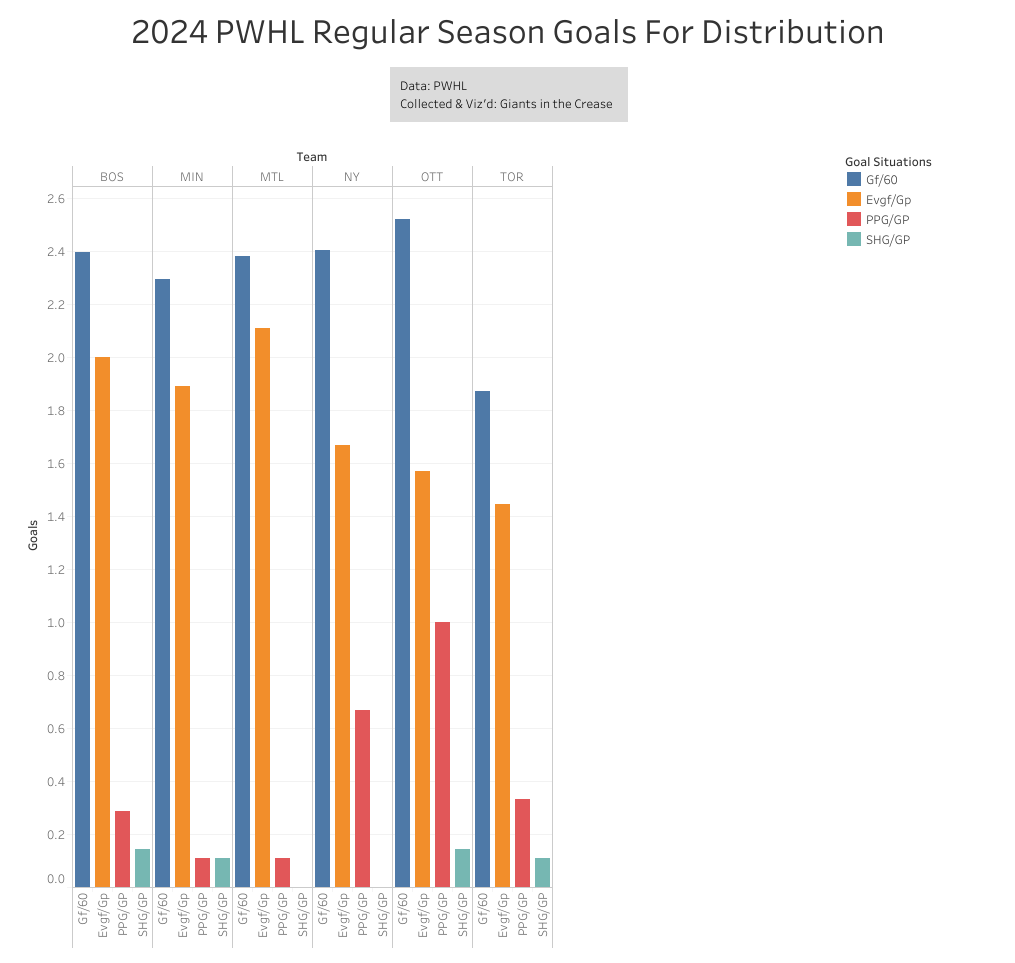
To say it’s been a mixed bag for Boston to start the season might be an understatement. This was a team loaded with offensive talent and who many expected to score a lot of goals while also stopping a lot of goals from going in. The former is happening as they sit first in the PWHL in team shooting %, second in all strengths GF/60, and second in even strength GF/60.
Despite all those very positive offensive team stats the team is currently third in the league both in points and in PTS% because they’ve been having issues keeping the puck out of the net. Boston currently sits last in EVGA/60 and fourth in team SV%. They have a special teams goal differential of plus two but sit at minus one in even strength goal differential.
Now as a reminder this is all a seven game sample size which means this doesn’t paint a picture of what the team will be for the next 17 games. What this does provide though is something for the team to build off and decide what cracks in the foundation need covering up.
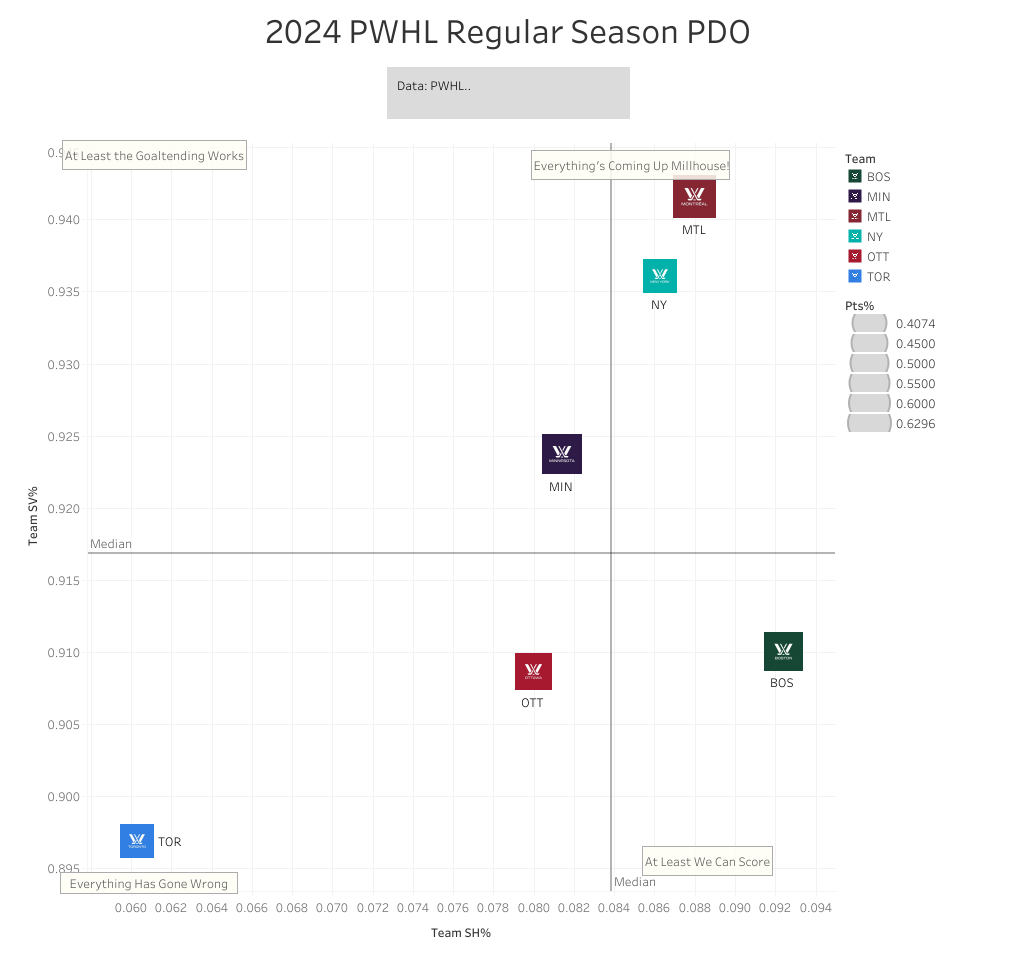
When the team SV% is fourth in the PWHL it’s easy to point towards the goaltending and declare they just need to be better. The coaching staff can’t simply do that though and expect results, a deeper dive needs to be done into the team.
A deep dive which would point out you can lay the feet of one loss at a goaltender’s feet (4-1 loss v NY) but the primary issue is the defensive core is they are who we thought they were. Quite talented offensively but lacking the defensive game to back it up. So far Kessel’s plan to shelter a struggling defensive core has put a lot of focus in clogging up the neutral zone. Prevent the zone entry at all costs is the mantra because once the puck is in the defensive zone Boston starts to show their weaknesses. Boston staff meetings will focus on the best way to direct their players in the defensive zone to try to get the puck out quicker or looking around for steady presence in the defensive zone.

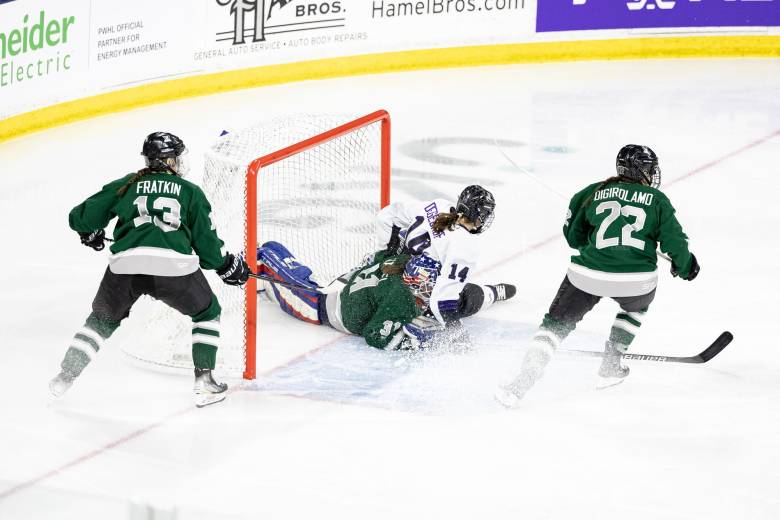
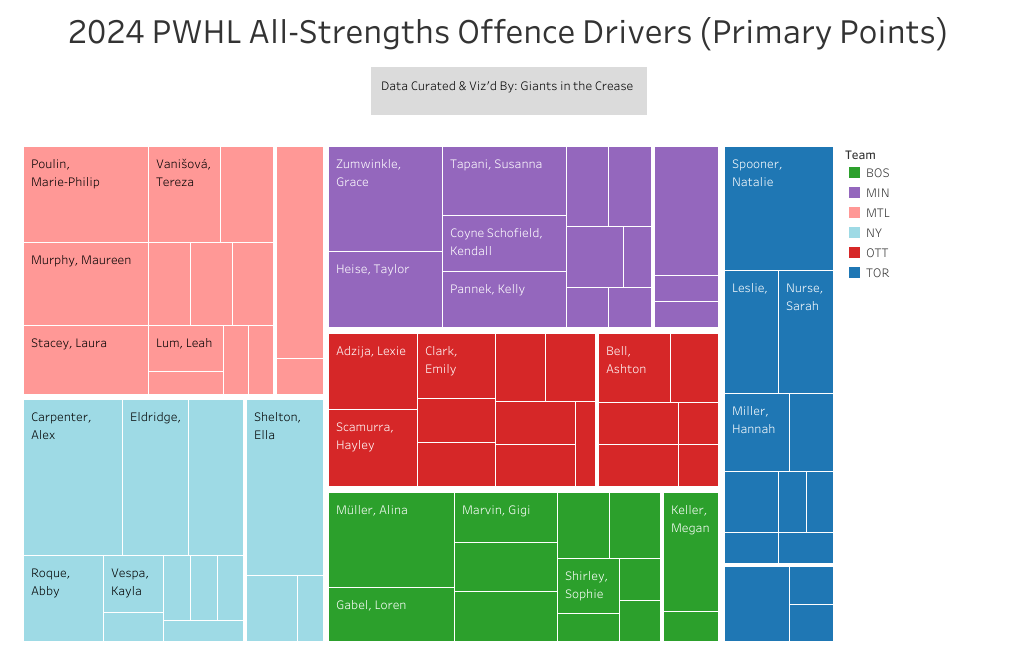
Boston is obviously thrilled by the duo of Alina Müller and Loren Gabel. They are leading the way offensively for Boston, especially Müller who hasn’t just put herself as the frontrunner for PWHL Rookie of the Year but also PWHL MVP. Müller leads the league in PTS/GP, primary PTS/GP, even strength PTS/GP, and even strength primary PTS/GP. The scoring depth of Boston hasn’t been bad and in fact has even been good. If Boston intends to catch up to Minnesota/Montréal they need scoring depth from the back end. Megan Keller is doing great with four primary points in six games. Rest of the defence has a single primary assist. They have the offensive talent on the blueline to overwhelm teams but need to see more from Sidney Morin and Jessica Digirolamo. If Boston’s offence starts coming more from the blueliners then we’re going to see that high potential team run through everyone as was expected.
Minnesota
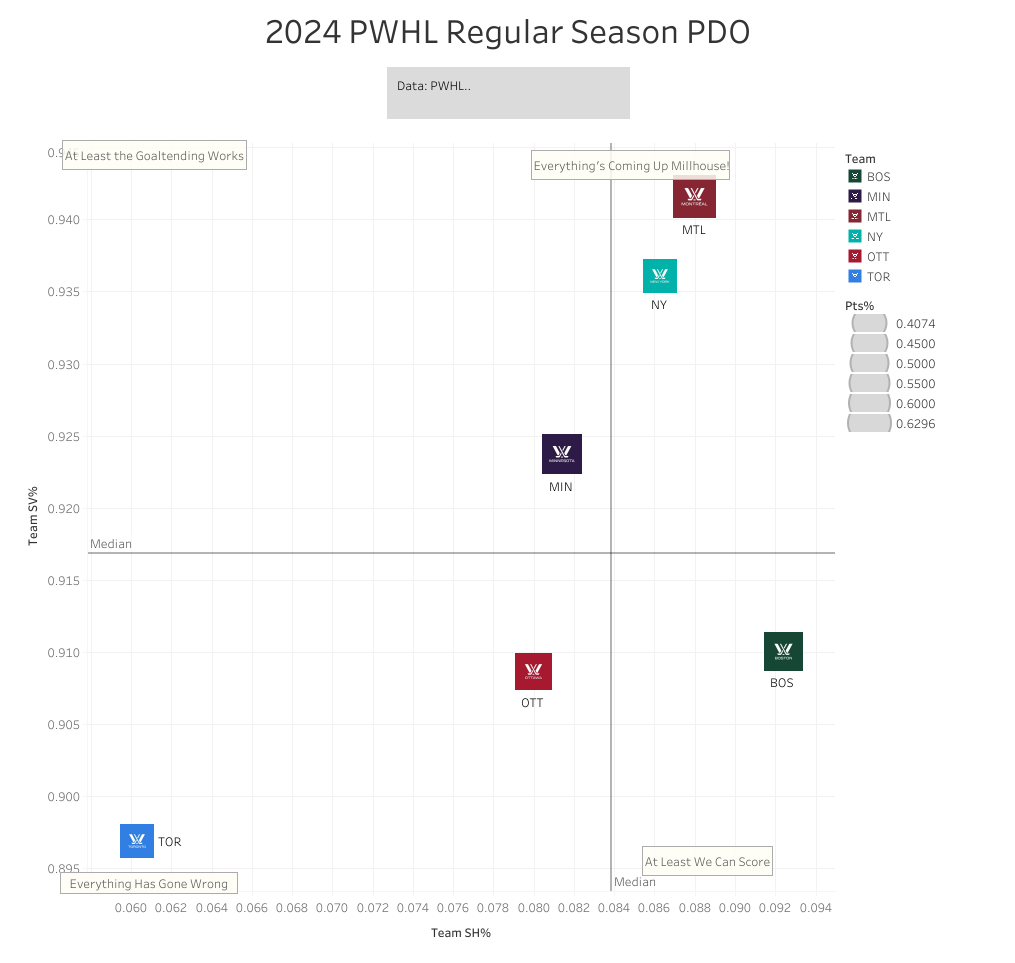
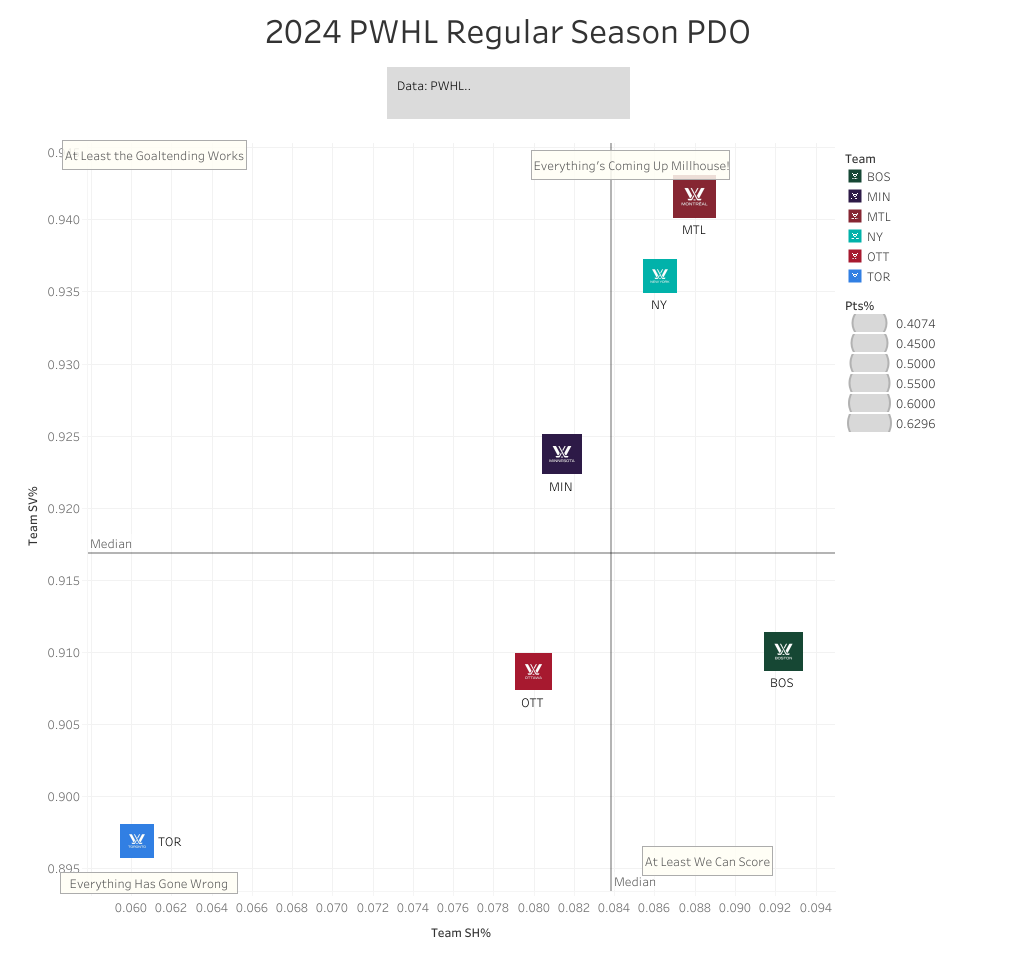
If there’s a team where management, players, and the coaching staff are just relaxing during the international break it’s Minnesota. They started off the season on a tear, winning three-straight games in regulation riding a PDO (Team SV%+Team SH%) high. If you asked General Manager Natalie Darwitz what she thought about her team’s start, she’d say it was all going according to plan. Recent NCAA graduates Taylor Heise and Grace Zumwinkle led the way offensively, especially in the first three games where they scored a combined seven goals. The defence that was designed to play great defence didn’t supress shots against but did force a lot of perimeter shots. Finally the veteran goaltending duo of Nicole Hensley and Maddie Rooney needed to deliver steady goaltending which they arguably have resulting in a team SV% of 0.924, not far off of the league leaders (New York/Montréal).

Everything appears to be coming up Millhouse for Minnesota so what is there for Ken Klee and his coaching staff to think about improving when it comes to the next stretch of games? They’re getting good secondary scoring and Lee Stecklein is looking to prove last season’s offensive performance (15 points in 20 games) wasn’t a fluke. In fact, she has five primary points in nine games matching the production of Taylor Heise. There’s not much to nitpick about a team second in points in the PWHL except for two aspects. The first is team consistency, especially when it comes to road games. At home the team has a 55.4 Shots For% and on the road they have a 46.5 Shots For %. And while Grace Zumwinkle has remained productive after her hot start with four points in the last six games Taylor Heise has seen her production start to stall out as in the last six games she has two points, only one of which was a primary point.
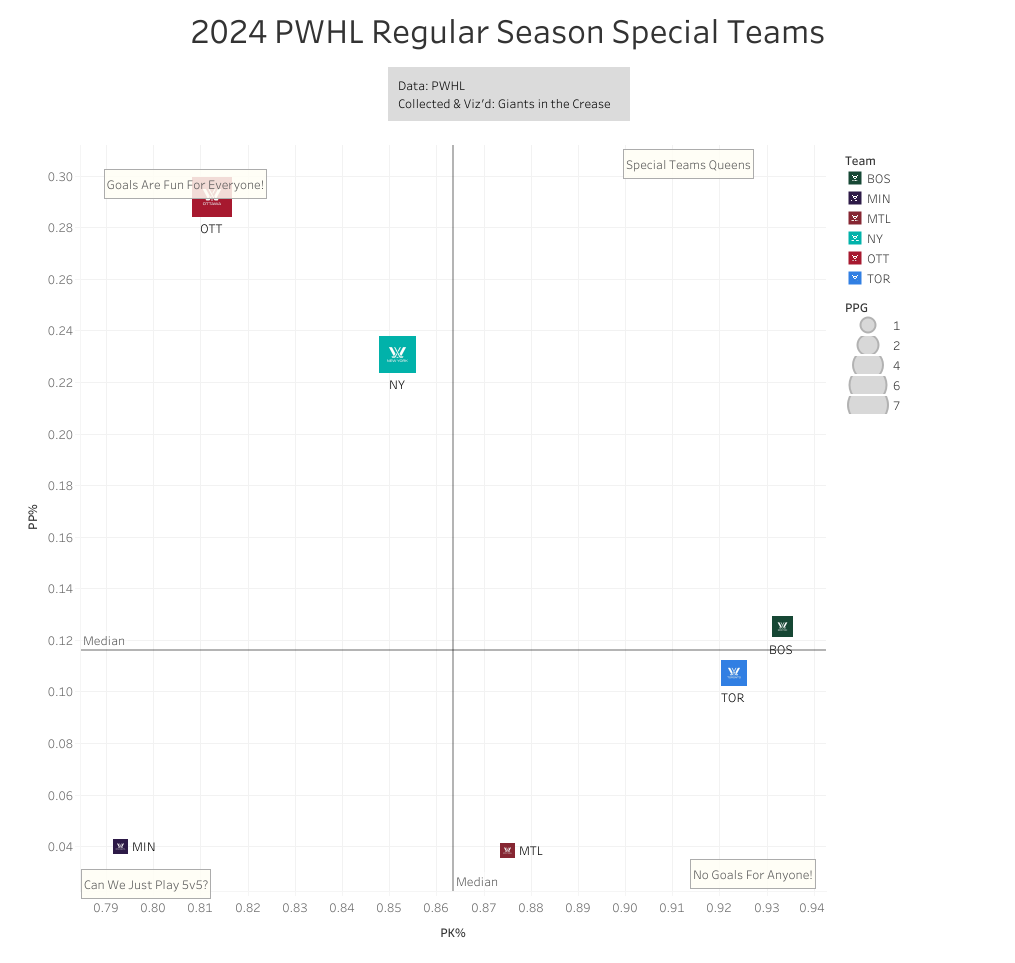
The other issue Minnesota seems to have is special teams. They have the lowest special teams goal differential (-4) in the PWHL, the second lowest PP% (4.00%), and the lowest PK% (79.31%). The PK issues would be less of a problem if Minnesota didn’t have the second highest amount of PK’s in the PWHL with 29 which means Minnesota allows a league high 0.667 Power Play Goals Against per Game. The PK issues could also be less of a problem if Minnesota could score on the power play. Somehow with all that scoring talent Minnesota only has one power play goal so far this season. Keep an eye out for new power play set ups and possibly new penalty kill players as we get into the next part of the season.
Montréal
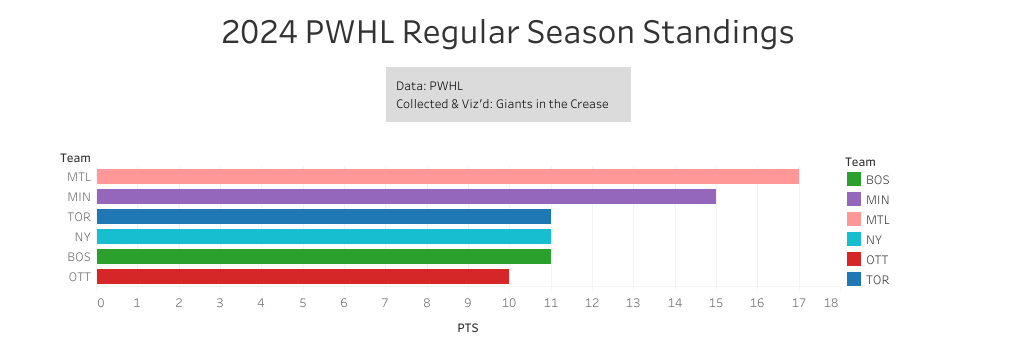
If there’s a team meeting expectations, it’s Montréal. They came into the season with the best player in the world and the best goalie in the world along with a roster well regarded in the analytics community. The word to use for Montréal is consistency. They’re not needing to go on hot streaks or PDO benders, they just come into each game with a game plan in mind and execute it. They have the highest even strength GF/60 (2.381) and the second highest team SH% (8.80%). Montréal has the best line in the league in Marie-Philip Poulin, Maureen Murphy, and Tereza Vanišová. The secondary scoring is arguably among the league best with Laura Stacey, Ann-Sophie Bettez, and Erin Ambrose stepping up with very good production. Then there’s the goaltending with Ann-Renée Desbiens and Elaine Chuli who have delivered Montréal a league best Team SV% (0.939).
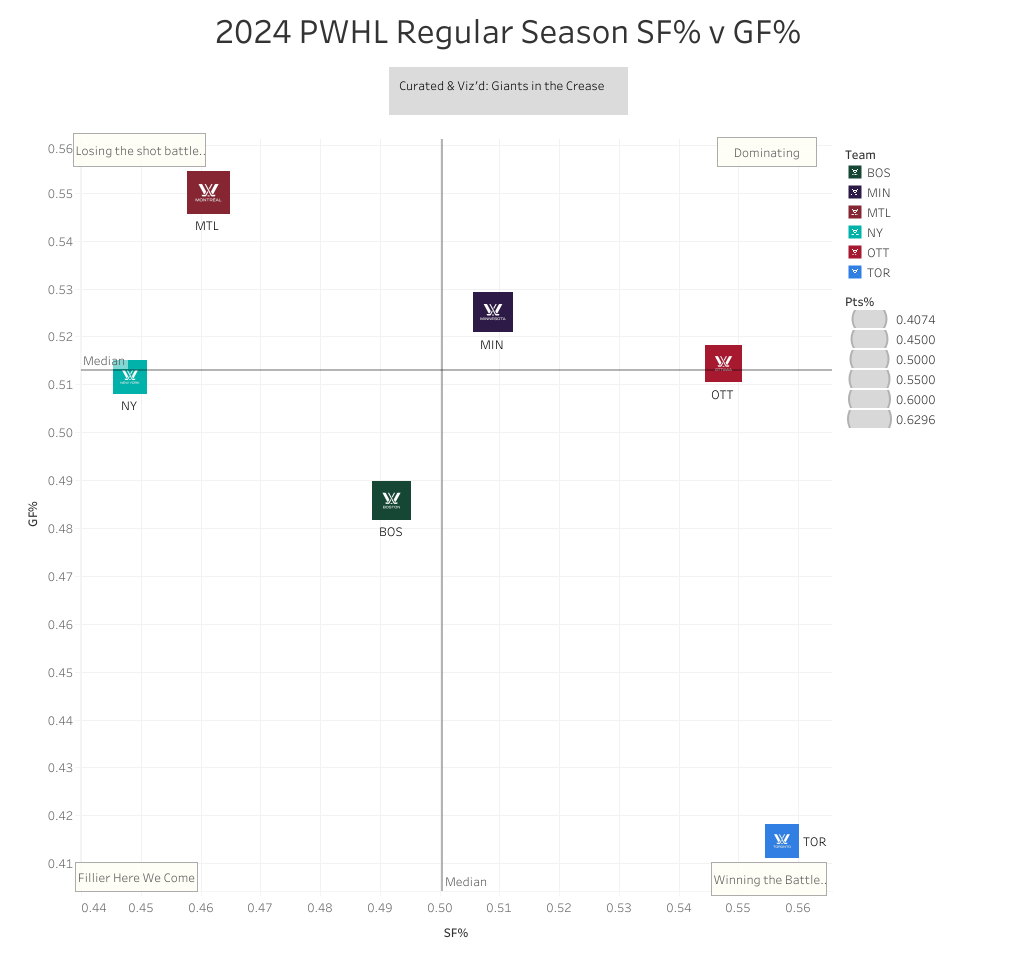
With Montréal, the concerns are different than the other top in Minnesota. Montréal is doing great scoring goals and keeping the puck out but are dangerously close to looking like a team riding a PDO high. Their league high SV% isn’t that much higher than the other two teams near them (New York/Minnesota) so while there will probably be regression it won’t be by a lot. The troubling part for Montréal is they have the second lowest shot share in the league (46.13 SF%) with the only team below them being the 11 point New York squad.
Where Montréal is noticeably struggling is their defence is unable to get the puck out of the zone efficiently which has led to a three-game streak of +40 shots against. Credit where credit is due, while the Montréal defence is allowing a lot of shots against they’re bending not breaking which means Desbiens/Chuli aren’t being hung out to dry. They’re busy but rather than having to stop a lot of Grade A Chances, it’s just a lot of Grade B Chances. Allowing +40 shots against per game isn’t a sustainable strategy though and Cheverie has to give her defenders more support in the defensive zone.
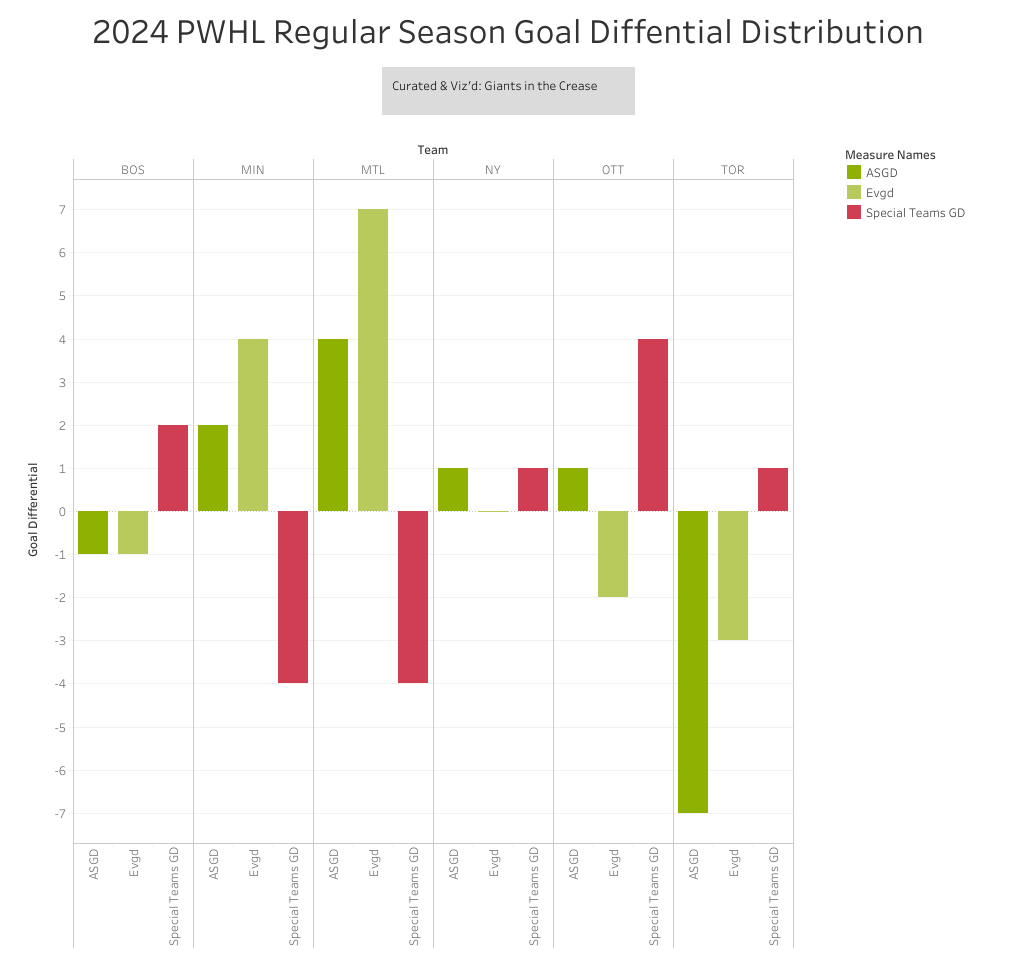
Oddly just like Minnesota, Montréal is also struggling a lot when it comes to special teams. Montréal has the lowest special teams goal differential (-4), lowest PP% (4.17%), and the third lowest PK% (86.67%). But wait it gets worse. Montréal has a 3.85% PP when in reality it should be 0% as they have a shorthanded goal against as well. They lead the PWHL in PK’s with 32 which is three higher than the next closest team in Minnesota with 29.
All of this can be mitigated by being more effective on the power play. Montréal is tied for second in the PWHL in overall power play’s at 26 with only Toronto having more at 28. If Montréal can start scoring on the power play their discipline issues and dodgy penalty kill don’t garner much more attention. It feels like the 5v5 offence efficiency should translate soon into PP success with all the talent Montréal has, especially since Montréal’s only PP goal is held by reserve list player Catherine Dubois.
New York
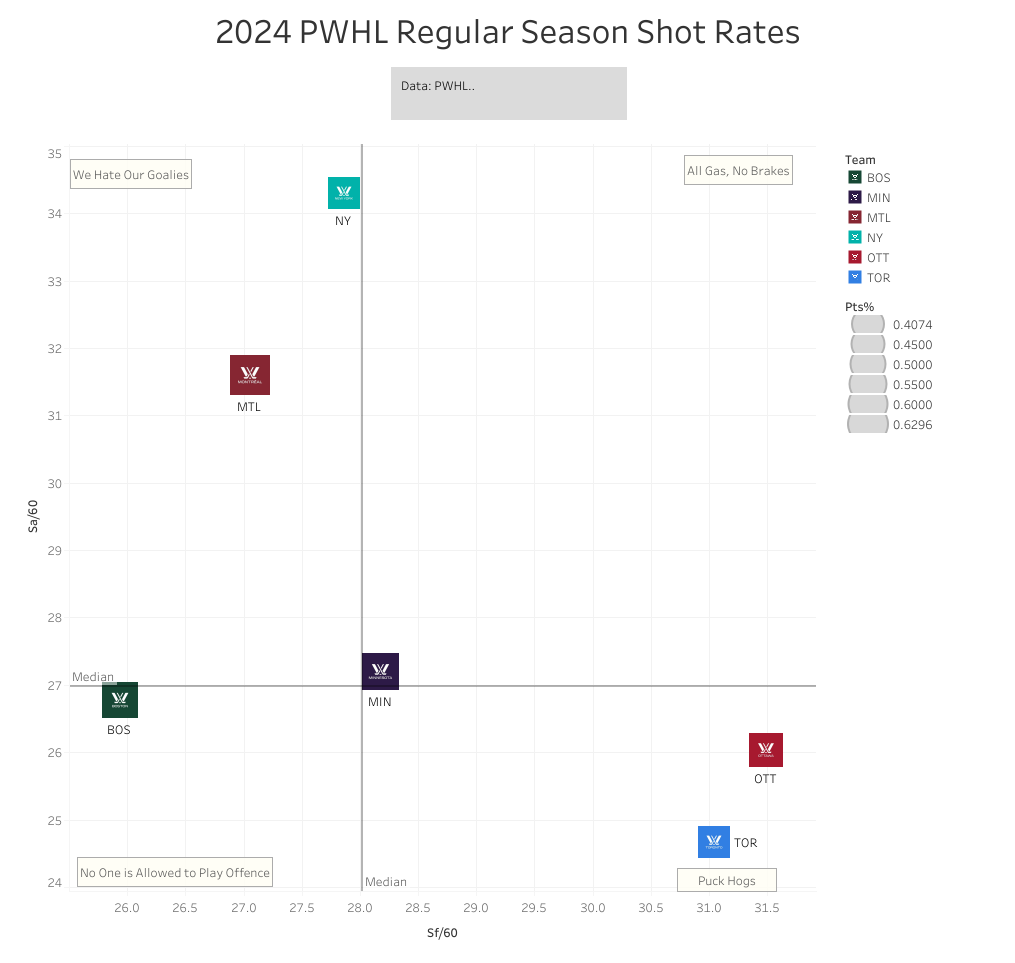
If there’s a team who isn’t playing to their potential, it’s New York. After a great start to the season in Toronto, New York has been plagued by inconsistency. They’re currently being held together by duct tape, goaltending, Ella Shelton, Alex Carpenter, and Jessie Eldridge. When New York plays their game by employing their heavy rush attack, teams struggle to handle the chaos it causes. New York has a strong roster of shooters who are among the most dangerous in the game once they’re in range. They want to get teams into playing high event hockey but at best they’ve been inconsistent in finding success in that regard. The biggest reason New York hasn’t found themselves side-by-side with Toronto is that goaltenders Corinne Schroeder and Abbey Levy have been holding up their end of the bargain. New York currently boasts the second highest Team SV% (0.936) so while New York is bleeding shots against (34.31 SA/60) the New York goalies are handling them well.

What New York isn’t handling well is getting into the zone with control of the puck. They have speed, size, meanness, and good shooters but if they can’t create offence off the rush the opposing team has them dead to rights. The biggest task for Howie Draper and everyone else on staff is creating offence. Versus Minnesota they struggled up until the third period where Minnesota lost their cohesion and it turned into high event hockey.
The two games before that New York only had 19 shots for per game. This shouldn’t be a team that struggles to play a successful rush offence especially now with Micah Zandee-Hart back on the roster to help with zone exits. Draper needs to find a way to get the New York forwards on the same page in regards to zone entries or New York is going to continuously run into the issue of turning the puck over in the neutral zone or just inside of the offensive zone leading to dealing with counter-attacks all game long.

While the coaching staff needs to take part of the blame for New York struggling they need some players to step up their game. At even strength the New York blueline had only seen one player produce primary points in Ella Shelton up until their ninth game of the season. At all strengths, Zandee-Hart and Bourbonnais have three primary points combined. With the way Bourbonnais is playing though it’s starting to feel like a matter of time before we start seeing her on the scoresheet more often.
At forward it’s even more concerning. If not for a Jade Downie-Landry hat trick and Abby Roque not having a big game against Ottawa, the secondary scoring for New York would have them at the bottom of the PWHL. They need another consistently producing forward to vault them back into contention for best in the league or some small hot streaks for lower in the line-up to give them that extra goal to win games. The best way to make that happen is find a playmaker to slot in with Eldridge and Carpenter. Carpenter can score from range and Eldridge can score when the offensive zone gets chaotic. A playmaker that is good at consistently entering the zone is a position New York would love to see filled internally to put them in Cup contention.
Ottawa
Is there a team more beloved and fun to watch than Ottawa right now? They were an absolute wild card coming into this season as they had the youngest roster to start the season as well as the most multinational team. It’s the team everyone has their eyes on because Ottawa looks like a team ready to break out and go on hot streak in a big way.
Ottawa currently sits fourth in the PWHL in PTS% and is poised to make a move to end up higher in the standings. They’ve arguably played the most structured and controlling hockey out of the six teams. They’re second in PWHL all strengths shot share at 54.74% and it’s been so consistent too. There’s only been one game that Ottawa was on the wrong side of the shot clock out of the six they’ve played.
The key to Ottawa’s success has been their league best mobile blueline. Teams will get the puck into the Ottawa zone but their defenders are right on the puck and it’s become second nature for them to move it quickly. Then in the offensive zone it’s all about possession and activating the blueline to keep the pressure up. Of course it definitely doesn’t hurt that Emerance Maschmeyer has been extremely consistent in net and might never get a night off because of how important she is in being a steady presence for the PWHL’s youngest team.
Having the fourth highest PTS% in the PWHL standings indicates that not everything is going perfectly for Ottawa and that would be correct. As mentioned above, one of the biggest strengths of the Ottawa is their very mobile defence. They can more than easily keep up with any team in the league and that’s helped in the defensive zone by a mobile forward core as well, everyone can skate.
Where Ottawa runs into issues defensively is their positioning and decision making in the defensive zone needs to be tightened up. The other teams are putting the puck in the net but it’s Ottawa giving their opponents the puck to quickly strike for goals. They’re not making mistakes that lead to low danger chances which is normal but rather it’s mistakes leading to high danger chances and not just a few either.
MacLeod wants her team to play with pace which is what they’re doing and why they are winning the possession game more often than not by a good margin. I don’t know if it’s fatigue or players assuming they always have to make a semi-risky play at least but it needs to be fixed. Players need to evaluate situations better and realize it’s ok to pass up on a high risk play when the score is close or tied to prevent those devastating goals.
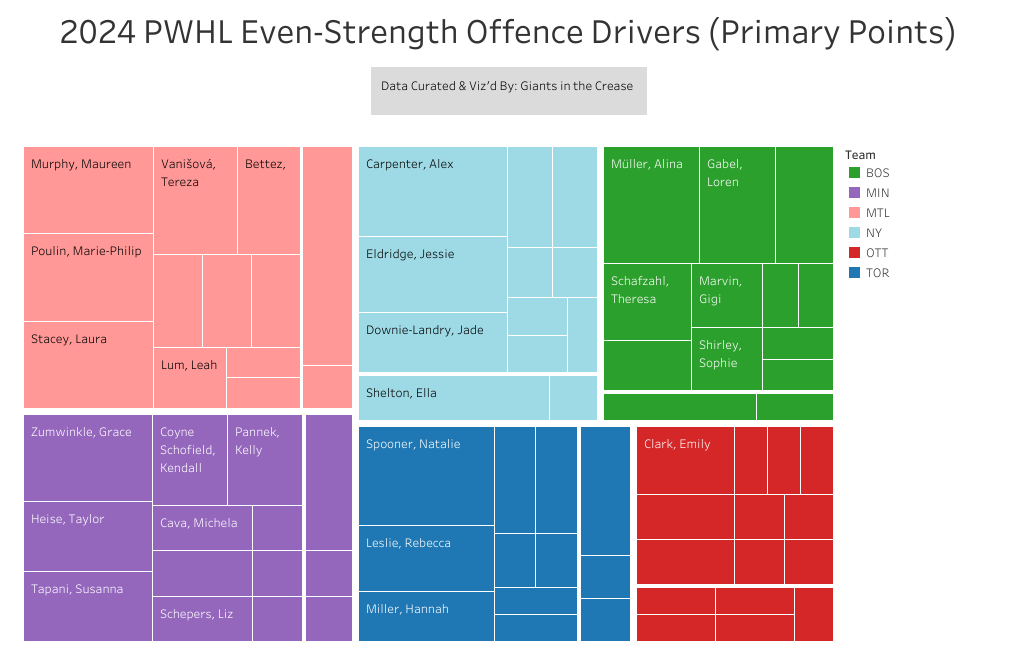
The other problem Ottawa is facing is they can’t seem to score at even-strength. Ottawa currently sits second last in EVGF/60 (1.571) and actually have an even-strength goal differential of negative two. What’s saved Ottawa so far is that have a great PP which ranks first in the PWHL at 29.17% and first in power play goals with seven. Ottawa has been effective at creating chaos in the offensive zone with their blueline activating which is why they lead the PWHL with four defenders having recorded even-strength primary points.
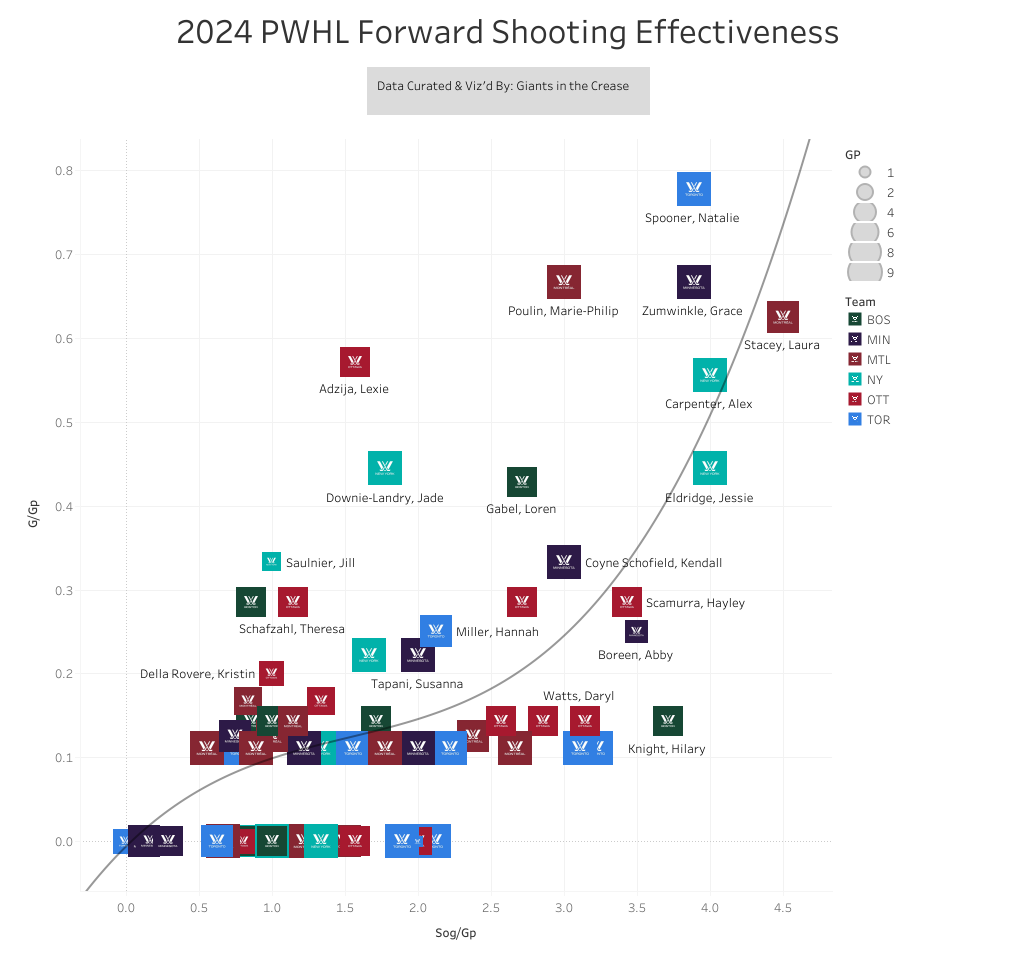
On forward Ottawa has a single player with more than two even-strength primary points. Montréal has six players with three or more EV primary points, Boston has four players, New York has four players, Minnesota has six players, and Toronto has four players. Ottawa needs at least one player who can finish while chaos is occurring in the offensive zone. Ideally and most likely that player is Daryl Watts. She’s currently sitting at 2.857 shots per game which is ideal until you realize that it’s only that high due to a seven shot game versus NY. The best goal scorers in the league are getting +3.000 shots per game and with a shot like Watts you want her putting pucks on net.
The other player we should be expecting to see a boost in goal scoring and thriving in the chaos is captain Brianne Jenner. She’s getting the shots on goal but pucks aren’t going in. That should change and don’t be surprised to see her start to get a bit hot.
Toronto
Doesn’t matter what league it is, Toronto will always garner the interest of everyone for whatever reason. The reason though in the case of PWHL Toronto is obvious, this was a team primarily built of Team Canada players, by the Team Canada General Manager Gina Kingsbury, and coached by Team Canada’s Head Coach Troy Ryan. Expectations have been high for Toronto due to all the Team Canada connections, the level of talent, and idea of instant chemistry.
Up until recently Toronto was not meeting those expectations in any way or form. They couldn’t score and they couldn’t play defence tight enough to avoid giving up golden scoring chances to some of the leagues best players. It took nearly a whole month of games but Toronto is finally playing the way Troy Ryan wants them to: heavy puck possession and pressure resulting in a shot share of 59.2% in the past four games. This has led to Toronto earning a possible 8/12 points in their last four games and putting themselves in a position where they can still earn a high playoff spot.

This turnaround still needs some pieces to fall into place to ensure that Toronto can firmly put that bad start behind them. There’s two noticeable aspects that are holding back the success of Toronto – their league worst team SV% (0.897) and team SH% (6.03). It’d be easy to say that they just need to score more and make more saves but that would make for a short article. As mentioned above Toronto has turned their defensive game around and it’s become tough to score on them. When you play the sort of puck pressure game Toronto does and it’s firing on all cylinders the past four games are a great example of how well it works.
It only works though until the controlled puck pressure turns into chaos in the defensive zone leading to Marie-Philip Poulin walking through everyone. If Toronto wants to see their success continue they need to be the team from the last four games defensively or we’re going to see a rerun of the first five games. That’s the problem though with a defensive system like this is it requires a lot of energy and focus. A shortened season will help keep that focus longer but Ryan’s task will be teaching his players how to best handle those first few games breakdowns, so Toronto isn’t living on a knife’s edge defensively.
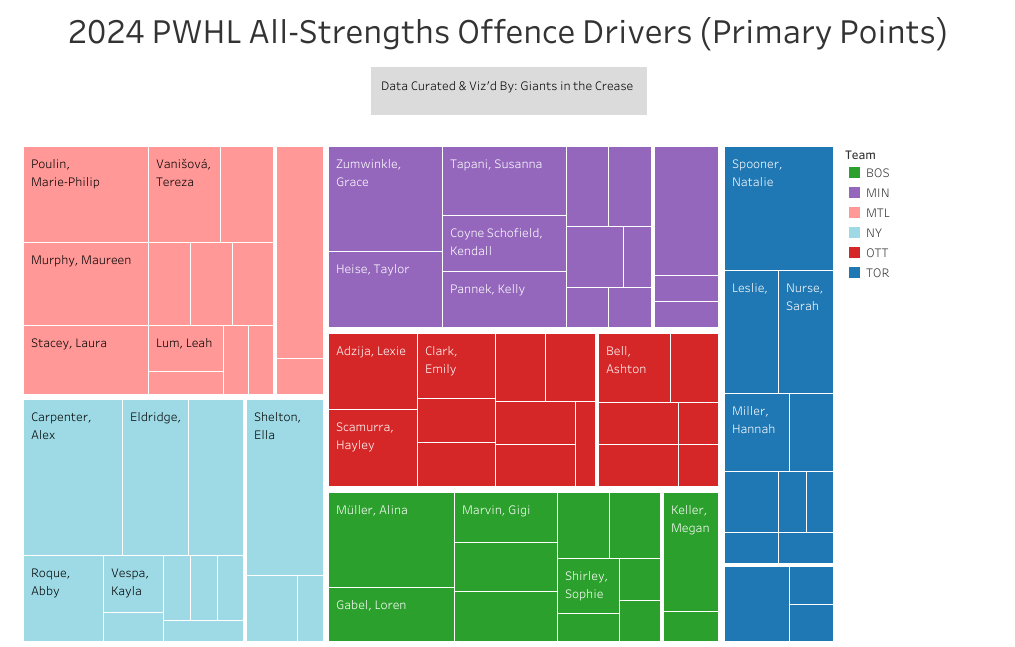
Offensively the team has been struggling and it would be easy to point to the very low team SH% saying the team is just unlucky. More than a third through Toronto’s season and being unlucky isn’t looking like that’s the case. The past four games which have been Toronto’s best stretch so far have seen them with a team SH% of ~8%. That would have them tied with the fifth and fourth highest PWHL teams in SH%. In other words they’re still not scoring easily and that’s because the don’t generate high quality scoring chances despite sporting the second highest SF/60 (31.05). If not for Natalie Spooner leading the PWHL in goals Toronto’s offence would look downright abysmal.
To put it in perspective, in nine games played Spooner has seven goals and only one other player has more than a single goal, Hannah Miller with two goals. This isn’t an easy system to play offence in and it’s become a valid concern they don’t have the personnel to create offence in this system efficiently either. I know Troy Ryan is busy with the Rivalry Series but hopefully he or his assistant coaches are finding ways to create offence in other fashion. Otherwise this is going to be a continually frustrating team offensively.