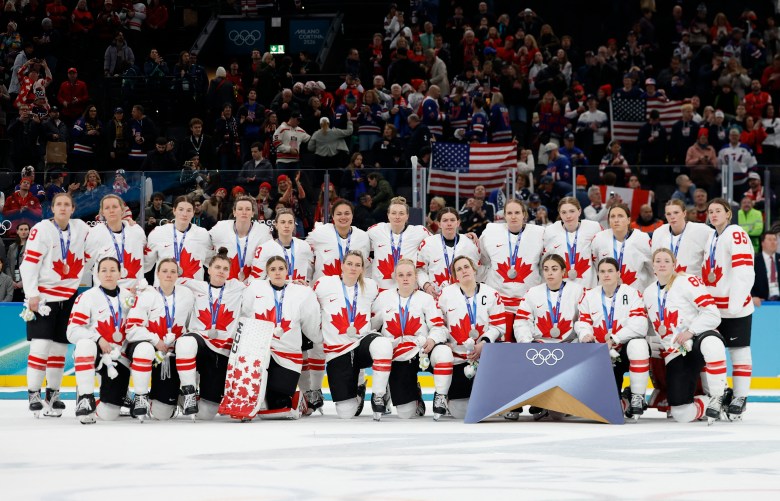
In early July, the Associated Press reported that the women’s Olympic rosters would grow from 23 to 25 players, matching the men’s roster size. This change will begin at the 2030 Winter Olympics in the French Alps. The expanded roster size had us at The Ice Garden thinking about what the 2026 Olympics would have looked like if teams had been allowed to bring 25 players instead of 23.
When it comes to this type of thinking, you obviously can’t know what would have happened. No one expected the illness that hit the Finnish team at the Olympics, and no one expected Marie-Philip Poulin’s injury, so it’s not easy to say that adding two players could have changed everything.
Except I’m going to say it anyway: adding two players would have gotten Team Canada that gold medal.
Roster additions
We’ve already talked and written at length about Team Canada’s unwillingness to bring young players to the Olympics. They had zero NCAA players on their roster and lost to an American team that was flush with young talent. The five draft-eligible NCAA players on Team USA’s roster were all drafted in the first round of the 2026 PWHL Entry Draft. While it was a show from the veterans in the Gold Medal game, the Americans were left with invaluable growth and experience for their young players. Canada didn’t benefit from any of that.
They could have easily swapped in a younger player on the 23-player roster, but with a 25-player roster, the space would already have been made to bring Chloe Primerano and Caitlin Kraemer to Milan.
Chloe Primerano
Arguably the next face of Team Canada, Chloe Primerano has already made waves representing Canada at International tournaments. She has 26 points in 12 games at the U-18 level, bringing home both a Gold and a bronze medal from her respective outings. She played six games for Team Canada at the last Women’s World Championships at just 18 years old.
When she was the first woman skater drafted to the WHL at 15, former NHL defender Richard Matvichuk said, “This girl is legit. She’s going to be an Olympian one day. I’m certain of that.”
Now, coming off two 30+ point seasons in the NCAA, Primerano has more than proven that she can be a key piece at a high level. Her presence on Team Canada would have provided more speed, more energy, and taken some of the ice time pressure off of Fast and Larocque.
Caitlin Kraemer
Kraemer doesn’t have quite the same name recognition as Primerano, but her skills would have been valuable to Team Canada. The 20-year-old put up 20 goals in 11 games with Canada at the U-18s, and has had two 30-goal seasons at Minnesota-Duluth. Canada scored 11 fewer goals than the US at the Olympics, so any scoring touch could have helped.
Is it risky for a player’s first senior international experience to be at the Olympic level? Sure, but that’s what the additional roster slots are for. Kati Tabin, who played in all of Canada’s games at the Olympics, had never played for Canada at any level before Milan.
If Primerano or Kraemer had made even half the difference they have in their previous times with the Canadian national team, they could have been the difference between Gold and Silver. Instead, Canadians will have to wait until the 2028 Olympics to see their first glimpse of these up-and-coming superstars on the biggest stage in the world.