Part One: The Tournament
Nearly everyone’s eyes were on Team Canada and Team USA going at it in the Rivalry Series in Cleveland, OH, and Buffalo, NY, to prepare for the 2026 Olympics in Italy. But while that was happening, Team Canada’s future was showing off in the Newfoundland and Labrador cities of South Conception Bay and Mount Pearl, with a combined population of nearly 50,000 people. The annual U18 Canadian Women’s National Championship is the last step for Team Canada in deciding its roster for the upcoming 2026 U18 World Championships.
That’s the short-term goal of the tournament, anyways. Long term, these are players who’ll be fighting for spots for the 2030 Olympics and who’ll be the main core of the 2034 Olympics team. I know 2030 seems rather soon for now-U18 players to be vying for spots, but if we look back at the 2023 U18 Nationals (which was only two years ago), we see Caitlin Kraemer and Chloe Primerano having played in that tournament now looking to make the 2026 Olympic team. As for these players making up the core of a team eight years from now? The proof is already in the pudding.
Thankfully, Hockey Canada does some rather good recordkeeping showing the pipeline of the U18 Nationals to the senior Team Canada squads. Three of the top five leading scorers of the tournament are names that come with Olympic gold: Marie-Philip Poulin, Jamie Lee Rattray, and Mélodie Daoust. One of the goalies with the best all-time save percentage at U18 Nationals is current Vancouver Goldeneyes and Olympic gold medalist Emerance Maschmeyer. It’s fair to say this tournament means quite a bit if you’re someone who cares about the future of the game and, specifically, Team Canada’s future.
I’ve been able to watch some games of this tournament for the last few years now, and just apart from the implications about the future of hockey, it’s very entertaining hockey. That’s not exactly surprising, as this tournament will feature either all or the majority of the roster headed to the annual U18 Worlds. Then, of course, there’s the players who just barely miss the cut of the roster. Considering Canada’s success on the international stage at the U18 level, that’s a formula for a fun tournament.
Especially this year, when history was made. To give a quick backstory to the tournament, there are eight teams that participate in the U18 Nationals: Team Ontario-Red, Team Ontario-Blue, Team Quebec, Team Atlantic, Team Manitoba, Team Saskatchewan, Team Alberta, and Team British Columbia. Your eyes do not deceive you—there are two Ontario teams, there is no province in Canada called Atlantic, and the northern territories of Canada are not represented.
Unfortunately, the territories just don’t provide the talent necessary to participate in this tournament. They do get to play in the Canada Winter Games, which is pretty similar to the U18 Nationals. But their results there place them as the equivalent of an IIHF Division IIB team. Simply put, Ontario gets two teams because it’s by far the largest province population-wise and player-wise. Ontario-Red is usually the best players Ontario has to offer, like the U18 Worlds Gold Medalists and so on. Ontario-Blue are usually the players who are a year away from joining Ontario-Red but obviously are still very good. Lastly, Team Atlantic is made up of players from four provinces: Newfoundland and Labrador, New Brunswick, Nova Scotia, and Prince Edward Island. Those four provinces have a combined population of about 2.5 million people, which is still six and a half times smaller than Ontario.
The Tournament
With that bit of off-ice Canadian lesson out of the way, back to the tournament. Ontario the province has won the tournament all 15 times leading up to 2025, with Ontario-Red taking gold 14 times and Ontario-Blue getting the other gold. No other team or province has won the U18 National Championships. This year wasn’t looking much different. Team Ontario-Red was going to feature five gold medalists from the 2025 U18 Worlds (Kate Viel, Sofia Ismael, Maddie McCullough, Rachel Piggot, and Caileigh Tiller) and a future star in Adrianna Milani. To further drive home the point, Ontario-Red featured 11 players who played for the U18 Canadian team that played the U18 USA team in the summer showcase, which is usually a strong indicator of who the Team Canada coaching staff likes.
Ontario-Red was living up to the hype early on in the tournament. They’d win all three of their round robin games in regulation by a combined score of 14-3. In the quarterfinals, they’d play Team Alberta, go up 3-0, and then close it out for a 4-3 win, even while Alberta’s top line got dangerous as per usual. The mark of a good team is having the depth necessary for dealing with an opposing team’s top line getting hot, and they were the favourites headed into playing against Team Atlantic in the semifinals.
🚨CLOSE CALL CHAMPS🚨@HockeyAlberta made it close but the defending champs from @OWHAhockey Team Red survived 4-3 in quarterfinal action at the @HockeyCanada U18 National Championship.
🎙️ @shawnmullin
Highlights sponsored by @SourceNationpic.twitter.com/cTyQq7XzAd
— HNLive (@HNLiveCA) November 6, 2025
Now I say favourites, but I wouldn’t say heavy favourites, even with the power of hindsight. As I mentioned above, Ontario-Red was well represented by the Canadian U18 team with five gold medalists and 11 players who had an inside track to the 2026 U18 Worlds roster. Team Atlantic had three players play in the summer showcase series against the USA and no past U18 Worlds medalists. They also had a bit of a rough time in the round robin, losing to Team Quebec in overtime, losing to Team Alberta in regulation, and finally getting a win with a victory over Team British Columbia.
Team Atlantic goes on to win their quarterfinal game versus Team Manitoba, scoring three power play goals and an empty net goal. Not particularly impressive, but a win is a win. Power plays are going to be hard to come by, though, against a team that generally dominates possession against you. Ontario versus Atlantic matches are generally possession heavy in favour of Ontario. This semifinal match-up wasn’t much different, as Ontario-Red would outshoot the Atlantic 39-19.
⚓️ATLANTIC ADVANCES⚓️
A late surge by Team Atlantic allowed the host team to advance to the final four of the @HockeyCanada U18 Women’s National Championship with a 4-1 win over @hockeymanitoba.
🎙️ @shawnmullin
Highlights brought to you by @SourceNationpic.twitter.com/D33kPHUQx8
— HNLive (@HNLiveCA) November 7, 2025
At the end of the day, though, if you can’t outscore your opponent in a semifinal game, it doesn’t matter what the shots are. Especially if the underdog scores three goals on eight shots, with heroic performances from Megan Mossey and Kendall Doiron. Team Atlantic only needed one power play, and they made the most of it to start the game off. Ontario-Red would score two goals to make it close, but they never got it tied. Their dynasty was toppled by some plucky kids from out East who earned Team Atlantic their first ever gold medal game in U18 Nationals history.
In the other semifinal game, Ontario’s hopes of keeping the streak going rested on the shoulders of Ontario-Blue holding off a Team Quebec that was coming into the tournament with nine silver medals. It was a good match up—Ontario-Blue won two games in the round robin, while Team Quebec won all three of their games. Team Quebec were the favourites going in, because just like Team Ontario-Red, U18 Canadian Worlds level talent was very present. Ontario-Blue made it a game, though, even taking a 3-2 lead in the third period. But it wasn’t meant to be: Quebec would tie, then win, the game in the matter of a minute.
🚨ST. JOHN’S SHOCKER🚨
Team Atlantic pulled off a massive upset knocking off the 14-time champions from @OWHAhockey Red in the semifinal of the @HockeyCanada U18 Women’s National Championship.
🎙️ @shawnmullin
Highlights brought to you by @SourceNationpic.twitter.com/8R4O5UL5wr
— HNLive (@HNLiveCA) November 8, 2025
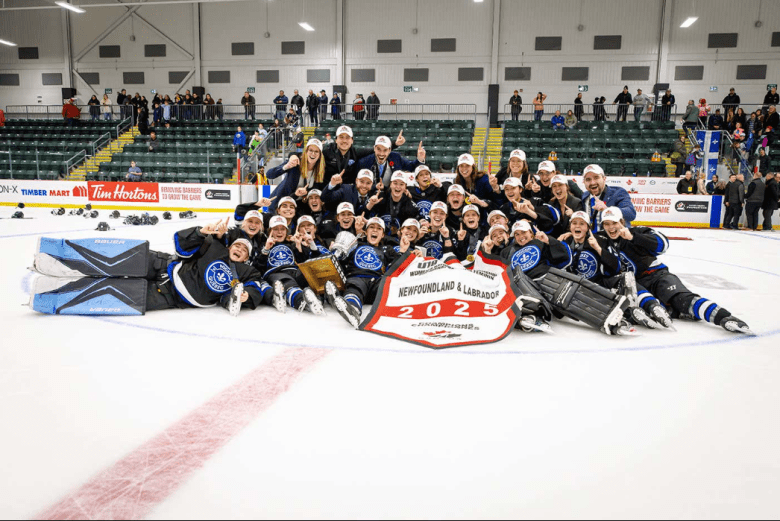
Narratively, this set up a very interesting set of medal games. In the bronze medal game, you not only had the literal Battle of Ontario going on, but Ontario-Red had yet to leave the U18 Nationals without a medal of any kind. They’ve never finished fourth place or lower. Then there’s the gold medal game, Team Quebec vs Team Atlantic. Quebec were the perpetual bridesmaids with their nine silver medals, and the Atlantic were making their first ever debut in a U18 Nationals championship game on home ice to add even more drama.
In the Bronze Medal Game, the drama did not disappoint. The leftovers versus the anointed ones. Ontario Women’s Hockey League teammates facing off against each other. A rematch from the round robin where Ontario-Red won 3-1 over Ontario-Blue. The game definitely lived up to the hype, maybe even more so than the gold medal game. Ontario-Blue would go down 2-0 midway through the first period, and would end the game having been on the penalty kill seven times. They persevered, though, and would go on to tie the game, only to watch Jordan Mulvihill rush the puck up the ice to end the game in OT and end Ontario-Red’s 15-tournament medal streak.
🥇GOLD FOR QUEBEC🥇
Highlights of the @HockeyCanada U18 Women’s National Championship gold medal game as @HockeyQuebec wins gold for the first time 3-1 over Atlantic.
🎙️ @shawnmullin
Highlight Sponsor: @SourceNationpic.twitter.com/YxGJ1wy0IN
— HNLive (@HNLiveCA) November 9, 2025
Last but definitely not least, we get the gold medal game with Team Quebec versus Team Atlantic in Newfoundland and Labrador. Megan Mossey opened the scoring for Team Atlantic on the power play and got the good vibes going. Quebec was not about to be denied in their 10th championship game, though, and just went to work. Zoe Charland would get an open spot in the slot to tie the game, Rosalie Tremblay would make everyone look silly to make it 2-1, and then Madison Levesque would score a pinball goal to ice the game. The Atlantic had no response and Quebec would hold on for their first ever gold medal at U18 Nationals.
To be continued. Come back for Part II soon!