The first time I thought about a true Rookie the Year award this season, separate from the Newcomer of the Year Award of recent years, was November 6, after Corinne Schroeder’s second consecutive shutout to start her professional career. I thought at that time that Schroeder would have a great shot for an actual rookie award, but that there was a good chance her performance, and those of other first-year pro players, would be overshadowed by established players entering the PHF from other leagues. I’m very happy that the Fed has split this recognition into two awards. More trophies = more fun! Who can argue with that math?
The league has announced the three finalists for the Rookie of the Year. Per the league, these finalists were determined by PHF hockey operations in consultation with all team general managers. In this article, I’ll look at the public stats provided by the Fed within the context of each team’s and each player’s season to examine every finalist’s case for the award. I’ll also look at a few other players throughout the league who also made a good argument for the award.
The Rookie of the Year Award is given to ‘the top first-year player who has joined the league immediately following their collegiate career without any prior professional experience.’ It is unclear to what extent this criteria includes or excludes non-collegiate players entering the league from outside of North America who may be the same age as recent college graduates. Jade Downie-Landry, a stand-out rookie who joined the league immediately after graduating from McGill University in Montréal, is 27 this season. There were several players aged 27 or younger who joined the PHF this season who developed in European club systems rather than the university track. At the time of publishing, the PHF has not replied to an inquiry to clarify; this article will be updated with that information should we receive it.
It is also not clear who will be selecting the winner of this award. I’m going to speak as though it’s a vote, because I think it should be a vote!
The finalists as announced are:
Élizabeth Giguère, Boston Pride
Corinne Schroeder, Boston Pride
Natalie Snodgrass, Minnesota Whitecaps
Élizabeth Giguère, F, Boston Pride
With only 18 games played for the Boston Pride, Giguère has been able to put together a very impressive résumé. Although she missed a quarter of the season to national team commitments, the Clarkson and UMD alumna is among league and rookie leaders in most categories. The Pride shuffled their lines a lot this year due to all the players coming and going, but Giguère did get to spend most of her time with her Golden Knights teammate Loren Gabel and Pride captain Jillian Dempsey at even strength and on the powerplay. 15 of Giguère’s 22 points came on goals scored or assisted by Gabel, but that doesn’t mean she was carried:
🚨: Élizabeth Giguère (@EliGiguere11)
🍎: Loren Gabel (@LorenGabel) pic.twitter.com/TRoFuzw9ep— Boston Pride (@TheBostonPride) February 5, 2023
Giguère finished the regular season as Boston’s third-place scorer after her linemates, with 6 goals and 16 assists for 22 points in only 18 games. That 1.22 points per game is fourth in the Fed, and first among rookies. She is also fourth in the league and first among rookies for assists. She had a point on 23.9% of her team’s goals, and scored 6.5% of them personally.
Élizabeth Giguère makes hockey look effortless. A big body that’s hard to shift off the puck, she’s always in the right place at the right time. She’s fast, whether she’s going down the ice or taking time and space away from an opponent trying to pass the puck as she bears down on them. And she’s great at knowing where the play is: she doesn’t hesitate, and while no one is immune to bad passes, hers are few and far between.
Playing with two of the best players in the league on one of the league’s best teams may factor against Giguère for this award, but it’s hard to say that when she’s one of the reasons why hers may be the best line in the league. Her time away from the team may also factor against her. An excellent three quarters of a season is a tough sell for best overall performance.
There’s also the question of the value she brings to such a high-flying team. Rookie of the Year is not explicitly ‘Most Valuable Rookie,’ but it’s hard to argue that the Boston Pride would have struggled without her. Giguère scored six goals this season; the Pride’s end-of-season goal differential is 15 goals higher than the second-place team. By no means should the success of the team override evaluation of a player’s individual performance, but it may to some voters.
Corinne Schroeder, Goaltender, Boston Pride
What does a goaltender have to do to win an award in a category that includes skaters? Goaltenders don’t create much offense for their teams, so they can’t win points for flashy goals. They don’t play every game like a skater does. It’s not as easy to say that a team would have lost without a specific goaltender, like it is for a skater who scores most of their team’s goals. So an award-winning goalie would have to be absolutely shutdown. Elite stats, no weaknesses, teams would have to be terrified of going up against her.
Corinne Schroeder are you serious?! 😲 pic.twitter.com/IGJi917837
— PHF (@PHF) December 18, 2022
Corinne Schroeder has had more shutouts in this, her rookie season, than Amanda Leveille has had in her seven-year pro career. She has only lost one game in regulation and one game in overtime. She won more games than any other PHF goalie has ever won in a single season. Her 95.5 save percentage and 1.67 goals against average are actually ridiculous for a professional player, with the latter number also setting a new PHF record, as did her 797 saves. There’s at least one more record that she broke, but I honestly had trouble keeping track. She also had two assists.
Schroeder is a big goalie whose style relies on positioning. When she comes forward from the net and squares up to a rushing shooter, there’s very little visible twine for them to aim at, and rebounds go consistently into the corners. If you can get through the Pride’s stifling defense for a cross-ice pass, her length means both elevation and precision will be needed to score. She’s not a flashy save goalie, but a calm and grounded goalie: good luck shaking her.
We do not have shot location data for the PHF, which means we can’t make more complex analyses that measure the difficulty of shots. Per the eye test, a lot of the shots Schroeder has faced this season have been off the rush, or low-quality shots, as Boston’s defense works hard to keep opponents from setting up in the offensive zone or getting shots from the middle or lower parts of the ice. This article by CreaseGiants analyzes how the Pride are set up to allow lots of low-quality shots and then quickly regain possession so their deadly offense can go to work.
It’s also worth asking whether the team would have been successful without her. Schroeder’s backup this season was Lovisa Selander, the 2020 PHF Goaltender of the Year. Selander seems to suffer as a backup, but when she played the lion’s share (ha) of her team’s games, she also rarely lost. And the Boston Pride scored the most goals in the league this season. While they say offense begins with defense, it’s hard to say that the Pride would be a basement team without Schroeder.
All that being said, players don’t decide systems or usage. Lacking more complex metrics, it’s hard to say what Schroeder could have done to present a better case for awards. And with the performance she’s had, she’s not just pushing for Rookie of the Year, but Goaltender of the Year and MVP as well.
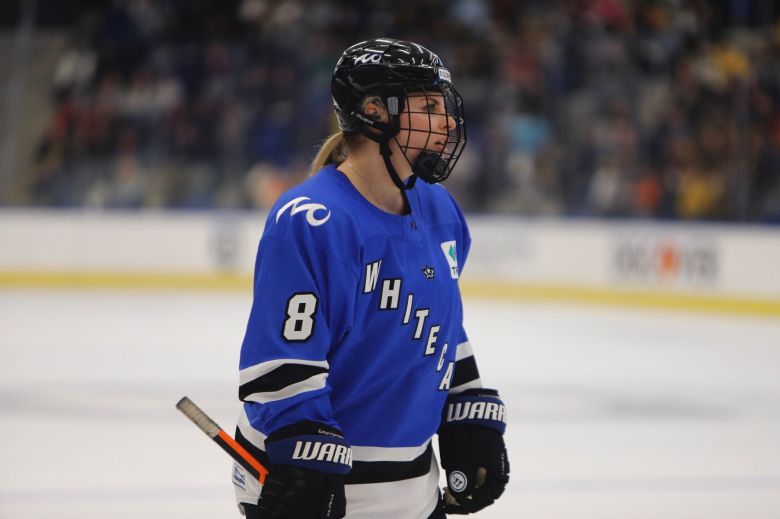
Natalie Snodgrass, F, Minnesota Whitecaps
After a relatively quiet start to the season on a Whitecaps roster with a lot of turnover, Natalie Snodgrass announced her contention for this award with a birthday hat trick in one of the season’s most, uhh, interesting jerseys.
Congratulations again to Natalie Snodgrass (@nataliesnod9) for her first PHF hat trick last night against the force! 🤩🤩#RollCaps | #MNWhitecaps pic.twitter.com/nE2LUhySsP
— Minnesota Whitecaps (@WhitecapsHockey) December 18, 2022
Snodgrass missed two games due to playing with Team USA in the Rivalry Series; while she was out, the Whitecaps dropped two home games to the Beauts.
By the end of the season, Snodgrass had notched 10 goals and 10 assists in 22 games, tying Jonna Albers for leading scorer on the team. She is first among rookies with three game-winning goals, T-1 on overall goals, and T-2 with three powerplay goals. Her .91 points per game is tenth in the PHF and third among rookies, while her .454 goals per game mark is good for first among rookies. She had a point on 34.5% of her team’s goals, and scored 17.2% of them personally.
Natalie Snodgrass scores goals, she assists, she comes up clutch. She’s good at even strength and on the power play, and she doesn’t take penalties. To watch her, she’s a playmaker. She’s a very smooth skater with great hands and a great eye for space and where she needs to be in relation to the play. She forechecks and creates turnovers and looks very comfortable on Minnesota’s powerplay, which finished second in the league with a 19.7% success rate. She’s an all-around player and will be a beast for Minnesota for as long as she wants to be there.
Midway through the season, I would have said Snodgrass was a front-runner for this award. The Whitecaps had a bad streak to finish off the regular season, which deflated her numbers, but when you watch Snodgrass play you can see the impact she has on the ice. The Whitecaps made the playoffs, which I don’t think should make a difference for this award, but it probably does in the minds of some voters. I think Snodgrass should get credit for fitting into the system on a team with a lot of turnover and creating a good amount of the team’s success.
Originally when I was compiling this article, dreaming of a Rookie of the Year Award that had not yet been announced, I narrowed the field down to five finalists. These two athletes at the very least deserve ‘honorable mention’, if not categorization as a snub.
Jade Downie-Landry, F, Montréal Force
The 27-year-old graduate of McGill University found immediate success on a line with captain Ann-Sophie Bettez, with the pair assisting on most of each others’ goals. She will go down in Force history for scoring the team’s first-ever hat trick during their first-ever game on Canadian ice.
Jade Downie-Landry put on a show for the home crowd as she netted a hat trick for the Montreal Force this afternoon 🎩🎩🎩 @DownieLandry | @LaForceMontreal pic.twitter.com/LD30RFTePS
— PHF (@PHF) November 26, 2022
Downie-Landry finished as la Force’s leading scorer, with 10 goals and 13 assists in 24 games. She is first among rookies for points, T-1 on goals and T-1 with three powerplay goals, second for assists, and T-2 with two game-winning goals. Her .96 points per game is T-8 in the PHF and second among rookies. She had a point on 41.1% of her team’s goals, and scored 17.9% of them personally. Her 482 draws were the third-most in the Fed after Shiann Darkangelo and Jillian Dempsey, and she finished with a 50.6% success rate. Her 92 shots on goal are fourth-most in the Fed and the most among rookies.
Montréal is a team that relies on crisp passing, speed, and the chemistry between its players. Downie-Landry is a strong skater who has excellent vision for the ice and other players. What has stood out to me most about her play is that she can be cunning and deceptive with the puck, taking advantage of confusion and making plays when and where it won’t be expected. A lot of her goals aren’t highlight reel goals per se, but they are often impressive because of their creation rather than a flashy finish.
The Force did not make the playoffs this season, but being the centerpiece of her team’s offense as a rookie is proof of a high level of skill and reminds me of last year’s Newcomer of the Year, Taylor Girard. Team success does factor into individual awards, both in the sense that voters may think a truly great player will get their team to the playoffs, and that in that it’s difficult to isolate excellent play on a team that is struggling overall. However, it was impossible to miss that Montréal’s top rookie was one of the best players on the team. Downie-Landry factored into an immense percentage of her team’s offense, and she wasn’t riding anyone’s coattails.
Caitrin Lonergan, F, Connecticut Whale
Starting the year in Connecticut’s top six and becoming a mainstay, Lonergan did not look like a rookie of the year contender early on. The BC and Clarkson alumna had a quiet start to the season, going without a point in her first six games, but she picked up steam with the new year. She had seven goals and 12 points in a nine game stretch, helping fuel the Whale’s run-up to the playoffs.
Lonergan finished the regular season as Connecticut’s third-place scorer after the dynamic duo of Marchment and Girard, scoring ten goals and eight assists for 18 points in 23 games. She tied for first among rookies in goals and was T-2 in goals per game. Lonergan and Courtney Maud of the Buffalo Beauts were the only rookies to notch a short-handed goal this season, and Lonergan followed it up with two power-play goals and two game-winners, the latter of which is T-2 for rookies. She had a point on 21.7% of her team’s goals, and scored 12.0% of them personally.
Lonergan with an incredible set up and Samo makes no mistake! pic.twitter.com/ia5duj2UYn
— PHF (@PHF) February 19, 2023
Lonergan is not a big body, but she carries herself like one, generating momentum in such a way that she controls the speed of play. She sees the ice and reads the play well and has a talent for getting the puck on her stick as she drives down the slot. A graceful and speedy skater, she’s also gifted at protecting the puck. The Whale shuffled their lines a little throughout the season, and Lonergan proved she was able to perform and produce with a variety of teammates, as well as playing on special teams.
10 goals in 23 games is no mean feat, not to mention that they came in every situation. But Connecticut had a strong group, with seven forwards scoring in the double-digits. There’s no doubt that Lonergan’s performance was impressive, but it seems it was not enough to compete with the other talented rookies this season.
A final word
I’d also like to mention that the public statistics we have for the PHF at the moment do not provide much in the way of measuring the value of defenders, or the defensive play of any skater in general. This list of outstanding rookies, as with basically any ‘best of’ list at the moment, is basically a list of the top scorers with the occasional nods for wins and shutouts. I look forward to the day when we’ll have better data to give dues to the players who make it harder for the opposition to score goals.