Building a college hockey team from scratch is hard. Doing so in a year and a half is even harder.
Beyond the names on paper, starting a team means construct a space people want to play for. How do you make words like resilience and dedication go from a motivational quote on the wall to something players put in practice? How do you create a culture that pushes players to be the best versions of themselves?
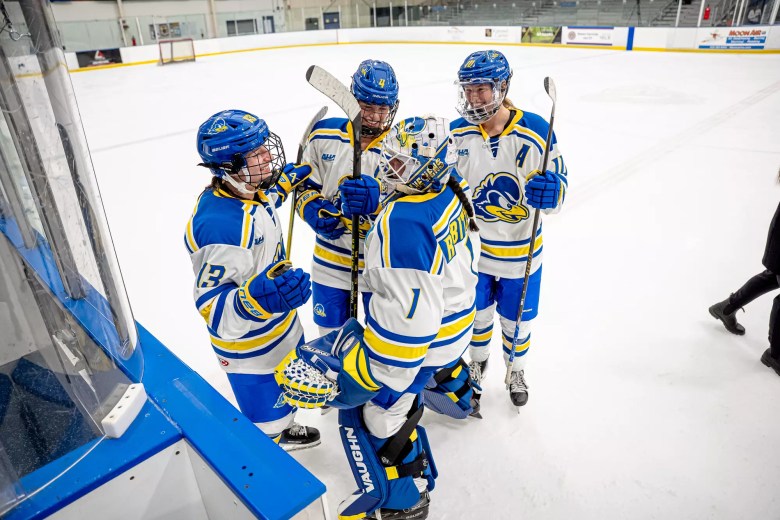
When the University of Delaware prepared for their inaugural season in the fall of 2025, the right student leadership was essential to long lasting success. The Blue Hens had 17 freshmen on their inaugural roster, and only four players with prior NCAA experience. All four players — Danica Mark, Tiana McIntyre, Mattie Robitzer, and Kaitlin Finnegan — were named captains and entrusted to set the standard for Blue Hens hockey.
While Finnegan graduated last season, the rest of the student leadership group are returning for the 2026-2027 season. With just under a month until puck drop, Danica Mark, Tiana McIntyre, and Mattie Robitzer reflected on the formation of the Delaware Blue Hens and expectations for year two.
Starting from scratch
Goaltender Mattie Robitzer grew up fifteen miles north of the University of Delaware, in Kennett Square, Pennsylvania. When she was entering college, few NCAA DI women’s hockey programs existed in the Mid-Atlantic. Her hockey journey took her several states away to Northeastern University. In December of her freshman year, Delaware announced the launch of its varsity women’s hockey team. The Blue Hens would take the ice in just under two years.
“When I heard that Delaware was getting a program it immediately stuck in my head that I want to be a part of that, I wanted to help grow the game around where I’m from,” Robitzer told The Ice Garden, speaking alongside Mark and McIntyre.
Robitzer, Mark, and McIntyre knew that they were in for a challenge. Leaving established programs for something unknown wasn’t easy, but starting something new was part of the appeal.
McIntyre, who wears a “C” for Delaware, already had experience forging her own path. She’s the first DI women’s hockey player from Utah, and coaches hockey development camps in her home state. Before transferring to the University of Delaware last fall, she spent three years at Quinnipiac and appeared in 76 games.
“It’s something brand new — we had 17 freshmen last year. With us being upperclassmen, we expected it to be a challenge,” McIntyre said, reflecting on Delaware’s inaugural season. “And it was at times, but I think more than anything it was so fun and so cool to see the team grow and see people learn from each other.”
New players needed to adjust to the intensity of Division I hockey. The collegiate level brought a new level of physicality and speed. Alongside the on-ice workload came the tougher off-ice academic expectations that one would expect at a flagship university. Only McIntyre, Mark, Robitzer, and Finnegan knew first hand what it was like. They emphasized the importance of leading by example, and making their teammates feel comfortable coming to them as resources. At the same time, they emphasized that the hard work is what makes Division I hockey so rewarding.
“A big emphasis was that it is going to be hard. Showing up to practice every day is going to be hard. Your classes are going to be hard. Lift is hard. That’s why only a select amount of girls play college hockey,” explained alternate captain Danica Mark. Prior to transferring to Delaware, Mark spent two years at Union. She excelled in balancing her academic capabilities with her life as a student athlete, and was named to the 2023-2024 ECAC All-Academic Team. In her first season with Delaware, she was named an AHCA/Krampade Division I All-American Scholar, granted to athletes who maintained a 3.75 GPA and appeared in 40% of games.
Creating a family
Beyond building the team on the ice, the three captains prioritized creating a strong and welcoming team off the ice. “This was the most connected, well cultured team that I’ve ever been a part of,” McIntyre said.
Most of the Blue Hens didn’t know each other prior to last season. Before arriving on campus, the players only spoke on a few Zoom calls. The unique set of circumstances around being a first year team, with every player stepping into something unknown together, fostered quick connections. Delaware’s coaches and staff members set a positive example that encouraged players to form bonds.
“It started with our coaches the day I committed — they were like, ‘welcome to the family.’ They put so much time into making this feel like a family and a loving environment where you can grow as an individual and an athlete, and I think that makes such a huge difference in our culture,” said Mark.
Delaware’s head coach is Allison Coomey, who has over two decades of experience in collegiate women’s hockey. Prior to coaching the Blue Hens, Coomey spent seven seasons at Penn State as an assistant and associate coach. She played a major role in helping the Nittany Lions rise to the top school in the AHA. Alongside her are assistant coaches Taylor Willard and Melissa Samoskevich, who’ve accumulated several years of NCAA and USA Hockey coaching experience. All three coaches served as USA Hockey girls national player development coaches over the summer.
Robitzer echoed McIntyre and Mark’s sentiments about team chemistry and the support from staff members. “One of our core values on the team is team first, and culture is really such a big pillar of our organization and team. It’s been stressed to us, we want to have a strong healthy culture and I think our team has really blown that expectation out of the water. We have meetings with the head of culture at the University of Delaware and we’ve done a lot of team building. I’ve never been on a team that’s so connected and so close and it’s been really special. I think part of that is because it was our first year as a program and we just had to get so close so quick. We built incredible bonds that you may not be able to find anywhere else.”
The closeness that Delaware prides itself in is evident in the relationship between Mark, McIntyre, and Robitzer. The three have lived together since last season, allowing for easy communication. Each player came from a different collegiate program and can brings different experience to help shape Delaware’s culture. Robitzer also points out how having a goalie, forward, and a defender in the leadership group allows for a diversity in on-ice perspective. “If we’re planning captains practice, we’re able to get input from every point of view of each player on the ice.”
Building on last season
Delaware had the growing pains one would expect from a new program starting out in the AHA. The Blue Hens finished the season with two wins and 31 losses. The majority of Delaware’s roster is returning in 2026-2027, and hoping to improve on what they started last season.
“Our team motto last year was ‘build the legacy.’ Last year, we got to lay the foundation, but this year we get to actually build on that legacy and build on our standards. I’m really excited to see now that we have more confidence and more experience,” said Robitzer.
Two of Delaware’s most promising young players are Francesca Barresi and Charlotte Payne. Barresi, a forward entering her Sophomore year, was second in the team in points with five goals and seven assists. In net, Charlotte Payne shined with a .914 save percentage in 20 games. She had 49 saves against Holy Cross in the programs first win.
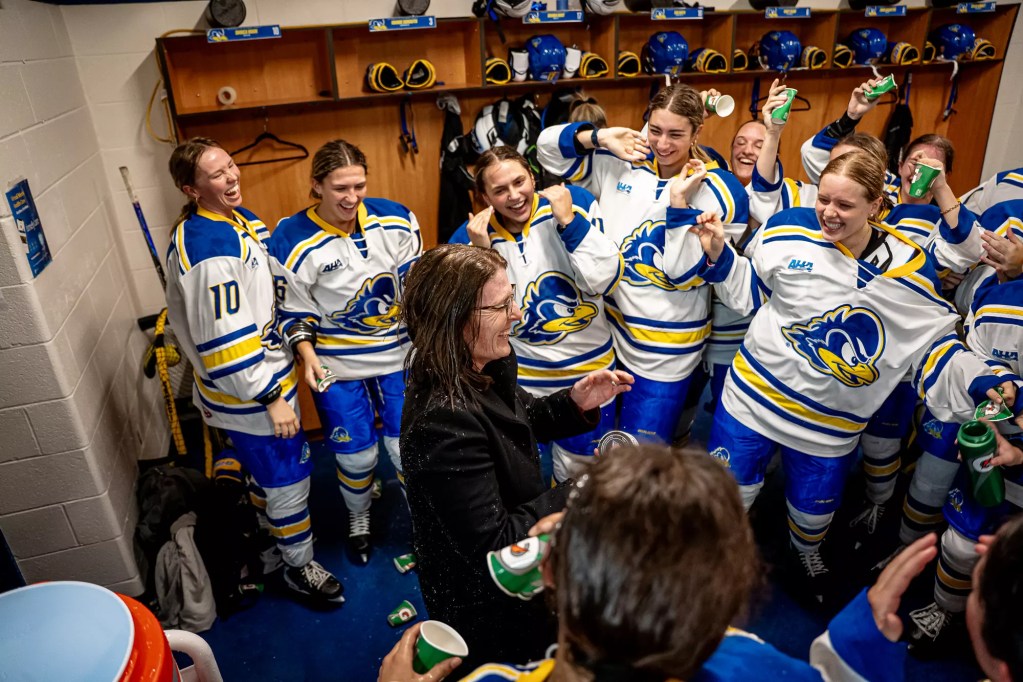
Alongside the returning players, Delaware bolstered the roster with eight new players: six incoming freshmen and two transfers. Hailey Anderson headlines the transfer portal acquisitions. She spent two seasons at Franklin Piece, scoring a career-high 22 points in 35 games last season. Delaware’s freshman class features goaltender Mackenzie Sunderbruch, who posted a .954 save percentage for Shattuck St. Mary’s U19 team last season.
Mark spoke highly of the incoming class, saying “they are all great hockey players, but they’re also amazing human beings. So far, it’s already been a great experience getting to know them, and our returners are coming back with more confidence and starting to lead the way. I’m super excited for our growth on the ice, but as a team, our culture is getting stronger. You can see these ideas developing and people living out these ideas that we preached for a year which is exciting.”
The Blue Hens kick off their season against Holy Cross on September 25. As important as last season was for kick starting the program, Robitzer, Mark, and McIntyre agree that there’s something different about Delaware going into year two.
“Everyone has a different hunger this year,” Robitzer said. “Last year, there was some nerves, obviously, some hesitations with being a new program. But this year everyone is just hungry to do well and grow and be a better team. I’m excited to see where we go with that.”