We are on the cusp of the 2025 PWHL playoffs and in the blink of an eye we are going to know who the second Walter Cup winner in PWHL history is. The road to get to that point starts now as the Toronto Sceptres get ready for their revenge series versus the Minnesota Frost and the Montréal Victoire look for redemption after being swept last year as they play a first-time playoff team in the Ottawa Charge.
The two series are best-of-five which leaves a lot of room for the random/luck effect to play a part in what happens. We saw that last year with the top two seeds in Montréal and Toronto losing to the lower seeds. Both teams lost three straight games to be eliminated with Toronto at least winning two games first.
Consider your calendars marked. 📆
The PWHL Playoffs presented by SharkNinja schedule is here! | Voici le calendrier des séries éliminatoires de la LPHF, présentées par SharkNinja.
📰 EN: https://t.co/vZjU9VBpq2
📰 FR: https://t.co/r5VJc3ATRKpic.twitter.com/CGjuLN9azn— PWHL (@thepwhlofficial) May 5, 2025
Maybe we shouldn’t have been surprised though at how those series played out. It’s possible that going into the 2024 PWHL playoffs we should have been more aware of how things were going to play out. No one could predict Boston would sweep Montréal with three straight overtime wins but perhaps the results of those games shouldn’t be too surprising considering how teams played during the regular season. Maybe it shouldn’t have been a surprise that two of three of the top even-strength goal differential teams made it to the Cup Final. Taking what we could learn from last season we’re going to find out if it can tell us potentially what to expect when coming into these playoffs.
Montréal Victoire vs Ottawa Charge
Offence
After last year’s playoffs the question that has been hanging around the Victoire’s head has been can they score? They scored ONE even-strength goal in the three playoff games versus Boston. Now part of that is that Aerin Frankel is among the best in the world but so is Ann-Renee Desbiens yet Boston still managed to score two even-strength goals a game against her proving to be the difference in that series. Even-strength scoring is proving to be the difference maker in the PWHL. You win the even-strength goal battle, you’re more than likely winning the game. Out of the eight teams to make the playoffs in PWHL history, the Toronto Sceptres this season are the only ones to make the playoffs with a negative even-strength goal differential which we’ll get to in their section.
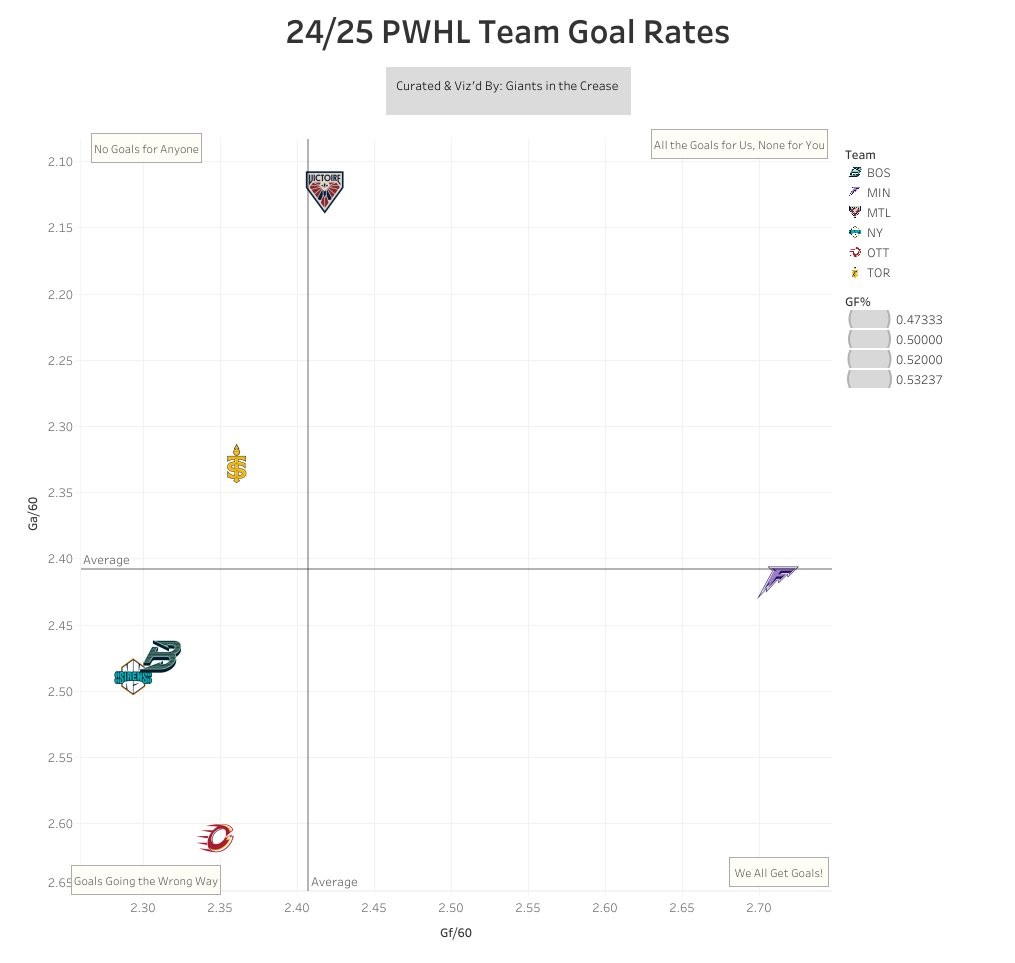
Last season Boston was the second-best goal scoring team at even-strength. This season it’s Montréal, tied with Ottawa, for second best even-strength scoring team. Step one of their plan is complete, show they can score at even-strength in the regular season. Notice who they’re tied with though, the Ottawa Charge, their playoff opponent. There is a small difference in that Montréal is the better shooting team at even-strength with an 8.6% EVSH% vs Ottawa’s 8.0% EVSH%. That could be evened out by Ottawa having the better Shots For% at even-strength (51%) but something to keep in mind is that going into the playoffs last year Boston had the better SF% (51.1%) than Montréal (47.6%) and in the three playoff games they played Montréal had a 58.7 SF% over Boston. It’s one playoff series but it shows when the games matter, Montréal can tilt the ice in the playoffs.
With both teams looking evenly matched in terms of even-strength scoring is this where the power play becomes a bigger factor than previously? Both teams are going in with relatively similar PP% numbers with Montréal operating a 15.7% PP and Ottawa with a 14.9% PP. There is a noticeable difference though in that Montréal has had 102 PP’s whereas Ottawa has only had 74 PP’s, the least amount in the league. If Montréal can keep that PP split in their favour and their even-strength scoring doesn’t evaporate, they have the edge over Ottawa. Not by a lot but enough of an edge that they can win three straight one-goal games.
Defence & Goaltending

Defence and goaltending has been a mainstay strength of the Montréal franchise for their short two-year tenure. While Boston didn’t have the edge defensively in 2024, they had enough of the edge in goaltending to eek out those three straight OT wins. Statistically last season Ann-Renee Desbiens was average. Had a 0.048 GSAA/30 to go along with her 0.625 Quality Starts %. Essentially there were a lot of games where Desbiens would post a SV% just above league average but not enough to be a noticeable impact past being average. In comparison Frankel had a 0.588 QS% but a 0.227 GSAA/30, having more games where she was a noticeable part of Boston’s wins and that translated to the playoffs where she arguably stole the series.
For the second year in a row Montréal is playing a former Northeastern goalie and Gwenyth Philips is carrying a great narrative with her. When Emerance Maschmeyer went down on March 11th, so went down the Ottawa Charge MVP. In comes rookie Gwenyth Philips backstopping a team outside the playoff race having to play the remaining eight games of the season. She rattles off a 0.750 QS% and 0.307 GSAA/30 with four of those games being above a 0.500 GSAA. What’s equally as interesting is Ottawa’s defensive game seemingly finding a new level or at least playing a tighter game when Philips is in net. With Maschmeyer in net she saw 29.77 SA/60, only second to Corinne Schroeder of the last place New York Sirens. Philips on the other hand has a 25.98 SA/60 this season similar to the best shot suppression teams in Minnesota and Toronto.
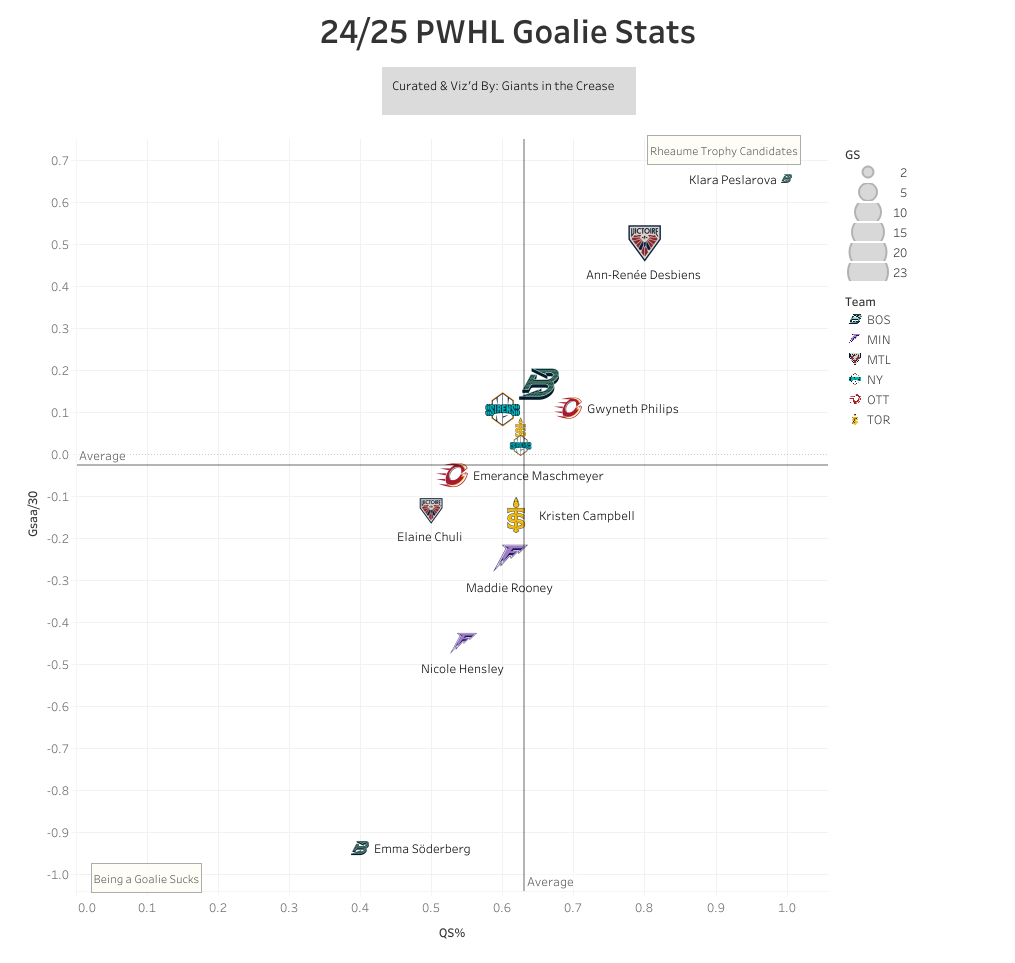
While I mentioned above that Montréal has the capabilities to control the shots split especially in the playoffs, Ottawa’s shot suppression abilities could be the deciding factor here. You have a great goalie in Philips who is a top three rookie in the PWHL and arguably putting up top five goalie numbers this season, who if she sees the continued great shot suppression in front of her would be the difference in creating an Ottawa upset. We’ll see if that matters to Montréal though who finished last in the PWHL in even-strength shots for but still scored the second highest even-strength goals.
With all this talk about Philips we’re forgetting who is at the other end of the ice and it’s Ann-Renee Desbiens. She plays on a good defensive team that is middle of the road in terms of shot suppression as Desbiens saw 27.16 SA/60 this season. She was dominate though and allowed Montréal to play their game without panicking. Desbiens should be the far and away Goalie of the Year pick as she dominated goalie stat categories such as QS% (0.800), GSAA (9.260), GSAA/30 (0.500), and EVSV% (0.945). Desbiens can usually be counted on to be great, her resume is full of greatness. This year she’s reached the pinnacle of being the best goalie in the PWHL.

For Ottawa your task is to try and score on a goalie who at even-strength allows essentially one goal for every 20 shots you take. For as great as Philips has been, and she’s been great, Desbiens is better this season. Philips has a 0.925 EVSV% which is higher than Schroeder and Campbell. Still not close to what Desbiens is doing. When a team matches you offensively and defensively in almost every way sometimes it just comes down to who is the better goalie. And as we saw last year you can have two of the best goalies in the world go at it but eventually someone is going to allow a goal to lose the game. Montréal is betting on Desbiens being the better goalie and it’s hard to argue against such a bet.
Prediction: Montréal’s experience, disciplined play, even-strength scoring problems taken care of, and Desbiens in peak form will give them the edge to win the series in four games.
Toronto Sceptres vs Minnesota Frost
Defence & Goaltending
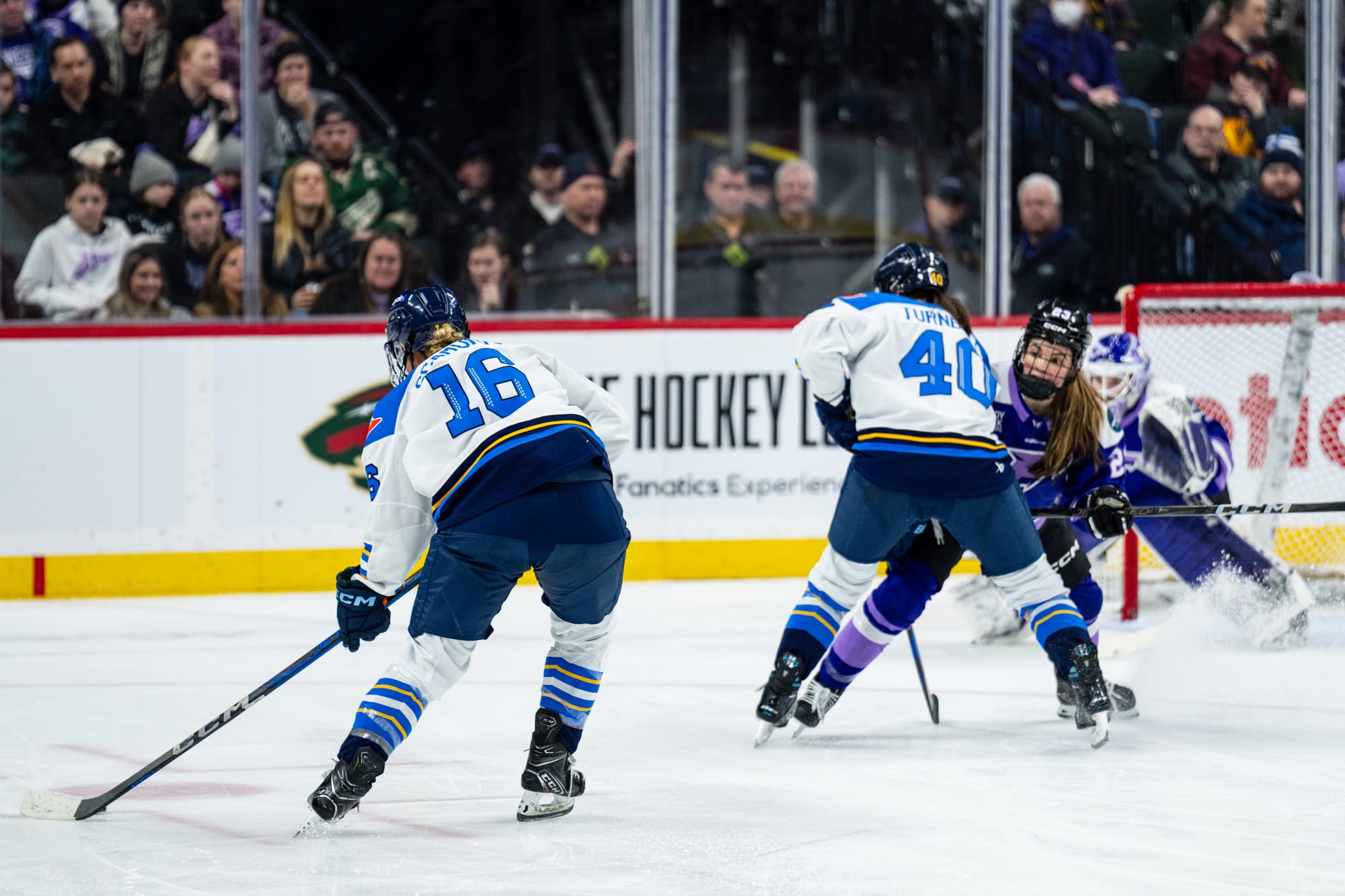
Starting with defence and goaltending for this series because this is where the teams are the most strikingly similar. In all situations Toronto and Minnesota are the best two teams in the league at suppressing shots against. They’re the only two teams under 26.00 SA/60 in the PWHL and last season they were the only two teams under 27.00 SA/60. They were also the best two teams at suppressing shots against at even-strength this season. We could be looking at a defensive stalemate between the two of them which would follow what happened last playoffs.
As just mentioned, Minnesota and Toronto were the best teams at suppressing shots against last year. Then in the playoffs that carried over to the point where each team only hit the 30 shots mark once in the five-game series. That includes a double OT game where neither team hit 30 shots on goal. Like the Montréal/Boston series the goals were also very hard to come by. In three of the five games a shutout was achieved and the maximum amount of goals scored was two. Game One and Game Two were the outliers where Toronto won Game One 4-0 while Minnesota took Game Five 4-1.
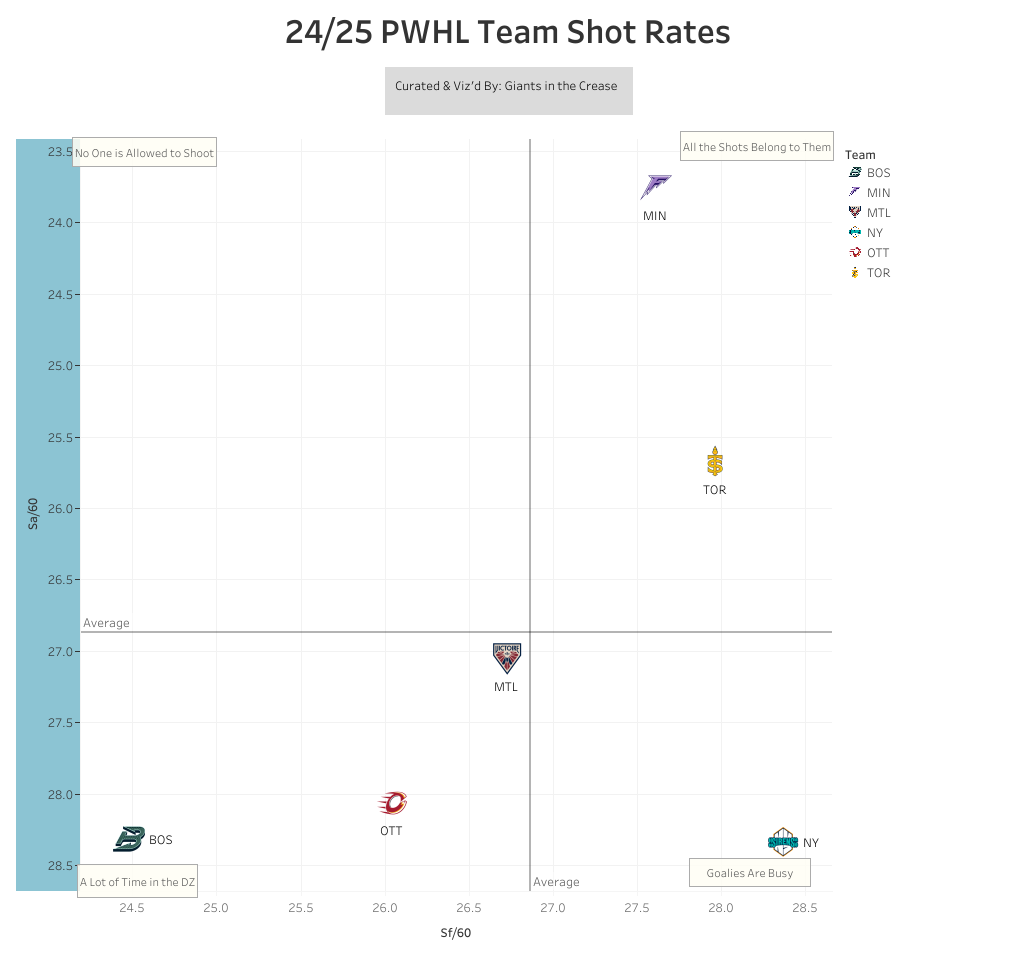
Here’s where we start to diverge from last years stats, the goaltending position. Last year Kristen Campbell was named Goalie of the Year and deserved it. There was a group of three featuring her, Aerin Frankel, and Corinne Schroeder who all had similar statistical resumes with Nicole Hensley on the outside looking in but not too far off. This season has been a lot less “fighting for Goalie of the Year” for any Toronto or Minnesota goalie and more “sometimes we’re very good, sometimes we’re not very good”. Three of the four Minnesota/Toronto goalies (Campbell/Rooney/Hensley) finished below the league average SV%, had a negative GSAA, negative GSAA/30, and below the league average in EVSV% as well.
These stats aren’t terrible when looking further into them. Campbell finished with a 0.619 QS%, Hensley a 0.545 QS%, and Rooney a 0.611 QS% meaning they had more games with a higher than league average SV% than games below. Being on such high end shot suppressing teams though means there’s fewer opportunities to help boost your SV% through extra shots on goal. Two goals on 20 shots (0.900) looks worse than two goals on 25 shots (0.920). This is a series where every goalie is comfortable being in a low shot environment. The good news for Toronto is Raygan Kirk has been aces at even-strength with a 0.928 EVSV% and Campbell since February has had a 0.927 EVSV%. The good news for Minnesota is very recent Rooney and Hensley have been great at even-strength too. Since March Hensley has had a 0.931 EVSV% and Rooney a 0.922 EVSV%. While defensively and in net it’s been a rollercoaster ride for both teams for the majority of the season, it’s calmed down for both teams and fans should be ready for trench warfare on ice.
Offence
In a mirror of last years series, what this series is going to come down to is offence. Who is going to break the defensive stalemate? As mentioned previously in last years regular season the top four teams in even-strength goals for all made the playoffs. Toronto finished first on the back of an all-time MVP performance from Natalie Spooner. Theoretically Toronto should have beat Minnesota but with Spooner out Toronto’s goal scoring disappeared. They scored once in the last three games of the playoff series with their only goal coming in Game Five. The offensive system employed by Toronto has always had questions of can it generate goals? No one questioned it when Spooner was healthy and dominating the league. As soon as she got injured the scoring problems appeared immediately and didn’t go away when the 2024/25 season started.
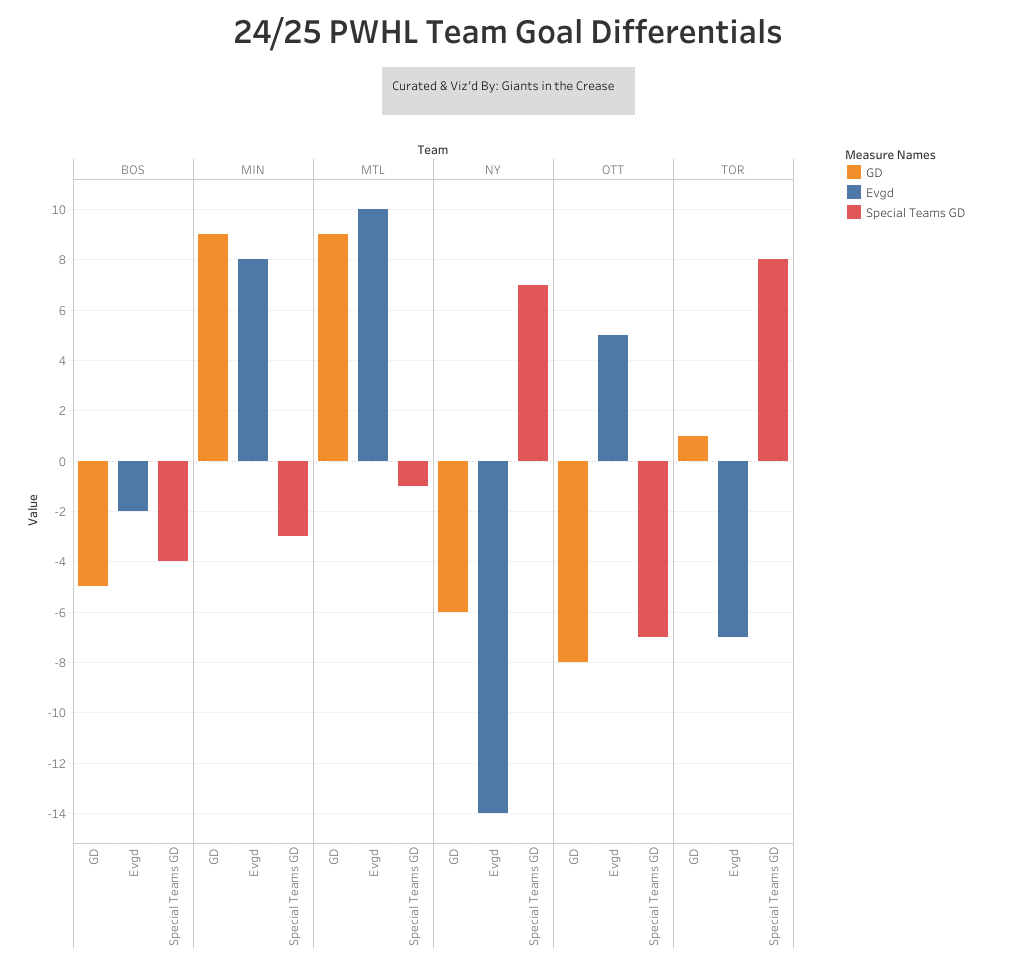
It’s not as though Toronto is lacking opportunities to score. They have the second best SF% (52.1%) in the league to go along with their second best SF/60 (27.97). They also have the third highest EVSF/GP at 22.27 to add onto their 51.4% EVSF%. If you’re just looking at their all situations goal numbers they have a positive goal differential and are third in the PWHL in GF/60 (2.36). It’s not last season’s eye popping numbers but those are all very solid numbers. They play a very well structured puck possession system.
It’s a system though that is apparently allergic to scoring. Before Spooner went off in the 2024 regular season Toronto had a 31.6 SF/60, 55.4 SF% and a 1.55 GF/60. Same story from this season where they controlled the shot share, controlled possession, put the puck on net a lot only to lose in heartbreaking fashion. Then suddenly their power play goes crazy operating at a 44% rate and pushing Toronto from the bottom of the standings to second place in the PWHL. Since their PP went cold with only one goal in the last eight games and 24 PP opportunities, Toronto has also only scored 1.5 even-strength goals per game.
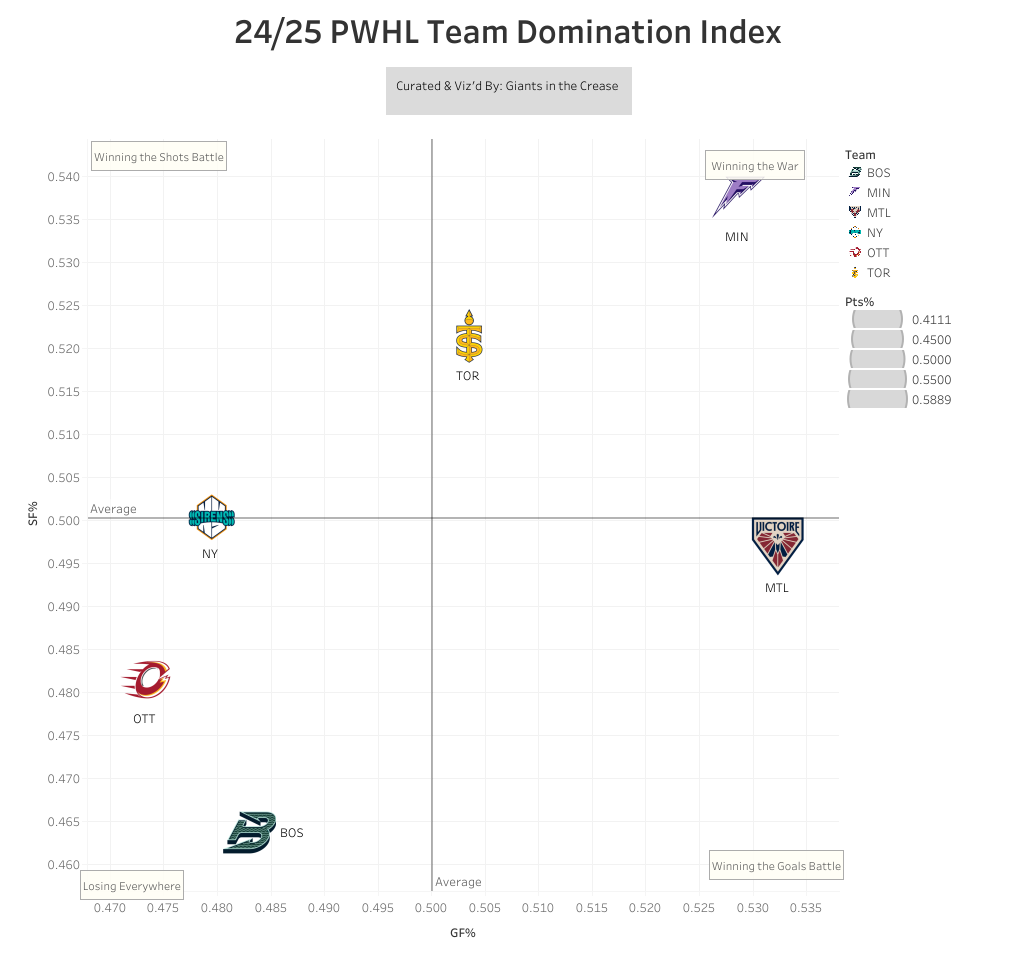
For Minnesota it’s been a complete opposite issue for them. In their last eight games they’ve scored 1.88 even-strength goals per game. This whole season they’ve been an even-strength scoring powerhouse. Minnesota holds the highest EV Team Shooting% at 8.9%, they have the best EVSF/GP (22.97), the best EVSF% (53.4%), the only team to hit the +2.00 EVGF/GP mark, and the only team to hit the +60 EVGF mark with the next closest team being eight goals away. Minnesota is a powerhouse at even-strength and in the playoffs where that matters the most they’re going to be extremely difficult to handle. I think this is a big reason why Montréal wanted no part of taking on Minnesota is round one.
Prediction: The two teams are nearly twins but Minnesota’s scoring should scare everyone. Odds are they finish the series in four games and are favoured to win the Walter Cup.