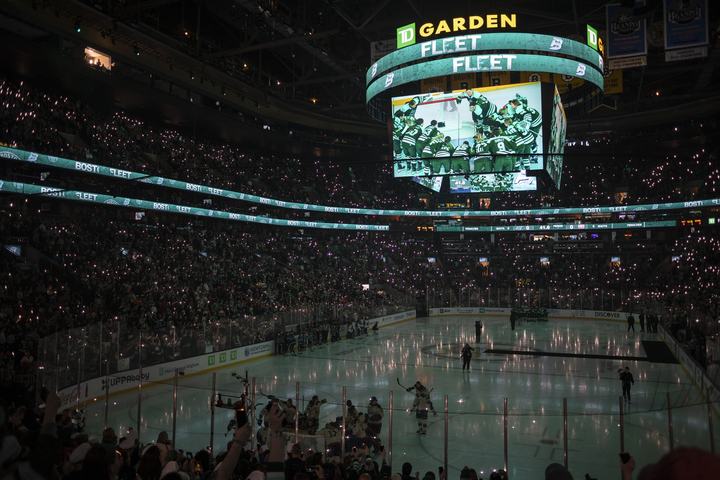
Megan Keller was the first Boston Fleet player introduced to the TD Garden crowd Saturday night, to deafening cheers.
Yet, despite captaining the Fleet and being this year’s U.S. Olympic golden goal scorer, Keller knew someone else would get a little more love.
“I thought Aerin [Frankel]’s cheer was so loud,” Keller told reporters postgame. “I looked over at Winnie [Haley Winn] and go, listen to this one.”
She wasn’t wrong. The crowd valiantly attempted to drown out the PA announcer and music with every introduction. But they undoubtedly saved their best attempt for last.
“[I had] chills hearing my name called and the fans responding that way,” Frankel told reporters postgame.
Saturday night was a long time coming for professional women’s hockey in Boston. Despite having teams in each of the previous leagues with the CWHL’s Boston Blades and the NWHL/PHF’s Boston Pride, plus a New England-based PWHPA squad, April 11 was the sport’s professional debut at New England’s largest arena. The past three NCAA women’s Beanpot championships also took over the Garden, to great success, but Saturday’s 17,850 sellout crowd was the largest women’s hockey turnout in the state’s history. It sits second all-time for a U.S. professional women’s hockey game, 156 short of April 4’s Madison Square Garden debut.
It was the latest in a long line of PWHL moments that, heading into it, felt bigger than a game. However, it should no longer come as a surprise when the PWHL draws large, boisterous crowds.
Earlier this season, in its 275th game, the PWHL’s all-time attendance crossed two million fans (regular season and playoffs). The league’s 2025-26 season attendance currently sits at 986,313 through 106 games. With 14 games remaining in the regular season, it will easily cross one million fans on its own. From the moment the PWHL launched on New Year’s Day 2024, it was clear that the days of professional women’s hockey playing in community rinks and NHL practice facilities were over.
Take the Fleet, for example. They play most games over 30 miles outside Boston in Lowell, which is challenging to get to on a weeknight. Bostonians have two transit options: an MBTA commuter rail train or driving. The train takes over an hour, drops you off a mile and a half from the arena in a not overly walkable area, and it has a challenging schedule for those working the traditional 9-5. Meanwhile, those who drive spend at least an hour and a half, and potentially over two hours, in traffic. Yet, the Fleet still draw crowds of 4,000+ for most weeknight games, while weekend Tsongas sellouts are now common. Meanwhile, they have four sellouts in six games at Boston University’s Agganis Arena, failing to cross 5,000 fans just once.
Then, there was this weekend’s Garden debut. The lower bowl sold out the day it went on sale to the general public in December. The event then fully sold out in February, although most tickets disappeared soon after each new section went live. Come gameday, TD Garden was a sea of Fleet merch, including swaths of Fleet sailor hats, which were only available as a giveaway at this season’s home opener at Tsongas or later through a special ticket link for their January 7 Agganis game and January 14 Tsongas one.

In short, this was a game that people were hungry to see after a long wait. They supported their team as noisily as their lungs allowed, despite the disappointing 1-0 loss to the Montréal Victoire. It did not have the feel of a special one-off game that people attended for the heck of it, but of one where more fans finally got the chance to come together at the same time and cheer on their team.
The vibe of already established fandom was in contrast to the PWHL’s Takeover Tour, which drew 199,631 fans this season across 16 games in 11 markets. At those games, it is usually a sea of mismatched hockey gear and signs such as “we want a team” or “first PWHL game,” along with gargantuan merchandise lines, as TD Garden also saw. Just three years into the PWHL’s existence, that’s still a vital part of growing the sport. However, the trips to their current markets’ biggest arenas should be a reminder that this league is already entrenched in eight communities across North America.
Still, much of the conversation around the Fleet’s Garden debut followed the novelty theme. Social media was flooded with posts about how big the moment felt. The postgame press conferences were filled with questions about playing in front of the crowd and what it meant to see all the young girls in the stands who can now dream of being in the PWHL someday. The game indeed marked a milestone for the Boston market, but it should be the last time those storylines overshadow the game itself.
With each record smashed and new venue packed, it is still valuable to reflect on the sport’s growth. However, it’s equally important to remember that this is the new normal. Large, raucous crowds are not the exception in the PWHL, but the norm. Women’s hockey is here to stay, and next time the Fleet sail into TD Garden, it’ll hopefully get to be just another day at the rink, albeit a particularly deafening one.