

PWHL expansion is in the rear view mirror and what started as a blueprint to build an immediately competitive roster is all but filled in with names, from seasoned stars to 2026 draftees. For many the acquisitions of Olympic gold medalists and pillars of the women’s game like Hilary Knight, Hannah Bilka and Cayla Barnes were a welcome injection of star power to Hockeytown. For those that followed the league over the past few years it may feel like deja vu.
Just last year, the Seattle Torrent and Vancouver Goldeneyes expanded the league to an eight-team structure. Over the course of that process Seattle signed or selected Knight, Bilka, and Barnes. Vancouver iced a team featuring Mellissa Channell-Watkins, Sydney Bard, and Nina Jobst-Smith now of PWHL Detroit. Results on the ice were slow to come, with Vancouver and Seattle finishing in sixth and eighth place respectively.
How does General Manager Manon Rhéaume’s team building compare to the approaches taken last year?
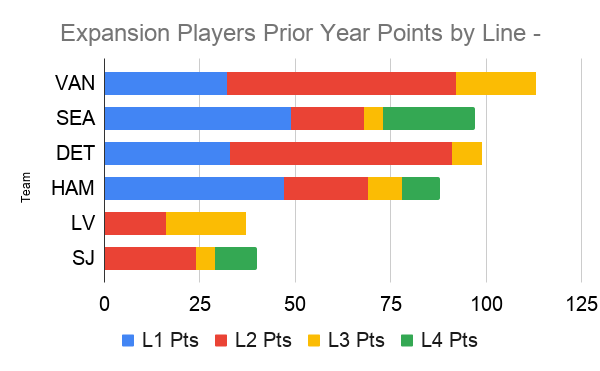
In terms of point production, Detroit quickly established a highly productive offense, rivaled only by Hamilton’s expansion acquisitions. Similarly to Vancouver last year, Rhéaume is relying on established top-six players rather than hoping for growth from middle-six players in elevated roles. Both 2025-26 expansion teams experienced production increases from their forward group, averaging 17% greater output on new teams, while original six teams declined 1%.
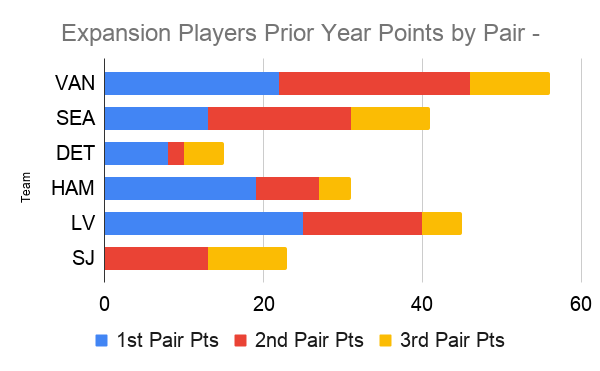
Production from the blueline is a defining factor for Walter Cup contenders, with last year’s playoffs teams racking up 30% more points from defenders than non-playoff teams. Last year, Vancouver and Seattle both bet big on high end defenders however, the resulting production declined an average 11%, meanwhile defenders on the original six teams produced at nearly the same pace as the prior year.
This is an area of opportunity for Detroit, with less emphasis being placed on defensive production through the expansion process. Still, Rhéaume’s team has room for upside, with Barnes who ranked 7th in defense production as a rookie in 2024-25 before dipping with Seattle last year. Much will hinge on growth from young players with the average age of the blueline under 26.
Between the pipes, PWHL Detroit is headlined by Swiss Olympian and bronze medalist Andrea Brändli who through five games posted a .95 save percentage (2nd only to PWHL goaltender of the year Aerin Frankel), and a 1.94 goals against average good for 4th in the 2026 Milan-Cortino Olympics.
Perhaps the most important factor in establishing a successful franchise may not be found on any stat sheet. In the days and weeks following the close of the season, many Seattle and Vancouver players shared the challenges of building a great support staff and locker room culture in such a short time. Detroit stands atop the expansion teams with six players acquired from Seattle or Vancouver. Six players with the experience to know what it takes to turn a roster into a team. The question is can they do it in year one?
Great article Izzy! So informative, and I appreciate the inclusion of all of the relevant stats. The colorful graphs are the icing on the cake!