For Sydney Morrow, draft night was less a finish line for her career and more the beginning of something she had never experienced before.
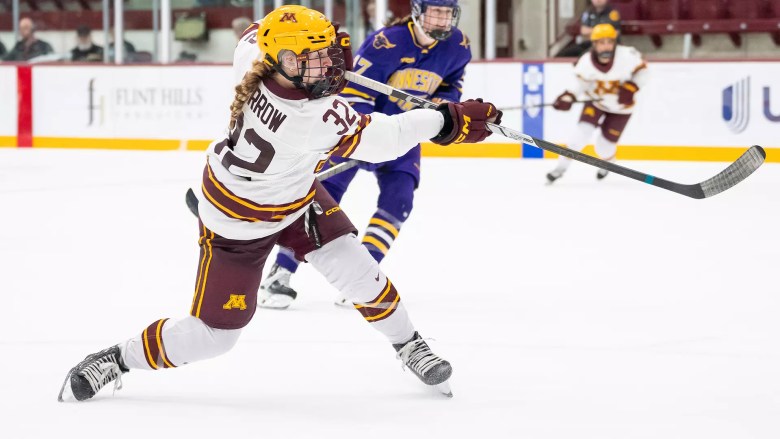
The Seattle Torrent selected Morrow 14th overall in the second round of the 2026 PWHL Draft on June 18. The Minnesota defender had spent the previous three seasons moving through Ohio State, Colgate and Minnesota, building a reputation as an offensive-minded defenseman who could contribute in all three zones. In her senior season with the Gophers, she recorded 38 points and 30 assists in 39 games, ranking second among NCAA defenders in both categories, according to Minnesota. She also earned CCM/AHCA Second Team All-America and All-WCHA Second Team honors.
But when the moment finally arrived, Morrow’s biggest worry was making sure to not trip on her way up to the stage.
“The whole draft was definitely a whirlwind,” Morrow said. The amount of media and activity surrounding the event pushed her outside her comfort zone. Before her name was called, she worried about getting her stick, walking up the stairs and making it through the interviews.
Once Seattle selected her, those nerves gave way to excitement. Morrow hugged the friends and family who had traveled to Detroit with her, then went onstage, where Torrent general manager Meghan Turner welcomed her to the organization.
“From there, [being] able to process everything and really get excited about the next chapter — not really have any more what ifs — was super nice,” Morrow said.
That next chapter will take her to a city she has never visited. Before she begins learning the rhythms of professional hockey, Morrow will have to learn Seattle, too.
A hockey family from the start
Morrow’s family shaped her path to the PWHL in generational ways.
She has two brothers and one sister, and all four siblings still skate together. Her younger sister, Sophie Morrow, is entering her sophomore season at Penn State. Her younger brother is continuing his hockey career, and her older brother, Scott Morrow, plays professionally with the Hartford Wolfpack. Their father also still coaches them.
“My path would have been completely different without all of them,” Morrow said.
Some of her earliest hockey memories came from skating on a small pond in the backyard with her father and older brother. Scott was a particularly important influence as Morrow developed, first as a player she could watch and learn from, and later as someone whose college and professional career gave her another example of what the next levels of hockey could look like.
Morrow also credits her father with providing a steady voice throughout her development. He tells her what she is doing well and where she can improve, while both of her parents have emphasized the same message:
“We just want you to be the best you,” Morrow said.
That support followed her to Detroit. Morrow’s family were part of the process long before a PWHL team selected her, so having them at the draft mattered to her.
“I hope in a few years when it’s my sister’s time that I can do the same thing,” Morrow said.
Learning when to take the risk
Morrow does not begin her description of her game with her offensive numbers.
“I would say the defining factor for my game is definitely IQ and hockey sense,” she said.
That affects the decisions she makes throughout the ice. Offensively, Morrow said she looks for opportunities to join the rush and find seams for teammates. Defensively, she relies on that same decision-making to manage her responsibilities in her own zone and move the puck out.
Finding the balance between those two sides of her game took time.
Morrow said she developed it through trial and error, beginning in high school and continuing through college. Coaches gave her room to take risks, make mistakes, and learn from them — rather than simply discouraging her from joining the play.
Her main example is the decision to pinch or jump into an offensive opportunity. If the play breaks down, Morrow explained, the result can be an odd-man rush going the other direction. Learning when that risk is worth taking has become part of Morrow’s development.
“Being in an environment where it’s okay to make mistakes and it’s okay to do that and then learn and then not make that mistake the next time,” she said, “and have people give you constructive criticism rather than getting upset with you … that’s been huge for me.”
Impact above the scoresheet
The numbers show why that offensive instinct has become an important part of her game. Morrow scored eight goals and added 30 assists in her final season at Minnesota, while also finishing with a plus-33 rating and 57 blocked shots. She recorded 10 multi-point games and had a career-high four assists against St. Cloud State on Jan. 23.
That four-assist performance also gives a glimpse into how Morrow thinks about her own impact.
Asked whether she would rather record a hat trick or four assists every game for the rest of her career, she chose the assists.
Her reasoning had little to do with her individual statistics. Four assists would mean her team scored at least four goals, and she sees an assist as another way to directly contribute to winning.
“For me personally, my positive impact that I have on the game, well, it’s not just on the score sheet,” Morrow said.
Minnesota prepared her to be a rookie
Morrow’s final season at Minnesota gave her another kind of preparation for the PWHL.
Teammates leaving to participate in the Olympics left the Gophers with a smaller roster. Morrow said the situation gave her more ice time and put her into more of a leadership role while the team continued playing strong WCHA opponents.
She described the experience as challenging and exciting at the same time. With fewer players available, more people had to take on larger roles, and Morrow saw teammates rise to those opportunities.
“I think in that time when you’re kind of going through adversity is when people really come together, too,” she said.
The experience did not eliminate the difficulty of the situation. Instead, Morrow said it changed how she understood adversity, giving her an example of how a difficult stretch can also strengthen a team.
That is a perspective she wants to carry into her rookie season.
“There might be challenges, there might be adversity, but there’s also so much good that comes from it,” she said.
Learning from the best
Minnesota’s environment also gave Morrow daily experience against players she described as highly talented. She pointed to the competition in practice — as well as the program’s strength and conditioning staff, facilities, coaches, athletic trainers, and equipment staff — as pieces of an environment designed to help players develop.
For Morrow, that development was also collective.
“All of us trying to make each other better” was a major part of what she believes prepared her for the next level, she said.
Now she is entering another locker room filled with players she expects to learn from.
Morrow said one of her favorite parts of being a rookie is getting to know people in a new environment. Some of her strongest college memories came away from the ice, when teammates were simply spending time together.
At Minnesota, she and her teammates had a tradition of putting a question of the day on the board before practice. The questions could be serious or funny, and sometimes they involved the coaching staff.
Morrow said she hopes to bring some of that energy to Seattle.
Her teammates would describe her as bubbly and someone who likes to “chat about nothing.” She enjoys bringing a lighter atmosphere to the rink when the situation allows for it, while also knowing when it is time to become serious and intense.
She is not planning to enter Seattle’s locker room trying to establish herself as its leader.
“I’m not trying to come in and be the number one leader right away,” Morrow said. “I think I’m just excited to get to know everyone and accept that leadership, so that I can grow as a person and a player.”
A rookie in Seattle, too
If Seattle fans are meeting Morrow for the first time when the Torrent begin their second season, she already knows what she wants them to notice.
She wants them to see her passion.
“I hope that they see that I’m doing it to the best of my ability,” she said.
That could mean blocking a shot, joining the rush, contributing offensively or killing a penalty. The specific assignment matters less than doing it for the team.
Morrow has never been to Seattle. She said she is excited to become a fan of the city’s other sports teams, explore the city, and collect recommendations for coffee shops and restaurants.
“I’m also a rookie in that aspect,” she said.
That makes Seattle another new environment for a player who has spent the past several years learning how to adapt to new ones. Now she has another transition ahead.
When she imagined speaking to herself at the end of her first PWHL season, her message was simple: enjoy it.
“You only get to be a rookie in the PWHL one time,” Morrow said.
She wants to remember the home games at Climate Pledge Arena, to look around and remember what it felt like to play there. She wants to remember the fans and the joy surrounding those moments.
For now, there is still a lot she does not know: she has not played a PWHL game, or experienced a home game in Seattle, or met the teammates she will spend the season learning from.
Those are all things she gets to discover for the first time. And Morrow intends to enjoy being a rookie while she does.