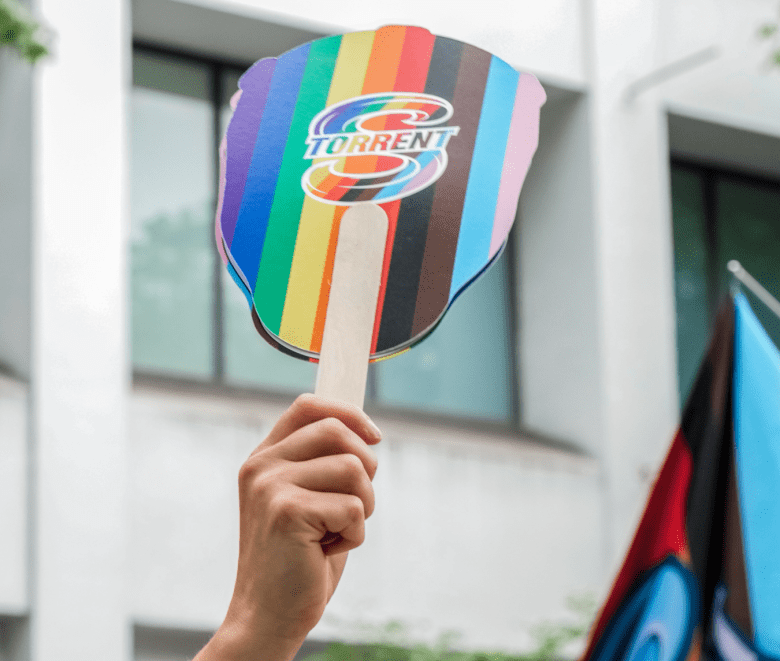
At some point during the 2026 Seattle Pride Parade, it became difficult to tell where the Seattle Torrent fans ended and the rest of the parade watchers began. Torrent upon Torrent jerseys dotted the route. Defender Emily Brown, representing the team as one of Seattle Pride’s grand marshals, walked through a city that had only gotten its first PWHL team a year earlier.
For Brown, the experience still hadn’t sunk in weeks later.
“If you would have told me five years ago that I’d have the opportunity to represent our team as [a] grand marshal in the Seattle Pride Parade, I think I’d have a hard time believing that,” Brown told The Ice Garden. “What an awesome experience to have that opportunity to interact with that community and a community that means a lot to me.”
The Torrent’s inaugural season did more than introduce another professional team to Seattle. Somewhere between the team announcement, opening night, Unity Games, player appearances, and Pride, people began incorporating the Torrent into how they understood themselves as Seattle sports fans.
That did not happen accidentally.
“Community wasn’t something we planned to do after we built the fan base,” Director of Team Business Operations Madi McNamara told The Ice Garden. “It was how we planned to build one from day one.”
If there is a Seattle Torrent guide to building a community around an expansion team, that might be lesson one: don’t wait until you have fans to decide who you want those fans to be.
Making community part of game day
There is an easy interpretation of community engagement in professional sports. Teams pick an identity month, invite an organization, and maybe put a themed graphic on the Jumbotron. They might post on social media, tag the organization, and then move on to the next event.
The Torrent diverted from that and took a page from local community spaces. The organization brought organizations to the rink in a way those organizations were familiar with: the resource fair, complete with tables, flyers, and people fans could actually speak to.
McNamara said that was intentional.
“Our games aren’t just about hockey; they’re about bringing people together and creating a community event,” she said. “By giving community organizations a presence in the arena, we can help introduce thousands of fans to important causes and hopefully inspire more people to get involved.”
Across the Unity Games during the Torrent’s inaugural season, 24 community organizations maintained an on-the-ground presence at games. Their tables became synonymous with Torrent hockey, giving local Seattle organizations access to the thousands of people who visited Climate Pledge Arena for a hockey game.
Of course, the Torrent could not escape the inherent tension of a professional sports team trying to form relationships with communities while also selling tickets, merchandise, and a new brand. No team can. So the question became: What does a sports team do with that tension?
McNamara said Seattle tried to begin by listening. The Torrent did not want to recreate work Seattle organizations had already done; instead, the team wanted to determine where its platform could amplify that work.
Joining Seattle’s women’s sports culture
Seattle did not need the Torrent to invent a culture around women’s sports; that culture already existed.
McNamara, a former University of Washington soccer player, knows that history particularly well. She pointed to the Storm, Reign, and generations of women’s sporting events that have drawn crowds in the city. The Torrent, she said, did not see itself as the beginning of that momentum.
“We are not the starting or the creating of anything in Seattle. It’s been here,” McNamara said. “We wanted to build on what’s already made women’s sports so special in Seattle.”
That may be lesson two: know when you are joining something that already exists.
Long before Seattle had a PWHL franchise, people organized to bring professional women’s hockey to the city. Before Torrent players ever wore the team’s logo, Seattle had already built an identity as one of the country’s most visible women’s sports markets. The Torrent’s job, evidently, involved less convincing that women’s sports mattered in Seattle, and more channeling that existing energy somewhere new.
The response surprised even the players.
Brown remembers coming to Seattle in July 2025, shortly after the league announced the expansion team. There was no team name yet. The players had not played a game in Seattle outside the PWHL Takeover Tour, but fans had already shown up for them.
“Every single touchpoint that we had with the community, with the fans, it just continued elevating that experience,” Brown said. “The reception we’ve gotten from the fans has just been something that I don’t think any of us could have expected.”
By the end of the season, Brown cited Seattle’s community as the first thing she would tell another player when explaining what made playing for the Torrent different. It even factored into a major career decision of her own.
Brown entered the offseason as a free agent, and she said Seattle’s community influenced where she ultimately chose to play.
“The community aspect in Seattle, it really separates Seattle from other markets,” she said. “It’s something that we talk a lot about internally about how much that means to us as players.”
Fan support reaching the locker room
That relationship also complicated the usual separation between what happens on the ice and everything beyond it.
Seattle’s first season did not always give its players much on-ice success to draw from. Brown said that during those stretches, players talked internally about what the city had already given them and the responsibility they felt to give something back.
“When things weren’t necessarily going right on the ice in terms of final results, that’s something that we drew a lot of energy from,” Brown said. “It gave us a purpose and makes us even more excited for year two.”
Community, in other words, was not only something the Torrent’s business staff built around the hockey team. The players felt it, too.
For McNamara, creating that connection requires the business and hockey sides of the organization to work together. The team cannot simply turn community appearances into another obligation on a player’s itinerary, she said. Those opportunities have to make sense for the player, the fans, and the organizations involved.
“We want community appearances to be meaningful,” McNamara said. “We want our players to be interested. We want our fans to be interested. We want it to be intentional and collaborative.”
Which brings us to another lesson: showing up once is easy, but that’s not how relationships are formed. McNamara is explicit about wanting the Torrent to build non-transactional community partnerships.
“Authenticity comes from consistency,” McNamara said. “We weren’t interested in checking a box by attending one event and moving on.”
Seattle Pride showed what Torrent community looks like
The Pride Parade provides an interesting test of that idea. Seattle Pride approached the Torrent about serving as grand marshals rather than the other way around.
For McNamara, who is part of the LGBTQ+ community herself, the invitation carried particular significance. Brown, meanwhile, used the parade as a chance to meet fans who told her directly what having the Torrent in Seattle meant to them.
“I’ve heard from a lot of fans that they just feel so grateful that they feel like they belong at Climate Pledge Arena for our games,” Brown said. “To me, that means the world because Torrent hockey is for everyone.”
That feeling of belonging matters because professional sports teams often talk about community in broad terms. The harder part is creating spaces where fans actually feel that connection.
Seattle Pride gave the Torrent one visible example of what that could look like. The more difficult work comes in sustaining those relationships once the parade ends, the theme night passes and the season moves forward.
The Torrent’s next test
McNamara acknowledges the Torrent still has significant room to grow.
Seattle had roughly five months to build the organization before its inaugural season. McNamara said the organization wants to explore opportunities throughout King County, Washington, and the broader region.
That could become one of the most important tests of the Torrent’s second year. If the Torrent wants to position itself as a team belonging to the Pacific Northwest, the organization will eventually have to build relationships beyond the communities closest to Climate Pledge Arena.
Another challenge waits alongside that one.
When the Torrent return for year two, fans will not see the same names on the roster they learned during the inaugural season. Expansion reshaped Seattle’s roster, sending some of the team’s most recognizable players elsewhere.
That creates a useful test of what exactly the Torrent built during year one. Did individual stars drive the connection? Or did Seattle create something sturdy enough to survive roster turnover?
McNamara believes the latter.
“The Torrent is so much bigger than one player or one athlete or one person,” she said. “Our building blocks are still there. Our ethos is still there. Our guiding principles are still there.”
Year two will help prove it.
For Brown, the standard is ultimately simpler than attendance figures or the number of organizations represented on a concourse.
“A place where everyone can feel like they belong, feel like they have a space, that hockey can be this outlet for people,” Brown said. “Some of the most impactful messages I’ve had are fans telling me that they feel like they can be a part of the Torrent.”
Hockey has given Brown that kind of place at different points in her own life. Creating it for someone else, she said, ultimately matters most.
“Obviously, it’s a sport, it’s a business, and we need to put the results up on the ice and win hockey games,” Brown said. “But really, for me, the most meaningful part of it is that people belong and feel like they have a place to go.”
Maybe that is the last lesson in Seattle’s guide: a community cannot simply be the audience for what you are building. It has to be part of the building.