Before making moves for the next season every team needs to figure out what way the league is trending in terms of on-ice play. Most of the smart people who are good at figuring out where the league is and where it’s going are already working for teams, so you’re stuck with me.
Let’s look at what teams learned this season and, most importantly, the lessons that are going to stick around for another season. The fun part of this article? You can bookmark it to dunk on me later if all of a sudden, the PWHL starts playing completely different hockey next season.
Lesson One: If You Can’t Take Care of Your Own End, You’re in a Lot of Trouble
There’s going to be some crossovers in terms of lessons learned, but a lot are going to stem from this first lesson. No one really knew what the league play was going to look like coming into this season and if there’s one thing coaches hate, it’s uncertainty. You’ll see this at the start of playoff series where teams will be feeling each other out, which means an emphasis on defence. That was the common theme among teams this season in that you needed tight team defensive play. There are two teams that exemplified this example the most, Toronto and New York.
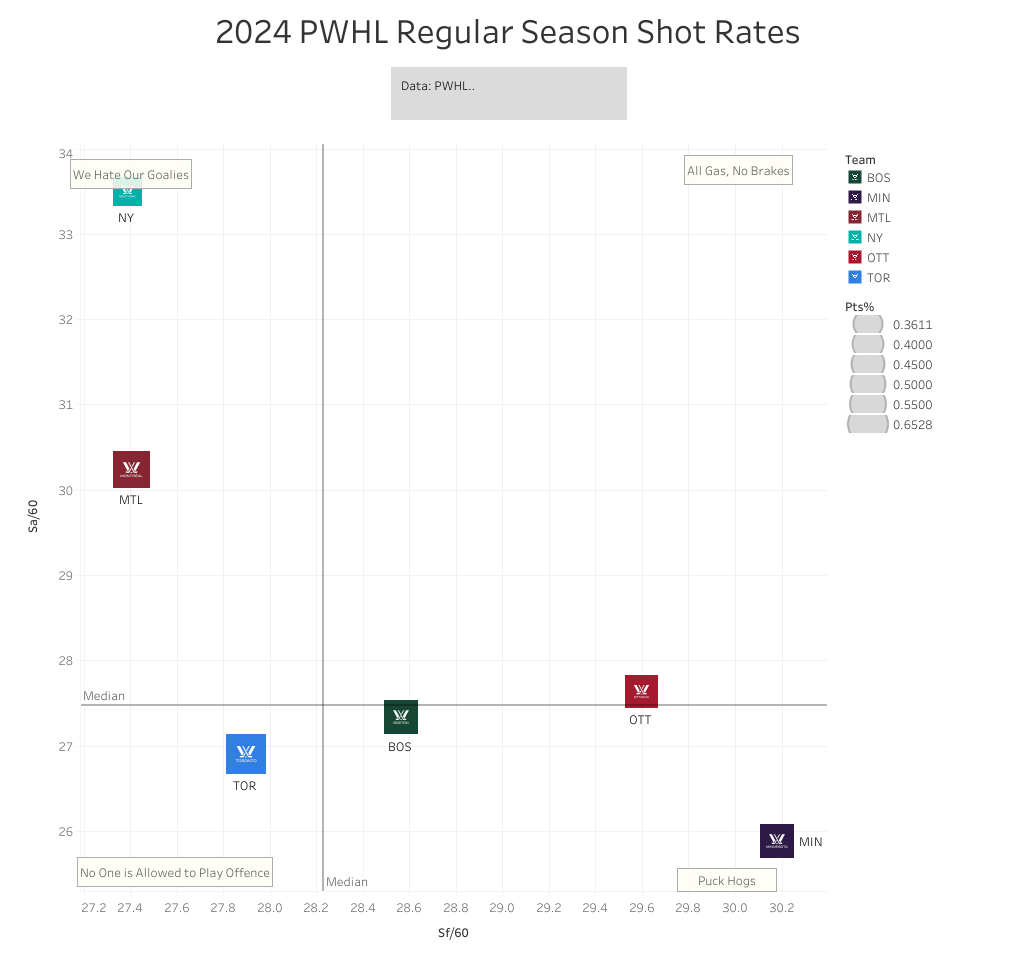
In Toronto they smothered teams almost right out of the gate. It took them a period against New York in the first-ever PWHL game to show off their defensive prowess potential, but they did. Head Coach Troy Ryan had been working on implementing this defensive play with Team Canada, which makes sense why the team picked it up so quickly with seven Team Canada skaters plus one Team USA skater on the roster. Of course, this also frustrated fans for awhile as Toronto refused to score, but we’ll get into that later. I think the other piece of evidence that shows how well Toronto played defense was the allegedly sudden change in play from goaltender Kristen Campbell. The prevailing narrative is that Campbell finally figured it out. It’s more like Toronto figured out how to play a complete defensive game, which benefited Campbell and her stats a lot.

At the other end of the spectrum unfortunately was New York, whose defensive team play left much to be desired. Throughout the season it was obvious that New York had the firepower to overwhelm teams and rack up goals quickly with their strike fast rush offence. To the dismay of the Head Coach Howie Draper and goaltenders Corinne Schroeder and Abbey Levy, the puck spent a lot of time in the New York defensive zone. This happened because they just didn’t take care of the puck well enough, either turning it over on breakouts or just failing to clear the zone once they got ahold of the puck. New York made it too easy on teams and instead of forcing their opponents to create offence, they gave them a head start on creating scoring chances. Shots on goal are tricky in that the stat does rely on score effects. When you have a league low 45% SOG Share and the league’s highest Shots Against/60 at 33.5, it’s clear that there are defensive issues to take care of.
Lesson Two: The Physicality is Here to Stay
I think it’s fair to say everyone has their opinion on the PWHL’s implementation of hitting, from the inconsistency of what’s a legal vs illegal hit to a lot of players don’t know how to hit or take a hit safely. The players wanted it and the players got it. The league definitely needs to nail down what constitutes a penalty and get players into checking clinics to avoid there being injuries. At the end of the day though, it’s going to be up to the players as to what they do to deal with the new reality of women’s hockey.
And it’s tied. NY has inexplicably kept Madison Packer off the ice almost all season. Here she breaks up a play off the draw, then throws a hit that separates the puck that ends up heading up ice for the goal. It’s the little plays that count as much as the finish #PWHL pic.twitter.com/wJDEiyEOOr
— Ian Kennedy (@IanKennedyCK) May 1, 2024
Women’s hockey has always had a certain interesting relationship with physicality. The level varies quite noticeably depending on what league you’re in. In the EWHL there’s not going to be much contact. The SDHL though has now had two seasons of body checking. In the NCAA you have a conference such as Hockey East, which is nowhere near the physicality of the WCHA, which can sometimes look like a hockey game from the 80’s. At the World Championships the physicality allowed can often vary game to game based on who the officials are which is why you’ll often see Canadian/American officials officiating Canada vs USA games at the request of those players.
Huge hit #PWHL pic.twitter.com/ODK0e34fxD
— Marc Dumont (@MarcPDumont) May 10, 2024
What does all of that have to do with the PWHL and its physicality? It means more than ever physicality is going to play a larger role than it has in the past. Strategy is going to change especially when it comes to the breakout vs the forecheck. Blueliners and the puck carriers are going to have to deal with more bumps and bruises which as the season goes along can add up especially in the playoffs.
Then there’s the ability to start setting the tone physically, which has happened in women’s hockey, though never to the degree here. Previously Emma Maltais couldn’t just crush someone against the boards unsuspecting but now she can. Having watched WCHA and SDHL games, those players are going to have a leg up coming into the PWHL. However, there’s still going to be quite the adjustment period.
The tricky part is how best to implement physicality when the players haven’t played this way since maybe they were in their U16 years playing boys hockey and women’s hockey hasn’t seen this since the early 90’s before it was taken out. Not to mention not knowing exactly what’s legal hit wise teams might be cautious about implementing a hard-hitting game but if a team chooses that path it could lead to untold fortune in the season as well as the playoffs.
Lesson Three: Finishing is the Hardest Thing to Do in the PWHL, So Teams Desperately Need Players Who Can Finnish
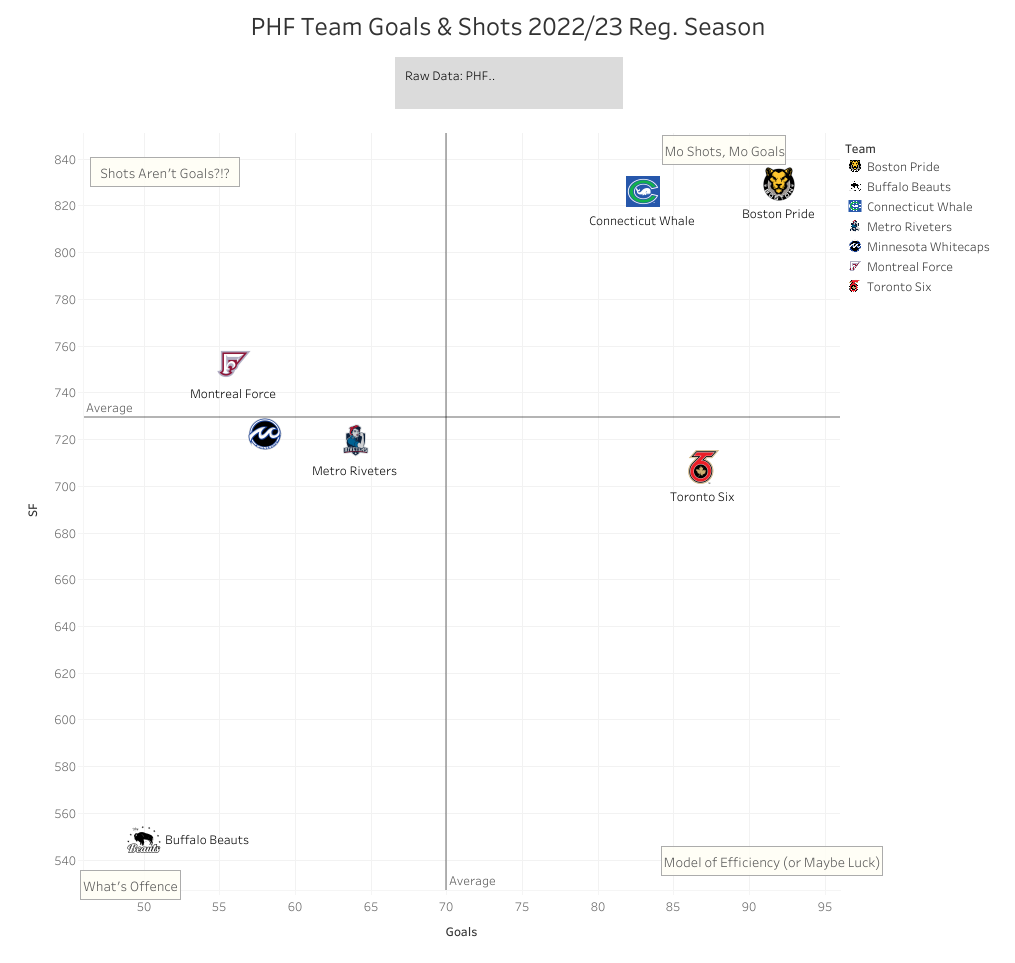
Coming out of the 2023 PWHL Draft the prevailing narratives were “wow look at all this talent together” and “these are some good goalies; how are teams going to score?”The people who ran with the second thought are probably thinking to themselves they look pretty damn good. And why wouldn’t they? Not a lot of goals were scored this season. You look at the PHF in its final season and they had 5.63 goals per game. The PWHL this year had 5.03 goals per game. The Boston Pride were the highest-scoring team in the PHF in the 22-23 season with 3.97 GF/60. Toronto was the highest scoring team in the PWHL with a 2.68 GF/60 which is quite the difference. To really drive the point home the PHF league average SH% was 8.9% in 22/23, while the PWHL league average SH% was at 7.7%.

The biggest question teams are going to ask themselves is, why is that the case? It’s not like the league is lacking for talen,t especially with players such as Marie-Philip Poulin, Loren Gabel, Alex Carpenter, Taylor Heise, Grace Zumwinkle, Laura Stacey, etc. Does the PWHL have all the best talent in the world? Of course not. The SDHL and NCAA held, and still do hold, some of the best players in the world. They’re not lacking that much talent though that would then lead to such a dearth of scoring.
You know where there was a lack of scoring though in 22-23? The PWHPA showcase tour. The average SH% was 7.8%, just 0.1 off of this years PWHL SH%. So why did the PWHL statistically follow the PWHPA and not the PHF despite the number of players in the PWHL coming from those two groups being essentially 50/50? The PWHPA received some side-eye when its four teams were created using a secret formula/process to decide the rosters but in the end the rosters on paper were pretty even. Coming out of the 2023 PWHL Draft no team was perfect, but it was clear that the talent level was pretty damn similar throughout the six teams.
What also need to be considered is there was no Worcester Blades or Buffalo Beauts or AIK for teams to beat up on, which certainly plays a role too.
Now let’s look at what happened in the past two NCAA National Championship games between Ohio State and Wisconsin. Two teams who ravaged the NCAA and were so evenly matched that in 2023 and 2024 both games ended 1-0. Offence was a struggle to come by, firstly because there’s a big focus on defensive play so when you have two teams like OSU and UW playing, no one is giving up any easy chances. Secondly, scoring goals is really hard and made harder by the fact that there are an extremely small number of players who can score at will along with an equal amount of players who can create enough chaos to get those goal scorers a good look. Hilary Knight has one of the best shots in the world but still only scored six regular-season goals and none in the playoffs.
This season really drove home the point that players who can create offence at a level beyond the average PWHL player are both extremely valuable and pretty damn rare. These players aren’t bad at scoring goals but they just learned that scoring isn’t going to be as easy as it was in college. In the PWHL if you want to score it’s going to take something special or you’re slogging it out in the trenches hoping for one more lucky bounce than your opponent.
Lesson Four: There Are Too Many Good Goalies Out There and It Would Be a Rarity if a Team Had Goalie Problems
You can argue and be correct that there are player types or positions in the game where there’s a seemingly lack of very talented available players. For instance, it’s very hard to find forwards who are pure goal scorers and can score from almost anywhere. Then of course we all saw the 2023 PWHL Draft and noticed that it wasn’t exactly packed with overly talented blue liners.
When it came to goalies though, especially in a league with only six teams, there didn’t need to be a rush in picking a goalie. New York waited six rounds before choosing PHF Goalie of the Year Corinne Schroeder which looks like a genius move considering the season she had. Elaine Chuli was taken by Montréal in the 12th round and look at how good she was this year coming off an Isobel Cup championship. Then you have Amanda Leveille, who didn’t play all season but arguably has put herself in HHOF contention having been the best goalie in PHF history. We also just saw Klára Peslarová go undrafted despite being one of the best goalies in the world right now.
If there was a concern about Klara Peslarova bouncing back from an injury that kept her out nearly a whole year, that concern should be put to rest. She’s right in the thick of the SDHL Goalie of the Year race & one of three frontrunners. pic.twitter.com/VyBatCBOc4
— Giants in the Crease (@CreaseGiants) January 23, 2024
Teams looking for an easy night in the PWHL because the 1G isn’t in net are in for a terrible wakeup call. Obviously, there’s a difference when you’re playing Ann-Renée Desbiens vs Elaine Chuli, but with the way teams are playing defence to find a difference that matters you’d have to look far down the list of goalies currently playing hockey to find one that would be noticeably easier to play against than their goalie partner. The talent necessary to finding a goalie spot in the PWHL is at an extremely high level and it’s something skaters haven’t really seen before. Even in the World Hockey Championships you’ll run into some goalies where the lights are shining a bit too brightly for them and they can’t bring a consistently high level of play. You just can’t count on that happening in the PWHL. You might get lucky and a goalie has an off-game or enough moments to make a difference but otherwise you’re earning every goal you get.
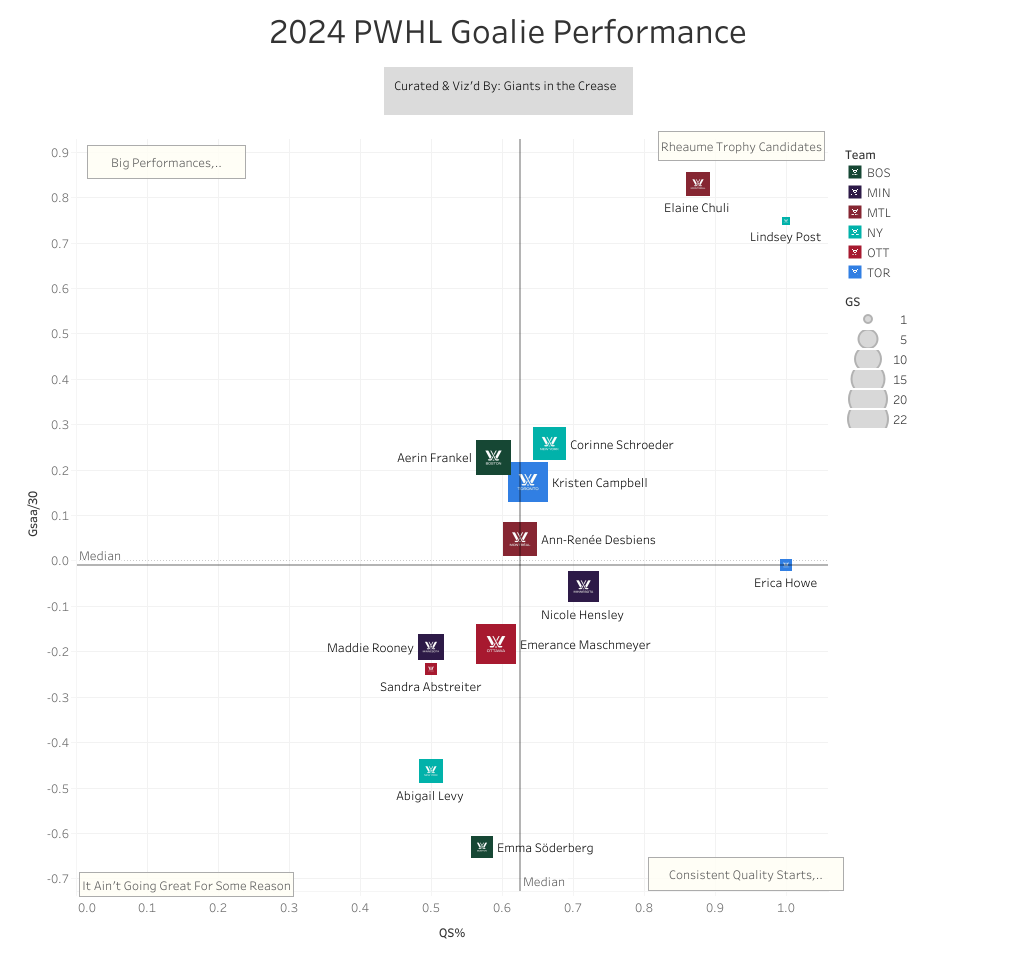
What this also means is that teams evaluating goalies must take a different approach than they usually would. Normally you’d just pick which goalies have the highest talent and then go from there. With the goalie pool available though you can throw a dart at a list of names and pick a goalie who can play in the PWHL. What teams are, or should be looking for, is goalies who fit the defensive systems they want to play. Goalies, plural, as goalie depth is important. Minnesota just won using two goalies an almost equal amount in the playoffs. Teams need to ask themselves are the skaters in front of the goalie going to change their game based on who’s in net and how much are they going to change their game?
In the case on Montréal we saw them take two goalies who play similarly in terms of play style. The result being Montréal barely had to change how they played and Kori Cheverie trusted Chuli to play games. In a way it’s almost gotten harder for PWHL teams as they can no longer just find a good goalie to put in net because everyone has a depth chart of them. Instead PWHL teams have to find the best FIT for how their team plays. That’ll be a deciding factor in terms of how many pucks stay out of the net.