The season is about to begin for all six PWHL teams and it’s the time for coaches to implement systems, strategy, play style, etc. that they came up with during the summer. They didn’t come up with this alone though. The best coaches work with their assistants, the general manager, and the other support staff available to them, such as the analytics department, to take the lessons from the season that just finished then apply them to being better for the next season. This isn’t anything groundbreaking that teams try, or should try, to learn from the past to be better ready for the future.
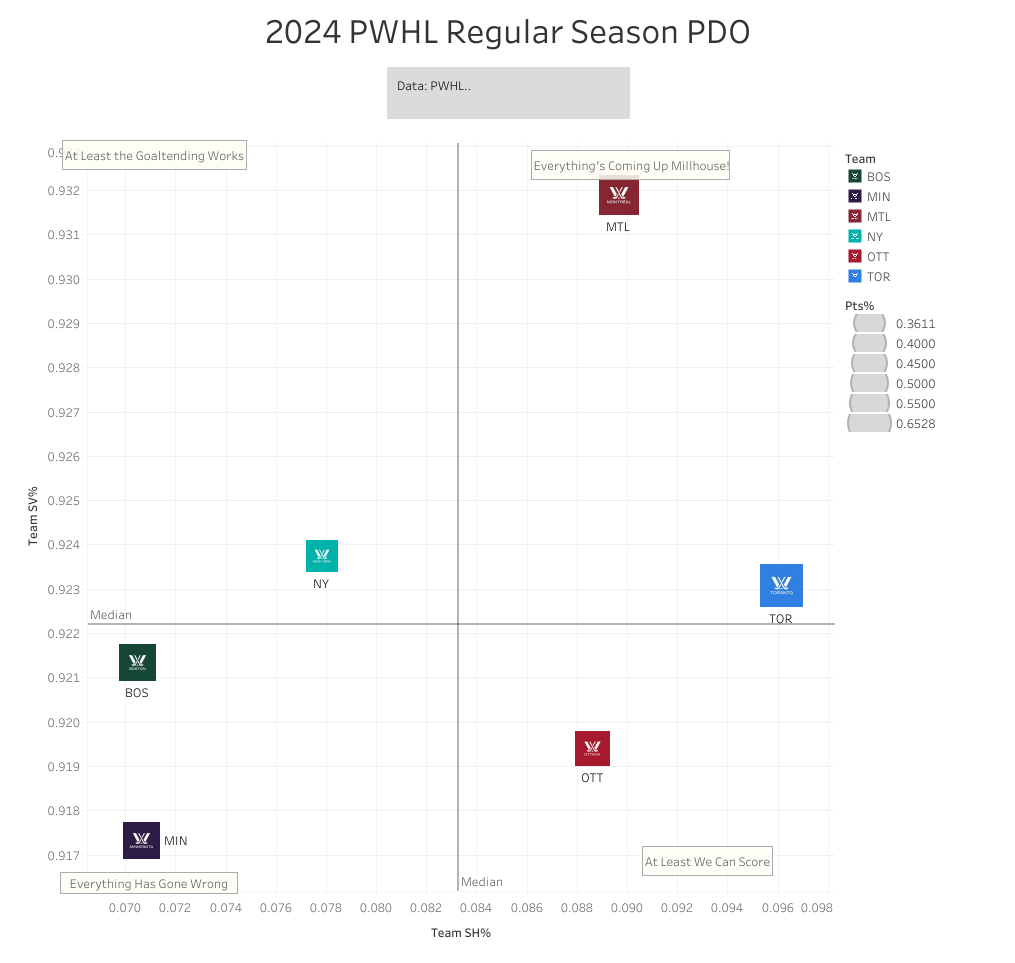
I don’t have access to any team’s to-do list of what they want to improve upon over the off-season, but when the league average save percentage (SV%) ends up at a 0.921 and the playoffs were essentially trench warfare, we can make an educated guess that teams want to figure out how to score more. Now these PWHL teams, while lacking a staff like an NHL team would, still have more people than me to figure this scoring problem out. They’re able to spend a lot more time pouring over game tape and advanced analytics than I can, but I also want to find a way to increase scoring. Yes, the goalie person likes goals, sue me.
So, if I can’t go over the hundreds of goals scored in the PWHL inaugural season, what am I going to do? Well, why don’t we look at the season Natalie Spooner had and see if anything can be replicated which is what coaches want, a player who can score goals at a ~0.83 goals per game pace? There are two factors we need to sort first though before embarking upon this journey. Is Natalie Spooner just an incredibly gifted goal scorer whose shot can’t be replicated or did she just have a very lucky season?
NATALIE SPOONER IS A GOAL-SCORING MACHINE. pic.twitter.com/FaQWValAEy
— Toronto Sceptres (@PWHL_Toronto) May 6, 2024
In terms of her shot, it’s quite obviously a good shot, but you’re going to have to trust me when I say it’s not an elite shot. Spooner isn’t just ripping down the wing and scoring at will. She’s not prime Hilary Knight. The second question was how much luck played into Spooner’s 2024 season, and while she obviously saw some bounces go her way she really earned them. Spooner had a 0.198 shooting percentage (SH%) which was among the best but not the best. Claire Dalton, Kateřina Mrázová, and Lexie Adzija all finished higher in SH%, with players like Sarah Nurse not far behind Spooner either. If Spooner is top five among forwards in SH% why won’t I consider that to be quite lucky? Well it’s because Spooner was the best player in the PWHL at putting shots on goal. She finished first in shots on goal with 101, and first in shots on goal per 60 minutes (SOG/60) with 13.36 SOG/60. If the saying “you make your own luck” is true, then Spooner would be used as an example of it.
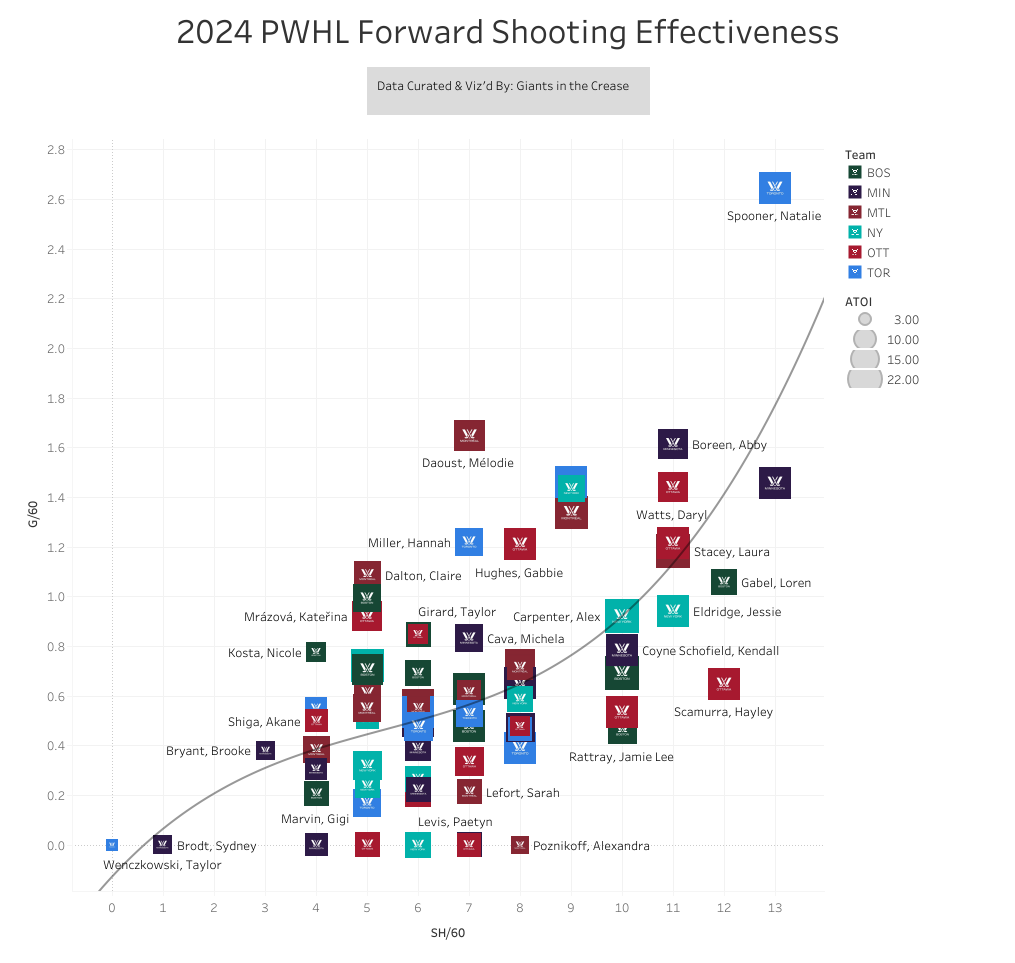
I’m going to cheat a bit and let you know that Spooner wasn’t the beneficiary of a lot of lucky bounces. A lot of work went into her goals that I believe can be learned from. It’s not suddenly going to make a team or player shoot at nearly 20% themselves but learning what worked well for Spooner can be valuable both offensively and defensively which is what we’re going to do here. I hope you like charts and numbers because you’re about to get more than you could ask for.
Getting this out of the way at the very start, we are excluding the empty net goal that Spooner scored and substituted in her playoff goal, so we’re still looking at 20 goals, just 19 regular-season goals plus a playoff goal. The second step in doing this project is looking at all the relevant factors that result in goals. I’ve excluded such factors as shot type and goal location on the net. Shot type is irrelevant, because you’ll see as we go through this that while the shot obviously plays a role in the goal, if you don’t shoot you generally don’t score. Doing a shot type for 20 goals is too small of a sample size to learn from. I’ve also just found goal location on the goalie or net to be useless due to how plays develop. It’s also just a fact that higher shots have a better chance at going in so I’m not going to relitigate that point.

Now onto the fun stuff and our first stop is a few simple, isolated factors. Looking at on-ice team strength, shot location, pass type, and goal situations/factors. We’ll start with the on-ice team strength and you’ll notice it’s nearly a 50/50 split in how Spooner scores her goals with 11 5v5 goals, eight 5v4 goals, and one 4v5 goal. It feels obvious saying this, but if you want to score a lot of goals you’re going to have to cash in on the powerplay and did Spooner ever cash in. Her eight 5v4 goals lead the PWHL and by a good margin. Next highest to Spooner were nine players, all tied with three 5v4 goals a piece. When it comes to shorthanded goals they’re nice to have, but you’re not going to see a boost in the goal scoring numbers there. Only 11 players scored shorthanded goals and only two players (Emma Maltais and Grace Zumwinkle) scored two shorthanded goals. The other nine players scored a single shorthanded goal.
If you took away the nine special team goals does that hurt Spooner’s goal totals? The answer is obviously yes. You take away nine goals from any PWHL player last season and all but six will have no goals to their credit. It’s a credit to Spooner’s scoring talent that if all we looked at were even-strength goals she’d still be first in the league in goals, only tied with teammate Sarah Nurse. If there’s a lesson to be taken from this, it’s that you can’t rely on power play production to get you consistently elite goal scoring numbers. You have to be able to score at 5v5 even-strength. This was born out if you look at the team stats from last season where New York led the league in power play goals (19) but were second last in goals for (52). The four teams that made the playoffs were the top four teams in even-strength goals for.

Next up is something I find to be very important but you won’t see a lot of in public data: pre-shot puck movement or pass types. It’s very simply what type of pass or other puck movement leads to the puck ending up on Spooner’s stick before she ripped one home. Our discussion on this chart is going to go quickly, because as you can tell, there’s not much in isolation you can gain from this. There’s not a single pass that is essentially a cheat code, like in NHL 17. This type of data is hard to take anything from if you don’t have a large sample size and should be accompanied by shot data, not just goals. If there is something to take from this, it’s that the defensive play from every PWHL team is so good that you need to diversify your attack.
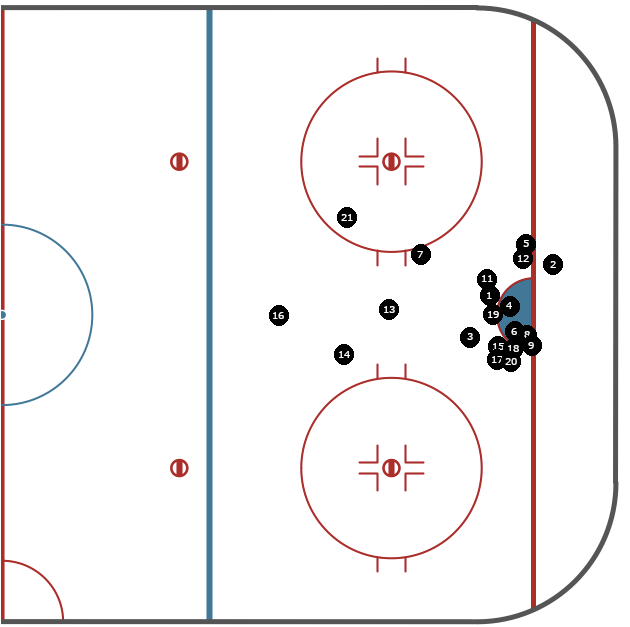
This chart is also a rather quick and easy one to go over. Where are the goals coming from on the ice? Unsurprisingly the closer you are to the net the more the puck is going to go in. The further away the shot, the more time the goalie has to react to it. I think it’d be fair to say that we can stop here. This chart clearly shows where the goals are coming from and with such a difference between high, medium, low danger goal totals, what more is there to say that the numbers don’t?

If you’ve ever played hockey or watched hockey, then you know you can’t just waltz to the front of the net with the puck. It doesn’t matter how good you are on Battle of the Blades—the net front is usually well defended. It’s like rule one of Hockey 101, protect the slot. So it’s all well and good to say go to the net, but getting the puck to those dangerous areas is the tough part, which this chart doesn’t provide help with.
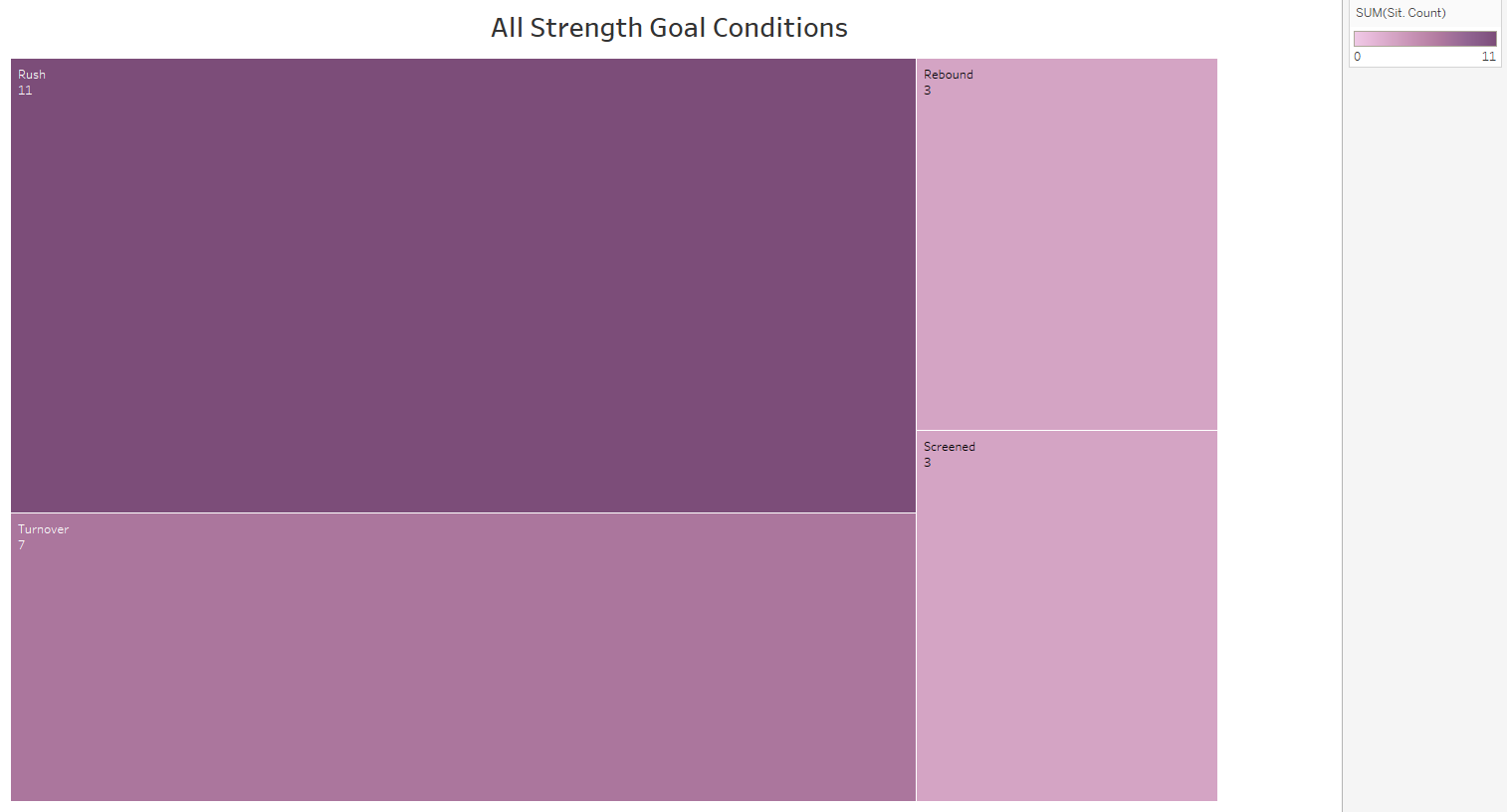
My favourite chart so far is 100% the goal factors because we can really start cooking to gain some real answers here. If we stopped with this one, that’d actually make for a decent article. Out of 20 goals scored, 11 of them coming off the rush is noticeable. That lines up with previous data in hockey done on this sort of subject. Attacking off the rush provides some of your best chances to score a goal. The other factor you’ll notice is turnovers. Seven goals happened because of turnovers and that’s at all strengths.

If we break done the goal factors by on-ice strength, we see even more clearly where you’re going to get your 5v5 scoring from. There were 11 goals scored at 5v5 and eight of them (72.7%) come off the rush. This makes sense as your best chance at scoring is by overwhelming the opponent with numbers to make it hard to defend. When it’s 5v5 it’s nearly impossible for the attackers to get that advantage once all 10 players are in the zone, which is why you need to score before it’s 5v5 in the offensive zone. That’s why attacking off the rush is considered to be so important. That’s also why we see turnovers attributing to goals so much as well. Turnovers create a number imbalance between attackers and defenders and can create rush opportunities. With how good the average defensive play was in the PWHL, it’s unsurprising that goals coming off turnovers was the second highest, as that’s when you’re going to catch a team at its most disarrayed.
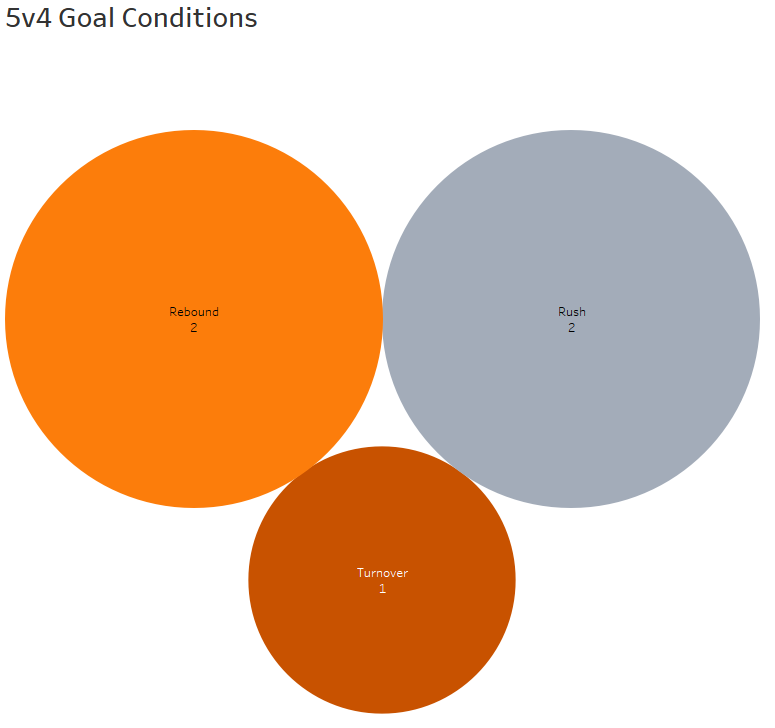
It’s also why when you look at the factors that contribute to PP goals, you’re not seeing the rush or turnovers factor nearly as much as 5v5 scoring. Eight goals scored on the PP by Spooner with two (25%) coming off the rush and only one coming off a turnover. You don’t need to create outnumbered situations when that’s how you’re starting. If there’s anything Spooner can teach us about how to score on the PP it’s simply get in close. Seven of her eight PP goals all came from the high danger zone. As mentioned above merely saying just get in close isn’t helpful. How is she so effective on the PP right in front? We’re going to switch it up a bit here and do some video review of Spooner’s PP goals.
As with all goal scoring you need to get a bit lucky at times, and the goal where it went off her skate, you can’t really replicate that. However, the rest of the video should serve as a lesson to teams on what they should be looking to add to their power play. I think there’s two aspects to Spooner’s play on the power play that stand out the most towards the success she had. The first is her ability to read the play in order to know where best to position herself. She gets herself open in the scoring areas—probably a bit too open for any teams watching this video over. The other aspect of her game that really stands out is her hands. Look how quick her hands are in close. Whether it’s deking out the goalie or being the first on the rebound, she’s always reacting faster than the goalie can. If you’re going to have a player be a net front presence, they need to be more than big. Spooner isn’t flat out just overpowering players to score goals. She’s outthinking and out-reacting the opposing team.
With the power play section out of the way, we can continue digging into how to create more 5v5 goals, the part of the game that happens the most. As mentioned above, the majority of Spooner’s 5v5 goals came off the rush. Looking deeper into the numbers, only three of those rush goals were scored without a turnover occurring. Looking at the video of the three goals that came without a turnover, the rush goal still needs chaos to occur to create that goal. Goals off a clean breakout were rare for Spooner. This makes sense as the players in the PWHL are generally very good defensively and don’t allow themselves to be outnumbered very often defensively. In other words, they know how to handle a breakout. A rugby scrum in the neutral zone though? That’s harder to handle.
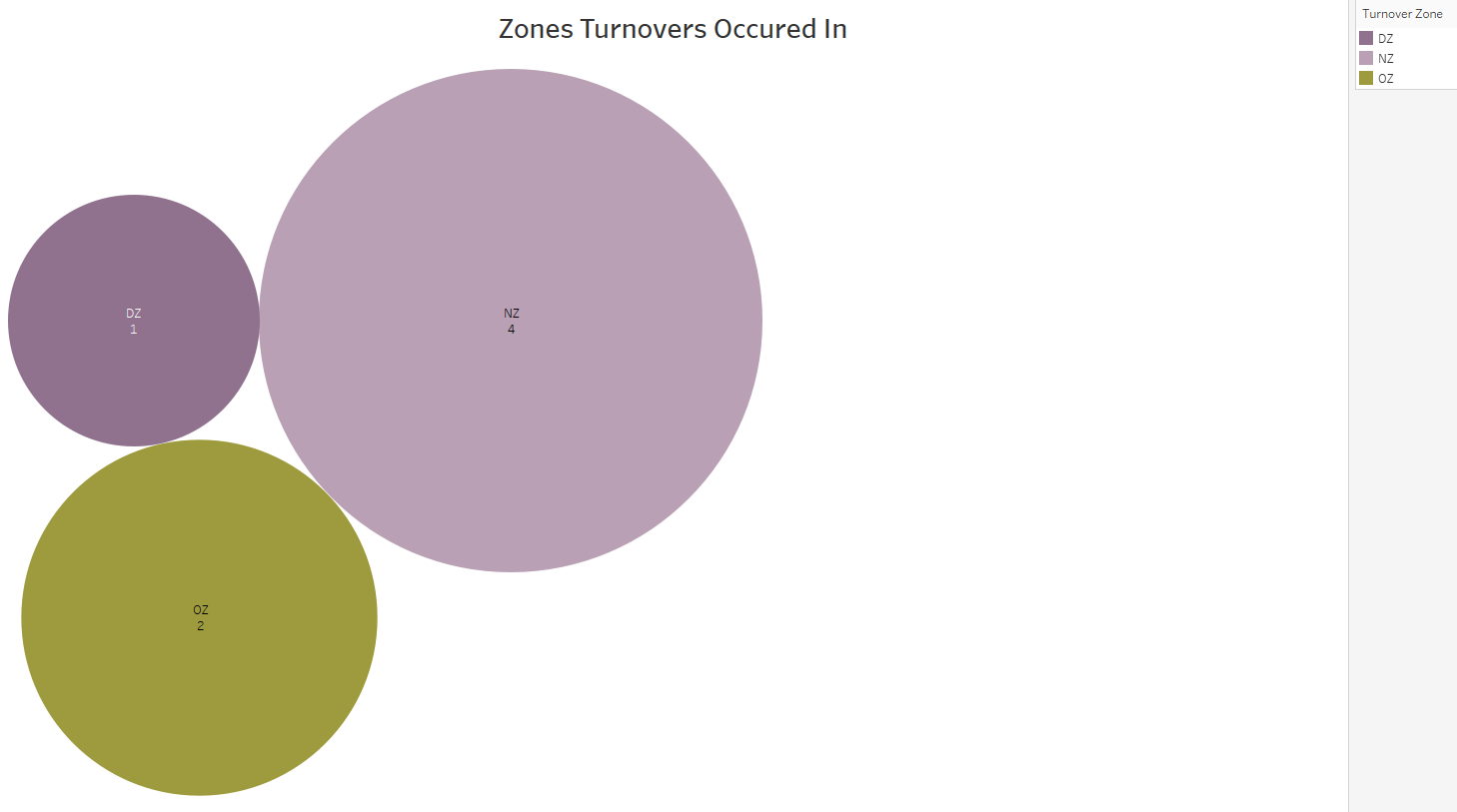
What’s also difficult to handle is a sudden change of possession in the form of a turnover. Specifically, turnovers that occurred in the neutral zone. Of the six 5v5 turnovers that lead to goals, four of them came in the neutral zone resulting in goals off the rush. The defensive zone and offensive zone each accounted for one 5v5 goal that was the result of a turnover. I know it’s a small sample size but we can come to some conclusions based on the data plus having watched the games.
I reiterate this point a lot because it’s true and something teams are going to consider when trying to work out how to score more goals at 5v5: the majority of PWHL players know the concept of defence. It’s why if there’s a turnover over in Toronto’s defensive zone, it’s hard to take advantage of it because the opposing team is already coming back on defence. When Toronto is forechecking it’s hard to create a goal off a turnover because the team breaking out isn’t flying the zone. It’s generally a well supported breakout. What makes the neutral zone such a prime area for turnovers leading to goals is that the puck carrying team is now getting ready for a zone entry. Their focus is going forward, leaving them very vulnerable defensively to a sudden change of puck direction. We’re going to go back to video one more time to get a better grasp on what’s happening in the neutral zone.
Having watched the video there’s a few conclusions to come to. Catching the opponent in the neutral zone is so important, because when the puck is turned over there’s at best just the two defenders you have to beat. That’s easier than beating a whole team or dealing with forward support for the defence. Another observation is how good and underrated is Hannah Miller? Her puck pursuit and ability to knock the puck loose directly contributed to two goals. Miller and Spooner’s ability to anticipate the play was also very noticeable. They knew when to jump in and stop the opposing team before they could get their zone entry going. Also, a shoutout to Allie Munroe, who could see when the play was opening up to make a quick pass and get the transition game rolling to catch the opposing team off guard.
We’re over 2,500 words in and we’ve finally come to the end of the article. The question now, of course, is what have we learned from Spooner’s historic season? What can a team take away from this and use to improve their own offence or even their own defence? If I’m a team, there’s a few things I would focus on. When it comes to the power play, you need the net front player to have quick hands. Get a rebound and have someone capable of jumping on the rebound before anyone else can react. You’re not going to get much off the rush or turnovers when it comes to the power play so if you plan on scoring you need to get pucks to the player in close. Nothing too revelatory there.
When it comes to 5v5 play there’s a lot to learn about how to improve both offensively and defensively. The neutral zone is a very dangerous place. That’s where the most dangerous turnovers are going to occur in this league. There will be turnovers in all three zones however the neutral zone is where you’re going to find your best opportunities to score. In order to score on those turnovers, you need blueliners who are capable of moving the puck back up the ice quickly and you need a player or two who are very capable of anticipating the play as well as have dogged determination to pressure the puck carrier. Teams are going to be tough to catch on the breakout but once they’re in the neutral zone is where you can take advantage of them.
You also don’t need a great shot to score goals. It makes it easier, but pure goal scorers are hard to come by. So, if you just can’t beat goalies coming off the wing with a laser of a shot you need to find other ways to score. What Spooner shows is where to find other scoring that’s effective. That’s not to say of course that anyone can replicate the season she had by just watching the video on her and trying to do what she did. Her hands, speed, shot, and anticipation are among the elite, or at the very least high end. What it does, though, is show what kind of players teams should be looking for. They might not be able to check off all the boxes, but a player who checks off a few can lead to a few extra goals, which can make all the difference.
With this kind of information, certain players like Hannah Miller become more valuable because of what she can provide to someone like Spooner. Even your elite players need certain linemates to help create scoring opportunities for them. You still need to get the puck to your Spooner type player and you need your Spooner type player to finish by putting the puck into the net. What I hope this project can do is show the path towards increased offence. I’m sure every PWHL team has already looked into the issue, but they’ll never release those findings so I hope this helps your average fan who’s interested in the minutia of the game.