When Bart, played by Cleavon Little, said a similar line to the title of this article in the movie Blazing Saddles, he wanted to know how to knit, and women were the best tailors around. It was expensive to replace a torn shirt in the Wild West and cheaper if you know how to repair it yourself. When fans of the PWHL ask “where are all the women at?” they’re asking where are all the women coaches after seeing the three head coaching vacancies all be taken by men. It’s a fair question to ask, as now only Kori Cheverie and Carla MacLeod remain as the two women holding coaching jobs. The ratio went from an even split of women and men holding head coaching positions to now men holding 75% of head coaching jobs.
Should it always be an even split? Should women hold most of the head coaching jobs? I’m not smart enough to answer those questions. What I will say though is that if the PWHL wants to follow up on its promise of empowering women and giving women a chance to show they know hockey, 75% of head coaches being men probably isn’t helping that goal too much.
First day on the job for Kris Sparre 💼
— Boston Fleet (@pwhlfleet.bsky.social) July 25, 2025 at 12:54 PM
That’s not to say Kris Sparre, Brian Idalski, and Steve O’Rourke don’t deserve their positions. It’s clear they have a lot of experience coaching, and in a league like the PWHL which purports itself to be the best of the best, it needs to be reflected from players to coaching to management. For the most part, the PWHL has done well in bringing in new coaches and new people into front office positions to gain experience. They’ve also done very well in finding people with experience at doing their current jobs. Compared to the CWHL or PHF, this is a completely new practice.
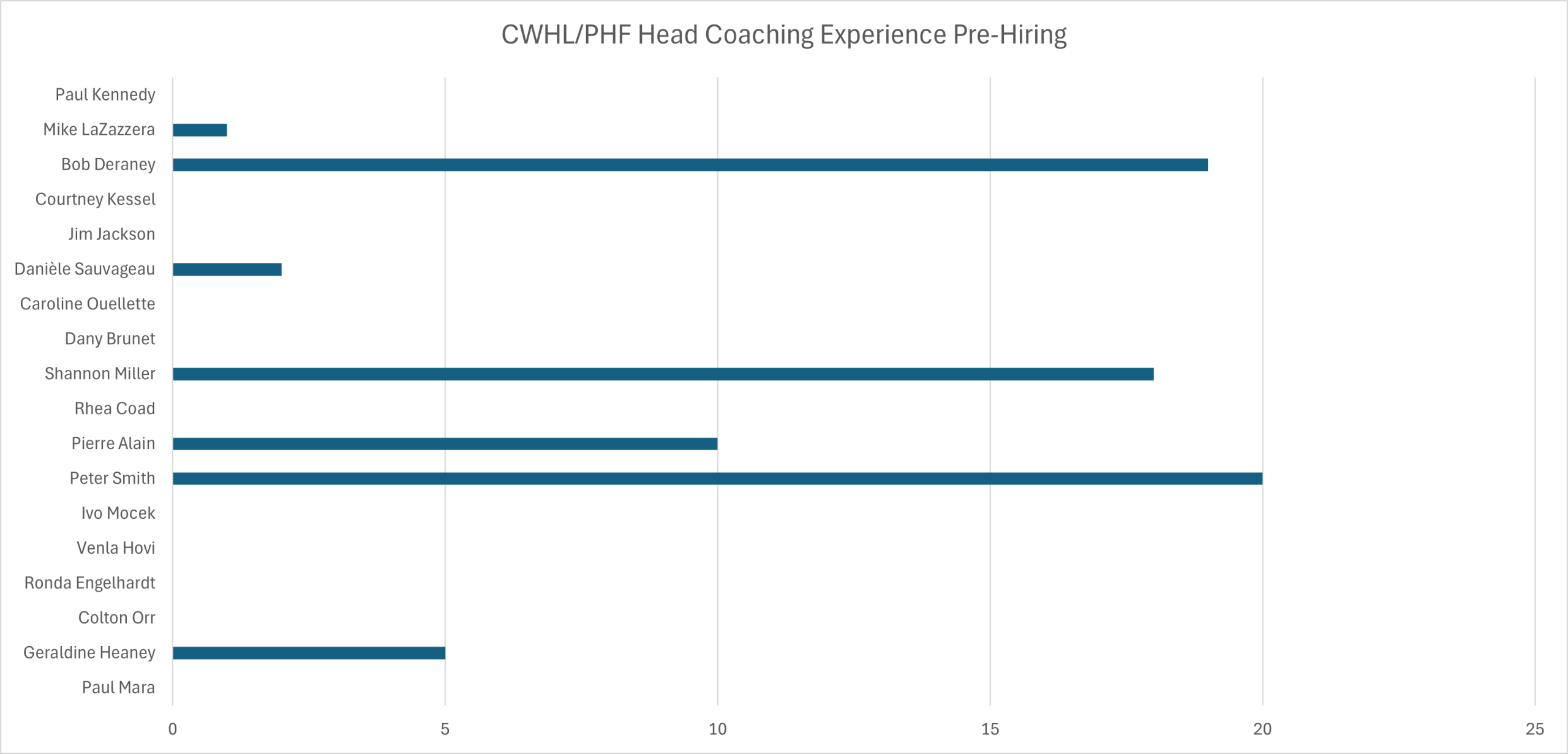
If you were around for the CWHL and PHF years, the coaching jobs were essentially a revolving door of new coaches with minimal to no experience entering the league, with a few coaches actually having experience. The CWHL and PHF were the starting points for a lot of coaches. There’s nothing inherently wrong with that, and it’s great that experience led to further opportunities. It shows that coaching experience was taken somewhat seriously at least. You always need new voices getting the opportunity to show their abilities, but the CWHL and PHF took it too far.
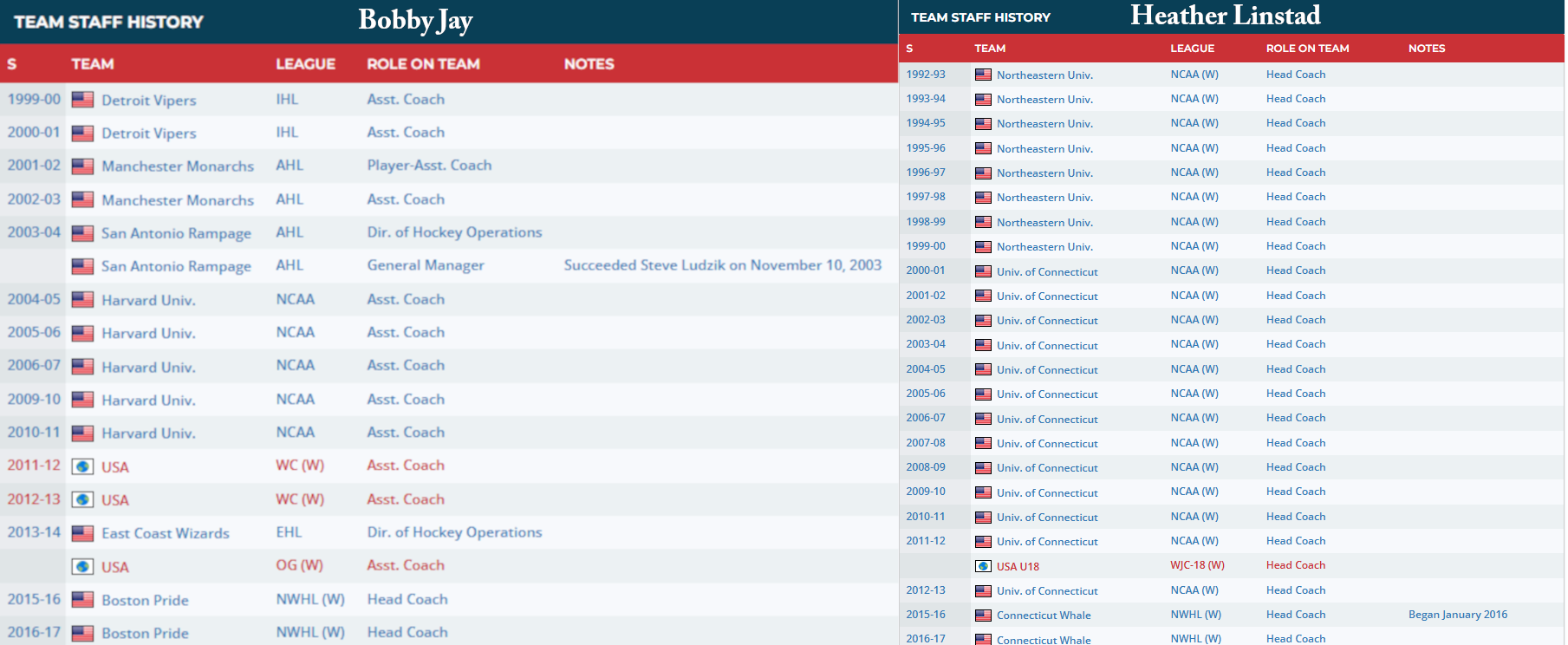
Now, look, they were dealing with limited budgets. They couldn’t exactly go out and offer a contract big enough to bring in some of the best NCAA coaches. That was in fact a very rare occurrence, especially towards the end of each league’s time. The PHF started out on fire in the 2015–16 season, grabbing Bobby Jay and Heather Lindstad. Jay had spent five years as the assistant coach at Harvard, plus two years with the US women’s national team, and Lindstad had been coaching for 21 years in NCAA women’s hockey and came out of a two year hiatus to coach in the NWHL after first-time coach Jake Mastel resigned. Mastel, Chad Wiseman, Ric Seiling, and Shelley Looney were all coming in relatively inexperienced, which is fine—it goes back to what I said about coaches getting opportunities.
The problem the PHF and CWHL ran into is that the head coach position became a revolving door, mostly a revolving door of first time or very inexperienced coaches with the odd experienced coach pulled out of a coaching hiatus. The Toronto Six managed to always find an experienced coach, but couldn’t keep a coach for more than a season. The Whitecaps kept Ronda Engelhardt for all five seasons, but her highest level of coaching before the PHF was Division III NCAA hockey as an assistant. The Pride saw Bobby Jay leave, only to be replaced by Thomas Pöck, with no experience, and a year later, Paul Mara, with virtually no experience.
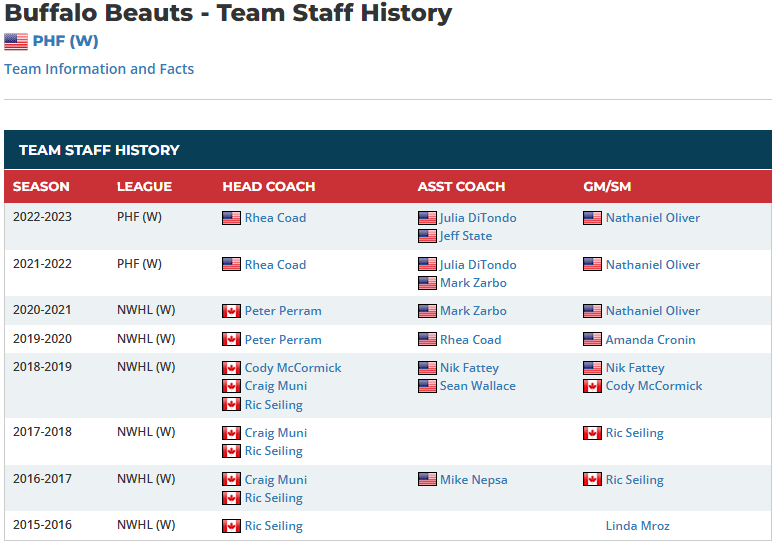
In Connecticut, the head coaching job went from Jake Mastel to Heather Linstad for two seasons. Then Ryan Equale, with no experience, stepped in for two seasons, followed by Colton Orr, also with no noted experience, who led the Whale for the rest of their existence. Buffalo might have had one of the craziest coaching carousels with some of the weirdest resumes you’ll see. Ric Seiling was the long time Rochester Americans broadcaster before joining the Beauts bench. He was then joined by Craig Munni, who was a former NHL scout from the early 2000’s, and then Cody McCormick joined in on the action for a season.
The Beauts post-2019 would see Peter Perram take the bench for two seasons. Perram had coached in the original NWHL, and five years before he took the bench for the Beauts, he was an associate head coach with Ontario Tech University. He was followed by Rhea Coad, who spent two seasons as an assistant coach with Nazareth College. The epitome of a revolving door with little experience was the Metropolitan Riveters. Chad Wiseman, Terry Watts, Randy Velischek, Ivo Mocek, and Venla Hovi all had zero to minimal experience before joining the Rivs. The Montréal Force lasted a single season, but for that season, found two coaches with plenty of experience in Peter Smith and Pierre Alain.

You see the pattern here, though: very minimal consistency from year to year and new coaches who had to deal with players who were mostly used to the experienced coaches from NCAA hockey. The CWHL and PHF purported themselves to be pro leagues, but is the pro experience a quality one when you’re hoping these coaches are getting it right as first-timers? The CWHL definitely doesn’t escape this criticism either. Markham coach Jim Jackson spent two years as a U Sports assistant coach before taking the Thunder bench. It was Courtney Kessel’s first time coaching when she became head coach of the Toronto Furies. Before being hired by Montreal, Dany Brunet was coaching AAA boys hockey as the highest level on his resume.
What does previous league hiring practices have to do with the current PWHL hiring practices? It’s not like the CWHL and PHF didn’t find coaches who found success. Paul Mara and Colton Orr certainly left with shine to them. Courtney Kessel became a PWHL head coach for two seasons. Adding new coaches is a good thing, just not having the majority of them being new and not a new one every two years. This is why the PWHL’s hiring practices are jarring in a way to those who saw a nearly even split among CWHL and PHF head coaches by gender.
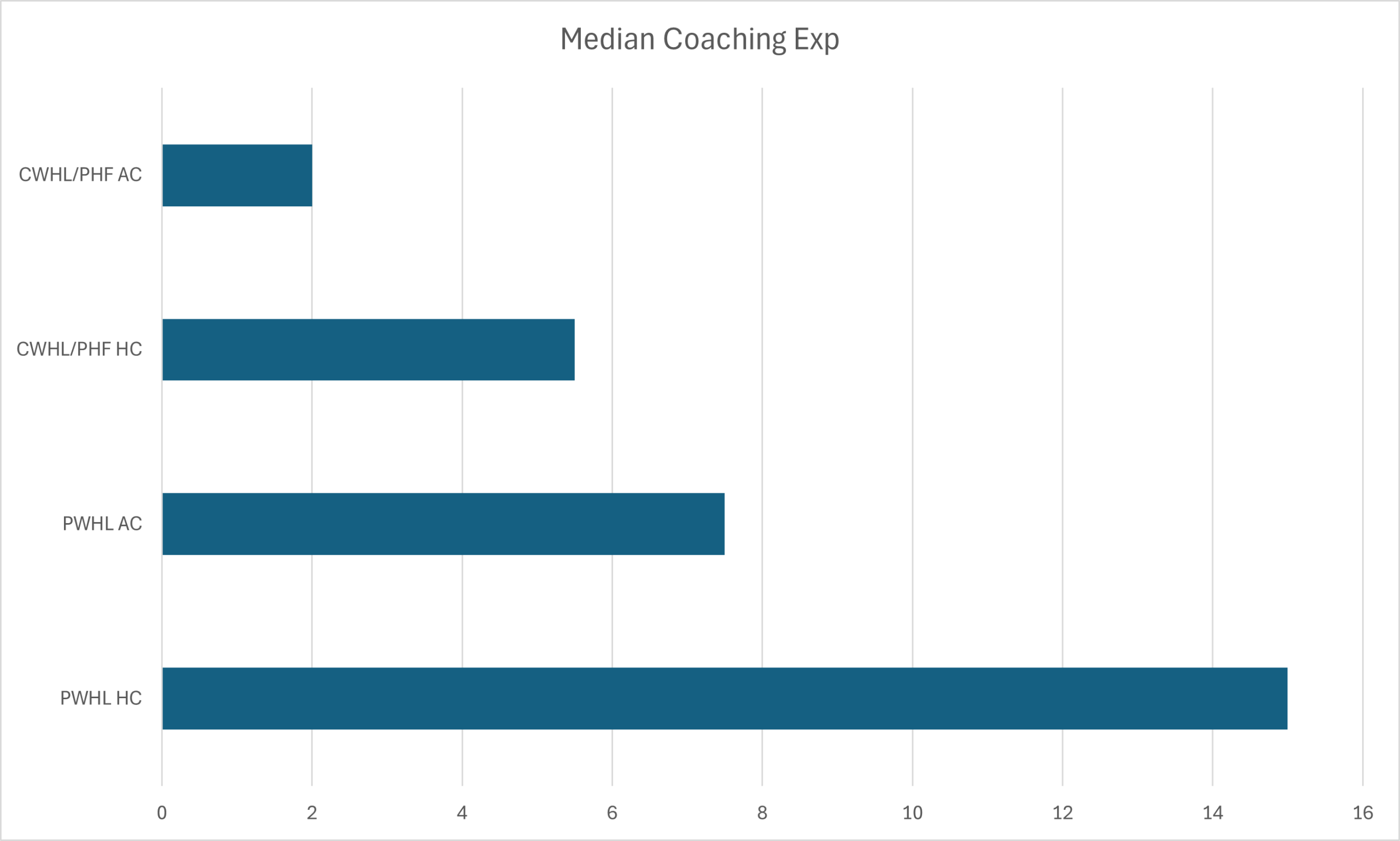
Women were being hired into the CWHL and PHF despite previous experience probably not being there in a significant way. If you compare that with PWHL hires, the difference is noticeable. You have your kind of inexperienced head coaches in Courtney Kessel, Ken Klee, Carla MacLeod, and Kori Cheverie, none of whom have more than three years of head coaching experience. That’s still a jump up from the CWHL and PHF, where the median notable head coaching experience prior to being hired is zero. The median head coaching experience for PWHL head coaches is 4.5 years.
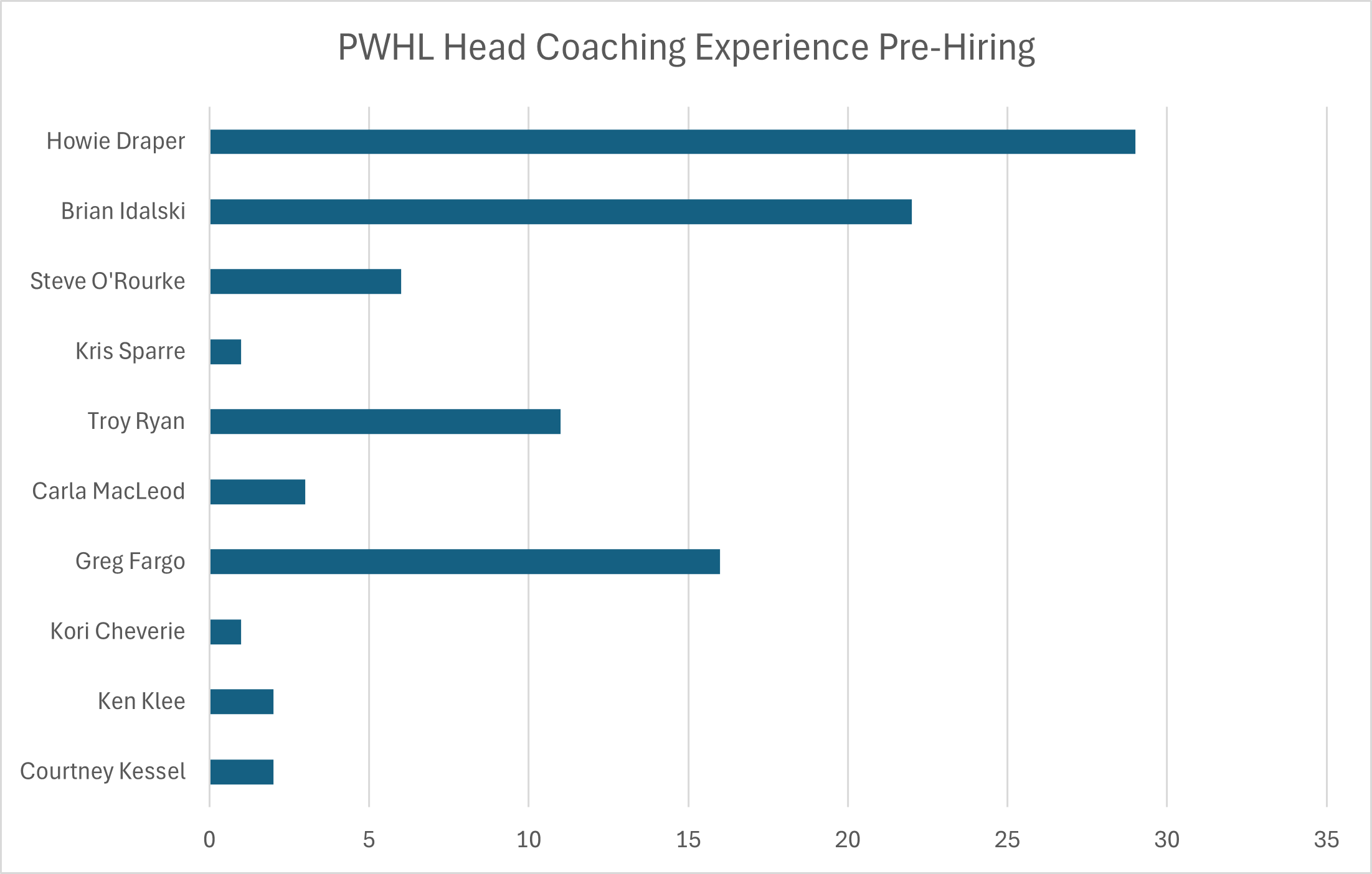
That’s the balance you’re looking for. Experienced doesn’t mean good and inexperienced doesn’t mean bad. Howie Draper came to New York with 29 head coaching titles and it just didn’t work for whatever reason. Experience can be very helpful, though. There’s a reason teams in any league like to go for head coaches with notable experience, while bringing in assistant coaches who are new to give them experience and potentially have them be head coaches down the line. If everyone on the coaching staff is trying to figure out how to be pro-level coaches at the same time, it can lead to disaster.
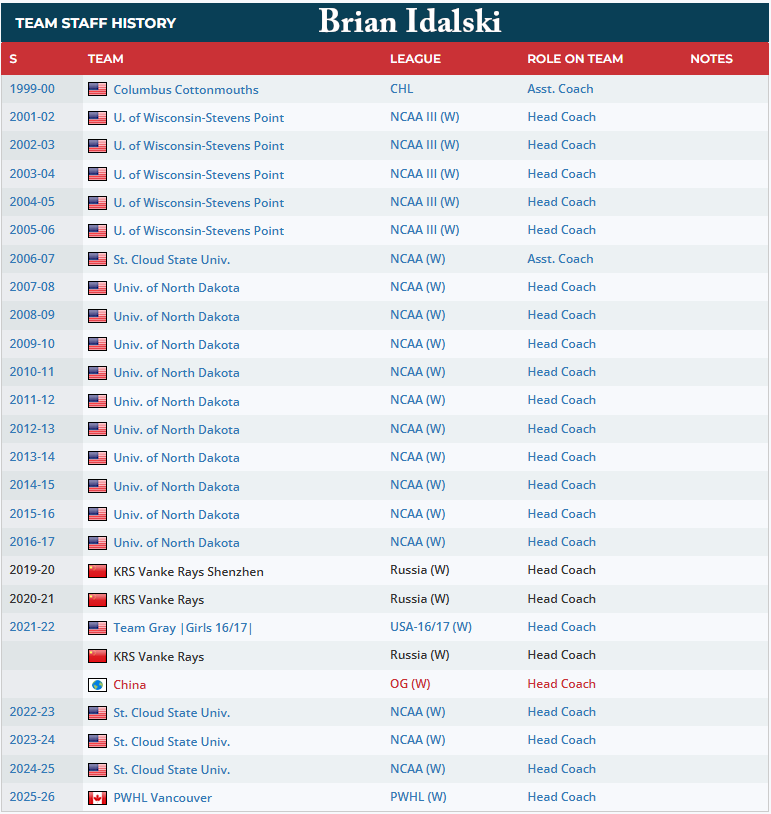
With that in mind, it should not be surprising that Seattle and Vancouver found coaches with 15 or more notable coaching titles, with Steve O’Rourke holding the least amount of head coaching roles with six. That’s still more than what Klee, MacLeod, and Kessel came into the league with. You can tell by the rosters that Seattle and Vancouver plan on winning a lot of games, so they went to get coaches who have experience to guide veteran players this coming season. They got coaches who know how to handle the head coaching role in a league with high stakes. Brian Idalski comes in with 18 years of being a NCAA head coach, spending three years in a women’s pro league, and having been a head coach in an Olympics.
Steve O’Rourke is a bit more of a controversial pick up because despite him coming in 16 notable coaching roles to his name, this is his first notable foray into women’s hockey. The appeal with Idalski is easy to convey to the average fan. He has a lot of experience running great NCAA women’s hockey programs and did well developing players for Team China in preparation for the 2022 Olympics. With O’Rourke, it’s been a harder sell to fans as there’s concerns that someone who has never really coached women’s hockey before is going to experience a longer learning curve for the PWHL game.
The person who hired Steve O’Rourke is Meghan Turner, who you might recognize as formerly being the assistant general manager for the Boston Fleet during the past two seasons. Now why might someone who has been in the PWHL for two seasons decide to go completely outside of women’s hockey to find a head coach? I think what Turner saw in these past two seasons is that the learning curve to being a pro level PWHL coach is a lot bigger than the learning curve of getting into women’s hockey.
You talk to any rookie or veteran player in the PWHL and most likely what you’ll hear is just how different the PWHL game is compared to the NCAA, CWHL, PHF, SDHL, etc. It’s faster and physically more daunting, the focus on hockey is much higher, and the resources involved are better than most teams that have ever put forth a women’s hockey team. If you go to the SDHL and play for Luleå or went to play for KRS Shenzhen, you were treated like a pro should be. Anywhere else, and there’s some sacrifices happening. The PWHL still has growing to do in ensuring that players are able to comfortably be a PWHL player full-time, but they’re a lot closer to that than what came before them.
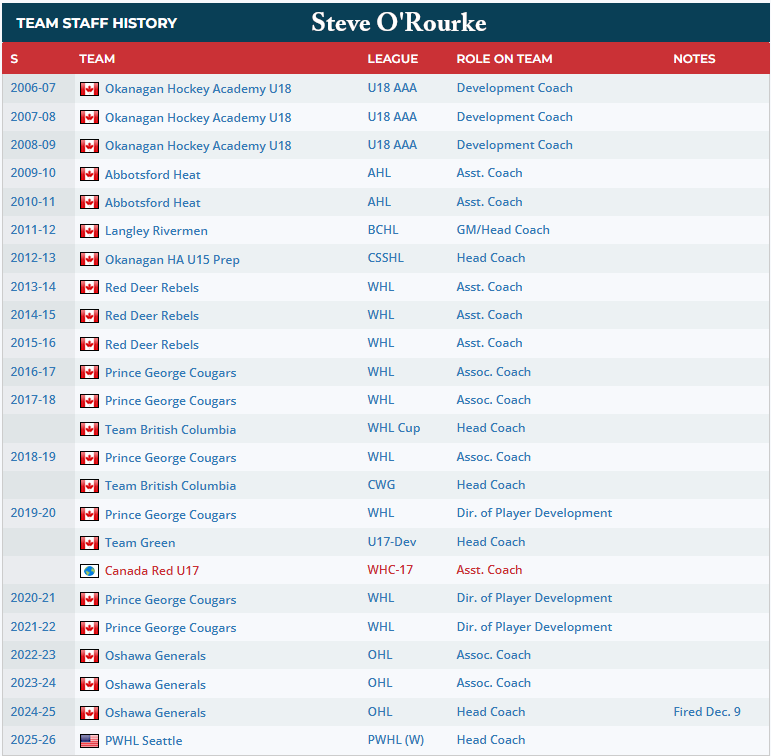
In the view of someone like Meghan Turner, that might could mean she views the PWHL closer to the AHL, ECHL, and Canadian Major Junior than the SDHL, NCAA, CWHL, and PHF. To those wondering why I included Canadian Major Junior Hockey (OHL, QMJHL, WHL) in there, it’s because the biggest selling point of the league to potential NHL prospects is being in a pro-like environment. Following that train of thought, someone like Steve O’Rourke has the type of resume you want: six years of head coaching experience between the WHL and OHL, with another five years of assistant coaching experience between the WHL and AHL. He knows what the demands are of a pro environment; it’s just a question now of if he can convey that to the players.
You see this type of thinking with the general manager Turner worked under in Danielle Marmer. The Boston Fleet general manager also went outside of women’s hockey to find the next Fleet head coach in Kris Sparre, once again to some confusion of fans. Sparre had zero women’s hockey experience and only one year of head coaching experience, but plenty of pro level experience. He spent one year with a head coaching title with the Flint Firebirds of the OHL, three years as an assistant coach with the San Diego Gulls of the AHL, three years as an assistant with the Niagara IceDogs of the OHL, and two seasons with arguably the best pro men’s team in Austria EC Salzburg. O’Rourke’s in the same situation as Sparre: he knows what pro level expectations are, but can he transfer that knowledge to the women’s game?
A PRESENCE on the bench 💪
Brian Idalski has been named the first Head Coach in team history! He brings 20 years of experience to the helm, most recently from St. Cloud State University women’s hockey program.
📰 bit.ly/44tdYBY— PWHL Vancouver (@pwhl–vancouver.bsky.social) June 23, 2025 at 12:02 PM
Taking gender out of the equation for a second here, it’s not too difficult to see why Brian Idalski, Steve O’Rourke, and Kris Sparre were hired. There’s still questions to be had about these coaching hires, especially Sparre, but you can see the logic. Without knowing who else applied for these positions, it’s very hard to say if someone was snubbed. Though if Nadine Muzerall wanted one of these jobs and didn’t get it, I’m not going to blame anyone for grabbing some pitchforks.
It’s a legitimate question to ask, though, how a league that’s about giving women opportunities in hockey and has six of their eight general managers be women, somehow ends up with only two of eight head coaches being women. Two of those general managers hired a woman head coach, Courtney Kessel, and turn around hiring two men with completely different resumes than Kessel. It’s fair for fans to ask what is going on here. Why are women being kept out of head coaching jobs?
This is where everything you’ve read in this article comes to a head, from the PWHL embracing different hiring practices when it comes to coaches compared to the CWHL, PHF, and SDHL to looking at what kind of coaching experience will lead to success. The fact of the matter is we’re seeing the result of women being kept out of notable coaching jobs for decades. How is Jessica Campbell the first woman to coach in the AHL and NHL after both leagues have been around since nearly the start of hockey? What woman, as a coach, has had access to the resources and demands of the pro-level game like every other guy who has seen time behind the bench in the WHL, OHL, QMJHL, men’s NCAA, USHL, AHL, or NHL? That’s even counting the various men’s leagues in Europe either.
I’ve looked through every team’s coaching roster from those seven men’s leagues, and only two teams during the 2024–25 season had a woman holding the title of head or assistant coach: Laura Fortino of the Brantford Bulldogs, and, of course, Jessica Campbell of the Seattle Kraken. The only other woman close to that position is Kim Weiss of the Colorado Eagles from the AHL, who was their video coach this past season. Three women out of more than 200 teams holding coaching positions. Now there is the possibility I missed one or two since I was just going through Elite Prospects, but does five, six, or seven women really show that men’s leagues are providing equal opportunities compared to three women holding positions?
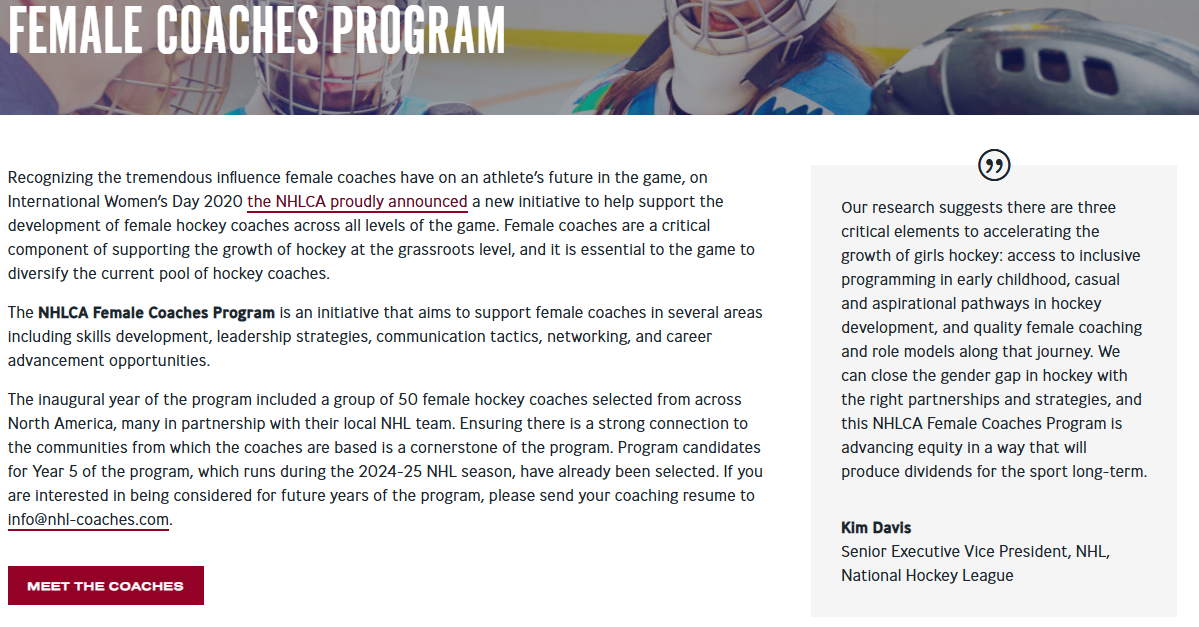
The NHL does bring in women guest coaches during development camps to give them a taste of being around the highest level of men’s hockey and the highest level of resources going into a hockey team. It’s good experience but nothing compared to actually spending a season behind the bench. What’s the solution? The PWHL works closely with Hockey Canada and USA Hockey. Those two organizations work closely with Canadian Major Junior, USHL, NCAA, and the NHL with all its feeder leagues. There needs to be a push to open some doors for women to get the same opportunities men have in environments that allow a lot of growth. The whole reason we saw the PWHL form is to ensure women can focus on hockey full time. It’s time to make sure women who want to coach get the same opportunity.
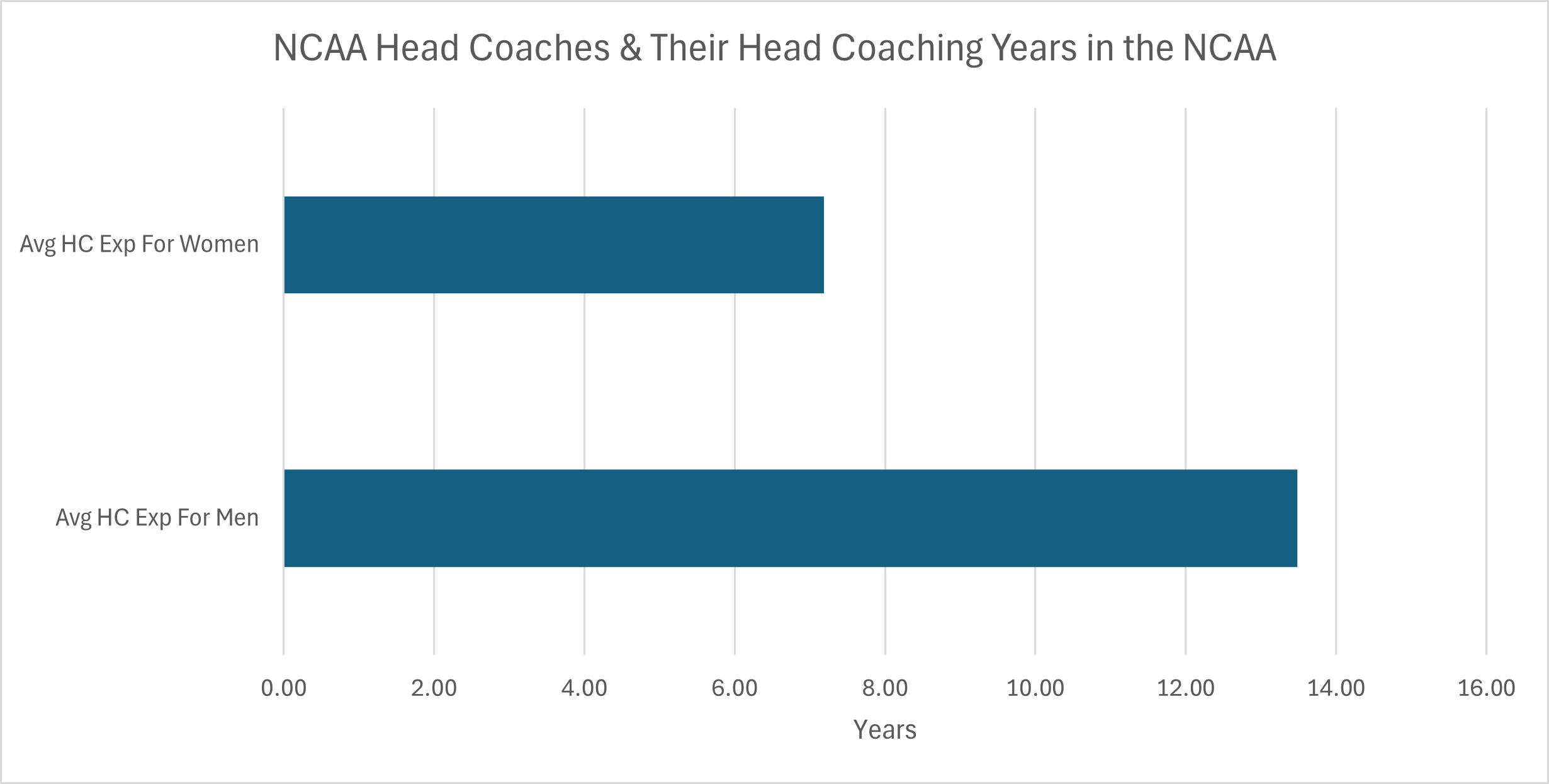
In a league that demands winning immediately, it’s going to be difficult being a Courtney Kessel or Carla MacLeod and competing with the resumes that a lot of men are going to have. Even if a general manager wanted to focus on just finding a head coach from women’s NCAA hockey, the average NCAA head coaching experience of a man is 13.48 years and women are at 6.41 years. If you’re a PWHL general manager and want to hire a woman from a successful program as your head coach, your options are slim.
The University of Minnesota is coached by Brad Frost, who brings 19 years of experience. University of Wisconsin has Mark Johnson and Dan Koch as head coaches, who have a combined 35 years of experience. Northeastern University has Dave Flint with his 21 years of experience, St. Lawrence’s bench boss Chris Wells has 16 years on his resume, Doug Derraugh has brought 20 years of experience to Cornell University, and Matt Desrosiers is sitting on 17 years of experience for Clarkson University. You see the problem here. If you’re someone like Maura Crowell or Katie Crowley and even with having over a decade of experience being a head coach in the NCAA, you’re not coaching one of the top programs.
Not all hope is lost, though for those hoping to see more women be bench bosses in the PWHL. There are some women who have resumes who should have realistic chances at making it to the PWHL. The first one is obvious in Nadine Muzerall. She’s a fierce coach who has seen Ohio State University to their first and second NCAA National Championships. She might be a tough one to bring over though considering she’s reportedly making over $400K a year at OSU. Someone more realistic with a good resume is Cassandra Turner, head coach of Quinnipiac. They’re consistently fighting for ECAC glory and play extremely structured hockey.
Tough moment here for Concordia Head Coach Julie Chu who has to address her team after the loss. This isn’t the end for Concordia as they’ll be at the USports National Championship & with the fire of this loss fueling them. Wouldn’t want to be playing them in that first game. pic.twitter.com/i3WOrVvwSM
— Giants in the Crease (@CreaseGiants) March 10, 2025
These last two names are probably cheating but I think they’re right on the doorstep as well: Caroline Ouellette and Julie Chu. Taking a look at Ouellette’s resume, it’s clear she’s being given every chance to learn as a coach at every level. She’s an associate head coach with one of the best U Sports programs with Concordia University, she’s been behind the Montréal Canadiennes and now an assistant with the Victoire, and, for the last four WHC tournaments, she’s been an assistant for Canada. With Julie Chu, she’s the main head coach for Concordia and has seen a lot of success herself. It’s not hard to put her on par with NCAA coaches in terms of success and experience. They’ve built a great program at Concordia, which has now seen one of their goalies in Arianne Leblanc go to Clarkson University.
Give it a few years and we’ll have some more names knocking on the PWHL’s door. Laura Fortino has spent three years as an assistant coach with the Brantford Bulldogs of the OHL getting that valuable pro-like coaching experience teams are currently interested in. Vicky Sunohara is a three-time U Sports Coach of the Year and has been a part of the Canadian U18 program for three years now, winning a Gold Medal as the head coach in her first try. Courtney Kennedy is being given her first chance at running the USA U18 program and spent the last season as a skills coach for the Boston Fleet. Delaney Collins has been a long-time member of the rising Hungarian women’s national program and has just been given the head coaching position.
Don’t be afraid to put yourself out there 🗣️
Earlier this season, Rachel Tos interviewed Video Coach Kim Weiss about her position with the Colorado Eagles and how she got to this level. #EaglesCountry #NGWSD pic.twitter.com/1xugvr1B82
— Colorado Eagles (@ColoradoEagles) February 5, 2025
Kim Weiss just wrapped up her first season as the AHL’s Colorado Eagles video coach and has been an assistant at Trinity College. Emily West spent three seasons as an assistant coach under Muzerall at OSU and most recently has been with Colorado College as their Director of Hockey Ops. There’s Saara Niemi out of Finland, who has coached with KRS Shenzhen, is currently a long time member of the Finnish U18 program, and has seen her Auroraliiga team to a lot of success. Last but not least, keep an eye on Britni Smith out of Syracuse University. She’s only been the head coach there for three years, but recently was on the Team Canada WHC bench and spent eight years as an assistant with Clarkson University.
We are going to see another woman end up as a head coach of a PWHL team. There’s a good handful with good resumes who have earned the opportunity to coach a PWHL team. If a GM doesn’t want to take much of a gamble, that narrows the women available, which means the applicants are probably going to be overwhelmingly men from both men’s and women’s hockey. Hopefully the outcry from fans and media pointing out the disparity in women coaches sees a push to opening up doors for women to get coaching jobs. There’s nothing wrong with men holding coaching jobs in the PWHL. But it just shouldn’t be the vast majority of them especially in a league looking to give women opportunities in hockey they had been locked out of before.
Editor’s note: This article has been updated to reflect that the Naisten Liiga is now the Auroraliiga.