PWHL teams are facing a tremendous amount of unknowns for the upcoming season. Rosters were sliced and diced between the expansion draft, entry draft, and free agency as four new expansion teams entered the mix. Existing organizations must re-calibrate their chemistry while expansions teams are constructing identities from the ground up. Teams need to figure themselves and each other out before puck drops in a few short months.
There’s leadership groups to appoint, roles to fill, lines to be crafted and tested, and so much more.
One expansion team, PWHL Las Vegas, determined their situation required a master of the unknown. Accordingly, they hired Kim Weiss, a coach who’s built a career off seeking out and thriving in unfamiliar territory.
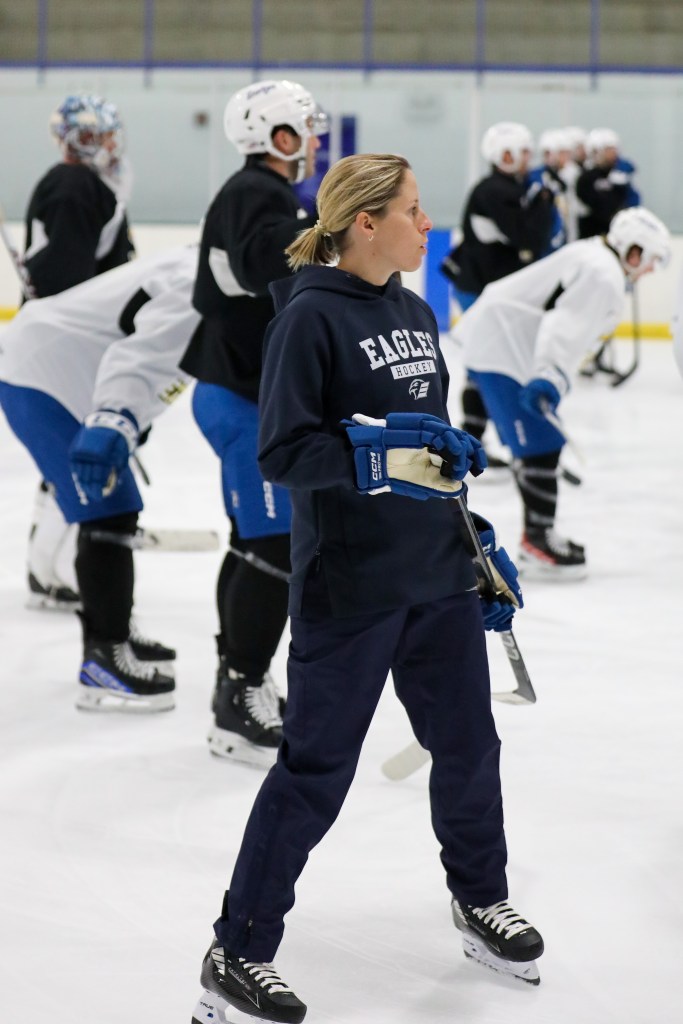
The announcement came on June 15 amid Weiss’ historical playoff run with the Colorado Eagles, the AHL affiliate for the Colorado Avalanche. She was promoted to Assistant Coach in January 2026 after a year and a half as the team’s video coach. The Eagles’ video coach position speaks to Weiss’ pattern of: jump the gap and use previous expertise to build the bridge later, if needed.
Despite experience with video in previous organizations, she admits it wasn’t to the extent required for the specialized role in the AHL. Still, when she heard the position was opening up, she didn’t hesitate to reach out. Her performance and work ethic were noticed by the players, coaches and management staff, swiftly earning that promotion.
She became second woman to act as a full-time assistant coach in the AHL and successfully led the Eagles to their first ever Western Conference final appearance. “I think when you first come into a group, that’s when you feel that pressure. I’ve done it now four times on the men’s side – acclimating to a new team and a new group,” Weiss told The Denver Post earlier in March in regards to her promotion. Its this mindset and subsequent success that Las Vegas GM and Weiss’ former Trinity College teammate, Dominique DiDia, certainly believes to be an invaluable asset.
Weiss’ additional strength is her ability to translate her coaching competency to nearly every major league in the U.S., men and women’s, including the NCAA, NAHL, AHL and a guest appearance in the NHL. On the women’s side, she acted as Head Coach and Director and Player Development for the girl’s Washington Pride AAA program. She had additional roles in USA Hockey, including player and coach development, and worked with the U.S. Women’s National team, according to the official PWHL announcement. Her ability to communicate and connect with players of all levels and abilities will no doubt assist her in formulating a cohesive team in this shortened time frame.
Weiss talked to The Ice Garden about her new role leading Vegas’ new professional women’s hockey team. We discussed her and DiDia’s vision for the team, how her enjoyment of the unknown could be a competitive advantage, her passion for developing players and people and more!
Editor’s Note: comments have been edited slightly for clarity and flow.
TIG: You’re tasked with leading one of the four brand new expansion teams. It’s a super exciting time in the PWHL and I noticed you also are doing it with a former teammate. Tell us about how you are feeling about this new chapter that you’re starting?
Kim Weiss: I think that’s one of the biggest reasons I took the job. You’ve seen it for a long time on the men’s side of pro hockey, of former teammates or former players and coaches hiring one another. So, to get to have that opportunity to do it with Dominique DiDia, our general manager in Vegas, was just too good of a chance to pass up, and I know her obviously really well as a person.
We’ve been through both adversity in the game and adversity in life together, so I know the character that she has. It made taking the leap, so to speak, to Vegas with her a pretty easy decision. So we’re really excited – I think it’s hard to put a certain emotion onto it, other than excitement, and I think just gratitude that there’s an opportunity for women now to

hire one another, right? And in professional hockey, we have these positions because of this league to be able to do that.
TIG: I noticed that Dominique also has a psychology background. I was curious how your previous connection and shared psychology lens might influence your collective approach to this team and the kind of environment you want to build?
KW: We shared our core values in our interview process with one another. It started as phone calls and gaining interest from her to me. Then you start to actually go down the path of potentially doing this, and I’m like, ‘I think we need to actually interview one another’. So we had an interview, and she asked me my core values. I already knew hers because she had sent over the presentation she put together for the PWHL when she was applying to become a GM.
The league had them present, and when she talked about building an organization, she wanted to have these six pillars, or core values: integrity, discipline, excellence, joy, community, and growth mindset. My three core values as a coach are joy, trust, and excellence. Pretty funny when I saw her presentation that two of the three were the exact same word and the third, for me, trust is encompassed in integrity and obviously discipline. I think when we talk about those words, what it really comes down to is having honest and open communication, and that’s the ultimate form of respect to another person, whether that’s a coworker, whether that’s a player.
Those were our guiding lights when we started these conversations. As we started to add people into the PWHL Las Vegas organization, we kind of kept going back to those six pillars. Do they have integrity? Do they want to win, or have they won? Do they know what winning looks like? The growth mindset piece is huge for us as well – both as players and coaches – that they know that we believe that there’s more to their game than what they’re currently showing. We want to provide an environment where we can get the best out of them and also for our staff; everybody is of the same mindset that they want to continuously get better. That’s what it came down to when we started this journey and as we start this journey, always go back to those six core values.
TIG: What a coincidence with the two core values there that you both had that set up ready to go!
KW: You can ask other people I’ve interviewed with in the past, and they’ve asked me, ‘what kind of coach are you,’ or, ‘how do you want to lead?’ To me, it comes back to those three words. I think they encapsulate who I am and who I want to be the best. So, pretty funny that [we used] the exact same words!
TIG: It’s interesting you say that because I was watching some other interviews earlier and there was a theme of positivity and confidence. Obviously you’ve found success in that leadership style! Do you find that having a mindset of being comfortable somewhere new will help other players who might feel more uncertain in a new situation?
KW: Yeah, I think when I’ve had conversations with players over the last few weeks, whether it was free agents or meeting our draft picks… it’s still very new to a lot of these women, right? This will be the fourth year, so the concept of moving for some of them, like Hayley Scamurra, it’s her fourth time [moving to a new team] to continue to be a professional hockey player, it’s still very new to them. I’ve had to do it as a professional for coaching and I’ve moved quite a few times the last few years to continue my career and continue to progress. I think it’s allowed me to find some common ground with them of understanding the mixed emotions with being really excited about a new opportunity and a great place to live, like Las Vegas, while also being a little hesitant.
It’s new! Like, I’ve never been there before and maybe some of the players have never met me, or don’t know me or their teammates. I think it definitely helps that we all are kind of coming from the same place. This team didn’t exist before so nothing’s established. There’s no preconceived notions of who you are, what you’re supposed to be, which I think is the exciting piece – but also the unknown. It can be scary to some, but I feel like my career, the last five years, has pretty much all been the unknown. From junior hockey as the first female coaching junior to college hockey on the men’s side, then to the American Hockey League. It was all leagues and levels that I had never played in or didn’t know much about when I got there and just found a way to learn and to have success. So I think I can bring a lot of confidence in attacking the unknown with a positive attitude.
TIG: And in those leagues, you’ve had to wear a lot of hats. You mentioned in previous interviews you kind of take on lots of responsibilities even if you’re not directly asked to and colleagues would often talk about your work ethic in those interviews. What motivates you to push and go above and beyond every time you get one of these new roles?
KW: I like being a part of something that’s bigger than me at the end of the day. I’m a pretty loyal person. If you look at the places that I’ve been before this there’s always a connection, whether I’m from there or I played there, or I knew who I was going to work for, so I’m pretty loyal. I want to give back to the people that took the chance on me. I think a lot of times that I’ve been hired in the past, there may have been outside questions like, ‘was she the most prepared candidate?’ or ‘is she the best candidate?’, and I want to prove that person right. That I was the best person for that role and I was the right choice. So I think about that mindset of wanting to be a part of something that’s bigger than me, and I want to be surrounded by great people and prove them right – that I was the right choice. And obviously I want to do that again for Dominique here in Vegas!

TIG: I love what you said about being ready for the role and trying to give back to people that took a chance on you. As a former player you always hope to get a coach that’s willing to take a chance on your if you’re a bottom defenseman or forward and know that they’ve experienced what’s what that’s like. I think that’s a pretty special connection if you’re a player coming into Vegas.
KW: I think that’s also where my experience the last two years has been so valid. There’s no shame in being a quote unquote ‘bottom six forward in professional sports’. You’re still a professional hockey player and you get paid to play for a living, right? And I think I’ve been fortunate here in Colorado to get to see some players live out their dream of playing in the NHL, because they figured that part out – that there is a ton of value and identity in every role on a roster, and I think, hopefully, my experience in the American Hockey League can help help some players on our team have a much longer professional hockey career.
I think identifying those roles and becoming the best in the world at it. Hayley Scamurra is a perfect example of somebody who’s done that. Now she’s a top six forward in professional hockey and she’s on the National Team. She wasn’t on that radar at the high school or earlier college career, but she figured out who she is and what she does well. She’s now going to be our longest signed player at this point and she’s extended her professional career three more years. There’s still a development opportunity within those roles. I think sometimes the mindset is you’re left behind, but there’s a way to be great at this and we have tools and things that we can make you great at and you can play for a really long time in whatever role that is. I’m excited! Like you said, I don’t think it has cultivated on the women’s side at this point, so I’m really excited to bring that to Vegas as well.
TIG: That’s that psych background playing into that! Now I’d like to flip the traditional question of ‘what advice you’d give to your younger self,’ and ask: is there a piece of advice that you’re trying to give yourself or maybe you’ve gotten from someone that you’re hoping future you will remember during this upcoming season?
KW: That’s a good question. The first one that came to mind was, I got this advice years ago and I think I’ve been living it. Ray Bennett said this to me when he was the coach of the Colorado Avalanche, now he’s in Washington this coming season. I was probably coaching the Washington Pride when I had this conversation with him, but he said, “Just be great where you are, and people will notice.” I think that’s happened a lot in my career. I’ve always just tried to stay where my feet are, be great in the moment, and not look too far ahead. I think I get interviewed like this, and you get some attention, and people are always trying to fast forward your life when you can just focus on being great where you are. You can put some trust in the fact that the rest will kind of take care of itself.
So, that would be one and I think, ‘don’t forget what you’ve learned’. I’m taking on a new role as a Head Coach in pro hockey. I haven’t been one before, but shad ome really great mentors and models, Mark Letestu, and Aaron Schneekloth, and Jared Bednar the last two years. I’ll take what I’ve learned from them and be prepared for this moment. It’s a new adventure for myself, so remembering the experience that I’ve had up to this point has prepared me for it and there’s probably a lesson from Jared, Aaron, or Mark that I can use in the future season.
TIG: I love that. Very grounded and trying to stay present. I’m sure it can get pretty intense, especially when you’re playing somewhere like Vegas! So, probably good advice to have.
KW: Yeah! Especially when Flavor Flav is giving you FaceTime calls!
TIG: You said something that you love about coaching is helping players. As coaches in professional hockey, you have an opportunity to develop and coach these women at a high level, but also when we see teams win the Stanley Cup. We see the connections between the players and the coaches. What is your favorite aspect of that player-coach relationship and what are you looking forward to on that level for the PWHL?
KW: I think I touched on a little bit earlier of being able to help them with the mental transition of being a pro athlete, of moving and you’re still playing for the jersey, of course, but you’re also playing for your next contract. That’s a piece I think I can really help our women understand while still hopefully creating a culture that people really want to be a part of. Where they do play for the jersey, but at the end of the day, if we didn’t have players, we couldn’t coach – so we only have jobs because of them. I think about that often, that everything that I’m doing is to serve them at the end of the day. Whether it’s planning practice or conversations or off days, whatever it might be, you always have the most special part.
I think I’ve been asked, ‘what’s been the greatest success for you in coaching?” It’s the same answer for me in that I’ve been invited to former players’ weddings. To have that kind of an impact on someone’s life that you’re there for the most important day of theirs, its a pretty good indicator of what you meant to them.
Of course I’m not asking for every one of my former players to invite me to their wedding, but I think that’s been a symbol of why I’ve always wanted to coach. The people and the sharing of a similar passion for the game of hockey. I was fortunate that I had a bunch of great coaches that are all still in my life today that I talk to regularly. They believed in me and trusted in me, whether it was as their captain or forward that they trusted in their lineup. I just want to pay that forward to my players and hope that they feel similarly about me as I do for the coaches that I had.