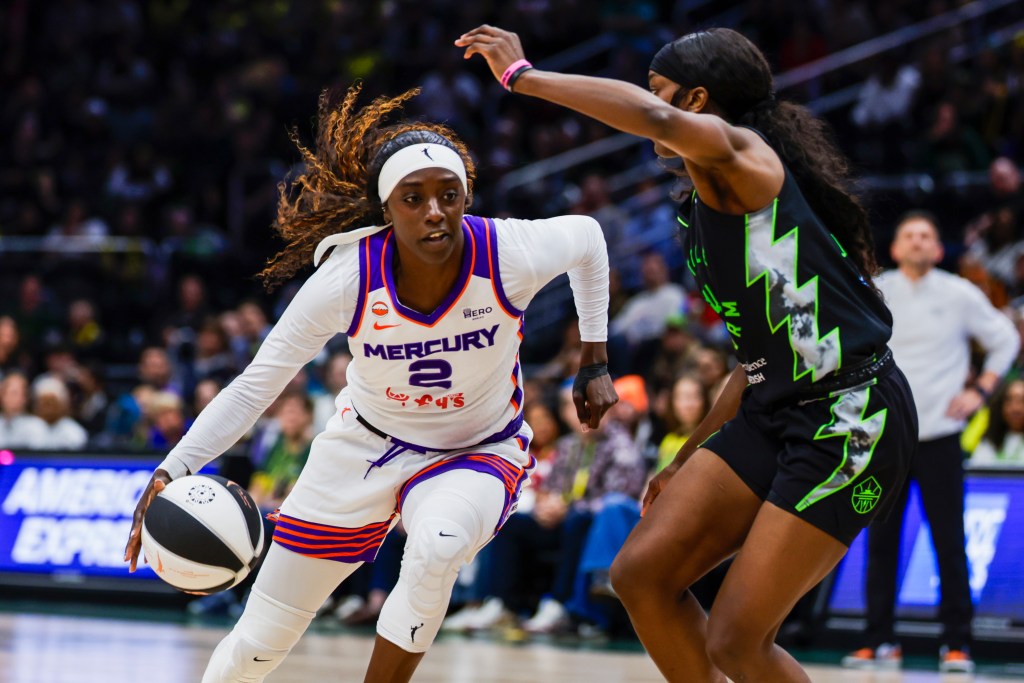
PHOENIX — Shooters keep shooting. Phoenix Mercury guard Kahleah Copper has embodied that mindset as she continues trying to find her way out of an early-season shooting slump. The 31-year-old is experiencing her lowest shooting percentages in her 11th WNBA season, and as one of the Mercury’s biggest stars and leaders, it’s stood out a bit more than it would for anyone else on the roster.
Still, the veteran Copper hasn’t wavered when it comes to her approach. She’s going to continue to get the ball, continue to keep playing the same way, and not show any sign that the cold spell is affecting her confidence.
“Outside of basketball, just leaving it, letting it just go, and then leaning into the people around me, the people that really care about me, really know who I am,” Copper said of what she does during a slump. “You gotta keep shooting that sh-t. It’s easy to get it, and then you’re already froze, and you don’t shoot it. Like, no, I’m still going to shoot it. I put in too much work not to. [I trust] I’ll be rewarded.”
Head coach Nate Tibbetts has echoed that sentiment, never showing too much concern whenever asked about her slow start.
“You don’t want to make it a bigger deal than it is,” Tibbetts said. “You want to keep working, keep your routine. Some people want extra shots, some watch film. She’s just got to keep doing what she’s always done, and work, and be a professional, and the tide’s going to turn.”
But even with that belief, it’s been awhile since Copper has come close to having an efficient shooting night. Especially with the Mercury at a point where wins are desperately needed, it’s important to figure out if Copper’s struggles thus far are simply a result of a small sample size early, or something much more critical.
The numbers
It’s important to note that Copper’s slow start is connected to Phoenix’s shooting struggles as a team. It’s not just Copper – everyone on the Mercury is struggling to hit shots, and it’s one of the main reasons the team is off to an alarming 3-8 start to the season.
That being said, Copper is missing a significant bulk of her shots. Through 11 games, she is shooting 33.3% from the field and 20.3% from three-point range, each career lows by a considerable margin.
Copper has shot above 40% in just one game so far — a 30-point outburst during a loss against the Minnesota Lynx on May 12 — but has shot below 30% in four games already, the worst of which being a 3-for-16 night against the Chicago Sky on May 15.
Her three-point shooting right now is currently nine percentage points lower than what her previous career low was. At one point, during a six-game stretch beginning with that game against Chicago and ending with a game against the New York Liberty on May 29, Copper went 6-of-40 (15%) from deep.
“Believe in the work, keep shooting,” Tibbetts said of Copper after the May 29 loss. “She’s a 10–year veteran, she’s won gold-medal games, she works like a professional. She wants to make shots. Great shooters go through these things at times. I don’t want her to have doubt. I want her to believe in the work, and we believe in her shooting. She’s not making it right now, she’s got to keep being who she is.”
With that, Copper isn’t afraid to keep shooting. She’s currently taking 16.6 attempts per game, which is the second-highest mark of her career and also accounts for more than one out of four Mercury shots, but is making just 5.5 of them per game. For comparison, co-star Alyssa Thomas is averaging a similar number of made field goals while taking roughly six fewer shots each night.
The numbers paint a clear picture of the struggles, but they don’t necessarily explain them. That’s why neither Copper nor the team appears interested in overhauling its approach. The focus instead has been on maintaining confidence, trusting the preparation and believing that better results will follow.
“We’re putting in the same work, getting the same extra shots, you know, we’re still doing the same thing,” Copper said. “I don’t think it reflects us as a team or individually. We just have to stay the course and trust that the shot’s going to fall.”
Other ways to get it
Now that the numbers are laid out, let’s try to examine possible causes. Is Copper’s shot simply not falling, or is there some kind of greater structural difference that might explain her shooting dip? The answer is likely somewhere in the middle.
The most glaring change that could be affecting Copper is that Satou Sabally is no longer in Phoenix after leaving for New York during this past free agency period. The sudden personnel change to this specific roster has definitely been one everyone is learning how to adjust to.
Last season, Sabally was the Mercury’s leading scorer while also taking the most attempts. She brought a dynamic scoring ability that took a significant load off of Copper, who could more comfortably get to her favorite spots as a result. Since Phoenix subsequently chose to replace Sabally with a collection of role players rather than another dynamic threat, all of that defensive attention shifted to stopping Copper.
“Oh, for sure,” Copper said definitively when asked if she’s noticed teams guarding her differently. “Just getting scouted a little different. I’m continuing to watch the film, seeing areas where I can continue to grow. For me, it’s being able to make the right decisions. If I’m able to make the right decisions that moves the defense around, then next play maybe I can get all the way downhill.”
But at the same time, it’s evident that Copper is having great success with this very roster. In two games this preseason, one of them being against the same Chicago team, Copper was on fire: scoring 36 points in just 37 minutes, while going 13-of-23 from the field and 7-of-12 from three.
From the perspective those performances provided, it looked like Copper was going to take advantage of the added responsibility to score even more. She certainly has the qualifications to do it as a four-time All-Star, Finals MVP and someone who has led her team in scoring in four different seasons.
Despite the shooting struggles, Copper is actually on pace to lead her team in scoring for a fifth season. Her 18.2 points per game is still top 10 in the league — impressive output considering the circumstances, and much-needed for the struggling Mercury.
She’s been able to do so by finding other ways to be productive, mainly by getting to the free-throw line 7.1 times per game, the highest rate of her career. From there, the ball is actually going in, as at 82.1%, she’s making free throws nearly three percentage points higher than her career average. With tighter officiating being a point of emphasis for the league over the offseason, drawing fouls has become a more crucial part of Copper’s game.
“It’s one of the things that we’ve talked to her about this offseason, is trying to get to the free-throw line…” Tibbetts said postgame after playing the Sky May 15, when Copper went 10 for 10 on free throws. “…The best scorers in the league typically get to the free throw line.”
Although the sample sizes vary dramatically, comparing Copper’s shot cart from 2025 to 2026 will show that this season, there’s less of a balance in the spread between perimeter shooting and shots at the rim. Copper has shown a conscious effort to adjust to both the new defenses thrown at her, and the new whistle — knowing that points are most likely to be generated from driving to the basket, where she can either be fouled or get a higher-percentage layup.
“Just finding other ways to get it,” Copper said when asked about getting to the free-throw line. “[When the] shot’s not falling, being able to get to the rim, and finding other ways. Adding that and getting to the free-throw line, that’s just a plus.”
Tibbetts too recognized the adjustment needed to Copper’s scoring profile, while also emphasizing that the solution isn’t solely on her shoulders. His focus has been as much about how she’s being put in position to succeed as it has been about the shots themselves. That balance between self-generated offense and team-created opportunities has become part of the ongoing conversation around how to stabilize her efficiency and maximize her impact.
“I thought the second half the other night we did a better job of finding her in the post a little bit with some mismatches,” Tibbetts said on May 29 when the Mercury lost to the Liberty. “So I could do a better job of helping her with that at times — getting her to the free-throw line, seeing the ball go through. I think for her, it’s just the confidence in the shot, finding the right shots, playing the right way. She can impact the game in a lot of ways, it’s just not the shooting, and I want her to focus on that too.”
Earlier in the season, after a May 19 loss to the Toronto Tempo, Copper shot just 38.9% and didn’t make a single three. “I don’t think it’s affected her defense up until this point,” Tibbetts added. “I think when you’re a really good player in this league, teams are going to try to do things to slow you down. We need to do a better job of helping her, she’s got to do a better job of helping herself, and it’s all connected.”
All of that context — the roster turnover, the defensive attention, the shot profile adjustment, even the internal emphasis on process — could easily point to a simple shooting slump that all elite scorers go through.
Most recently, there are signs that the “just keep shooting” approach is slowly starting to work. On Monday in a 111–77 loss to Minnesota, Copper went 3-of-7 from three-point range (42.9%), surpassing her previous season-high three-point percentage, which was only 28.6%.
Two nights later against the Seattle Storm, despite again struggling from the field, Copper still finished tied for a team-high with 16 points, knocking down 6-of-6 free throws down the stretch to help will Phoenix to the victory that finally snapped its losing streak.
While so far we haven’t seen the dramatic breakout some may have expected, nothing about Copper’s situation has drifted outside the boundary of what’s typical over the course of a long WNBA season. The volume is still there, the aggression hasn’t changed and the work habits remain consistent.
For great players, the stretch can look alarming in the moment, but it might not necessarily signal a larger decline. For Copper, it’s something she’s only going to continue to work at.
“Definitely been feeling much better,” Copper said. “I just gotta get it off, you know? Just no thoughts. I missed the last one, it doesn’t matter. Just put it up, just get it up.”