


PHOENIX — The Phoenix Mercury’s Monday night matchup against the Minnesota Lynx felt like a golden opportunity for the team to turn the tides after a disappointing 2-7 start to the 2026 season. National TV. The beginning of Commissioner’s Cup play. A chance to take down an opponent at the top of the WNBA standings in front of the home crowd.
“Can you imagine a more desperate team being on their home floor for one game, then going back on the road, and it’s a must-win game for them?” Lynx head coach Cheryl Reeve said pregame of the Mercury. “Their best effort of the season is what we expect.”
Instead, Phoenix suffered what is likely its worst loss of the Nate Tibbetts era, falling 111-77, the most points allowed and largest margin of defeat during Tibbetts’ tenure as head coach. For a team that was already in the midst of a defensive identity crisis and on a now-six-game losing streak, all while being under the weight of expectations following a WNBA Finals run in 2025, it couldn’t have come at a worst time.
It was the kind of loss that felt bigger than a single mark in the standings. Whether it proves to be the moment the Mercury begin to turn things around, or the point where their season slips further off course remains to be seen, but that feeling of being at a crossroads is becoming more palpable as fans and analysts alike grapple with what exactly is going wrong in Phoenix.
“There wasn’t a lot working the whole night,” Tibbetts said postgame. “We were a step slow. We didn’t do a good job playing at the second side. It was a tough one.”
Just how the Mercury respond will be under the biggest microscope.
Listen now to The IX Sports Podcast and Women’s Sports Daily
We are excited to announce the launch of TWO new podcasts for all the women’s sports fans out there looking for a daily dose of women’s sports news and analysis. Stream on Spotify, Apple Podcasts or anywhere you listen to podcasts, and make sure to subscribe!
What’s going wrong
Throughout the Mercury’s rough start, their defensive woes, shooting struggles and lopsided scoring runs have been common failures pointed out by the team in postgame interviews. On Monday night, it felt like all of those margins were dramatically made clear, more so than in any other game so far this season.
By halftime, the Lynx had already scored 67 points and were shooting 75% from the field. Olivia Miles was making any pass she wanted, Courtney Williams was constantly getting to her patented mid-range jumper uncontested, and on multiple occasions, Lynx players were able to get behind the back line of Phoenix’s defense for wide-open layups. By the end of the night, Minnesota scored 50 points in the paint while also going 10 for 17 from 3-point range.
Phoenix, on the other hand, once again struggled to find any rhythm. The offense looked stagnant, as passes and shots were attempted with far less conviction in comparison to Minnesota’s fluidity. The defense often allowed quick baskets without much resistance, allowing Minnesota to easily lock back in on defense and rally for multiple big runs. All of it created the impression that the Mercury were always a step behind the Lynx.
The result was a 34-point loss in which the Mercury shot just 34.4% from the field, conceded 23 points off 14 turnovers and were outrebounded, 35-24. At many points in the game, Minnesota’s Williams and Miles alone had more field goals made than the entire Mercury team.
In other losses during this stretch, Tibbetts was still able to credit the team for the level of effort put forth despite not coming away with a victory. Last night, that was not the case.
“We weren’t close tonight,” Tibbetts said. “I think we’ve battled in some games, and tonight we did not … It’s one of those things when you start to lose, people start to hang their head a little bit.”
“We needed to play harder,” guard Kahleah Copper added. “We know what we have to do, moving the ball side to side, we missed a lot of in the paint, and then sending them down in transition, not being matched up, not sprinting back.”
Rock bottom?
At no point during the Mercury’s 2025 season did they ever dip below .500. Prior to this year, a Tibbetts-coached team had never even fallen more than three games below .500. His previous longest losing streak in Phoenix was four games, which coincidentally also came following a loss to Minnesota heading into June 2 (in 2024).
To be on a six-game losing streak and as many games under .500 now is simply alarming considering the standard that Tibbetts has set. The last time any Mercury team started off 2-8 came in 2023, the year before Tibbetts took over, in a season the Mercury ended 9-31. Head coach Vanessa Nygaard was fired just two games later when the team hit the 2-10 mark.
None of that is to suggest Tibbetts’ job security is suddenly in question or that this year’s Mercury are destined to follow the same path as that 2023 team — the circumstances of the two are dramatically different — but the comparison goes to show exactly how significant of a low point this is for a franchise with constant championship aspirations.

Disaster may not be inevitable, but it’s clear there’s plenty of work to do. That goes for everyone in the organization — from the front office, to Tibbetts, to of course, the players. General manager Nick U’Ren already made a significant move to begin that work, even before Monday night’s game started. He waived guard Kiana Williams, previously considered to be a 2026 breakout candidate, in favor of returning guard Lexi Held to the roster.
Held played in 32 games for the Mercury during her rookie season in 2025, showing flashes of an all-around game that could complement Phoenix’s stars off the bench. However, her minutes declined in the 2025 playoffs, leading to Phoenix being fine with the possibility of her being selected in the 2026 expansion draft, which is exactly what the Toronto Tempo did.
But Toronto waived Held on May 28, allowing U’Ren the opportunity to bring back another player from 2025 in hopes of recapturing some of that season’s magic. Held’s quickness and instincts as a point-of-attack defender addressed a glaring weakness of the team in particular.
“Lexi is super excited about this opportunity to be coming back here, it doesn’t always happen like that in your career,” Tibbetts said pregame. “We need her defense on the ball, her shot making, and it works out to have her back.”
Still, even with roster changes, more practice and potential gameplan adjustments aimed at improving the team on the court, there’s work to do in regard to chemistry-related connectivity, as well. The issue of team morale is one that comes up during stretches like, making it just as important to manage the emotional side of things as it is the basketball side.
“We’re going through a little bit of a low right now, but it’s a lot of the same people in that locker room last year,” Held said postgame. “You know what we’re capable of, so [we’re] just continuing to find a way and stick together. I’m really excited for the opportunity. I know I’m a little bit fresh on the scene, but I have a lot of faith in this group and these coaches in this organization.”
As the losses continue to stack up, so too does the risk of the season spiraling into something far more difficult to reverse. In a league where margins are thin and the momentum of a 44-game schedule can shift quickly, prolonged stretches like this have a way of defining teams before they ever find a chance to respond.
That’s why it’s important for the Mercury to correct course as soon as possible. Monday night proved that things may not go to plan even in a setting where peak desperation was expected. The longer that pattern continues, the more difficult it becomes to separate early-season struggles from something more entrenched.
Rep The IX Sports at your next game!

Shop the logo collection or special “Women’s Sports are Front Page News” collection now on Shopify.
The fire is lit
The other option for Phoenix is to use Monday night’s loss as motivation for a turnaround. From that perspective, there’s ways to pick out some context that can prevent everyone from prematurely pressing the panic button.
First, Phoenix is led by veterans who have been through their own past adversities. Copper, Alyssa Thomas and DeWanna Bonner have a combined 38 seasons of WNBA experience, and although they have yet to fully meet their own individual standards so far this season, each of them have experience with fighting back from extended periods of losing.
For example, Bonner was the leading scorer of the worst Mercury team in franchise history — the 2012 squad that went 7-27. She and the Mercury proceeded to make the conference finals in 2013, then win the WNBA championship in 2014.
In 2021, Copper was a part of a Chicago Sky team that went on a seven-game losing streak early in the season. After the final loss in that stretch — coincidentally also in a game where her team shot just about 34% — Copper rallied the Sky for a seven-game winning streak, ultimately going all the way to the WNBA Finals that season. Chicago beat Phoenix in four games, and Copper was named Finals MVP.
“I lost seven straight, [then] I won a championship, so that’s just what’s in my mind right now,” Copper said. “I do want to come out of it, not falling into what the record says. I think that we have to continue to hold this standard of what it takes to be a championship team, and what it took for us to do that last year.
“It’s not easy. It just doesn’t carry over just because you did it,” she added. “So, for us, it’s about everybody looking in the mirror. Everybody’s here for a reason. Everybody has a job to do, and it’s like a puzzle — everybody’s got to do what they bring to the team, whatever that is. You got to bring it every single night. So, I think that’s just where we are right now.”
Like Copper, Thomas also recalled a previous early-season turnaround. Both her and Bonner began the 2020 season on an 0-5 start with the Connecticut Sun. With even less margin for error because of a shortened 22-game schedule, the Sun miraculously made the playoffs with a 10-12 record, then just narrowly missed a trip to the finals by one game.
“If you haven’t played sports then you don’t understand it,” Thomas said after losing 75-68 to the New York Liberty on May 29. “I’ve been [0-5 then was] one game away from being in the finals, so the tide turns, shots start to fall. This isn’t the time to get in your head and think that the season’s over or you’re not going to make playoffs.”
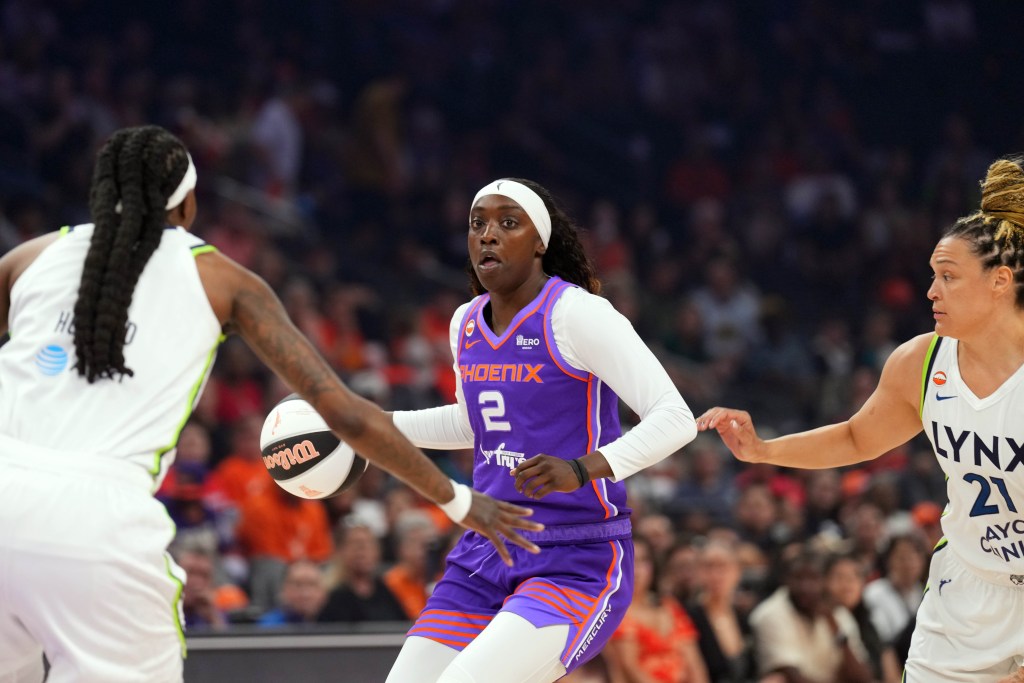
While there’s still a greater sense of urgency with each day that passes, it’s early and far from over for the Mercury. Their 2-8 record might be tied for the worst in the league, but they’re just 3.5 games out of a playoff spot as it stands.
Phoenix will have to begin its turnaround without homecourt advantage, though — another lengthy road trip is on the schedule. They next play on Wednesday against the Seattle Storm, who have also been struggling at just 3-7, then play an expansion team in the Portland Fire on Friday.
On paper, those two games present a more manageable challenge than the past stretch of four against teams who look to be championship contenders. Perhaps those contests can provide the opening the Mercury need to halt their slide, but that possibility existed Monday night, as well. For now, all eyes are on the Mercury’s response — what happens next will be revealing.
“Whether it’s individually or [as a] team, you want to get over the hump to just feel a little bit better,” Copper said. “We got to continue to stack the days and practice, and then kind of let it translate to the games. We are searching, we are on a hunt. I don’t think today really reflects who we are and what we want to be able to represent for this organization, but we’re going to get it right, we’re going to figure it out.”

Excellent commentary Dylan! I’m super excited and proud of you! I would suggest bringing in Hayley Jones she is an incredible player and played at the YMCA in Watsonville! But she’s having a tough time fitting in!!!