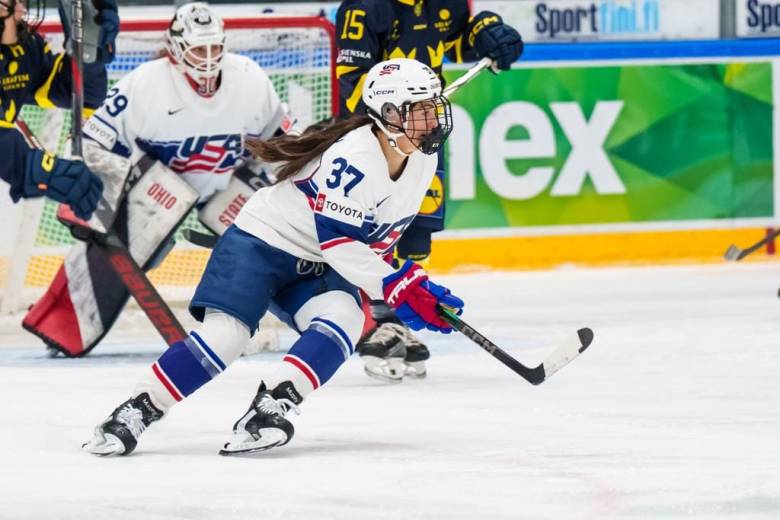
While the PWHL, SDHL, and NCAA paused for the December international break, the top countries in the world gathered their teams in Finland, Denmark, and Germany to prepare for upcoming IIHF competitions. Other notable matches took place in Montréal and Slovakia.
These games give us valuable insight into teams’ roster deployment and tactics, and can provide insight to which teams may rise—or fall—in future international competitions.
Six Nations Tournament: Czechia, Finland, Sweden, Switzerland, Canada Development Team, USA Development Team
Six of the top teams in the world sent squads to Tampere, Finland in this newly extended installment of the European Hockey Tour. The US and Canadian Development Teams, composed of NCAA athletes, participated for the first time. While most of the American and Canadian senior national teams play in the PWHL, eight Americans and one Canadian on these U22 teams played for their countries at the 2024 Women’s World Championship in Utica.
The European squads also left their top players off their rosters for club play, injury, or to let younger players get opportunities: all nine Czech players in the PWHL stayed in North America, Sweden and Finland were both missing half of their top six forwards and top four defenders, and five of Switzerland’s top nine stayed with their clubs.
Results:
1. USA Development Team
2. Canada Development Team
3. Sweden
4. Finland
5. Czechia
6. Switzerland
Minnesota’s Abbey Murphy led all skaters with five goals and nine points. The potential 2025 PWHL first round pick was named USA’s Player of the Game twice in their four games. Canada’s Jocelyn Amos (Ohio State, NCAA) was the next-highest scorer, with three goals and two assists.
Here’s Abbey Murphy’s second of the game for USA.
Ella Huber has since put one into the empty net to make it 4-0 USA. pic.twitter.com/HKywmRxYsg
— The Hockey News – Women’s (@TheHockeyNewsW) December 11, 2024
Finnish defender Sanni Rantala (Frolunda, SDHL) led all Europeans with three assists. Sweden’s Thea Johansson (Mercyhurst, NCAA) and Elin Svensson (HV71, SDHL) and Czechia’s Adéla Šapovalivová (MoDo, SDHL) each had two goals. Šapovalivová announced prior to the tournament that she will play for the University of Wisconsin next season.
All four North American goalies posted a shutout, as did, in a way, all three Czech goalies; 18-year-old Aneta Šenková (Clarkson, NCAA) and 19-year-old Michaela Hesová (Dartmouth, NCAA) shared the clean sheet over Switzerland, though it was credited to Šenková.
Sweden’s goaltending situation deserves a second look. The Boston Fleet’s Emma Söderberg was the only PWHL player to attend this tournament, and she performed well, with a shutout against Czechia and a single goal allowed to Finland. But it was the 2024 SDHL Goaltender of the Year, 21-year-old Ida Boman (Djurgårdens), who was given the starts against the US and Canadian teams. Bowman allowed only two goals to Canada, but was pulled after letting in five goals to the US. Her replacement was 20-year-old Ebba Svensson Träff (Linköping), who led the SDHL in save percentage last season and leads the league with six shutouts this year. Svensson Träff stopped all 10 of the Americans’ shots in her only action of the tournament. The allocation of Sweden’s starts at the senior level will be a situation to watch going forward.
Implications:
The American team had a goal differential of 20-5, and this should not come as a surprise. They brought their NCAA A-team to this tournament, boasting ten of the top 16 scorers in the NCAA. The future of American skaters is bright.
The Canadian team found lower-scoring success than the Americans against their European opponents, which was perhaps predictable. Canada’s team had only two of the NCAA’s top 15 scorers and eight players age 19 or younger. Scoring isn’t everything, and there are more Americans than Canadians in the NCAA, but Canada is leaning on players from their U18 teams, which have had success in recent years. That method does lead you to Wunder if they may be missing out on promising players who have not been rostered in the past.
Sweden was shut out by the US, but scored a goal in a 2-1 loss to Canada, shut out Czechia 3-0, and defeated rival Finland 2-1. Two-thirds of their goals and assists were scores by players 22 or younger. A few years ago, the Swedish Ice Hockey Association pledged to invest in the young women in the national program, and we are seeing signs that their investment is paying off. Although the senior team has floundered in the last few years after rounds of scandals, Sweden’s up-and-comers are showing that this will be a team to watch over the next few years.
Finland failed to score against the US or Canada, shut out Switzerland, and lost a 2-1 game to perennial rivals Sweden. Their only goal in that game came in the third period on the penalty kill by Sanni Vanhannen (Brynäs, SDHL), who declared for Ohio State in November. This tournament wasn’t a roaring success for Finland, but depth players scored about half of their points and their goaltenders stood up well.
Czechia saw the return of potential PWHL 2025 first round pick Kristýna Kaltounková (Colgate, NCAA), who finished with a goal and an assist. Although they were missing seven of their top scorers from recent years, getting shut out of two of their four games is a cause for concern; and all five of Czechia’s goals came against Switzerland. The performance of Viktorie Švejdová (HV71, SDHL), who saved 40 of 43 shots against the US and shut out Switzerland, is largely to thank for this tournament not being an embarrassment.
Switzerland’s only two goals of the tournament came against the United States in their first game. Although their goaltenders performed as well as could be asked of them, they were drowning, facing an average of 40 shots per game. Switzerland’s elite players in Alina Müller (Boston, PWHL) and Lara Stalder (EVZ, SWHL) weren’t available, but you cannot rely on just a few players to score everything. In Utica, Switzerland defeated Germany in overtime on a goal from Müller to stay in Group A of the top division. With hungry countries on the rise, that position looks like it may be in real jeopardy.
Four Nations Tournament: Denmark, France, Hungary, Japan
Four teams on the top division bubble gathered in Odense, Denmark in the run-up to the Olympic Qualification Tournaments in February and the Women’s World Championship and the Division 1A tournament in April.
In the last international season, Japan managed to avoid relegation from the top division, while Denmark slipped down to Division 1A once again. Meanwhile, Hungary earned their ticket back to the top division for 2025 and France just missed out on earning promotion; they will play in 1A for the second straight year.
Unlike the Six Nations Tournament, these countries fielded nearly complete teams. Japan’s most notable absence was their first line center, Haruka Toko (Linköping, SDHL). Denmark was down their starting goaltender in Emma-Sofie Nordström (St. Lawrence, NCAA). Hungary had a few big players missing in forward Réka Dabasi (HK Budapest, DFEL) and NCAA athletes Mira Seregely (Maine) and Zsofia Pazmandi (Lindenwood). France was without a few notable players in Captain Lore Baudrit (ERC Ingolstadt, DFEL) and the injured Jade Barbirati, who recently declared for Quinnipiac University.
Results:
1. France
2. Hungary
3. Japan
4. Denmark
Akane Shiga (Luleå, SDHL) led all skaters with four points in three games. The 2024 SWHL MVP Estelle Duvin (Bern) scored France’s only goal in a shutout against Denmark, as well as the winning shootout goal against Hungary.
Les Bleues 🇫🇷 battent 1-0 le Danemark 🇩🇰
Blanchissage de Justine Crousy Théode et le but du match marqué par Estelle Duvin après… 10 secondes en 2nde période !3 victoires, les Bleues remportent le Tournoi d’Odense, ça tombe bien à 2 mois du TQO pour Milan-Cortina 2026 ! pic.twitter.com/bcchyKEhkA
— Nicolas Jacquet (@Nico_Jt_) December 14, 2024
Chloe Aurard (New York, PWHL) scored the tying goal and the overtime winner in France’s game against Japan.
Les buts des Bleues contre le Japon, avec notamment deux réalisations et une assistance pour Chloé Aurard 🤩
📺 https://t.co/ydt5XA3d5g#TeamFranceHockey pic.twitter.com/Blcptr03uu
— Équipes de France Hockey 🏒 (@Hockey_FRA) December 12, 2024
Aurard’s Sirens teammate Taylor Baker also had a goal in Hungary’s win over Denmark, assisted by former PWHL Ottawa forward Fanni Garát-Gasparics (Brynäs, SDHL). Hungary also saw a goal and assist from 15-year-old Réka Hiezl, who played her first games with the senior team this year.
France’s backup Justine Crousy Théode (Reims, France 3) and Japan’s backup Riko Kawaguchi (Daishin, WJIHL) both posted shutouts against Denmark, who only scored one goal in their three games. The Danish netminder Aya Juhl Petersen (Malmö, SDHL 2) gave her low-scoring team the opportunity to win, allowing only three goals in two games.
Implications:
After missing out on promotion back to the top division in April thanks to a game that went to ten rounds of shootout, France is hungry. They beat two teams who will compete in the top level Championship this year, including Hungary, who had defeated them the last seven times they played each other. I would like to see more goals—seven in three games may get you wins, but it’s hardly dominating—but France should feel good after this tournament. They will face Japan again in February at the Olympic Qualifying tournament in Japan, fighting for the same spot at the 2026 Olympics.
Hungary won two of their three games, including a 2-1 win over Japan, who they will face in Group B of the Women’s World Championships in Czechia in April. Their loss to France came in the shootout, and it was their backup goaltender, 19-year-old Bianka Bogáti (MAC Budapest, EWHL), who was in net for that game. Their starter, Anikó Németh (Budapest JA, EWHL), allowed only a goal apiece to Denmark and France on 41 shots. Again, I would like to see more goals than six across three games, especially for a team that will compete in Czechia in April to keep their spot at the World Championships. Before that, however, Hungary will compete for a spot at the Olympics in Germany in February.
Japan was missing one of their best players, but it is still disappointing to see them drop games to Hungary and France, who stand at 10 and 13 respectively in the IIHF’s ranking. Starting goaltender Miyuu Masuhara allowed five goals in her two losses, while Japan’s skaters scored three goals across those games. Without placing blame anywhere in particular, that is not the kind of play that will see a team stay in the top division, not with teams like Hungary and Norway fighting to stay up. Japan will face France again, as well as a China team also seeking re-entry to the top division, at home in February to compete for an Olympic berth.
Team Denmark can say they played without their starting goaltender in Nordstrom, who is currently leading the NCAA in save percentage, but there’s only so much even the best goalies can do when a team scores one goal in three games. Perhaps playing at home invited echoes of the 2022 Women’s World Championship, when Denmark finished tenth and was relegated by a devastating last-second goal from Germany. Whatever the reason, this performance does not bode well for their chances in February, facing a team like Sweden in competition for an Olympic roster spot, or in April, where France will seek to push past them to return to the top division. You need to score goals to win hockey games, and Denmark didn’t do that in December.
Two game matchup between Norway and Germany
Germany kept its seat at the top division tournament this past April in Utica, New York, and Norway earned promotion to the top division for the first time in team history. The two teams faced off for a pair of games in Füssen, Germany.
Germany fielded nearly their complete senior roster while Norway was missing several top players, including Captain Mathea Fischer (SDE, SDHL) and Emilie Kruse Johansen (Leksands, SDHL).
Results:
Game 1: Norway 3, Germany 2 in the shootout
Game 2: Germany 4, Norway 2
Germany’s Emily Nix (SDE, SDHL) led the field with two goals in the pair of games, while Franzciska Feldmeier (Berlin, DFEL) led in points after assisting on both of Nix’s goals and adding one of her own. Norway showcased a successful line as Marthe Pabsdorff Brunvold (Linköping, SDHL) and Andrea Dalen (Frölunda, SDHL) each scored a goal and assisted on the other’s goal, and Millie Rose Sirum (Providence, NCAA) also assisted on each goal. Dalen also scored the winning penalty shot for Norway.
Sandra Abstreiter (Montréal, PWHL) was able to get some ice time, playing both games for Germany. Ena Nystrøm (Brynäs, SDHL) started both games for Norway.
Implications:
It’s hard to take anything serious away from just two games, but Norway can certainly be proud of their performance. Germany is historically a strong team and they took one game and put up a pair of goals in the second. Without goaltender statistics, it’s hard to judge, but I expect that Nystrøm did her team proud, particularly in the shootout win. Norway will compete in the Olympic Qualifying round in Sweden in February.
Equally, a shootout loss to and then a regulation win against a team that just won its first promotion to the top division isn’t an astounding record, but it’s nothing to panic about. Abstreiter’s lack of game time with her club is something I’d be concerned with, but her practice time is against PWHL players. Hopefully that’s enough. Germany will host the most intriguing of the final Olympic Qualifying Rounds in February, when Hungary, Austria, and Slovakia may all present a challenge.
No games—Austria
In advance of the Division 1A tournament, the Austrian national team chose not to schedule any games against other nations during the international break in order to host and focus on an intensive camp for their players.
General Manager Martin Kogler stated that playing games does not allow teams to work on certain details or introduce players to the team’s systems. Hosting a camp instead allowed the team to invite a large number of players to scout and develop for future depth.
The two Austrian players in the PWHL, Anna Meixner (Ottawa) and Theresa Schafzahl (Boston), did not travel to the camp.
Implications:
It’s a bold strategy, Cotton, let’s see if it pays off for them.
Two game set for Italy against the University of Montréal and Concordia University
Although Italy is currently ranked 19 in the world and are competing in the IIHF’s Division 1B tournament, they will compete in the 2026 Olympics as the host country. As such, their national team is in a phase of rapid development, which has included the hiring and importation of a number of Canadian coaches and Canadian-born players, most notably former Canadian national team star Laura Fortino (Neumarkt/Egna, IHLW).
The Canadian connections could have informed the team’s trip to Montréal to play two friendlies against a pair of the top teams in USports, and Concordia University has a history of collaborating with Italian ice hockey on the men’s side. Concordia and the University of Montréal have produced a number of top-flight players, including Alexandra Labelle (Montréal, PWHL), Team France’s Estelle Duvin, and Emmy Fecteau (New York, PWHL).
Results:
Game 1: Italy 2, University of Montréal 0
Game 2: Italy 3, Concordia University 2
Italy took the first game on goals from two of their Canadian-born players. The first was from Kristin Della Rovere (Bozen, IHLW), a former captain at Harvard who played nine games last season for PWHL Ottawa The second was from Kayla Tutino (Neumarkt/Egna, IHLW), a former captain at Boston University who was the first overall pick in the 2016 CWHL draft and played three pro seasons before retiring in 2019. Tutino was named the Italian team’s video coach last year and began playing again in Italy this season.
In the second game, Italy’s three goals came from Italian-born players. Aurora Abatangelo (Davos, SWHL), Mia Campo Bagatin (Bozen, IHLW), and Anna Caumo (Franklin Pierce, NCAA) are all players who have been with the Italian program for years.
Implications:
A number of American- and Canadian-born players have begun playing in Italy in the past three years, particularly for Bozen and Neumarkt/Egna, where many of the Italian-born national team players are based. Several of these imports have experience in the SDHL, PHF, CWHL, USports, and the NCAA, and a number of them are dual citizens or have stated their intention to become dual citizens.
When the Chinese national team had their Olympic debut as the host country at Beijing 2022, 14 of their 23 players were dual American or Canadian citizens, and many of them played for the KRS Vanke Rays. As the Italian team continues to develop in advance of Milan 2026, it will be interesting to see how much of their roster is eventually composed of Italian-born players.
Italy will play in the 2025 Division 1B tournament in Great Britain in April.
Bonus highlight: Slovakia
Slovakia did not participate in a tune-up tournament during this break because they were competing in the first Olympic Qualification Round of the 2026 cycle. They won the six-game tournament at home in Piešťany, Slovakia, to move on to the next qualifying round.
The Slovakian team was led by an astounding performance from 16-year-old Nela Lopušanová, who was playing her first games with the senior national team. She did not wait long to earn her first points, scoring four goals in the first 22:07 of her first game.
Amazing Nela Lopušanová :
📌 16 years old
📌 1st official game with senior Team Slovakia 🇸🇰
📌 Hat trick after 16 minutes of the game
📌 4 goals / 5 points
📌 And (once again) a Michigan goal 👇WOW !!! pic.twitter.com/Gu6OQWiHbA
— Nicolas Jacquet (@Nico_Jt_) December 12, 2024
Lopušanová scored a hat trick in the second game and added four more goals in Slovakia’s final game. She finished with 11 goals and 18 points in three games. The next highest scorer, Slovakian defender Livia Kúbeková, had seven points.
Implications:
There’s not much to take away from a team drubbing three teams six, seven, and 12 ranks below them. Slovakia were the favorites in this group and they will move on to face the real test—and Lopušanová’s first at the senior level—battling Germany, Hungary, and Austria for an Olympic berth in February.