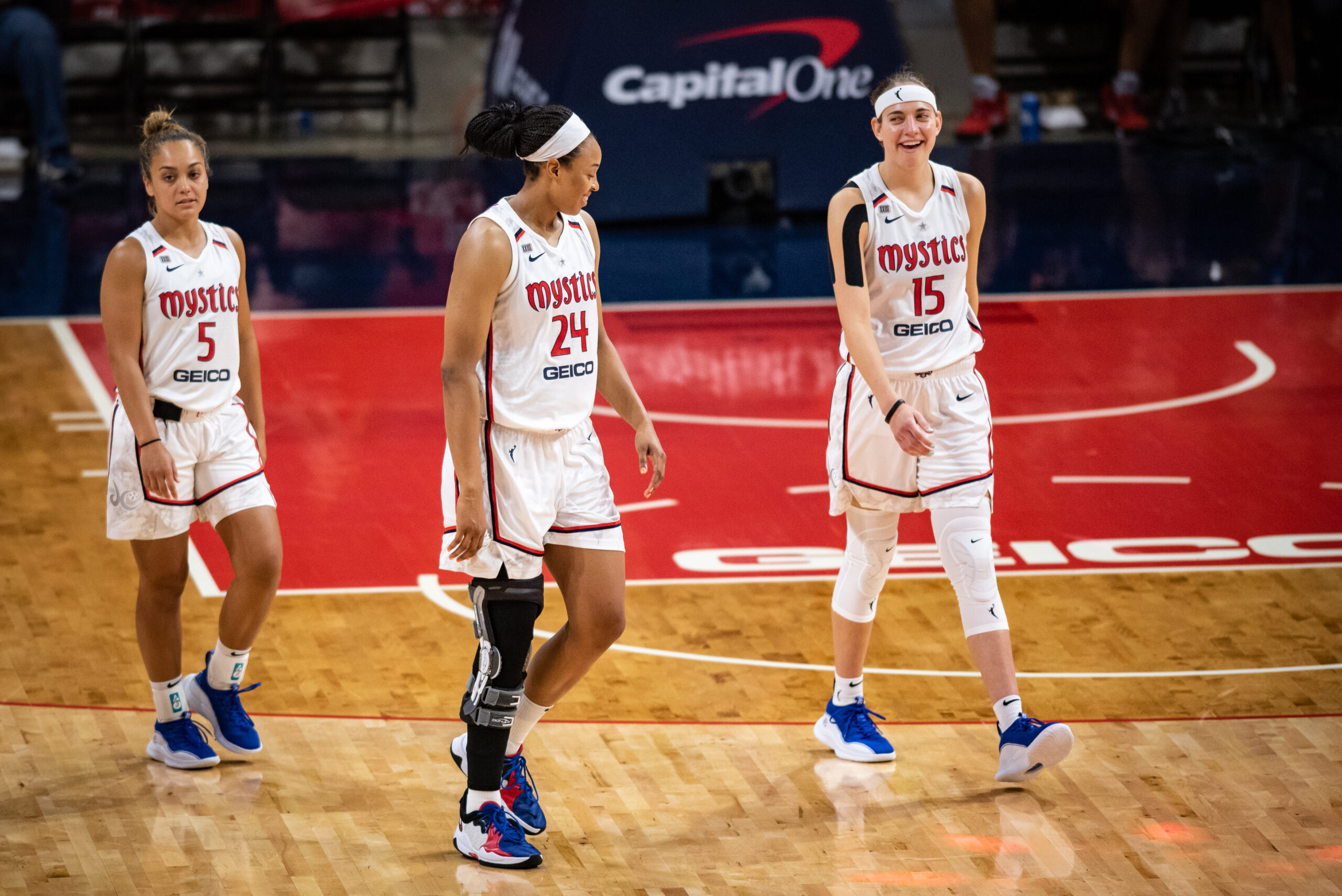
The day that Erica McCall’s basketball dreams came true was also the day they came crashing down.
On April 28, the Washington Mystics cut McCall, who had been hampered in training camp by knee and ankle injuries. But the Spanish team Perfumerias Avenida also reached out, interested in signing the 6’2 forward to compete in Europe’s top league starting in the fall.
“What? A EuroLeague team wants me?” McCall remembers thinking. “This team has been dominating for years!” She didn’t know what to feel, buoyed with happiness about reaching the EuroLeague but held back by the knowledge that she wasn’t going to play for the Mystics.
According to McCall’s agent, Mike Cound, the then-26-year-old McCall would have had a good chance of making a WNBA roster if she had been healthy. Instead, for the first time in her six-year professional career, she had to figure out what to do during a summer when the league played on without her.
The injury that sidelined McCall this summer was lateral meniscus pain in her right knee. It has been chronic dating back to her college days at Stanford, though she told The Next that it hadn’t bothered her much in her first three WNBA seasons, all with the Indiana Fever, or while playing in Hungary during those offseasons. But in 2020, during COVID-19 shutdowns, her knee didn’t take kindly to her running three miles a day outside to stay in shape. “I’ve definitely been having some trouble with it since then,” she says.
In 2021, McCall, then playing for the Mystics, missed eight games after she felt a pop in her knee during a June shootaround and had to have surgery. She returned to finish the season, but her knee pain resurfaced overseas as she averaged 34.7 minutes per game — a career high across the college and professional levels — for the Turkish team Beşiktaş and played on a severely sprained ankle late in the season.
“Going into [training] camp, I just truly wasn’t healthy to the point to where I could compete at a high level,” McCall says. She did get some interest from other WNBA teams, but her knee made the decision for her: “It just said no. … I just needed to rest.”
So McCall headed home to Bakersfield, California, in full understanding of the Mystics’ decision to cut her but struggling to accept that her body couldn’t push through any longer. She had played well for Beşiktaş despite the injuries, and she was mentally ready for the rigors of another WNBA season. The adjustment was difficult enough that McCall declined a friend’s invitation to go to a Los Angeles Sparks game early in the season, not ready to watch from the stands instead of being on the court.
“As a professional, a female athlete playing in the [WNBA], you are trained to just go, go, go,” McCall says. “You are not known to rest. And so that was really hard for me mentally to tell myself to rest.”
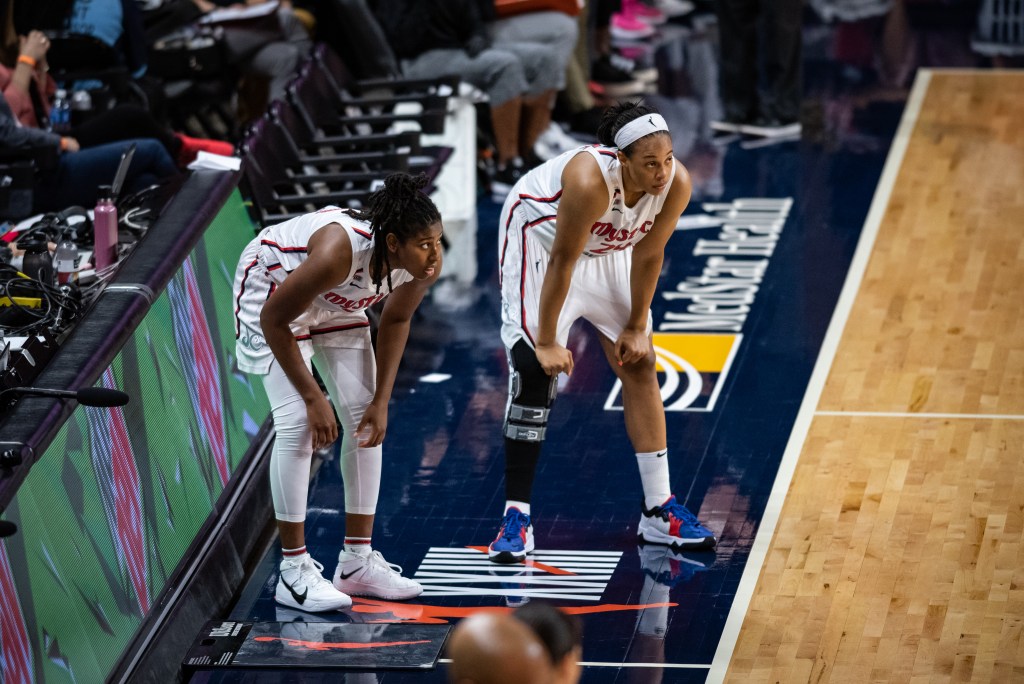
McCall also faced the challenge of securing health insurance; she had had coverage through the WNBA until the day she was cut, when she was suddenly on her own. Getting insurance was urgent because she needed MRIs to tell her how her knee was healing, but it ended up taking her about a month to get coverage. During that time, she says, “I was kind of in struggle mode of just not knowing what to do because I needed these tests.”
Along with health insurance, McCall had to find her own physical therapist, strength and conditioning resources, and gym access. She asked a strength and conditioning coach from one of her overseas teams to give her workouts that wouldn’t exacerbate her knee until she could get her MRI results and plan her next steps. And even when she did get health insurance, she said on her podcast, it wasn’t feasible for her to go to physical therapy daily because of the out-of-pocket costs.
McCall opened up further about the logistical challenges of getting waived on that podcast, “Bird’s Eye View,” in June. “I just feel like I haven’t had any support. Any support from the league, any resources,” she said. “I feel like I’ve been trying to do everything on my own … and it’s just been really mentally taxing.”
Struggling to find the resources she needed in Bakersfield, McCall reconnected with former Mystics teammate and college rival Sydney Wiese, who was at home in Phoenix, Arizona, recovering from a torn ACL. Wiese invited McCall to come visit for a week and see whether she liked Wiese’s physical therapy setup. Cound also connected McCall with former college and WNBA coach April Schilling, who was working with players from the high school to professional levels in Phoenix.
“Phoenix is becoming a hub in a lot of ways … for resources when it comes to gym access, trainer access, [physical therapy], training, across the board,” Wiese told The Next. She thought McCall could benefit not only from having all of that nearby, but also from having the sense of community that Wiese felt there.
McCall ended up staying in Phoenix and working with Schilling for about two months, gradually ramping up her basketball workouts to prepare for the EuroLeague season. Schilling put her through a lot of ball-handling drills, aiming to build her confidence.
“We start every workout with probably 15, 20 minutes of just two-ball work,” Schilling told The Next, “so that when [you] get to one ball, you just have all kinds of confidence. And you’ve built your basketball muscles for 15 minutes every single workout, the same muscles that you’ll use on the court in the game.”
Schilling and McCall also honed McCall’s shot, including her trail shot in transition, and worked on countermoves for when defenses would try to take away her jump shot. But Schilling made sure not to overtax McCall, planning lighter workouts for days when McCall had tough strength and conditioning or physical therapy sessions.
By the middle of the WNBA season, McCall had fully accepted that her summer would be spent recovering and decided not to take any more calls from WNBA teams. Her sister DeWanna Bonner, a veteran on the Connecticut Sun, helped her get to that point by urging her to focus on recovery, then on overseas play, and only then on a WNBA return. McCall started to attend Phoenix Mercury games with Wiese and got to see her WNBA friends when they passed through Phoenix. She found joy in cheering for whoever she wanted and interacting on Twitter in ways that she had never been able to as an active player.
During the daily grind of rehabbing an injury, McCall leaned on Wiese, her one-time roommate at the WNBA Draft who was also cut by the Mystics this spring, just days before getting injured in Italy. “She’s really been my rock this whole summer,” McCall says. Wiese reinforced to McCall the importance of resting — even if McCall didn’t always heed the advice — and was someone McCall could talk to who knew exactly what she was going through.
“Our journeys have been so similar that we can fast-forward all the explanations of where we’re coming from because we get it and we understand it [in] a different way,” Wiese says, “where our family won’t be able to because they haven’t walked that path. They don’t know what it’s like. So … we gave each other a safe space to verbalize what we might be struggling with or carrying on any given day.”
One of the most difficult aspects of recovering from an injury is often the monotony of training. There are no games to look forward to, progress comes incrementally, and playing at full speed can seem a long way off. McCall said on “Bird’s Eye View” in July that she was sometimes frustrated that she wasn’t farther along in her recovery, but she had to be patient. “That whole summer, really, [was] just all about patience,” she told The Next.
So McCall tried to focus on whatever small victories she could find, knowing that they would eventually add up. She noticed when her body felt stronger and as her quadriceps muscles got bigger. She celebrated her shot getting better. And eventually, she got to play five-on-five with Schilling’s high school team, Bella Vista College Prep.
“That was a big one for me,” she says. “I’m like, ‘Okay, yes … it’s like a game.’”
Practicing with other players lifted McCall’s spirits and helped her refine her skills on the court. She worked on reading the defense and not rushing through her moves, which has been a frequent admonition throughout her career. She also helped teach the Bella Vista players nuances of the game, which honed her basketball IQ. (It could even preview what’s to come far in the future, Schilling says: “I think she might have the coaching itch.”)
Schilling appreciated how McCall brought a new voice for the Bella Vista players to heed and how her professional and enthusiastic approach to workouts can impact an entire gym. “She’s that type of glue player that I think every team needs. And I couldn’t say enough about how she met every challenge and every workout with a good attitude and worked really hard,” Schilling says. “I mean, there was never a time where I had to say, ‘Erica, pick it up.’ … She’s the ultimate team energy-giver.”
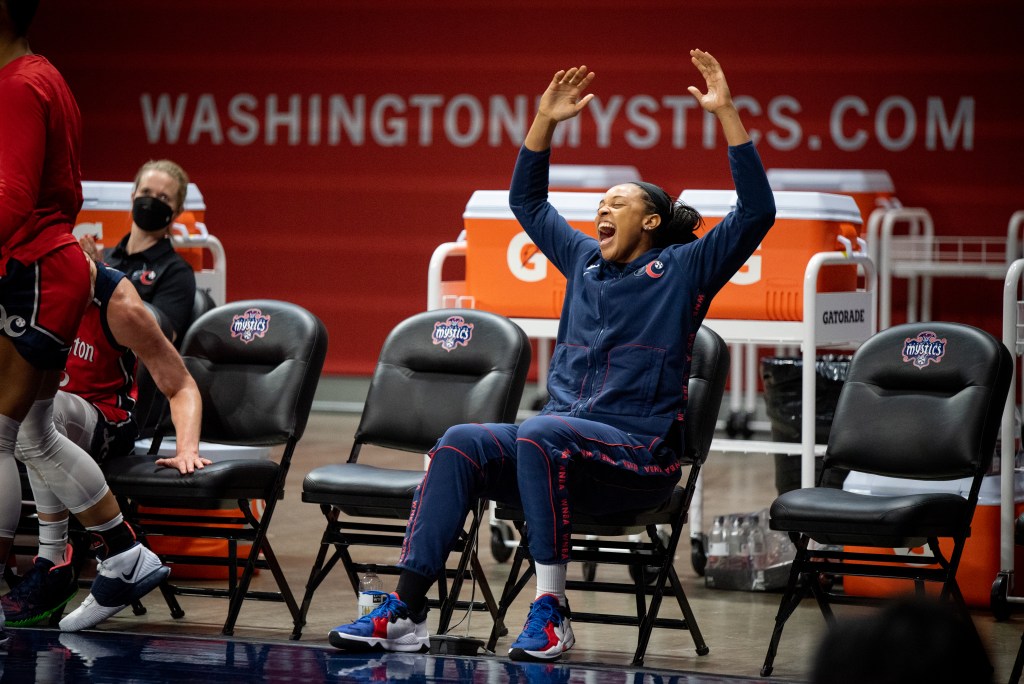
Off the court, McCall spent much of her time with Wiese and Megan Gustafson, another former Mystics player who now plays for the Mercury. Wiese and McCall’s physical therapy schedules never seemed to align, but they hung out in the evenings “like an old married couple,” as Wiese put it.
Wiese and McCall often cooked dinner together and watched WNBA games or movies on Disney+, sometimes with Gustafson and her Corgi, Pancake. Sometimes they went to Wiese’s family’s house for dinner. And they celebrated McCall’s Aug. 21 birthday with a barbecue and a rain-soaked Chris Brown and Lil Baby concert. “We were literally stuck in a monsoon, drenched in water, and then the concert resumed and it was a great time,” Wiese says.
“It was just really fun,” Wiese adds about the birthday weekend, “because you felt like a 20ish-year-old human being instead of [an athlete] going through a rehab process.”
By the end of the summer, it was clear to both McCall and Wiese that McCall had made a great decision to rest and recover. McCall was feeling “so much better,” and Wiese saw how her friend — widely nicknamed Bird — was soaring.
“Wow, she looks bouncy!” Wiese thought. “She’s moving well. She’s Bird. That’s Erica McCall.”
“Bird is a go-getter,” Wiese adds. “… She’s gonna outwork you and out-hustle you; that’s why she is as successful as she is. But this component of allowing herself to rest is only going to make that so much better.”
On her last day training in Phoenix, McCall brought in Crumbl cookies for everyone to show her appreciation for the community that had helped her heal. She capped off her summer by traveling with her dad to cheer on Bonner and the Sun in the WNBA playoffs, just as she had as a teenager during Bonner’s 2009 championship run with the Mercury.
“That brought back a lot of memories,” McCall says. “… That was a blast.”
Now living in Salamanca, Spain, McCall is pleasantly surprised by how well her knee is doing. She had jumped at the chance to sign with Avenida, as she had long dreamed of playing in the EuroLeague and in Spain. The cherry on top was that Avenida’s head coach, Roberto Íñiguez, had coached Bonner in 2011-12 and earned a strong endorsement.
In Íñiguez’s system, McCall is learning a new role as a stretch four, spending most of her time on the perimeter and shooting threes. As a player who has historically thrived on physicality in the post, McCall finds the new position “a bit uncomfortable” at times, but she knows it could create opportunities for her in a women’s basketball landscape that is increasingly positionless. As Cound told The Next, “The true big man is disappearing … You’ve got to be able to face the basket at that level or … [general managers] forget about you.”
McCall is adjusting to the new position by relying on the ball-handling skills she developed with Schilling and some of the psychological tools she learned in her third season in Indiana, when she sought out a sports psychologist to help her with performance anxiety.
Through three games in Spain, McCall has already made more 3-pointers (four) than she has in five WNBA seasons (three), on half as many attempts. She is averaging 11.0 points, 6.3 rebounds and 1.0 steals in 29.7 minutes per game and has committed just two total turnovers.
“All this work, this process that she’s been through in the dark all summer, away from all people, is coming to light,” Wiese says, “and you can see the 3-pointers, you can see the blocks, you can see the boards, you can see the energy. I’m so excited for her to just be out there and to receive the fruit of her labor.”
McCall will get two games this season against Bonner, who is playing for the Turkish team Cukurova, and then have a chance to put Bonner’s vision for her comeback in motion. The fact that McCall is playing in such a strong league and can show WNBA teams that she’s healthy could go a long way toward getting her another WNBA contract.
“It’s hard to keep yourself relevant if you’re not playing, if they’re not seeing you,” Cound says, pointing to the limited number of roster spots in the 12-team WNBA and the league’s tight salary cap. “… If you’ve gone four, five years in the league and you don’t stick, it’s really [hard]. You’ve got a 20% chance to get back in.”
One complicating factor for McCall is the WNBA’s looming prioritization rules, which penalize players who arrive late from overseas. In 2023, players with more than two years of WNBA experience can’t play in the league if they miss the start of the regular season; in 2024, that deadline will be the start of training camp.
If Avenida makes a deep run in the EuroLeague playoffs, as many people expect, McCall could be a few days late to training camp in 2023, but she will not miss the start of the regular season. Cound doesn’t expect her arrival date to impact teams’ interest; instead, he worries more about whether teams can afford her salary instead of a cheaper rookie contract.
“People love her,” Cound says, referring to WNBA decision-makers. “People love how great a teammate she is, how much effort, how much energy, how much bounce she has in her step.”
But if prioritization does become a sticking point, McCall says she is comfortable with the trade-off. She makes most of her income and develops as a player overseas, and she has already achieved the goal of playing in the WNBA.
“I’m really hoping it all works out,” she says, “but if it doesn’t, my summer is off again, and I’m looking forward to having a vacation.”
After all, the 2022 season gave McCall a blueprint for how to approach a summer without the WNBA. She dealt with the Phoenix heat and the monotony of rehab, and she found a community that helped her thrive. She learned how to let her foot off the gas so she could rev it up later. And now she is living her EuroLeague dream, with her foot on the accelerator and her game ready to take flight.