During the FIBA 3×3 U23 World Cup in Mongolia in September, Team USA coach Christina Batastini got several text messages from her family members, who were waking up in the middle of the night back home to watch the games. Several of their messages gushed about Harmoni Turner, a Harvard guard who was playing 3×3 for the first time.
“Oh, wow, that kid Turner,” Batastini remembers reading. “Thank God you have her!”
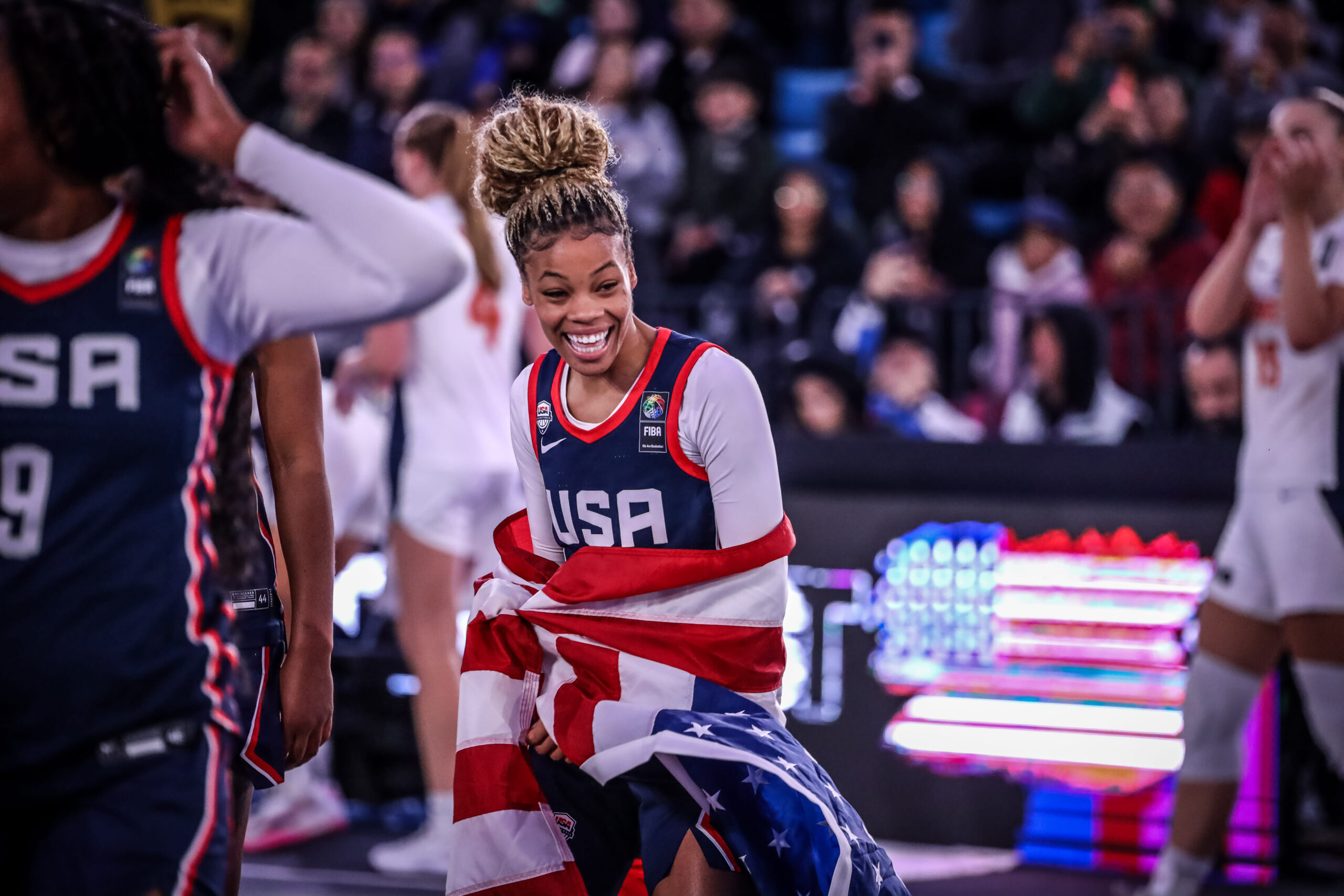
Team USA won the gold medal in Mongolia, going 7-0 and becoming the first American women’s team to win the event since it was created in 2019. Turner scored 40 total points, which was tied for the second-most of any player in the tournament.
(In 3×3, the first team to 21 points or the team that’s leading after 10 minutes wins. Teams are awarded 1 point for a shot inside the arc and 2 points for a shot outside the arc. With the shorter game times than 5×5, Team USA played 62.8 total minutes in the seven-game tournament.)
The 5’10 Turner is a two-time first-team All-Ivy selection and was named to Her Hoop Stats’ preseason watch list for the nation’s best mid-major player. She was the only mid-major player on the World Cup team alongside former Seton Hall forward Azana Baines, South Carolina forward Sania Feagin and Ohio State forward Cotie McMahon.
Batastini, the coach at St. Andrew’s School in Rhode Island, had coached Baines and McMahon at a 3×3 tournament in July. USA Basketball then tapped 3×3 newcomers Turner and Feagin to fill out the World Cup roster.
“Honestly, I just feel like it’s just basketball,” Turner told reporters at Ivy League media day on Oct. 17 about adjusting to 3×3. “That’s the mindset that I went in with. I prepared for it. It’s something that has been on my bucket list since I was a little girl. So I felt like I was just seizing the moment.”
Batastini told The Next she was impressed by how quickly Turner absorbed the finer points of 3×3, especially with limited preparation time. The team had only three practices, a scrimmage and some film sessions in Mongolia before the tournament began. In contrast, many of its opponents train year-round.

The scrimmage was against Germany, which went on to finish fourth and had two 3×3 Olympians on its roster. Though Batastini lives relatively close to Harvard, she hadn’t seen Turner play in person before they got to Mongolia, so the scrimmage was her first look at Turner in live competition.
Turner struggled offensively in the scrimmage, Batastini said, but her defense was elite. Batastini’s defensive philosophy in 3×3 is not to switch ball screens, so players have to be tenacious at sticking with their matchup.
“I distinctly remember a defensive play where Harmoni fought over a ball screen, she fought over a rescreen, she chased,” Batastini said. “It was just an unbelievable defensive effort. And after that first scrimmage, although her offensive output wasn’t where we needed it to be, I knew just defensively, her presence on the court was going to make a huge impact.”
After the scrimmage, Batastini told USA 3×3 national teams director Jay Demings that Turner would be the X factor in the World Cup. She was right.
“We had a really solid group in terms of basketball skill set,” Batastini said. “We had some good leaders; we had some good communicators. But I think Harmoni brought the group together, just with her incredible energy. I mean, she’s a spark, both emotionally, mentally and then physically on the court. …
“I’m not sure we win the World Cup without her.”
Turner had 6 points in each of her first two games in the World Cup, mostly from inside the arc. But in Batastini’s eyes, she really got going offensively in Game 3 against Spain, when she found her rhythm from long range. It was cold that day, and Team USA started sluggishly. Turner led the comeback with 7 points on three 2-pointers, including the game-winner with time expiring.
“That was the confidence she needed to get on the offensive end,” Batastini said. “And she ultimately changed our trajectory offensively because she was one of our few players who was consistently making the 2-point shot.”
Turner made 12 2-pointers in the seven-game tournament, while her teammates combined for just two. Turner’s shooting particularly complemented Feagin’s inside play, as Feagin led the tournament with 44 points, all from 1-pointers or free throws.
“Since we touched down in Mongolia and we had our few practices, it was pretty commonly known who [Team USA] decided the shooter was and it was me,” Turner told The Harvard Crimson in September. “I understood that I had a responsibility for the team and I was willing to do whatever I [could] … for us to win. I credit my team for being confident in me. They were telling me to shoot more.”
In the quarterfinals against France, Turner poured in her tournament high of 10 points on four 2-pointers — nearly matching France’s point total in the Americans’ 21-11 win. She again swung the momentum in the gold-medal game against the Netherlands. With just over two minutes remaining, Turner hit two 2-pointers that, sandwiched around a Feagin 1-pointer, flipped a 12-11 deficit into a 16-12 lead. The second 2-pointer ended up being the game-winner, as the United States won 18-15.
Just like Batastini had family watching the tournament overnight, Turner’s Harvard teammates and coaches were setting alarms to watch her play — and discussing the results excitedly at practice.
“You could see [Turner’s joy] in the midst of the games, from possession to possession,” Harvard head coach Carrie Moore told reporters at media day. “And I think the biggest thing for myself and our team was to really see her make the plays that she did in order for that team to win the gold medal. So for her to be able to answer the call and really meet the moment in that way, I think, was a big relief, and … it’s something that she’s been working towards.”
“I’ve never, ever seen a more confident, composed Harmoni,” junior forward Katie Krupa added. “I was more stressed out sitting on my couch watching her. My hands were sweating.”
Turner and Krupa both felt that Turner winning a gold medal helped highlight how good Ivy League basketball is. It also gave Turner a broader platform as she works to become an early pick in the 2025 WNBA Draft. And it was only part of a busy few months for her, following a trip to China for a basketball exchange program in August.
Now, Turner is back in Cambridge, about to begin a senior season in which Harvard has a legitimate chance to win the Ivy League and make the NCAA Tournament. It would be the Crimson’s first Ivy League title since 2008 and first NCAA Tournament berth since 2007.
Individually, she has a good chance of ranking in the top three in program history in career points and the top two in career steals by season’s end. (She is already third in steals.) And the hope is that she’ll reach even another level of confidence and scoring efficiency this season.
Turner has kept up her 3-point shooting since the World Cup, Moore said, which would be huge for Harvard. Last season, Turner averaged 19.3 points per game, which ranked in the top 40 nationally. But she shot a career-worst 26.4% from 3-point range, even as she had the most efficient season of her career from inside the arc.
After that season, Moore and Turner talked specifically about improving her 3-pointer to make her “unguardable” and open up the court for herself and others. They also discussed the steps she needs to take to reach her professional goals.
“She knows that this needs to be the year that people are talking about Harvard women’s basketball,” Moore told reporters on Wednesday. “And therefore they will be talking about Harmoni Turner, and that just only raises her stock come March.”

Moore plans to play Turner off the ball more this season, which will free her up from calling plays and allow her to get the ball more on the run and score early in possessions.
“It’s just a different lens for us and for the opponents as well, which I love best, because I feel more comfortable at the two,” Turner recently told The Next’s Howard Megdal on the Locked On Women’s Basketball podcast. “So … you’re going to see a lot more facilitating this year, but also a lot more putting the ball in the basket. I think it’s just a different, a new level this year.”
After Turner got back from Mongolia, Moore was excited for her. She congratulated Turner on her medal — and then quickly pivoted to the upcoming season.
“OK, you won the gold medal,” Moore said. “Now help us win a championship, please.”
‘Rare Gems’ is out now!
Howard Megdal, founder and editor of The IX Basketball and The IX Sports, wrote this deeply reported book. “Rare Gems” follows four connected generations of women’s basketball pioneers, from Elvera “Peps” Neuman to Cheryl Reeve and from Lindsay Whalen to Sylvia Fowles and Paige Bueckers.
If you enjoy Megdal’s coverage of women’s basketball every Wednesday at The IX Sports, you will love “Rare Gems: How Four Generations of Women Paved the Way for the WNBA.”