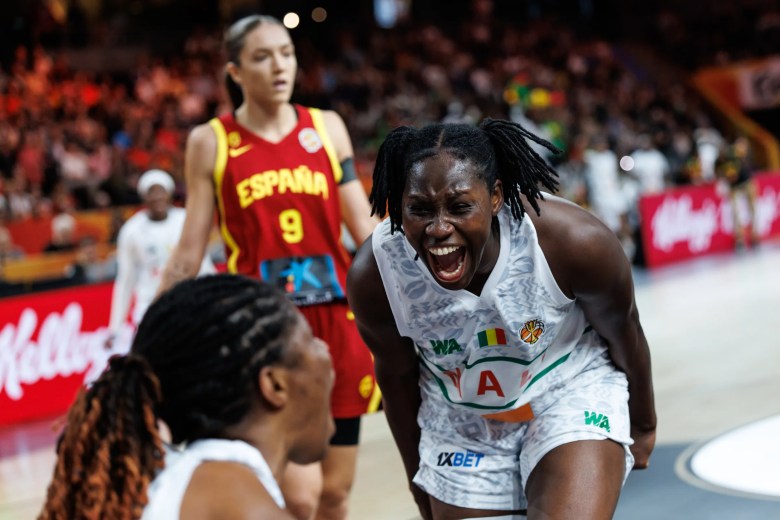
BERLIN – In 2010, Mali defeated Senegal at the FIBA World Championship in a consolation game. The stakes? The winner would finish 15th, and the loser would finish 16th. It was so long ago that it wasn’t even called the World Cup. Now, the team is fresh off an 82-73 win against Spain in one of the largest upsets in World Cup history.
Just four days ago, FIBA ranked Spain third among the 16 at the World Cup, while Mali ranked 15th. Mali overcame this gap and broke through with its historic first-ever World Cup group stage victory. This came just one day after a narrow 5-point loss to Japan, an especially close game considering Japan shot a blistering 20-for-35 from behind the arc.
Spain were just 16 hours off dismantling hosts Germany by 30 points in front of 12,550 fans inside Berlin Arena. Spain were methodical in that first game, scoring 24 points in the first six minutes. Maria Conde had 9 of those 24, and Iyana Martín was close behind with 8. Even with the atmosphere and the stage, Spain ensured the last 34 minutes of the game were garbage time.
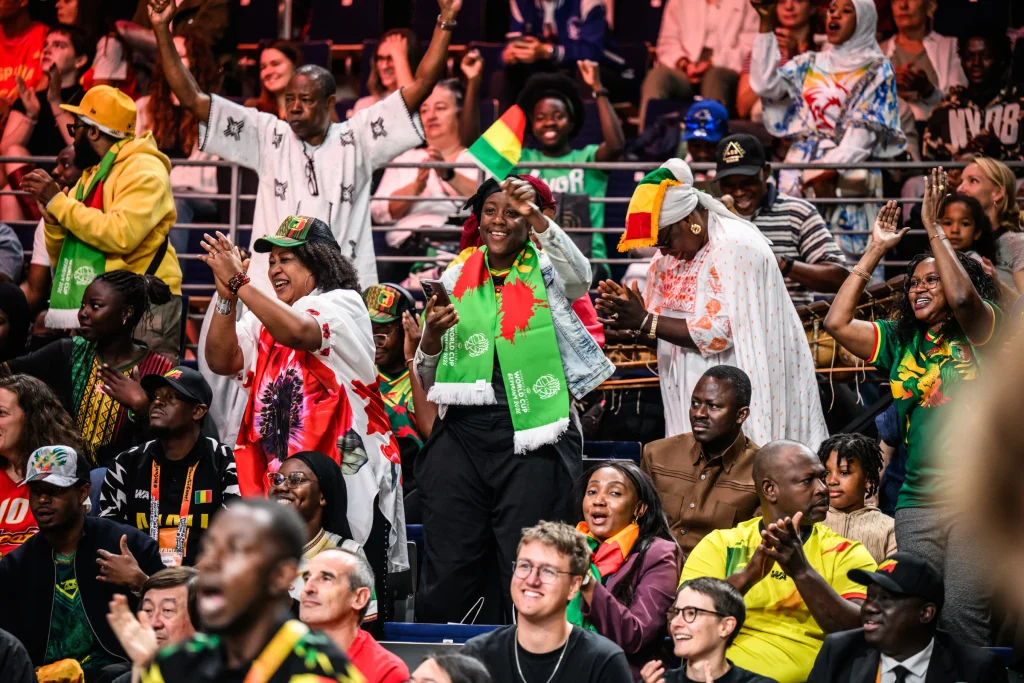
The 11:30 a.m. start for Mali and Spain saw fans fill in as the game was going on. After all, cafes in Berlin open at 10 a.m. on Saturdays, much to some people’s disdain. Who wouldn’t be discouraged by the early tip-off? The Mali fans, seated right behind their nation’s bench, balafon and all.
Mali controlled the scoreboard through the first quarter, but Spain grappled back by halftime, leading Mali 34-32. Spain has one of the richest basketball histories in the world. Mali is writing its history, and it’s much closer to its first page than its last.
With this massive gap in each team’s intergenerational history, it’s expected that coming out of the half, Spain would retain control of the scoreboard with the momentum they built in the second quarter. What better team to do this against than a young, 15th-ranked Mali team who has never won a group game at a World Cup, right?
This couldn’t have been further from reality. Mali took the lead back in 92 seconds and only let go of it for 18 seconds the rest of the game.
“We didn’t make a lot of subs,” Mali head coach Oumarou Sidiya told The IX Sports about the second-half approach for Mali. “We wanted to keep the same players on and stay close with Spain. If we won or lost the game, we wanted to take it to the end of the fourth quarter. Whatever it took to stay close to Spain until the end.”
As it turned out, Mali wasn’t trying to keep it close with Spain; Spain was trying to keep it close with Mali. At some points it wasn’t close. With two minutes to play in the third quarter, Mali was up by 13. Halfway through the last quarter, it was at 16. The closest it would get for the rest of the game was the final margin of 9.
Rep The IX Sports at your next game!

Shop the logo collection or special “Women’s Sports are Front Page News” collection now on Shopify.
As for his rotation, Sidiya didn’t waver. Sika Koné played all 20 minutes in the second half, Djeneba N’Diaye played a little over 16, Aminata Sangaré had close to 16, Rokia Doumbia had 15 and Alima Dembélé had 14.
The first two in that list have led the charge for Mali, with Dembélé as third fiddle. Their consistency in producing for their nation is the stuff of seasoned veterans, though they have just a combined 98 games in the WNBA — all from the 24-year-old Koné.
N’Diaye had 22 points in the prior game against Japan, with Koné at 21. In the win against Spain, they both provided 19. Dembélé had 14 against Japan and 11 against Spain. Though 11 points doesn’t jump off the page, the fashion in which she was able to ignite the crowd with all four of her buckets went further than the stat sheet.
“All thanks go to the crowd,” Dembélé told The IX Sports. “Thanks to them I managed to play this way [feeding off the crowd]. Thanks to them, we won our game. They are always there for us, so all thanks go to them.”
It really did feel like a collective effort that spilled into the stands and reverberated back onto the court.

To Dembélé’s credit, however, she was the one making clutch play after clutch play. In the last quarter, she hit a 2-pointer and a 3-pointer, both times extending the Mali lead to 16 and hammering the tentative nail in the coffin for Spain. She also had two assists and a steal in the final frame, making crucial big plays when her nation needed them.
This game was every bit of an all-in effort. Mali were stubborn, mature and professional in the way they demanded the win from themselves. As a reminder, before the tournament began, Koné told The IX Sports:
“We have to win as many games as we can [to pass through the group phase]. The objective is to deliver that to Mali. Mali has never been there. To do that, we have to take it game by game, and every game is a final for us.”
Now, they have won. And it wasn’t just any win; it was a win against the strongest team in the group. Sure, they lost to Japan, but they’ve now unlocked the ability to advance through the group phase if they beat Germany.
“It means everything to us,” Koné told media in the mixed zone. “Spain is one of the best teams, so to be able to beat them, it’s just amazing. And … we have good players too; we just have to believe it and just try to stay with the game plan with what coach told us.”
She then added to that, before she was, rightly, rushed off to join the celebrations:
“I mean, we’re not surprised because we all are professional players. So we just have to continue to believe and believe what coach told us and stay with that.”
Listen now to The IX Sports Podcast and Women’s Sports Daily
We are excited to announce the launch of TWO new podcasts for all the women’s sports fans out there looking for a daily dose of women’s sports news and analysis. Stream on Spotify, Apple Podcasts or anywhere you listen to podcasts, and make sure to subscribe!
Doumbia was huge in the win. When her coach relied on her in the second half, she delivered, finishing the game with nine assists. Postgame, she spoke with media alongside N’Diaye, who she happily translated for.
“We’re proud, we’re proud, we’re happy. All of the emotions, all of the emotions,” Doumbia said emphatically. “This is not the championship; we didn’t win the World Cup, but we got to do something special with a group that’s very special.
“We’ve always believed in the group that we have, always believed in the coaches, the players. This is what we thought we could do; we never doubted this. Yesterday, we felt short. But today we came up with a win, and we’re hoping to keep it moving towards that direction.”
N’Diaye had a smile on her face throughout the entire response, and as Doumbia started translating to her, N’Diaye cut her off. Doumbia then relayed the message: “She’s happy with what I said.” N’Diaye nodded.
Overall, Mali sent a consistent message: play all four quarters with focus and execution.
“It feels good to pull it out because yesterday we were winning three quarters and then we pretty much lost in the fourth,” Doumbia explained. “So it feels good to keep our lead, to stay together and everybody just on the same page. “
“It’s a great feeling, she continued. “This is the world stage. Like we said, we came to write history, we came, we had a dream. We still have a dream to go even further than where we are right now. So that’s pretty much all it is.”
Again, with a smile, this response sufficed for N’Diaye. It was 40 minutes and more from Doumbia, providing assists off the court too.
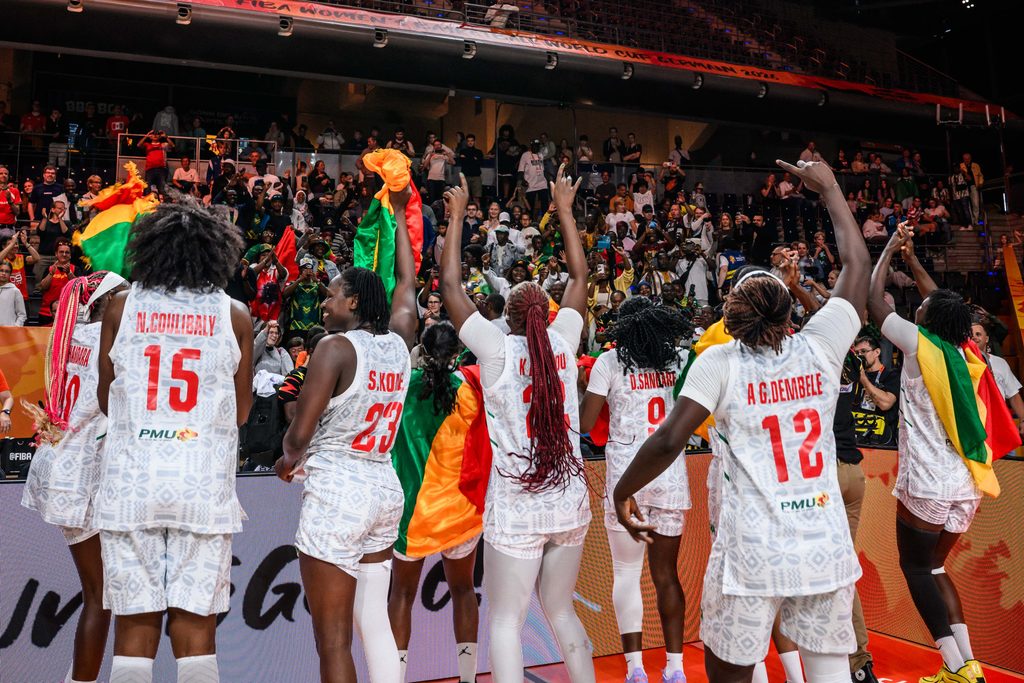
Mali didn’t let anything get lost in translation, with assistant coach, translator and former player Diana Gandega responding to a question before translating it to Sidiya. Cesare Milanti from FIBA said, “If I’ve done my maths correctly, 16 years ago at the 2010 World Cup Mali lost against Spain by 44 points.”
Gandega chimed in before Milanti could finish his question, saying, “I was a player [on that team].”
Although it was all in fun in the presser, it was actually a perfect way to connect all the dots for Mali’s basketball journey. Gandega is a through line back to the 2010 World Championship, with a 44-point loss to Spain and, technically, a win, even if it was a playoff for 15th place. That game was a 69-67 win against Senegal, where Gandega played 38 minutes. They were at the Olympics in China two years earlier, with an 0-5 record. Gandega was there too.
In 2014 and 2018, they missed out on the newly renamed World Cup. In 2022, they went 0-5. It got even worse when there was an infamous in-team brawl between Salimatou Kourouma and Kamite Elisabeth Dabou in the mixed zone after a loss to Serbia. This was a shocking low and a forgettable moment for a proud nation.
They’ve come a long way since then, and today marks a point where they take charge of their history. Returning to Milanti’s question, which was about how far they had come since 2010, Sidiya responded:
“It starts with the youth teams; under-16s and under-18s. We beat big, big teams in these categories, so it explains why the women today won. It’s the same group from youth, under-16s to now. Most of the women play in big teams in Europe, in big leagues in France and Spain. Now they can all play and bring this together.
“Most of the women in the team play in Spain, so they know their opposition. We had a big, big difference with the way Spain responded to our defense. We were surprised, because we leveled up. So that’s what led to this game.”
Dembele chimed in on this too. “We just kept working together since under-19s. Just kept working.”
This is Mali’s development happening in real time. That development was on display against Japan too, but winning reframes growth and makes it undeniable in a way that narrow losses can not.
Sidiya was stoically on task in the press conference, looking ahead to the game against Germany.
“We gotta stay focused, we gotta work on the strengths and weaknesses of Germany,” he told media. “They lost against Spain, so it’s going to be a big game. And Germany is the host, so it’s tough for opposing teams. So you have to do everything to beat this team.”
Mali’s win came four hours before Germany tipped off against Japan and won in emphatic fashion. This sets up for an epic Monday in Group A, with every team at 1-1 and everything to play for. And Sidiya is right; the atmosphere they will face against Germany is unlike anything they have seen in this tournament, as Berlin has provided their home team with two sellout crowds.
For Germany, it’s actually taken longer than Mali since their nation last saw a win at a World Cup/Championship, dating all the way back to 1998, the last time they hosted. Current German head coach Olaf Lange was on the staff for Germany back then too, so he has an intimate understanding of what it takes to deliver a win under the conditions these teams will face two sleeps after their historic days.
Mali’s history will continue to evolve, and what happens against Germany will help define it. They have redefined their context and arrived on the world stage. They don’t rely on one person, but there is always a headline talent.
Sika Koné and Djeneba N’Diaye are the top liners, with Alima Dembélé as the reliable supporting act. Of course, there are contributors throughout the roster, and they can’t win without them, but those are legitimate core pillars the rest of the team can build on.
Sidiya needs to be named in that as well. He has established a system, identity and most importantly, a belief. Mali has always had incredible athletes; then it had incredible basketball players. Now it has an incredible basketball team. No one knows what the future holds for Mali, but a win against Spain makes it feel like the next 16 years might be more fruitful than the last.
The IX Daily: Six different women’s sports in your inbox every week!
Subscribe now and join us, just $6 a month or $60 a year. It’s the women’s sports media network we all wished for, and now it’s here! Soccer Monday, Tennis Tuesday, Basketball Wednesday, Golf Thursday, Hockey Friday – powered by The Ice Garden — and Gymnastics Saturday.
Japan’s 3-point barrage too much for Mali
In the game before Mali’s breakthrough win, it was Japan’s offense that stole the show. Head coach Corey Gaines was pretty happy with the team’s 102-97 win in the postgame press conference.
“We knew the game was going to be a physical game. Physicality versus speed,” Gaines said. “They hit nine threes; I wasn’t expecting that. … They probably weren’t expecting us to hit 20. That’s how the game went for us.”
Saki Hayashi was responsible for nine threes herself, single-handedly matching Mali’s total on just 15 attempts.
“Our start wasn’t great. My threes included weren’t going in,” Hayashi explained. “And a tough game like this made me remember how life-or-death the World Cup is, how much of a battle each game is going to be.
“More than anything, I think our belief in each other, our trust and our togetherness is what kept us through tough times, and we really feel that from Corey. Not just the five that are on the court but the team. That trust he has in us allows us to play confidently and freely and like ourselves.”
It wasn’t hard to be happy with a 102-97 win on the strength of 20 3-pointers. What was hard was playing against a Mali team that was threatening to pick up its first group stage win a day earlier than it ultimately did.
Mali head coach Oumarou Sidiya was quite direct in his opening statement in the press conference after the loss to Japan. “We played a great game,” Sidiya said. “We just missed out on luck.”
Sika Koné struck a similar tone in chalking the outcome up to focus: “It was okay. We didn’t focus for the full 40 minutes. The game is 40 minutes; it isn’t just the first 10 minutes.”
The numbers on Mali’s side validated the sense that Mali was right on the precipice of a win. They put up 97 points on 39.1% shooting from deep, 55.8% on 2-pointers, and 75% from the line. They won the assist battle by two and outrebounded Japan by 14. That’s usually a box score one sees below the winning team’s name.
Against a formidable opponent like Japan, Mali’s wins came from being able to play their brand of basketball, but they weren’t satisfied with the result. Now 1-1 and with a chance to advance with a win against the host team, Germany, Mali is within reach of more history.