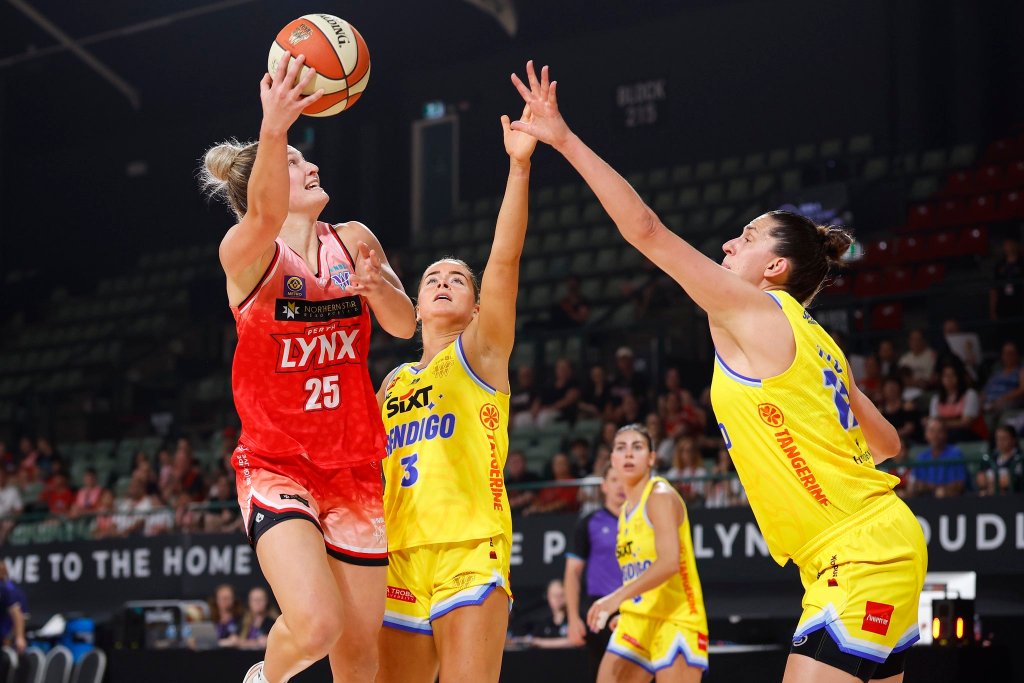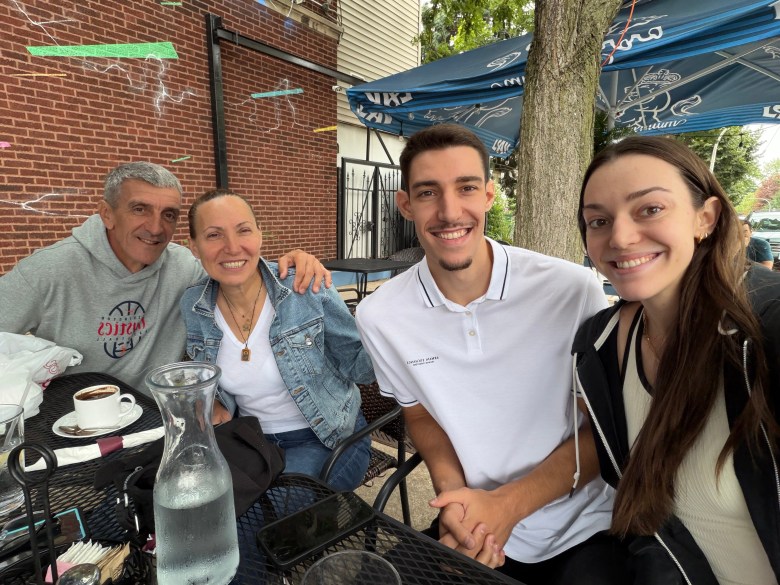
Angela Dugalić is usually quite descriptive when she talks. That comes from her parents.
As a second-generation immigrant, all she knows about her parents’ lives in their home country of Serbia is what they’ve told her. She’s now been there several times, but it’s a different experience for her than it was for them decades ago.
“When they tell me stories to this day about how their life was when they were younger, the only thing I can have is my imagination and a few pictures,” Angela told The IX Sports. “So they try to be as descriptive as possible, expressing everything that they lived through and where they lived, and I think that’s why I’m also like that.”
Angela’s parents, Vesna and Dragovan, were accomplished athletes back in Serbia (which was then part of Yugoslavia) before they immigrated to the Chicago area in the mid-1990s. Now, Angela, a Washington Mystics rookie, is adding to the family tradition by playing in the WNBA and for the Serbian women’s basketball team.
Dragovan and Vesna were born in Kraljevo and Smederevo, respectively — two towns that are several hours apart. They met in Belgrade, where Dragovan was practicing judo and Vesna rose as far as the junior national level in team handball before suffering an injury.
“That was my best life,” Vesna told The IX Sports. “… That moment was very nice. I lived in Belgrade. Like Angela now, [how] she [lives] her life. … Every week we had a game, practice, everything.”
In the 1990s, Yugoslavia started to break apart into separate countries, and a series of wars in the region lasted from 1991 to 2001. Vesna’s best friend immigrated to Des Plaines, Illinois, a suburb of Chicago, and encouraged Vesna and Dragovan to follow.
“We kind of hesitated for a couple years, hoping that the situation will get better,” Dragovan told The IX Sports. “But unfortunately, it wasn’t. So we decided, ‘All right, let’s go.’”
Dragovan went first, leaving Vesna behind as they waited for her paperwork to come through. He said it was difficult to leave his family, friends and day-to-day life, but once they decided to immigrate, “there [was] no turning back.”
When Dragovan got to the United States, he didn’t know much English beyond “hi” and “bye.” He started taking beginner English lessons and working for an American company, where one of the owners became like a second mother to him. On his drives to and from work, he listened to the news on the radio to further develop his English.
Nearly two years later, Vesna joined Dragovan in the U.S. They held out hope that they might be able to return to Serbia in a few years. But they had their first child, Miloš, in January 2000, and Angela followed in December 2001. By the time the children started school, Dragovan and Vesna realized they were settled in the U.S.
“A lot of people told [us] over here, ‘If your kids start going to school here, you’re stuck. You’re staying here,’” Dragovan said.
Listen now to The IX Sports Podcast and Women’s Sports Daily
We are excited to announce the launch of TWO new podcasts for all the women’s sports fans out there looking for a daily dose of women’s sports news and analysis. Stream on Spotify, Apple Podcasts or anywhere you listen to podcasts, and make sure to subscribe!
So the family stayed in Illinois, but the Dugalićs continued to honor their Serbian roots. Vesna doesn’t exclusively cook Serbian dishes, but she makes plenty of them, from sausages to cheese pie to stuffed cabbage. And Serbian was Angela’s first language because her parents wanted their children to be able to communicate directly with their family back in Serbia.
“It would be really sad for us if my kids couldn’t talk to my parents,” Dragovan said. “That would be really sad [if] I need to translate.”
Angela ended up speaking a mash-up of Serbian and English when she was young. “It was bad,” she said. So when she started school, she had to take English as a second language (ESL) classes for a few years, until her English caught up to her Serbian.

Growing up, Angela “was always happy, always smil[ing], like now,” Vesna said. Angela and Miloš also had plenty of energy, and Vesna and Dragovan channeled that into sports. The Dugalić children tried all sorts of sports: basketball, soccer, volleyball, tennis, swimming and track. They even tossed around a handball from time to time, as Vesna still practiced the sport some after coming to the U.S.
Sometimes for fun, the whole family would go to the playground and see who could do things like jump through hoops the fastest. It was “like a little Olympic game,” Angela said.
But Vesna and Dragovan never imagined that both of their children would become professional basketball players. (Miloš has played for pro teams in Serbia and the United Kingdom since graduating from Illinois Tech in 2023.) They just wanted their children to channel their energy into sports rather than screens, get fresh air and learn how to compete. But sports became important enough to Angela and Miloš that eventually, their parents’ most effective punishment for bad behavior or subpar grades was having to miss practice.
Angela’s sport of choice was initially soccer. Miloš had picked basketball, so Angela didn’t want to do the same thing. One day, she even did homework instead of participating in a practice her parents had dragged her to alongside Miloš — but she snuck a few glances at what was going on on the court.
Basketball finally pulled Angela in around fifth grade, when a friend mentioned she was trying out for an area team. On the day of the tryouts, Angela decided she’d give it a go, too, but she didn’t have basketball shoes. So she borrowed her friend’s shoes, even though they were too small.
“My feet hurt so bad, but I had so much fun because I was playing with friends, and I didn’t feel forced to play it,” Angela said. “And so I would say like fifth grade is when I actually started consistently playing.”
In middle school, Angela stopped playing soccer to focus solely on basketball. From there, she got better and better.
At Maine West High School, she led her team to an undefeated season as a junior and averaged 20.6 points and 10.3 rebounds per game as a senior. (Maine West retired her jersey on Friday, with her Mystics teammates and coaches in attendance.) She was espnW’s No. 22 recruit in the class of 2020 and went to the University of Oregon and then UCLA. She won a national title with the Bruins in April, and the Mystics drafted her ninth overall barely a week later.
Your business can reach over 3 million women’s sports fans every single month!
Here at The IX Basketball and The IX Sports, our audience is a collection of the smartest, most passionate women’s sports fans in the world. If your business has a mission to serve these fans, reach out to our team at BAlarie@theixsports.com to discuss ways to work together.
While Angela has ascended in the American basketball system, she has also already had a long career with the Serbian national team, despite being just 24 years old.
When she was a teenager, Dragovan told her she should play for whichever national team — Serbia or the U.S. — called her first. The Serbian team started recruiting her when she was 16 through Danielle Page, a former national team player who is now a college coach. Page saw Dugalić at an AAU tournament, noticing both her 6’4 height and the “-ić” at the end of her name. The latter was a pretty big hint that she was Serbian.
Page alerted the Serbian coaches about Angela, and they set up a meeting with the Dugalićs over Zoom. Not long after that, Angela flew to Serbia for a training camp ahead of the 2019 European championships, known as EuroBasket, which Serbia cohosted with Latvia.
Suddenly, players she’d grown up watching, like former Los Angeles Sparks guard Ana Dabović, were her teammates. And she was just 17 years old, whereas some of her teammates were twice her age and had children of their own.
“Everyone just wants to chill [and] drink coffee, and I’m bouncing off the walls, like, ‘Hello, let’s do something!’” Angela said about her first training camp. “They’re like, ‘Angela, calm down, please.’”
Angela didn’t make the final roster for that tournament, but she stayed in Serbia to watch and learn all she could from the team’s eventual run to the bronze medal. Two years later, she was on the team that won EuroBasket 2021 and made the Serbian roster again for the Olympics, which had been postponed from 2020 because of COVID-19.

“[She] grew up here, didn’t have much connection with Serbia, didn’t know much about Serbia … and then suddenly you have to represent the country on a bigger stage than high school,” Dragovan said. “It was really nerve-wracking for us. … [But] we are really, really proud [of] how she handled it.”
In 2024, Angela made her second Olympic team, averaging 5.3 points and 2.8 rebounds per game. A year later, she averaged 10.0 points and 5.7 rebounds at EuroBasket 2025. In total, she has already played in 22 career games in EuroBasket, the Olympics and associated qualifying tournaments.
When Angela started playing with the national team, she didn’t grasp how big of a deal it was or all that it meant for her family. Her parents had told her about their own athletic endeavors in Serbia, but it was hard as a teenager to have that multi-generational sense of history. It took several years and her maturing as a player for that to sink in.
Her older teammates helped her with both of those things. They told her what it meant to them to wear the jersey and pushed her to accept whatever her role was, even when it fluctuated over the years.
“It was very blunt and sometimes harsh [feedback], but that’s just how Serbian people are,” Angela said. “And … I’m happy that they were like that, that they were a little bit more stern with me. I felt like they were my parents away from home, and my parents, every time they see them, they’re like, ‘Oh, thank you so much for taking care of her, for helping her.’”
Eventually, it started to sink in how Angela’s path with the national team traced back to Des Plaines, but also to Belgrade, and to Kraljevo and Smederevo. She watched her teammates sing the Serbian national anthem so passionately that it seemed almost like they were screaming it. She saw them beaming with pride, standing with their heads held high and their shoulders back.
“And then I’m thinking about what my parents had sacrificed, what it means to be Serbian,” she said. “And every time I now I hear our national anthem when I’m on the court … I get so emotional because — even though I try to maybe sometimes block it out so I don’t get emotional — it’s such a prideful thing to feel that, to be able to represent your country and know that with everything that we went through and [being] such a small country, we’re here. We’re proud. We deserve to be here; we worked for this.”
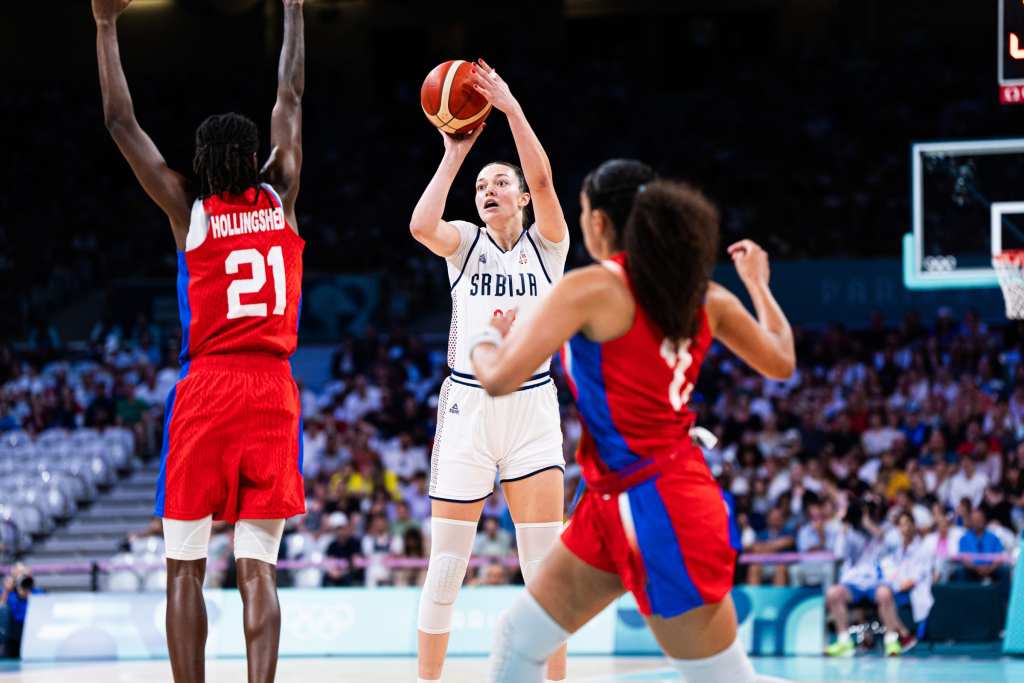
Serbia is currently ranked 15th in the world and sixth in Europe. It did not qualify for the 2026 World Cup, so Angela wasn’t among the Mystics players competing in Berlin this month. But she continues to represent her parents’ home country in the WNBA, picking up the torch from Dabović, Page and several others. She has appeared in 36 games this season, starting three, and is averaging 2.8 points and 2.3 rebounds in 9.1 minutes per game.
This summer, Angela took some of her teammates to Ambar, a Balkan restaurant in downtown Washington, D.C. As a kid, she’d seen her parents host non-Serbian friends and teach them about Serbian culture, she said on the Mystics’ television series “Courtside Queens.” So this was her attempt to do the same, and she was thrilled that her teammates accepted the invitation.
“Most of them are probably not going to go to Serbia,” she told The IX Sports. “Maybe one day if I get married there, and I’ll invite them to my wedding, so there’s that. But they’ll probably never try Serbian food. So this was just my way of showing that to them.”
As the Mystics players shared dishes and rated them on a scale of one to 10, Angela beamed.
“I get so excited because it sounds weird sometimes, the food that I’m describing, but I know you’re gonna like it because everyone likes it,” she said. “And so it was the same thing when we went to Ambar. … You truly felt like you were transported in Serbia.”
As a child, Angela had to learn how to disentangle Serbian and English and when to speak each language. But as an adult, she takes pride in representing both cultures wherever she plays. Both sides are part of her family’s story, which has now stretched all the way from the Serbian capital to the U.S. capital and back again.
Monumental Sports and Entertainment, the group that owns the Washington Mystics, holds a minority stake in The IX Sports. The IX Sports’ editorial operations are entirely independent of Monumental and all other business partners.