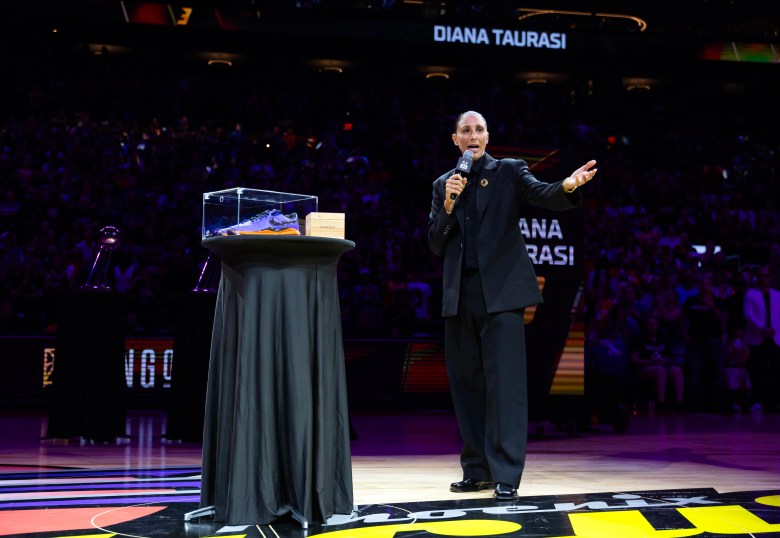
PHOENIX — Diana Taurasi was the center of attention Sunday night, as a game between the Phoenix Mercury and Portland Fire felt like it came secondary to the main event: Taurasi’s induction to the Mercury’s Ring of Honor.
Taurasi’s No. 3 was everywhere. Her friends, family and former teammates had gathered to celebrate her. Twenty players and executives representing the 20 years of her career lined up to give her flowers, and tributes poured in from athletics stars across different generations and sports.
And yet, there was Taurasi on the sideline, still arguing with the officials that a DeWanna Bonner 3-pointer had been tipped before sailing out of bounds. Some things, apparently, don’t change.
It wasn’t just any ceremony honoring one of a franchise’s most impactful players. Taurasi is the icon in Phoenix, and one of the most influential figures women’s basketball has ever produced. Yet still, on a night built to celebrate that legacy, she wasn’t treated like a relic — she’s still Diana.
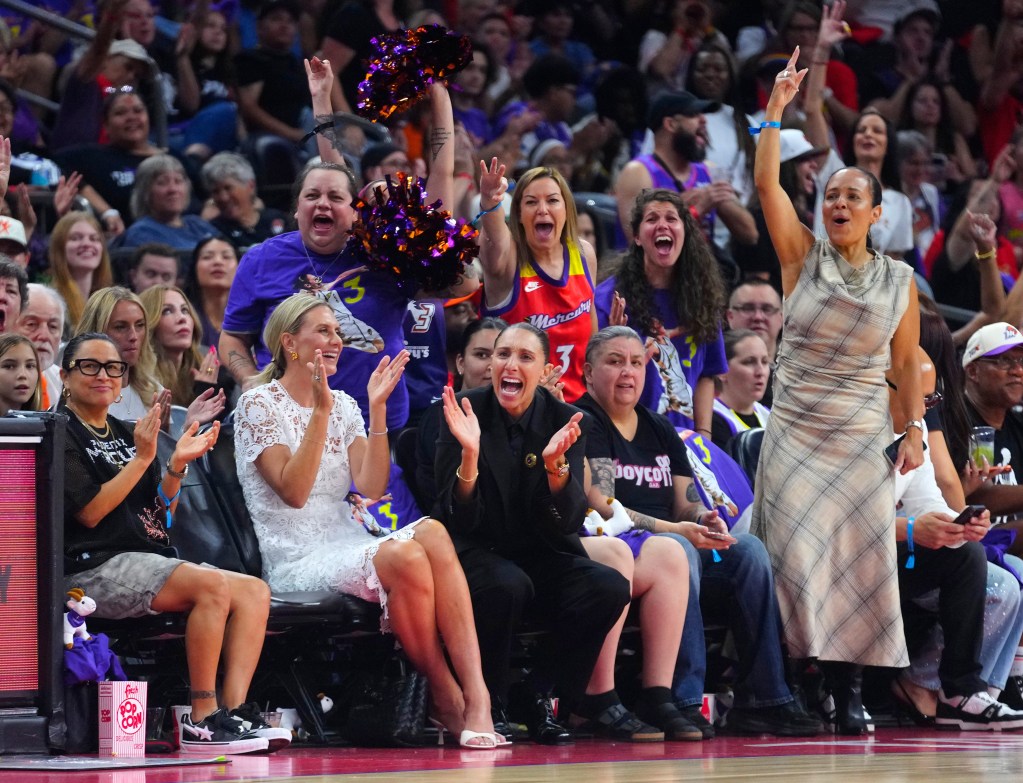
She delivered a final speech that felt equal parts eulogy and stand-up comedy routine. She acknowledged fans who shouted to her from the stands during pauses in said speech. When Kahleah Copper drilled a 3-pointer in front of her, Copper turned and blew a kiss toward the woman whose legacy was being celebrated all around the arena.
It was, in many ways, the most fitting Taurasi ending to a Taurasi career. And that’s just scratching the surface.
2026 WNBA Injury Tracker
A Phoenix hero
When Taurasi arrived in Phoenix as the No. 1 overall pick in 2004, she knew almost immediately she had found where she belonged.
She spoke about that feeling during her halftime speech Sunday, reflecting on the place that became home for the rest of her life. What started as the beginning of a basketball career became something much bigger: Taurasi and Phoenix grew alongside each other.
That kind of longevity is almost impossible to replicate in professional sports, particularly in a league where players routinely change teams. Taurasi never did. Every season of her 20-year career came in a Mercury uniform, and over those two decades, she became inseparable from the franchise she helped turn into one of the WNBA’s defining organizations.
“It just makes everything worth it, and that’s really how I feel about this place,” Taurasi said in a pregame press conference. “When I walk in, I don’t see strangers, I don’t see employees, I don’t. I see friends. I see people that I go to dinner with. I see people that I text regularly with … This isn’t just something that I showed up and said, ‘Oh, let’s see what we can do here and leave.’
“I treated this like my family — my extended family — and I think that’s why walking in today, I’m really emotional because I feel like I need to be giving that same love back to them. Because without them, none of this is possible. It takes a lot of people to have a 20-year-old career. I talk about loyalty a lot, and that only works if it’s a two-way street, and I’ve always had that here.”
The Mercury were a sinking ship before Taurasi came into the fold. From 2001 to 2003, they were one of the worst teams in the league, highlighted by a 2003 campaign in which their 8-26 record granted them the rights to the No. 1 pick used to select Taurasi. With a non-competitive, unentertaining team at that point, Phoenix could’ve easily gone down the path so many other WNBA franchises did and fold under the weight of an unsustainable business model.
Instead, Taurasi came in and turned it all around. She helped lead Phoenix to four WNBA Finals appearances, with three of them ending in championships. Today, the WNBA is celebrating its 30th season, and the Mercury are one of only three teams to be active in every single one of them — thanks in large part to Taurasi.
“When you talk about two decades of being in this league, we’ve been through it all: the highs, the lows, the tough times…” Taurasi said. “…It’s truly a badge of honor to play in the WNBA and to see where it’s going now with the visibility. With the value of the league where it’s at, it’s where we wanted it to be for a long time.”
Scores are only part of the story.
Unlock full access.
But Taurasi’s impact in Phoenix extends far beyond the basketball court, at least the one she played on in what is now the Mortgage Matchup Center. In the buildup to Taurasi’s Ring of Honor ceremony, three outdoor courts in the Phoenix area were renamed and redesigned in Taurasi’s honor — just one of many ways she has given back to the local community and helped inspire the next generation of basketball players.
The purest symbol of that relationship between Taurasi, the Mercury organization and the Phoenix community is her jersey number — No. 3 — which could be seen everywhere around the city this week; from fan apparel, to the center of those outdoor courts, to decorative displays all over Jefferson Street.
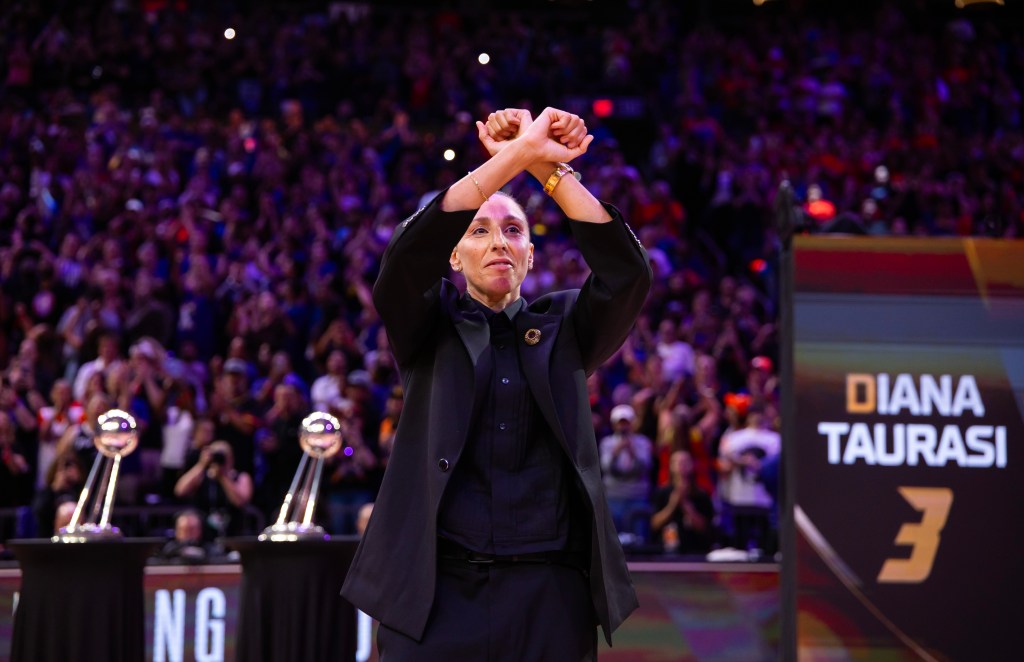
Now, that No. 3 will hang in the rafters, immortalized as a permanent emblem that represents the two decades Taurasi spent turning Phoenix into a home, and the Mercury into a basketball mainstay.
“I’ve really tried not to think about it,” Taurasi said when asked how she would feel seeing her number in the rafters. “I just kind of want to let it happen when it does go up there. But just walking into the arena today, there’s a lot of emotions.”
She later added, “If there was any little competitiveness still in me, I think today it goes up in the rafters with the number, and it feels really good to know that.”
The greatest of all time
Taurasi’s imprint on the WNBA extends well beyond the franchise she spent her entire career with. When she retired in 2025, Taurasi left the league as its all-time leading scorer, a six-time Olympic gold medalist and one of the most decorated players in the history of the sport. Determining a sport’s GOAT (Greatest Of All Time) is often a hotly-debated task. In women’s basketball, for many, it’s clear that the GOAT is Taurasi.
That belief and influence was evident in the people who came to Phoenix to celebrate her, too.
The GOAT of swimming, 23-time Olympics gold medalist Michael Phelps, was in attendance. So were WNBA legend Sheryl Swoopes, Phoenix Suns cornerstone Devin Booker and football Hall of Famer Larry Fitzgerald — a collection of icons from different corners of the sports world who made the trip to honor an icon of their own.

Stay plugged in with women’s sports
Get smart, reliable coverage delivered straight to your inbox — with the context that makes every game matter.
Even Brittney Griner, an active WNBA player who plays across the country for the Connecticut Sun, made the trip out to Phoenix to show support for her former teammate.
And fittingly, there were even real goats in attendance. A petting zoo sat just outside the court in a section known as the “Scorchyard” as part of the festivities, giving the night a particularly on-the-nose visual for Taurasi’s celebration.

Then there were the people who couldn’t be in the building.
Throughout the night, the jumbotron rolled through video messages from generations of basketball stars who had been influenced by Taurasi, or simply wanted to pay tribute to what she had meant to the sport, many of whom also explicitly proclaimed her as the GOAT.
A’ja Wilson, Lisa Leslie, Paige Bueckers and Breanna Stewart were among those who sent messages, a reflection of how Taurasi’s reach stretches from the pioneers of women’s basketball to the players carrying it forward today. Some of the biggest names in the men’s game, including Magic Johnson and LeBron James, also gave lengthy praise to what Taurasi means to the game of basketball.
But of course, no one could convey Taurasi’s greatness better than her former teammates and coaches, the ones who saw what made her wheels turn on a daily basis. Some, like Bonner, Copper and head coach Nate Tibbetts participated in the actual game as current members of the Mercury. Others, like her wife Penny Taylor, returned to Phoenix simply to celebrate the person they had spent years alongside and the legacy they helped build.
All of whom had a variety of great things to say about her.
“Dee is an amazing person, an amazing player,” Copper said at practice on Friday. “She definitely deserves this … The things that she’s done for the Mercury as a franchise, and then Phoenix as a community, it’s amazing. Even during my short stint with her, we’ve had an amazing time. From the Olympics to just welcoming me here in 2024 with open arms. I can’t speak enough to having her at that Olympics and how I was able to just be me and really lean on her in those moments.”
At Saturday’s practice, Bonner added, “I felt like whenever we stepped out on the court, we were like, ‘We got Dee, so we’re going to be fine.’ I don’t know what kind of pressure that is to put on her, but she handled it with grace. She gave the whole team that energy.”
Bonner wasn’t alone in describing the almost unreasonable confidence Taurasi inspired in the people around her. Everyone who competed with or against her saw the same thing: a player whose intensity could be intimidating, whose competitiveness was borderline absurd, whose personality away from the court made her easy to love.
Las Vegas Aces head coach Becky Hammon, who both played and coached against Taurasi, saw that duality up close. She noted how that edge wasn’t a flaw. It was part of what put Taurasi in the same category as the game’s most iconic competitors.
“She’s one of those people that I feel like had a split personality,” Hammon said following an Aug. 11 game against the Washington Mystics. “She was one way on the court, complete probably asshole on the court, and then so cool off of it —like, ‘Hey, let’s go get a beer’ — off of it. That’s just that’s who she is. Those are Michael Jordan traits. Those are Kobe Bryant traits. I mean, she has that. It. So that’s really what jumps out.
Current Toronto Tempo head coach Sandy Brondello had one of the longest firsthand views of that edge, having spent eight WNBA seasons coaching Taurasi in Phoenix, and also coached her overseas in Russia.
“She is the GOAT,” Brondello said back in May when the Tempo played in Phoenix. “Probably one of the reasons I got the job [in Phoenix] — so very thankful and grateful for that. But to be able to witness greatness, I mean, how lucky was I just to be courtside and watch what she does … She should have a statue out there pretty soon, I would imagine.”
And if there was any question about what Taurasi meant to the league beyond Phoenix, Val Ackerman, the WNBA’s first president, offered perhaps the most fitting assessment during her speech at Sunday’s ceremony:
“We only overlapped one season, your rookie year,” Ackerman said, addressing Taurasi. “But when you came and I left, I said to myself, ‘This league is in great hands, because the Michael Jordan of this league has arrived.’”
2026 WNBA transaction tracker
What’s next?
By the end of the night, with Taurasi taking the mic one final time, it felt less like a conclusion of a historic career and more like the beginning of a new chapter. All night, a tension existed that felt like Sunday was supposed to provide finality — the number goes into the rafters, the playing career is over — but it became clear Taurasi’s relationship with the organization, its fans and the people who accompanied her along the way isn’t finished.
So, as chants of “DT! DT! DT!” slowly ceased, an entire arena awaited her words.
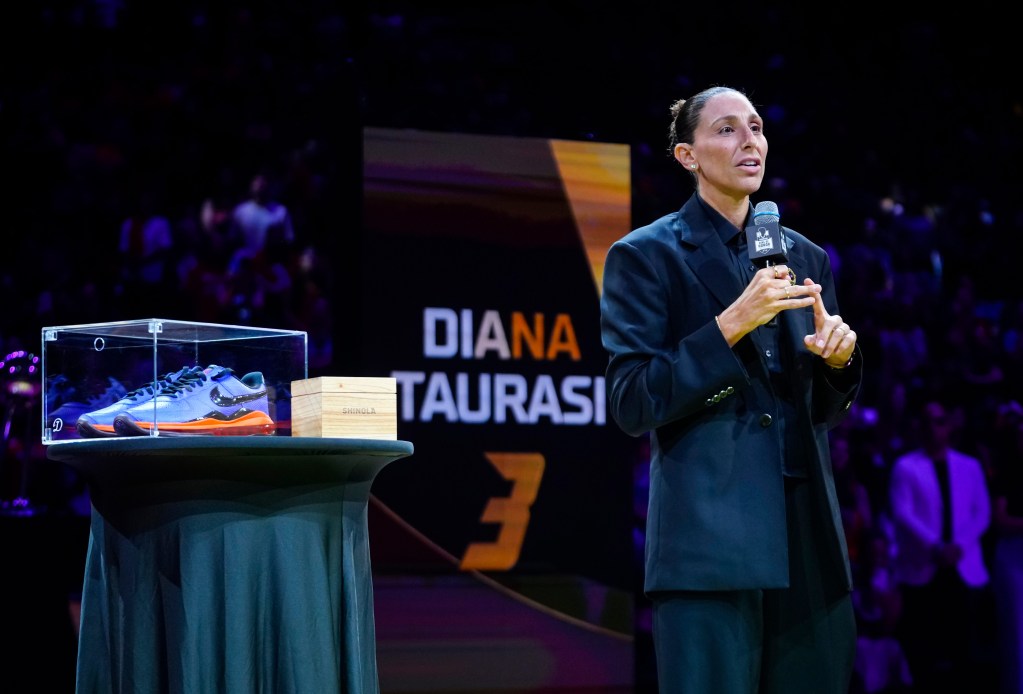
Of course, she couldn’t simply give a conventional retirement speech. She opened by acting like she was about to read “Green Eggs and Ham,” joked multiple times about her coaches having “some good, some bad” qualities and repeatedly stopped to acknowledge fans shouting things from the stands during her pauses.
It was funny in the way Taurasi has always been funny — unfiltered, self-aware and unwilling to take herself too seriously. But beneath the jokes was a genuine gratitude for the people who had carried her through two decades in Phoenix.
She thanked her family. She thanked the Mercury — everyone from the front office to the training staff. She thanked the fans and all of her former teammates. Yet for all the finality surrounding the night, there was still an unanswered question hanging over Taurasi.
What’s next?
It is an existential question for someone who has already accomplished virtually everything she dreamed of as a kid. What else can the No. 1 overall pick who won three WNBA championships, six Olympic gold medals and every major individual scoring honor available to her possibly do? There isn’t a mountain left for her to climb.
But Taurasi doesn’t seem particularly interested in finding one.
“That didn’t make me happy, the winning or the losing,” Taurasi said. “It didn’t motivate me more or less. So once I retired, I didn’t have this urge to be competitive. I didn’t have this urge to prove myself. Hopefully, I still treat the day the same way: where whoever I come in contact with, I give them my attention, I give them my energy. And obviously, when you have two kids, that’s sucked out of you really quickly.”
Still, the possibility remains that Taurasi’s next chapter could eventually bring her back to the place where her basketball story began. Recently, Taurasi told ESPN she hopes to join the Mercury’s ownership group within the next year or two.
If that happens, Sunday’s ceremony suddenly looks like a transition and not a farewell. The person who spent two decades representing the Mercury on the court may potentially become someone who could help shape its future from the other side of the organization.
“When you spend 20 years anywhere, especially a place like this, where I feel like it’s family, it’s home,” Taurasi said. “I put all my hard work in here. My family lives here. I feel like I’m a true Phoenician. If that happens down the road, it would be a dream come true. As a little kid, all you wanted to do was play basketball … So if that happens to come across my path, it would be a dream and an honor.”
For all the questions surrounding what comes next, perhaps the biggest takeaway from Sunday had little to do with what she does after basketball. It was about how she got here in the first place. With the flowers finally at her feet, she offered her full reflection on the legacy she left behind:
“I never really thought about it as I was playing,” Taurasi said. “I didn’t ever think about what the legacy was, what I was leaving behind, what I meant to other players. I really was just so obsessed with making sure my team was as good as it could be, making sure I was as prepared as I could be.
“That’s the one thing I tell the next generation: don’t worry about that stuff,” she continued. “That stuff you can’t control. You can control what you do every single day when you show up. I was very short-sighted with my goals, and that was to be the best way I could be every day. I know it’s cliche, but in these times when everyone wants instant gratification right away, that’s not reality.
“The reality is there’s ups and downs. There’s tough times, there’s good times, and whether you come back and keep coming back. That’s what really makes you a true champion, and I hope the next generation, even the players now, understand that because that’s what it’s really about. You’ll get your flowers when they come.”