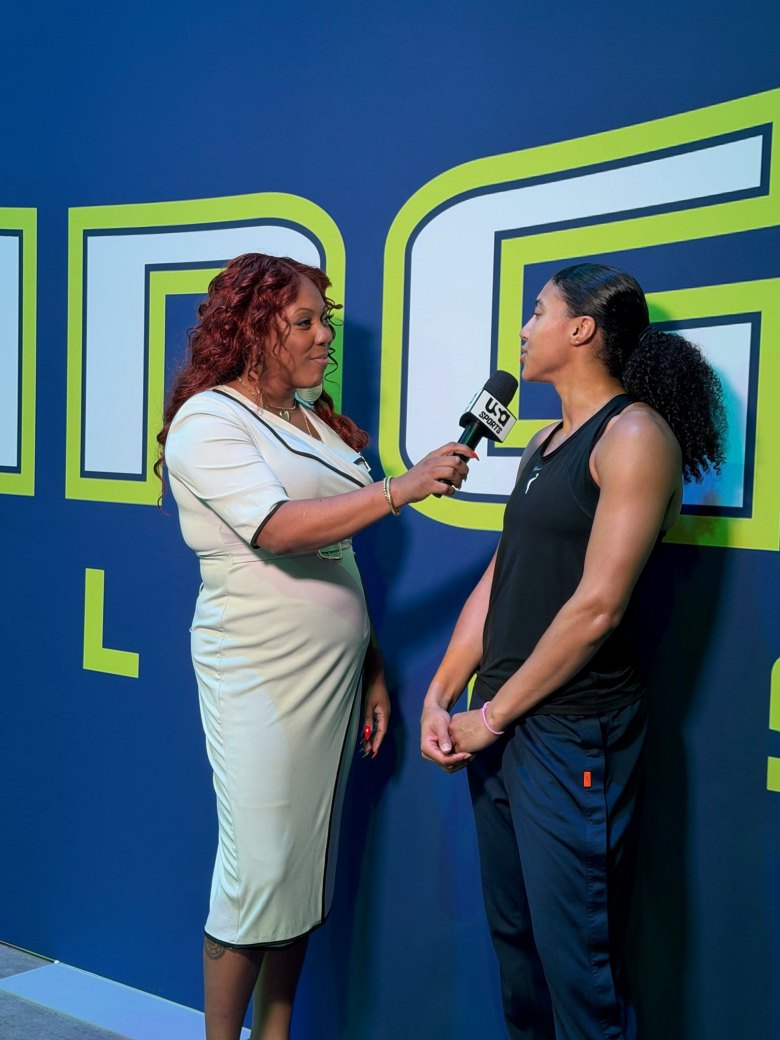
Terrika Foster-Brasby silently chuckled when she heard the words.
“I had an executive once tell me that I was not good enough to be on television, that I didn’t look good enough to be on television, even though they had never paid attention to any of my work ever,” Foster-Brasby told The IX Sports during a Zoom interview. “I had an executive at (a previous company) tell me that I was not good enough to be on the desk, and they would never jeopardize the product by putting me on. … That was the second time somebody had told me that.”
For Foster-Brasby, it was another log thrown onto the raging inferno within her that’s fueled her career. That fire has continued to showcase her professional resilience — because the discouraging words never broke her.
The Detroit native didn’t let it define her because she always believed in her ability and authenticity to open doors, build tables for others, and confidently enter spaces only she believed she’d appear in.
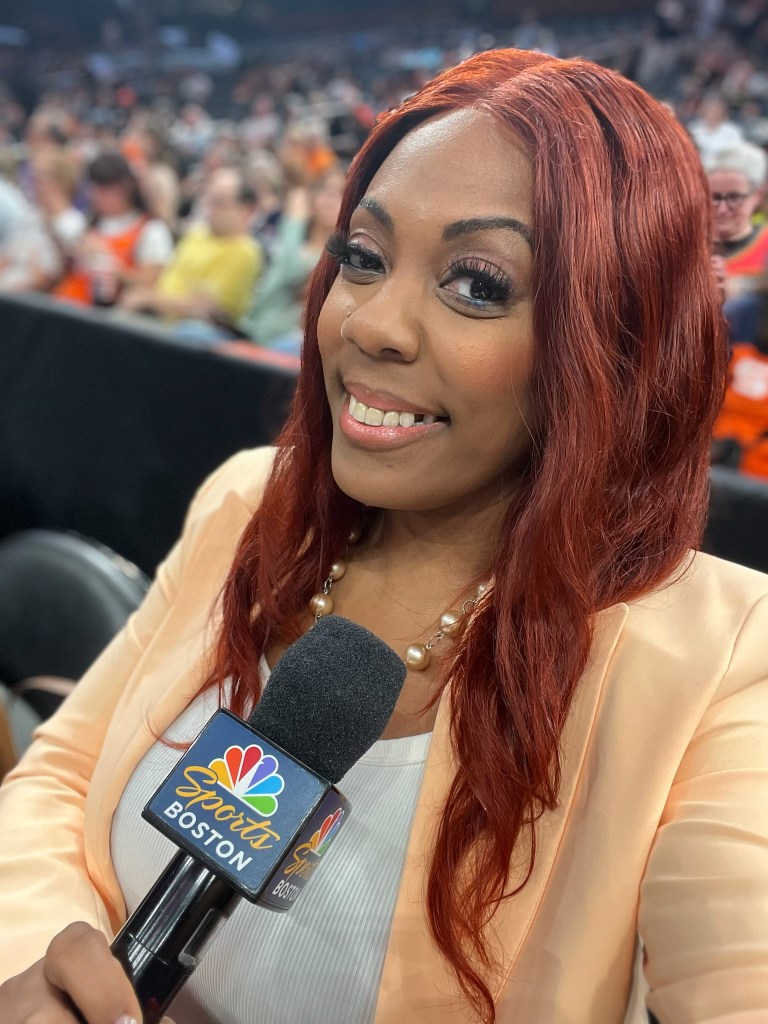
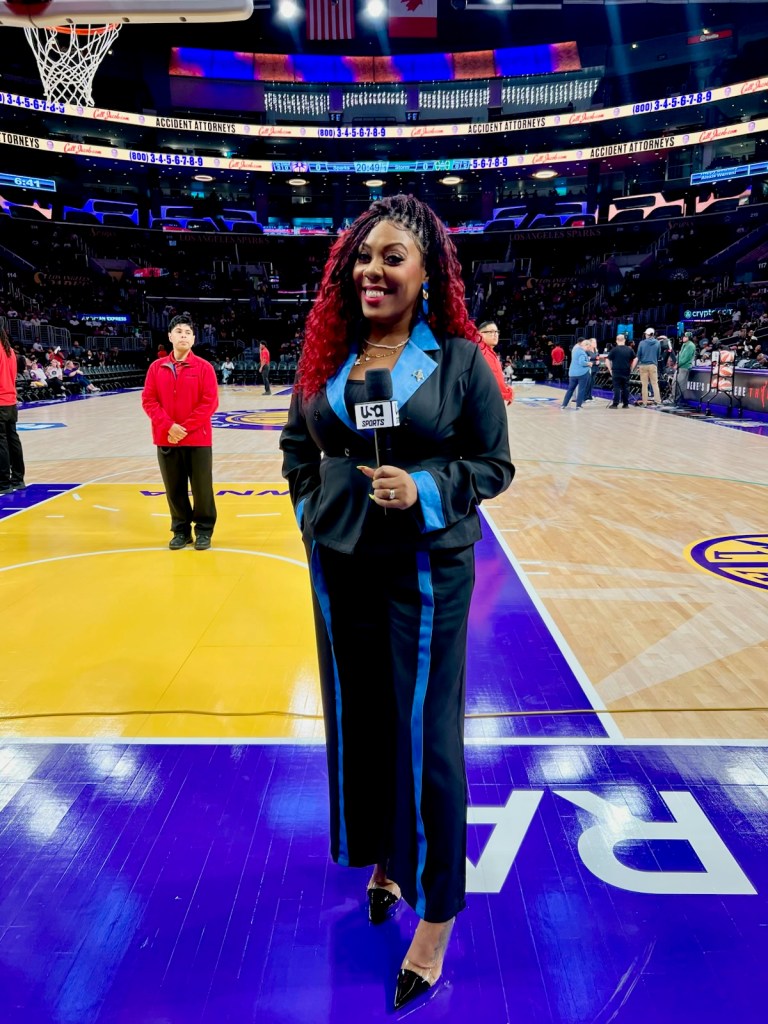
Now, her portfolio reads like an executive’s dream. She’s everywhere. Delivering insightful reporting during WNBA games for USA and Versant. Interviewing some of the top players in the WNBA as a sideline reporter for the Connecticut Sun. Engaging with people on social media, shining a light on women’s basketball while sharing her love of the Detroit Tigers, Detroit Pistons, Indianapolis Colts, and, more importantly, her sorority Sigma Gamma Rho.
All that success is proof that betting on herself was the only opinion that really mattered. The irony, of course, is that the same people in the industry that once questioned her “fit” now watch as she’s evolved into one of the most trusted voices of women’s basketball coverage during a transformative era.
Foster-Brasby has never fit neatly into anybody’s box, and said she never stopped being herself, authentically.
“Being authentically you was not always cool. Early in my journalism career, there was a standard. You had to wear your hair a certain way, you had to speak a certain way, you had to dress a certain way,” Foster-Brasby explained.
“Like you had to do all those things if you even wanted to be considered for on-camera TV talent, but we got to a place where that kind of didn’t matter as much, and so I think the authenticity and the freshness of how I presented and me being myself kind of played in my favor.”
‘Just feels a little different’
Connecticut’s two remaining home games (against Minnesota on Sunday, Sept. 20, and Toronto on Thursday, Sept. 24), are also bittersweet for Foster-Brasby, as this is the Sun’s final season in the Nutmeg State. She has documented this season on her social media platforms with the hashtag #SunSetSeason.
For Foster-Brasby, the Connecticut Sun’s move to Houston isn’t just another franchise relocation. It’s the end of a chapter that reshaped her life. She’s covered the league long enough to understand the business — but this move hits different, she said.
“With Connecticut, this was a heart and a career investment,” Foster-Brasby said. “The Connecticut Sun was the first team that really believed in me as a sideline reporter, really believed in me and my career in terms of giving me opportunities that I don’t think other people were willing to give me at the time. So, to see Connecticut leave, it just feels a little different.”
Foster-Brasby has grieved the move in private, and she said she’ll miss the atmosphere and interacting with familiar faces at the Mohegan Sun Arena. But this isn’t the first time a team she was connected to left her. Foster-Brasby was invested as a young fan following the Detroit Shock during their 2006 and 2008 championship runs, and was sad when the franchise left for Tulsa and ultimately, Dallas.
Even though she had time to prepare for the Sun’s departure, it still didn’t make it any easier.
“Being privy to some information before the general public, I’ve known for a while that this ultimately was going to happen, so I had time to process that this was going to happen well before it became public news,” Foster-Brasby said. “We didn’t always know that it would be Houston, but we did always know that they were essentially going to be leaving at some point.

Professional pivot
Foster-Brasby is clear that her story doesn’t begin or end with one franchise. Her career path has been constructed in the old-fashioned way: through hard work, repetition, and grit. A graduate of Saint Augustine’s College (now Saint Augustine’s University) a historically Black college (HBCU) in Raleigh, she was never handed anything. After earning her undergraduate degree in political science, Foster-Brasby thought her future meant case law and courtrooms, not scouting reports and sideline hits.
Her pivot into broadcasting didn’t start in a control room; it started behind a bar at TGI Fridays in North Carolina, across the street from a Hooters with wall-to-wall flat-screen televisions and NFL Sunday Ticket. Logic said football fans should have gone there.
Instead, they packed her bar, even though it had far fewer televisions and aired whatever network games were available in that region, mostly involving the Carolina Panthers.
NFL Sundays became a party and something to look forward to — because Foster-Brasby learned how her personality and opinions illuminated a room. That regular crowd taught her something no classroom had: she could connect, inform, and entertain in real time.
“The one thing that Fridays had that Hooters didn’t was Terrika,” she laughs. “People loved to come in the bar on Sunday game day because they wanted to talk (trash) to me because there was no other girl that they knew who knew football, loved football, loved sports, talked sports the way that I did. They would pack the bar on a Sunday just to come see me.”
But Foster-Brasby didn’t initially think of those skills as something that would lead to a career.
“Sports was just a fun thing for me,” Foster-Brasby said. “I never thought I’d really make a career doing it. It was just a fun thing. I loved Robin Roberts growing up… I loved so many different people… but I never ever thought I would actually ever have a career in this business.”
Her manager at TGI Friday’s planted the seed, telling her she should be on ESPN.
“That is what put it in my head,” she said.
That spark pushed her from daydreams to a decision to attend graduate school and enroll in a journalism program, which ultimately landed her on national broadcasts.
‘Coming from a place of positivity’
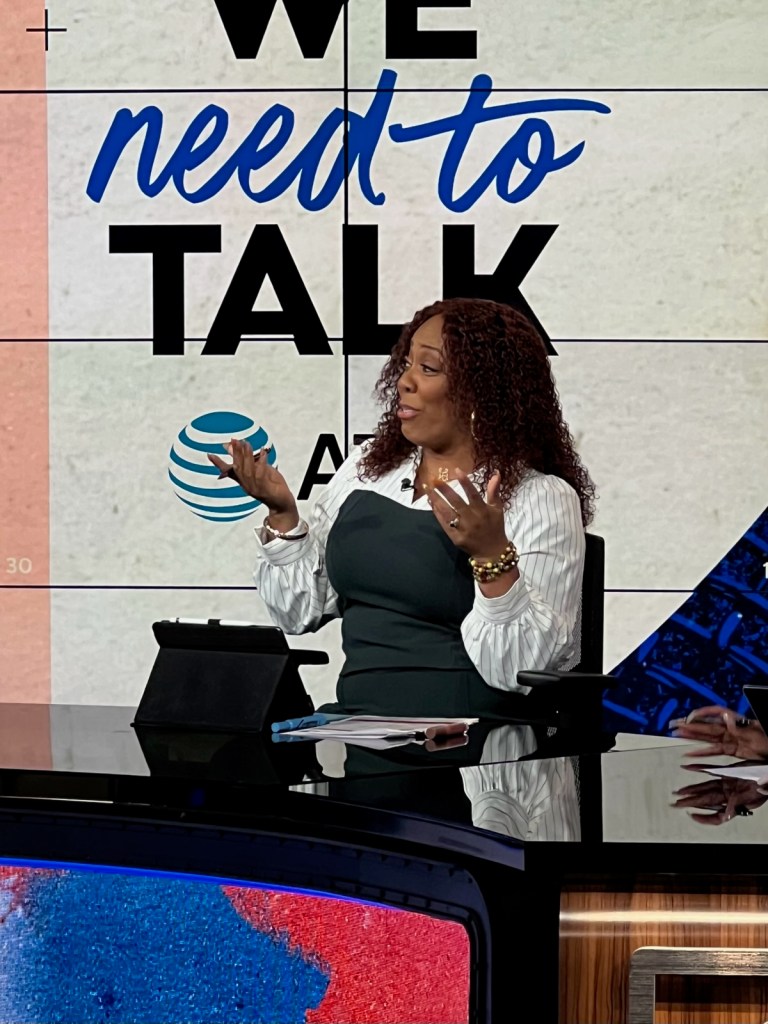
Foster-Brasby, who worked at ESPN for nearly a decade, is also the co-host of the iHeart Women’s Sports Network podcast “Levels to This,” alongside WNBA legend and Hall of Famer Sheryl Swoopes. Foster-Brasby also co-hosted the long-running women’s basketball podcast Around the Rim with LaChina Robinson.
She understands that she’s blessed to be in a space where access isn’t an issue. Foster-Brasby’s authenticity has helped her earn trust and respect from players, coaches, and executives. Her standing in the W isn’t just about the games she works; it’s about how she shows up for the people playing them.
She is not afraid to offer performance-based criticism of players, and it’s never personal. Foster-Brasby recalls a situation in which Kelsey Plum approached her.
“What do analysts do?” Foster-Brasby said. “We analyze, and we said Kelsey was messing up. … Kelsey listened. She saw us at a game, and she said, ‘Oh, I’ve been meaning to talk to y’all because I heard when you said A, B, and C, and I respect it,'” Foster-Brasby recalled.
“But the point is, I’ve built enough respect with players to where we can have those conversations, and it’s okay, right,” Foster-Brasby said. “I’ve done my best to build trust; I want them to know that I am always coming from a place of positivity.”
The respect she’s earned from players shows up in the detailed, nuanced answers they give her. For example, during a USA broadcast in late July, Angel Reese shared in response to a question from Foster-Brasby that being in Atlanta made her feel “safe, loved and poured into,” a rare pregame glimpse into her thought process.

Paying it forward
Everything comes back to being herself, standing on her beliefs, and never flinching. These qualities have sustained Foster-Brasby during her career even as the WNBA’s media ecosystem has changed.
Foster-Brasby remembers covering the WNBA when reporters had locker room access and only a handful of reporters were present at games. She calls this moment in the W “bittersweet.” On one hand, she’s thrilled to see the league’s profile finally catching up to the talent. She’s also happy to be one of the many storytellers documenting this era and connecting with fans through her work.
“There is something remarkable about where the WNBA is headed and how it’s catapulted so quickly to the top of, you know, being marketable again and I stress again because it was before,” she said. “I am in awe of the women that play the sport… I love that fans are starting to gravitate to the sport.”
The growth has also come with new barriers for the same independent outlets that covered the league when few others cared. The WNBA instituted a new tier access system for media members this year, providing tier one access to some and tier two to others. In tier two, media can cover the games but have limited access to players and different areas of the arena.
“You would think that with more TV networks and more people wanting to broadcast and have distribution rights, that that would mean more opportunity for some of us who’ve been here for a very long time, and that is not always the case,” she said. “The best way I can describe it is the gentrification of, like, now all of these people are coming in with their new waves and their new things, and they’re upping the price and pushing out the folks who have been there to build it from the beginning. … It just feels unfair.”
Foster-Brasby’s professional path moved from social media roles at ESPN to an in-arena host role and eventually to sideline reporter for the Connecticut Sun. Embracing a range of jobs such as researcher, host, social media manager allowed her to get a foot in the door and stay there.
Her collegiate experience at Saint Augustine’s of playing volleyball, serving in student government, and performing in the school’s marching band (the Superior Sound Marching Falcons) was quietly laying the foundation for a career she couldn’t yet see.
Now, she makes sure to pay it forward.
“I like that I’ve not blocked or gatekept anybody else from being in this business,” Foster-Brasby said. “When I see other Black women that want to come up, I share the tea. I share the keys. I give them the connections because somebody did it for me. Jemele Hill did it for me. Cari Champion did it for me. Lachina Robinson did it for me. Christina Williams did it for me. Like, these are people who spoke my name. You know what I mean? They put me in other positions. So, I am proud that I’ve never become that person. Like I never have, and I never will, but like I’m very proud of that.”
The in-arena work, in particular, gave her space to prioritize networking with key decision-makers, including then-Sun president Amber Cox and executive Amy Shear.
That same mindset carried into her work earlier this year at the Atlantic 10 tournament for USA. She approached it like every other assignment — prepared, professional, and present — without realizing it would serve as an unofficial audition for the network’s WNBA coverage.
Moments like that A-10 run and being the first woman to become part of the Central Intercollegiate Athletic Association broadcast crew in 2022 with Angel Gray, Helen Williams, and Tiffany Green affirmed what some executives still couldn’t see: she was more than ready for the spotlight.
‘I am always gonna be Terrika’
Working the CIAA tournament was more than an announcing assignment for Foster-Brasby. It was bigger because she recognized not only the significance of being the first woman in the 78-year history of the nation’s oldest HBCU conference at the time to broadcast a tourament game, but also the opportunity it presented for young women aspiring to be in the business to see themselves. It was also another way to spread her HBCU roots.
“Number one, I was representing my college and my conference,” Foster-Brasby said. “Number two, I was literally accomplishing something that had never been done before, and hopefully that showed other young girls that, you know, anything is possible. This industry is predominantly male. I know it doesn’t always feel like that, but it’s predominantly male, and for women to be able to do something like that and keep doing it year in and year out means everything to me.
“Now, women like Thai Floyd and what she’s doing with HBCUs and how she became a prominent voice with the conference, and the work that Lawrencia Moten is doing is impactful. I see these young Black women coming up in this space, making this noise, and I absolutely love it.”
Through it all, Foster-Brasby’s essence has never changed. She has always kept the main thing the main thing, starting with family. During the recent FIBA world championship break, she went home to Detroit to recharge before the WNBA’s stretch run and playoffs, where she’ll again be a central voice in the coverage.
Some may think Foster-Brasby has reached the pinnacle of her career and again, she’s proud of where she is. However, she remains focused, tenacious, and hungry about her aspirations for women’s basketball.
“I want to see a daily consistent women’s basketball show in season, out of season on television,” Foster-Brasby said. “If there’s a way that I can help be a part of that first daily consistent women’s basketball show on linear programming. That’s the next goal for me.”
Bartending shifts, late nights grinding, informed opinions, and a steady kindness toward others have helped Foster-Brasby become one of the WNBA’s leading ladies in conversation. Her authenticity and versatility have always been her superpower.
It’s her competitive advantage — and her greatest gift to the WNBA.
“I’m proud that I’ve never lost who I am throughout any of this process,” Foster-Brasby said. “I am so proud of that. I’m Terrika. I am always gonna be Terrika. I’m the same. Obviously, you grow as you mature. But in terms of, like, your character, your integrity, who you are as a person. I’m the same individual that I’ve always been, no matter if I was, you know, the part-time editor at ESPN or the national sideline reporter.”
That unshakable belief in herself has allowed her to enjoy the last laugh at those who once doubted her.