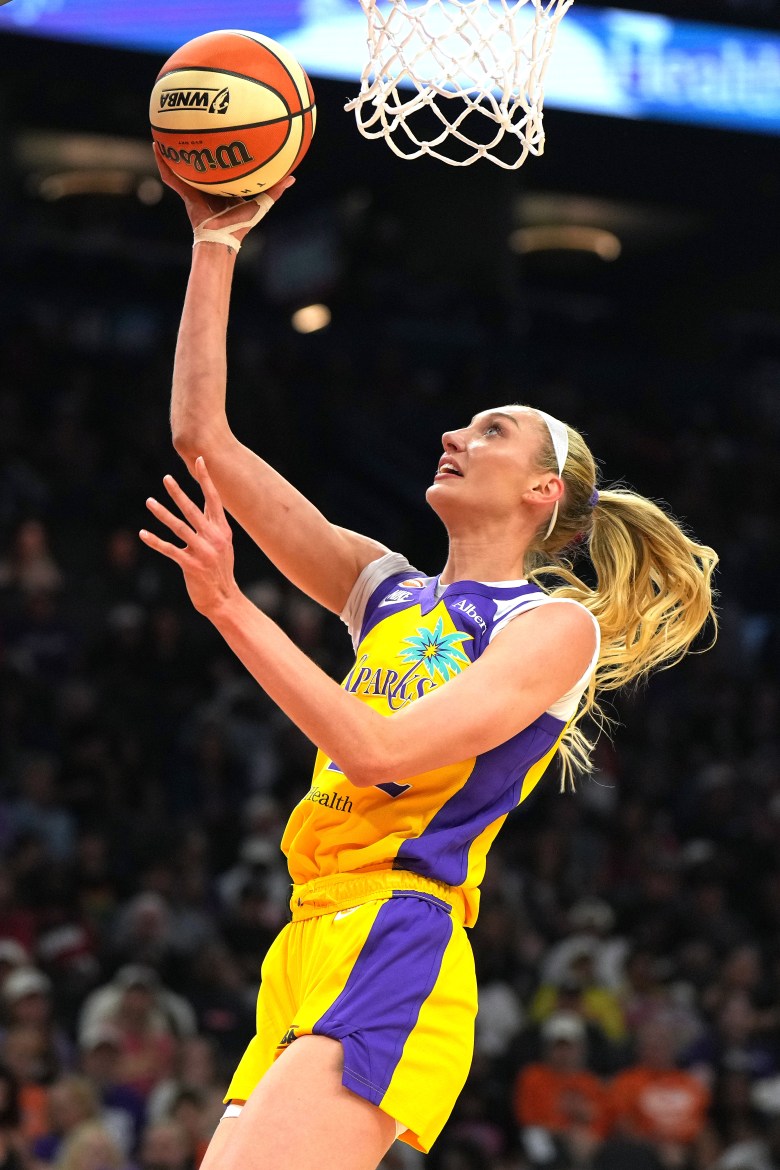
As the clock wound down in the first quarter of the Sparks’ May 13 game against the Indiana Fever, Cameron Brink elevated and blocked a Caitlin Clark floater with an emphatic swat that sent the ball into the first row of seats. She accompanied it with an equally emphatic verbal punctuation mark. It visibly fueled her: two minutes later, she blocked another Clark attempt.
She finished the game with 11 points, all in the second half. She looked more aggressive and more confident than she’d been in any prior game this season. More paint touches. Higher percentage looks. The kind of presence her team actually needs from her.
One game earlier, after the season opener, Sparks head coach Lynne Roberts was asked why Brink barely played. She said, “Um,” before looking down at the stat sheet for a beat. The pause spoke volumes.
Then, she answered: “We need Cam to produce. We need Cam to bring that defensive energy. She’s got to get out on the floor with some confidence and do what she’s capable of doing.”
The Sparks had just lost to Las Vegas 105-78 in their home opener. Brink played eight minutes off the bench and finished scoreless, with zero field goal attempts, three rebounds, three turnovers, and three fouls. It was not the debut anyone had in mind for what Roberts had said would be Brink’s breakthrough year.
Fifteen games into Brink’s rookie season, she was averaging 7.5 points, 5.3 rebounds, and 2.3 blocks per game before she tore her left ACL. She had already had five double-figure scoring games and recorded at least five blocks twice. It felt like the Sparks were rebuilding toward something, with a 6’5 first-year center at the center of it.
Then, thirteen months of ACL rehab passed. She returned for the final 19 games of the 2025 season off the bench, averaging five points and four rebounds in under 13 minutes a night, never exceeding 20 minutes in a game.
At media day, Roberts told reporters, “She only played in 33 games in two years, and it was plagued with peaks and valleys of injuries, and she’s healthy, and she’s confident. And she’s strong. She looks as good as she could look.”
Roberts later added, “This is almost like her second season. Her first two years combined is like a rookie year with ups and downs of injuries and stuff, a coaching change. … I think you’re going to see her hit her stride this year. Really excited about her and her headspace and where she’s at.”
The IX Daily: Six different women’s sports in your inbox every week!
Subscribe now and join us, just $6 a month or $60 a year. It’s the women’s sports media network we all wished for, and now it’s here! Soccer Monday, Tennis Tuesday, Basketball Wednesday, Golf Thursday, Hockey Friday – powered by The Ice Garden — and Gymnastics Saturday.
Most players Brink’s age and draft pedigree have had a chance to adjust to the league, build their game, and settle into a system. But Brink is still building her confidence and rhythm on a team whose identity has been rebuilt almost entirely without her.
Brink told reporters at media day that while last year was spent focused on her knee, this year she just gets to “play.” “I’m still super young, and I’m still making mistakes, and I may not be living up to my potential yet, but I definitely think I’m on the right path,” she said. She teared up, noting that she’s had to fight her way back to feeling like herself.
The Sparks team she is rejoining in 2026 is not the one she watched from the sideline her rookie year two years ago, or even the team she cheered on last year. Kelsey Plum, Nneka Ogwumike and Ariel Atkins were all acquired after Brink’s injury. Roberts has built a three-headed frontcourt rotation, with Dearica Hamby, Ogwumike and Brink cycling through minutes.
“What I love about it,” Roberts told reporters ahead of Thursday’s win over the Mercury, “is all three of them are very different. There’s versatility there. It’s a tough guard for whoever we’re playing.”
Hamby frames it similarly: “We’re all very versatile and three-level scorers. You’ve got to pick your poison.”
That structure makes conceptual sense: two seasoned veterans starting games with Brink coming off the bench for the first time in her career. What it also means is that Brink is learning her role inside a team that already has chemistry she wasn’t part of building, a set of relationships, habits and flow that developed amid her absence. Rejoining a team mid-evolution — especially when the identity has shifted from rebuild — is hard.
Brink has handled this with more grace than most would. “My goals are to win, to be a great teammate, and to learn from all my amazing vets,” she told reporters at media day. “I want to hoop, and keep it simple.”
As Roberts said, the Sparks need production from Brink now. What Brink needs to develop into a franchise-level center is something else: continuity, games, minutes. The kind of sustained floor time you cannot simulate in Unrivaled or training camp or thirteen minutes off the bench. She is, in many ways, starting over every time she takes the floor, recalibrating to a pace and a physicality and a set of teammates that keep changing around her. But she is also getting closer to the version of herself the Sparks have been waiting for.
The initial block on Clark was perhaps the clearest evidence of that so far. After her first block of the night, Brink got the ball in the block on the very next Sparks possession on an excellent low-post seal. “I’m a defensive-minded player,” she told The IX. “If I’m focused on the defensive end and can make plays there, I can flow into offense more confidently. It helps with my confidence and the momentum shift in the game.”
Fouls have always been an issue for Brink. In her first two seasons in the WNBA, she averaged 6.8 fouls per 36 minutes. This season, Brink is averaging 8.45 per 36 minutes. The fouls are not the result of one thing.
Some are the product of genuine aggression: she is a help-side defender and one of the best shot blockers in the league (“glad I’m on this side!” her teammate Erica Wheeler said at media day, talking about her “volleyball blocks”), but occasionally the instinct gets ahead of the play. The fouls that ultimately cost her are the reaches long after a chance of disruption, moving screens, and swatting at a rebound after the other player has already secured it.
The officiating environment early this season is actively making it harder for her to play extended minutes, and Brink is hyper aware of that. She told The IX that her new goal is to have zero fouls by halftime. Not to minimize fouls, not to play under a number: zero. But the version of Brink who racks up fouls is also, often, the aggressive, shot-hunting version who changes possessions. Threading that needle is a challenge.
‘Rare Gems’ is out now!
Howard Megdal, founder and editor of The IX Basketball and The IX Sports, wrote this deeply reported book. “Rare Gems” follows four connected generations of women’s basketball pioneers, from Elvera “Peps” Neuman to Cheryl Reeve and from Lindsay Whalen to Sylvia Fowles and Paige Bueckers.
If you enjoy Megdal’s coverage of women’s basketball every Wednesday at The IX Sports, you will love “Rare Gems: How Four Generations of Women Paved the Way for the WNBA.”
Through her first four games, there has been a noticeable improvement in Brink’s confidence and, as a result, output. After her struggles in the Fever game, she’s increased her minutes, averaging nearly 18 per game since. She has averaged 10 points per game in those 18 minutes, as well as almost four rebounds, one make from deep, and getting to the free-throw line six times in her latest outing. She blocked three shots against the Mercury, looking like the version of herself who is a highlight-reel mainstay. Her energy appeared different, and coming off the bench seemed to fuel her.
Roberts confirmed ahead of Thursday’s game that this will continue to be the approach with Brink, starting Hamby and Ogwumike opening, and hoping Brink can provide a spark off the bench. She told reporters that she wants the veterans to set the tone, and then “split their minutes three ways,” unless someone really “gets into the groove.”
Before Thursday night, it looked clunky. But on Thursday, it looked like what they have likely been hoping for: Brink, Ogwumike and Hamby combined for 51 points.
“What I love about it is all three of them are very different,” said Roberts. “There’s versatility there, even within those same positions. … I think it’s a tough guard for whoever we’re playing to have those three kind of rotating those two spots. So what you’ve seen so far is kind of what we’re, the vision is.”
After the game, Brink spoke about her impact. “My job is just to come in and bring energy, and you know, I thought I did that today,” Brink told media. “I’m just really loving my role and just bringing energy every time I’m on the floor.”
While her season may not have opened the way she hoped, Brink is settling into a role that will hopefully bring her game to the next level.