WASHINGTON — On July 20, the Washington Mystics used a 17-2 closing run to beat the Golden State Valkyries, turning the tables on the WNBA’s best defense. It was an impressive road victory for the Mystics — and illustrative of how they’ve leaned on defense to win games all season.
“We’re a team that really takes pride in our defense,” second-year guard Sonia Citron told The IX Sports on July 22. “So if that’s not going well, we don’t really feel like ourselves.”
The Mystics’ defense has put them in playoff position with a 15-12 record, despite being only in Year 2 of a rebuild. And it’s an unusually strong defense for a team that’s as young as they are.
The Mystics are the second-youngest team in WNBA history with an average age of 24.1 years old as of July 1. Yet their defense ranks third in the league this season, allowing just 103.5 points per 100 possessions.* That’s 5.0 points better than the WNBA average this season.
Since 2009, none of the WNBA’s 50 youngest teams besides the Mystics have been even 4.5 points better on defense than the average team that season. The next-youngest team that was more dominant than the Mystics defensively was the 2015 New York Liberty, whose average age was more than two years older at 26.7.

“I’m really proud of … such a young team to defend at this level,” Mystics head coach Sydney Johnson told reporters after losing to the Valkyries on July 6. “Oftentimes it’s the offense that comes earlier.
“There’s a lot of things that they have to transition towards in the W. Defensively, this group is learning fast, and you can see the results of that. So it’s been fun to see that, and yeah, we just want more of it.”
The Mystics’ defense isn’t flashy, to the point that veteran guard Michaela Onyenwere had to stop and think about what makes it so good. They aren’t averaging lots of steals or blocks; instead, they’ve simply been solid at forcing opponents to miss.
They’re holding opponents to the third-lowest effective field goal percentage in the WNBA at 48.9% — just 0.3 percentage points away from first place. (Effective field goal percentage adjusts a team or player’s field goal percentage to factor in the added value of 3-pointers.) The Mystics are also allowing the third-fewest points in the paint at 35.0 per game, while scoring a ton there themselves.
“You can do a lot of really good things with just playing really hard and taking pride in the defense,” Las Vegas Aces head coach Becky Hammon told reporters before facing the Mystics on July 22. “And I think this team does that. … They know where their help’s coming from. They know their spots.
“But I think their length and their physicality and athleticism are definitely a separation factor. I don’t think very many teams … have the offensive tools to go at that kind of size. And it’s important in any league you play professional basketball to get some layups and stuff at the rim, and they challenge you in there.”
Listen now to The IX Sports Podcast and Women’s Sports Daily
We are excited to announce the launch of TWO new podcasts for all the women’s sports fans out there looking for a daily dose of women’s sports news and analysis. Stream on Spotify, Apple Podcasts or anywhere you listen to podcasts, and make sure to subscribe!
Defense was a point of emphasis for the Mystics even before the season started. The front office intentionally added players in the WNBA Draft and free agency who could help there, from the size and length of rookies like Lauren Betts and Cassandre Prosper to the experience and defensive prowess of Onyenwere and Shakira Austin.
“I knew that we would be able to do more defensively with this roster, yes,” Johnson said on July 20. “… But to have the third-ranked defense at this point in the season, I did not foresee that.”
Once the Mystics opened training camp, the coaches focused on teaching their defensive concepts. There are eight rookies on the current roster, and even more were in training camp, meaning that the coaches had to start with basics like terminology.
“We all bought in pretty quickly,” Prosper told The IX Sports on July 16. “I think it just takes time for all of us to be on the same page and all of us to understand defensive schemes. … But I feel like everybody was locked in from the start.”
As Prosper alluded to, there has been a learning curve when it comes to defensive game plans, particularly for the rookies. In college, teams usually have multiple days between games to prepare for opponents, and they generally make minor adjustments to a base defense as needed. In the WNBA, games are often every other day, so players might have 24 hours to absorb a scouting report. The defense also changes more from game to game based on the opponent.
“[Players] have to realize, ‘OK, well, on Wednesday night, I was going over screens. Well, on Friday night, I gotta go under these screens, and then come Sunday, I may have to switch the screen,’” Mystics player development lead Clinton Crouch told The IX Sports on July 5. “And this is happening in real time against some of the best players in the world. And that’s a huge adjustment for some of our young players.”
‘Rare Gems’ is out now!
Howard Megdal, founder and editor of The IX Basketball and The IX Sports, wrote this deeply reported book. “Rare Gems” follows four connected generations of women’s basketball pioneers, from Elvera “Peps” Neuman to Cheryl Reeve and from Lindsay Whalen to Sylvia Fowles and Paige Bueckers.
If you enjoy Megdal’s coverage of women’s basketball every Wednesday at The IX Sports, you will love “Rare Gems: How Four Generations of Women Paved the Way for the WNBA.”
WNBA scouting reports also tend to focus more heavily on opposing players’ tendencies, and the Mystics have improved throughout the season at taking those away. All-Star guard Marina Mabrey of the Toronto Tempo is an example: On opening night and again on June 12, the Mystics allowed her to score 27 points. But on July 14, the Mystics held her to just 8 points, her third-lowest output of the season.
“Having dealt with a lot of other really, really good players, I think that we’re starting to get a feel for, if we don’t take care of detail 1, 2, 3, 4 and 5 in a single possession, these W players can light you up,” Johnson said after that game.
The coaching staff has continued to emphasize defense in practice, including by making the players get defensive stops before they can get reps at transition offense. But arguably what’s helped the players improve the most has been facing different offenses from game to game.
“I think the best way to learn is by just doing it,” Citron said, “and I think that’s why … we’ve just been getting better, because we’ve been gaining more experience.”

From month to month, the Mystics’ defense has noticeably improved. They allowed 106.8 points per 100 possessions in May, 102.5 in June and 101.9 in July. For comparison, that 4.9-point difference between May and July is larger than the gap between the Mystics’ season-long defense, which ranks third in the league, and the Phoenix Mercury’s, which ranks 11th.
That defensive improvement has helped the Mystics compensate for an offense that is scoring just 100.6 points per 100 possessions, which is second-worst in the WNBA.
| Points scored per 100 possessions | Points allowed per 100 possessions | Difference | |
|---|---|---|---|
| May | 102.5 | 106.8 | -4.4 |
| June | 98.3 | 102.5 | -4.2 |
| July | 102.2 | 101.9 | -0.3 |
Coaches and players alike have pointed to help defense as a key area where the team has improved. Citron and Onyenwere each brought up how the Mystics see defense not as five sets of one defender guarding one offensive player, but as one offensive player having to face five Mystics.
“Making sure that nobody’s guarding by themselves — one [versus] five mentality — I think that we’ve really just honed in on that, and you’ve seen it on the floor,” Onyenwere told The IX Sports on July 22. “… We’ve been able to kind of have that as our anchor, even when our offense is trying to catch up.”
The improved help defense has cut down on easy baskets for opponents, forced them deeper into the shot clock and reduced the Mystics’ fouling. In May, the Mystics committed 25.0 fouls per game and allowed 25.7 free-throw attempts per game. In July, those numbers dropped by over 30%, to 17.1 and 15.2, respectively.
They’ve also steadily improved their 3-point defense, going from third-worst in the WNBA in opponent 3-point percentage in late May to fourth-best now.
“Defensively, we’ve really locked in these past few games,” Betts told reporters after beating the Valkyries on July 20 and the Aces on July 22. “So just making sure that we’re continuing to do that, sticking together as a team, holding each other accountable, bringing that effort to practice every day, and just learning from each other, I think it’s gonna go really far. So I’m just excited to see what the future holds for us.”
Like many young teams — and even some older ones — the Mystics are looking for more consistency defensively. In their wins, they’re allowing 99.8 points per 100 possessions, but in their losses, that jumps to 108.3. (The offense is also much worse in their losses.) They have often started games slowly, too: They’re allowing 107.2 points per 100 possessions in the first quarter, which is the worst of any quarter for them.
“It’s really our start,” Austin told reporters after a loss to the Portland Fire on July 16. “We’ve had moments where we had to come back. We’ve had moments where we had to fight through a hole. But I think our energy just took entirely too long [to find tonight]. … We just have to be ready to go when the ball is jumped.”
“We should have got to business a lot sooner,” rookie guard Cotie McMahon told reporters after the Mystics gave up 33 first-quarter points in a win over the Connecticut Sun on Tuesday. “But we’re gonna get back in the gym [and] get back right.”
Your business can reach over 3 million women’s sports fans every single month!
Here at The IX Basketball and The IX Sports, our audience is a collection of the smartest, most passionate women’s sports fans in the world. If your business has a mission to serve these fans, reach out to our team at BAlarie@theixsports.com to discuss ways to work together.
Still, the Mystics have been a tough out nearly every time they’ve taken the court. Johnson calls toughness a non-negotiable for his team, and it has especially shown in the recent wins against the Valkyries and Aces. In both games, the Mystics were down by 9 points with under five minutes left, but they beat two of the top teams in the WNBA anyway.
“This team is sizing up to be one of the mentally toughest teams I’ve ever coached,” Johnson said after the win over Golden State. “It’s inspiring.”
Austin and Onyenwere have set the tone for the team defensively. They’re both versatile and vocal, and they take pride in their defense. Johnson has called Austin the team’s defensive “anchor” and “quarterback” at the center position, while Onyenwere is quite literally a coach on the floor.
“[Michaela] comes in with such a high standard, and she’s such a competitor,” rookie forward Angela Dugalić told The IX Sports on Tuesday. “… [And Shakira] sets the standard for not letting other teams … punk us. Yeah, I think she just comes in and does her job so well and brings everybody along. But yeah, I think she just brings another level of competitiveness for us.”
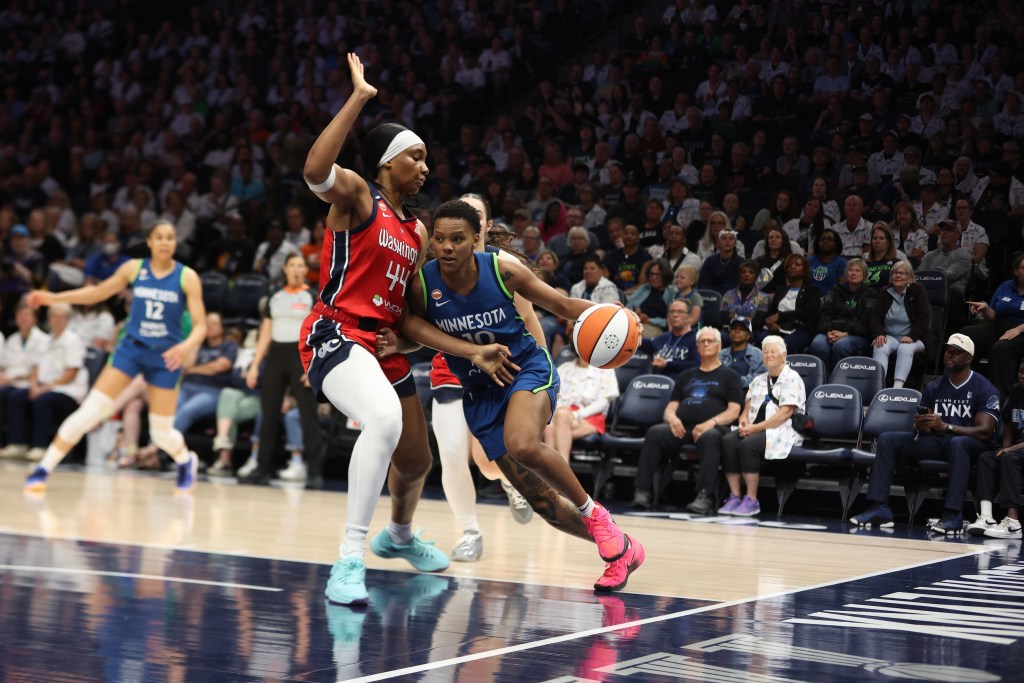
Though they’re primarily protecting the paint as part of the Mystics’ imposing frontcourt rotation, Austin and forward Kiki Iriafen have both become more comfortable guarding on the perimeter this season. That raises the Mystics’ ceiling because it allows the team to do more things defensively.
“Every game, we’re just getting more comfortable,” Iriafen told reporters after the win over the Valkyries. “Also, just working off, playing off of each other … like, who’s rim protecting? Who’s being the extra helper? … We were switching one through four, so I think that’s one of the reasons why we’re the No. 3 [defense] in the league.”
“Whatever we need from them, they can do, whether that’s switching one through five, not switching, guarding just whoever,” Citron said.
“I think the perimeter defense and how they’re able to add that versatility is going to take us to another level,” Johnson said. “… That inside-out defensive ability is pretty special, and we certainly want to keep developing that.”

The biggest Achilles heel for the Mystics defensively has been guarding in transition. They are averaging the most turnovers in the WNBA, and they also have the highest share of live-ball turnovers in the league at 58.1%. That means opponents are getting lots of chances to score against a scrambling defense.
And they’re converting.
In the halfcourt, the Mystics are allowing opponents to score just 87.7 points per 100 possessions, according to Synergy Sports. That’s the second-fewest in the WNBA. But in transition, the Mystics are allowing 113.5 points per 100 possessions, which is tied for 12th. Currently, 85% of the Mystics’ defensive possessions are in the halfcourt, and 15% are in transition. But if that 15% could drop to 13% or even 10%, that would make the Mystics’ defense that much more daunting.
That might be the scariest thing about these young Mystics going forward, even more than their tenacity or the sheer talent of their “Big Three” of Citron, Iriafen and Austin. Their offense has struggled and turnovers have been a problem all season. But as they continue to grow up in the WNBA, they’ll be able to lean on a defense that’s already playing beyond its years.
* All statistics reflect games through July 28, 2026.
Monumental Sports and Entertainment, the group that owns the Washington Mystics, holds a minority stake in The IX Sports. The IX Sports’ editorial operations are entirely independent of Monumental and all other business partners.