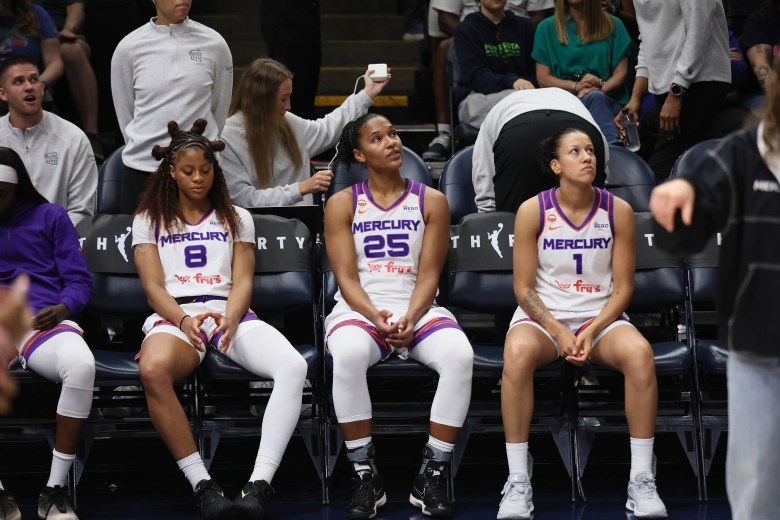
PHOENIX — The Phoenix Mercury’s struggles during the 2026 season have been well documented. Everyone is attempting to understand why the team has so significantly underperformed expectations only one year removed from making a run in the 2025 WNBA Finals.
At 8-17, the Mercury have already matched their loss total from the entire 2025 season, and the All-Star break hasn’t even arrived. And at 13th in the WNBA standings, it’s not lost on the team that it will have to play near-perfect basketball to claim a spot in the upcoming playoffs.
“For us right now, all of them are big,” Phoenix head coach Nate Tibbetts said of the upcoming games at a July 15 practice. “We got 19 to go … every game is a big game. There’s about four or five of us all playing for the eighth seed. You don’t have many more times to say, ‘Hey, we didn’t get that one.’ The time is now, and we got to play like it.”
When determining Phoenix’s outlook for the rest of the season, being stuck in the past may not be the most productive way of assessing what the Mercury must do in the present and future. It does, however, offer some clues as to what has to change for better results in the win-loss column.
Of the Mercury’s 17 losses, eight of them have come in games where they have either held a lead in the fourth quarter or lost by seven points or less, showing a trend of winnable games slipping away in the final moments. While it’s unrealistic to assume every single one of those results could’ve been flipped, if they were, then the Mercury would instead be 15-10.
If even just a few of those losses turned into wins, they would be in much better position. It would be an encouraging sign that their season may be more salvageable than their record indicates — if they can finally solve their late-game issues.
“You hate losing, and it sucks when you look at it and you’re like, ‘Oh, so many were close. We could have had those,’” veteran guard Sami Whitcomb said. “Would have, should have, could have all of those. But I also think it means we’re competing. We’re competitive. We are in those games. We can win those games. So yeah, now it’s fine tuning.”
Of course, the difficult part is identifying what exactly those issues are and if they were common across all those instances. The good news for Phoenix is that, while no two losses were identical, many of them shared similar characteristics that can possibly salvage its season if corrected.
The evidence
The two most glaring issues when it comes to Phoenix’s late-game execution have been committing costly turnovers and failing to get timely stops. Take for instance the team’s May 24 matchup against the Atlanta Dream. Ahead by eight points entering the fourth quarter, the Mercury committed six turnovers in the final frame, allowing Atlanta to outscore them by 10 points and escape with an 82-80 victory — the closest loss of the Mercury’s season so far.
In the final possession of that game, with the Mercury down two with half a second remaining on the clock, they failed to even attempt a game-tying or game-winning shot as Alyssa Thomas’ baseline inbound pass was stolen by Angel Reese.
About three weeks later on June 13 against the Los Angeles Sparks, the Mercury showed tremendous poise to come back from down nine in the fourth quarter to force overtime. But then, those same issues emerged. A turnover on Phoenix’s first possession of overtime set the tone for Los Angeles to race out to an 8-0 run to begin the overtime period.
After finally scoring its first points of overtime to make it 106-100 and in need of a huge stop to get back in the game, Phoenix did everything right on defense for 24 seconds, but still gave up a backbreaker as Erica Wheeler drilled a contested 3-pointer with the shot clock expiring to put the nail in the coffin. One can argue a possession like that is a case of bad luck, but the same can’t be said for the previous 14 3-pointers made by Los Angeles in the game — some of which stemming from defensive lapses in the fourth quarter and overtime.
“I think each of [the losses] are different,” Tibbetts said. “When you talk about slipping away, I think it’s more like when you have a lead and a team comes back and takes it from you … Both teams have possessions to go win it. I think it’s about coming up with a stop at the right time, and at times we haven’t done that at the level we need.”
Those late-game struggles have been especially evident in two of Phoenix’s three most recent losses, July 9 versus the Indiana Fever and July 13 at the Minnesota Lynx. Against Indiana, Phoenix led for most of the second half before squandering it late into the fourth quarter.
Rep The IX Sports at your next game!

Shop the logo collection or special “Women’s Sports are Front Page News” collection now on Shopify.
While there wasn’t much the Mercury could do against some of the shots the Fever hit to come back initially, the sequence of events in the final minute or so can certainly be looked at under a microscope. Tied at 84 with 1:03 to go, Phoenix’s Monique Akoa Makani coughed up the ball to Sophie Cunningham, eventually leading to two Indiana points to take an 86-84 lead with 44 seconds left.
Still, the Mercury were able to twice answer with go-ahead layups from Kahleah Copper and Thomas, but failed to get the timely stop after each of them that would’ve put them in the driver’s seat. In the end, Indiana’s Kelsey Mitchell drove through Phoenix’s defense without much resistance to lay in the game-winning shot.
A similar story was told just days later, as Phoenix led for most of the game against the WNBA’s best team in Minnesota, but let it slip away after being outscored by 10 in the fourth quarter. Although the Mercury only committed one turnover in the fourth quarter, it came at the worst possible time, as a Thomas pass was stolen during Phoenix’s final opportunity to tie the game with 20 seconds remaining while trailing by three.
Once again, the Mercury wouldn’t have been in that position in the first place if they were able to string together some stops to maintain their lead; Minnesota scored on 10 of its final 12 offensive possessions before that point.
“We’ve been in a lot of these games here down the stretch,” Tibbetts said after the game. “And it’s not only offensively, but defensively, and making a stand and getting a stop. There was at least one, maybe two, possessions where we did get stops, and they got offensive rebounds, and those are backbreakers.”
“Looking at the last Indiana game or the Minnesota game, in both of those we did have leads at different stages,” Whitcomb later said at Thursday’s practice. “We were winning, we did have control at different stages. What are the things that got away from us, and how can we try and limit that moving forward?”
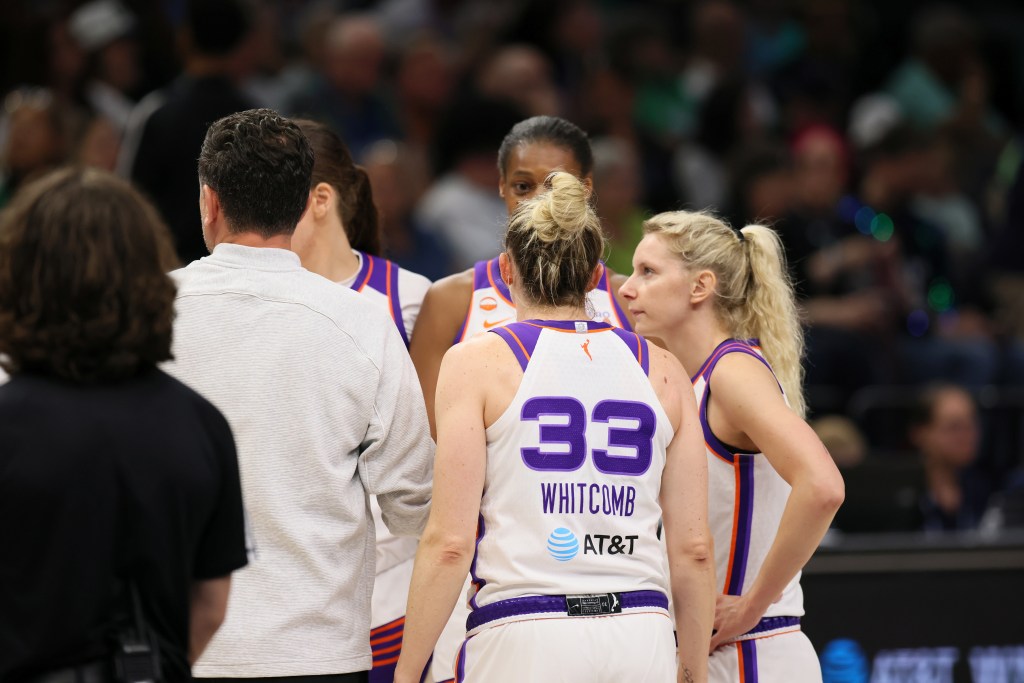
Defending without fouling — which has been a core principle for Phoenix — was another primary culprit. Minnesota shot 13 free throws in the fourth quarter, compared to 11 across the other quarters in the game, highlighting how costly those fouls became.
Free throws are called “free” for a reason. In late-game situations where teams are more likely to be in the bonus, eliminating unnecessary fouls could be the most important step toward the Mercury consistently finding the stops they need to close out games.
“Unfortunately, I think it’s just the little details, like taking more care of the ball and being able to defend without fouling,” Akoa Makani said at a July 16 practice. “Because our opponent most oftentimes go to the free throw line a lot, especially in the last quarter.”
Margin for error
The Mercury can’t get back the games they’ve already let slip away. What they can control is making sure those mistakes don’t continue to define the final stretch of their season.
“There’s a lot of people battling for that eight spot, four or five of us,” Tibbetts said following Monday’s loss in Minnesota. “Who’s going to go on a run? This is a group that thinks that we want to be a part of the playoffs, but time is moving, and we got to make a move. I thought today was the right step in the direction that we want to go. But we know these are the games that you got to win.”
How Phoenix does in its remaining clutch games could be the difference in edging out those teams nearby in the standings, especially when playing against each other. Thus, the Mercury’s cushion for making mistakes has grown thin — both in the microcosm of individual games, and in the macrocosm of the remaining season as a whole.
“I think that we just have to understand our margin of error is very slim,” Copper said. “So whether it’s turnovers, live-ball turnovers or just being able to get a stop and then being able to secure rebounds, I think the more we just understand that our margin of error is slim, we’ll be better off in those tight-game situations.”
Akoa Makani added, “It’s not time to try to make things more complicated. The easiest thing I think is just to take it one game at a time and try to erase every mistake that we make. Because at the end of the day, the season is far from its end, and we still have a chance.
“I think it’s possible because we’re having [close] losses, and yeah, I think we’re closer than what it looks like.”
Those words give great insight into what Phoenix’s mindset and approach looks like internally. It doesn’t seem like the Mercury want to make drastic changes to reinvent their identity. While the sense of urgency to turn things around is definitely there, the team believes the solution lies in cleaning up the mistakes they already know they’re making, rather than making sweeping tactical changes.
At this point of the season, the Mercury are well past the stage of learning the balance of who takes accountability between coaches and players. It’s do or die, and for the players, the focus is on continuing to play with the utmost precision and effort. Practice and film sessions continue to be useful, but no amount of either will tell them what they don’t already know must be done in the rest of the season.
“I don’t think it’s something that has to do with them,” Akoa Makani said of the Mercury coaching staff. “I think it’s us. We know basketball. We know when this pass wasn’t right or we didn’t take care of [the ball] enough. It’s not up to them. Yeah, they usually point it out to help us just in case, but I don’t think it’s necessary. We know when we messed up and what we gotta do to improve.”
Repeatedly putting themselves in position to win isn’t enough on its own, but there are lessons that have been learned through those experiences to retain some level of optimism moving forward.
“Any momentum for us at this point is important,” Thomas said after the loss to Minnesota. “This is the make-or-break point of the season [to decide] whether or not you’re going to make that final push to try and get one of those playoff positions. You need games like this to come down in the stretch. And once again, it goes their way. It just seems to be the epitome of this season.”
The only way to change that narrative now is to make sure the next close game ends differently.
“It’s frustrating to continually be in those positions and not come up with the win,” Whitcomb said. “So now it’s like, ‘What do we have to do?’ I think it’s having honest conversations with ourselves to figure out how we can put ourselves in that position again, and then make sure we come out with a win.”
With back-to-back games this weekend against the Connecticut Sun — one of the only teams with a worse record than the Mercury — the next opportunity to turn the tides of the season has arrived just before the All-Star break.
While previous opportunities resulted in a mixed bag of outcomes, the Mercury are grateful for another one. However, now 5.5 games back of the eighth seed with time running out, this could be the final chance.
“It’s not just this weekend that’s important, it’s from here on out,” Copper said. “I think just us being realistic and making a push to even be in the conversation of [the playoffs]. So all these games are important, and we want to be able to push it with the right mindset.”
‘Rare Gems’ is out now!
Howard Megdal, founder and editor of The IX Basketball and The IX Sports, wrote this deeply reported book. “Rare Gems” follows four connected generations of women’s basketball pioneers, from Elvera “Peps” Neuman to Cheryl Reeve and from Lindsay Whalen to Sylvia Fowles and Paige Bueckers.
If you enjoy Megdal’s coverage of women’s basketball every Wednesday at The IX Sports, you will love “Rare Gems: How Four Generations of Women Paved the Way for the WNBA.”