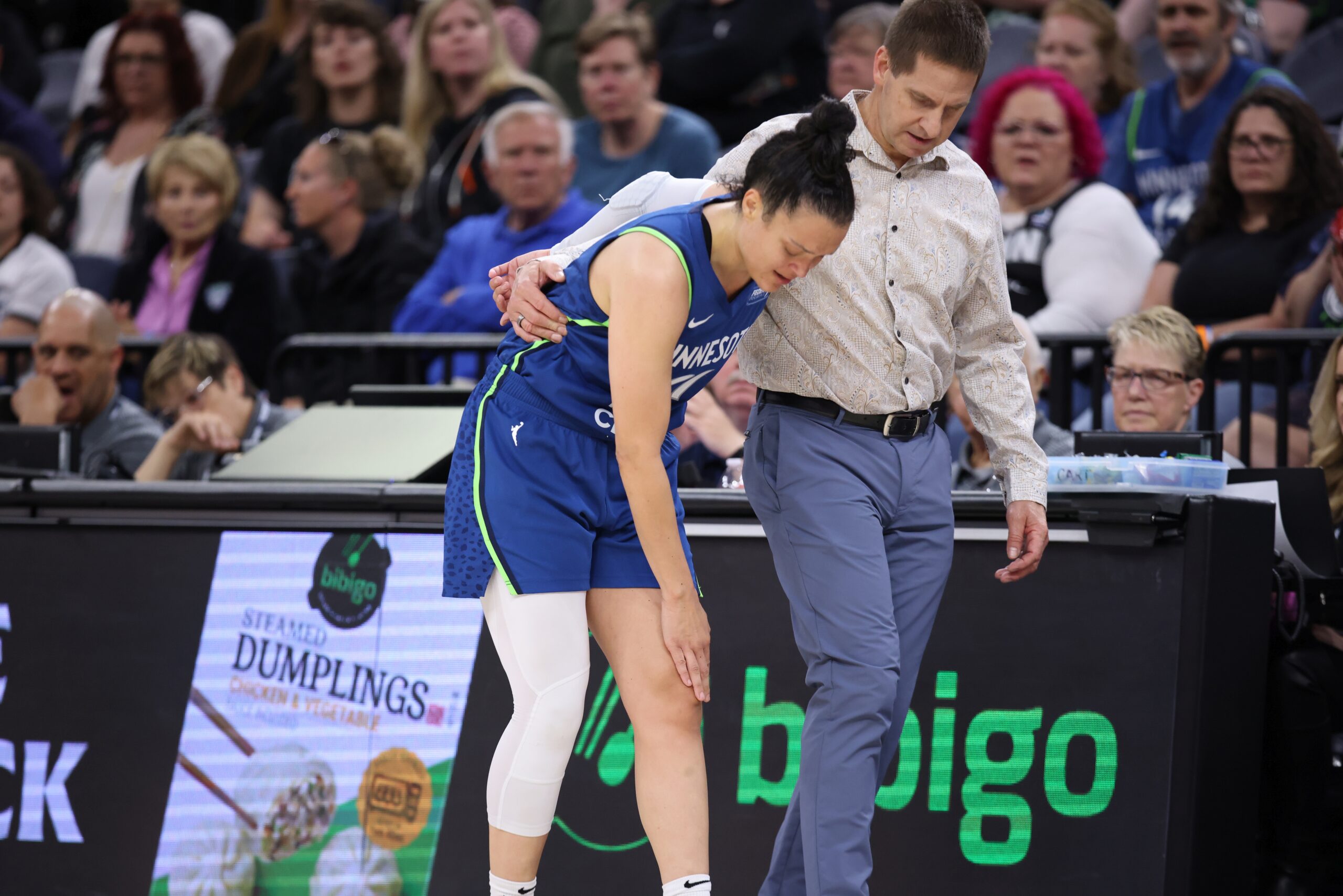
Injuries and games lost due to injury during the 2026 season are tracking to be the highest the WNBA has experienced since The IX Sports started tracking them in 2023. As of this writing, the league has experienced 178 total injuries and 644 games lost, which equates to 55.7 injuries and 201.5 games lost per 1,000 athlete games played; there have been 3,196 athlete games played thus far this summer. (For reference, the current highs in terms of total numbers are 252 injuries and 967 games lost, and in terms of rates are 46.6 and 178.8, with all registered in 2025.)
Leg (29), knee (29) and ankle (26) injuries make up 47.2% of all injuries, while knee injuries are the source of the bulk of games lost (283; 43.9%). Foot injuries are the only other body part to cause more than 90 games lost (94). The Portland Fire have suffered the most injuries (21), while the Chicago Sky (90), Minnesota Lynx (86) and Seattle Storm (84) have lost the most games; notably, all three teams have suffered from multiple and/or severe knee injuries.
(The IX’s WNBA injury tracker can be found here.)
The natural question to ask is: Why? Why are injuries and games lost increasing for the second consecutive season? Why is the WNBA on track to set the record for both injuries and games lost again in 2026?
It’s a question that teams around the league have been working to answer for many years now. Unfortunately, few answers have been found.
“I wish I knew. I mean, it’s shit, isn’t it?” Toronto Tempo head coach Sandy Brondello told The IX.
Various potential explanations and interventions have been offered as to why injuries are an ever-growing problem in the WNBA, particularly this summer, ranging from the personal to the logistical to the random.
“This is just a guess: I think having very little time for a lot of players to move right before training camp, to me, that would jack my nervous system,” Golden State Valkyries head coach Natalie Nakase said. “And then that also bumped the draft. I think everything just moved a little bit tighter. … You could also maybe look back at the college players, maybe, who are maybe a little banged up. Did they go far in the [NCAA] Tournament?”
‘Rare Gems’ is out now!
Howard Megdal, founder and editor of The IX Basketball and The IX Sports, wrote this deeply reported book. “Rare Gems” follows four connected generations of women’s basketball pioneers, from Elvera “Peps” Neuman to Cheryl Reeve and from Lindsay Whalen to Sylvia Fowles and Paige Bueckers.
If you enjoy Megdal’s coverage of women’s basketball every Wednesday at The IX Sports, you will love “Rare Gems: How Four Generations of Women Paved the Way for the WNBA.”
“We all have load management, so we’re always conscious of that, making sure their spikes are not too high. But sometimes in sport, shit happens too, you know?” said Brondello.
“Obviously, it’s incumbent on players to appropriately prepare themselves right for a regular season,” Minnesota Lynx president of basketball operations and head coach Cheryl Reeve said. “It’s also coming to my team to provide the resources necessary to care for the players. The more games you play, seems like the more injuries to be. Seems like that would be obvious. … For me, I’ve not really dove into it.”
But may I suggest that “Why?” is the wrong question to ask? Or, at least, it’s too simple an approach.
Traditionally, as highlighted by the WNBA personnel above, injuries have been considered the result of the additive impact of numerous variables. Factors such as the schedule, muscle strength, flexibility, age, sex, hormones, wear and tear, sleep quantity, and countless others all added together to cause an injury. This is an example of a linear thought process: variable A + B + C + … = injury.
As such, the majority of research and treatments have considered individual variables in an effort to reduce injuries, such as specific training regimens to improve muscle strength, reducing overall stress on the athlete’s body via load management, and daily soft tissue massage and cold tub plunging to reduce inflammation. The scientific method seeks to isolate variables and rule out confounding factors to derive cause and effect.
However, in practice, determining cause and effect is quite difficult. Unlike in medical research, where the effectiveness of a medication can be compared to an inert placebo, it’s very difficult, if not impossible, to run double-blind, placebo-controlled randomized controlled trials. Still, science has found that certain interventions are more correlated with protective effects than others. All things being equal, stronger muscles are more protective against injury than weaker ones; the effectiveness of load management is up in the air; massage and cold plunging are good for short-term pain relief but don’t necessarily provide long-term benefits.
And yet, as injuries continue to rise, something is clearly still missing.
Enter a relatively unexplored method of examining injury occurrence: nonlinear dynamics. Chances are, you are familiar with at least one example of nonlinear dynamics in the form of Chaos Theory, the idea that if a butterfly flaps its wings in Brazil, a seemingly unpredictable chain of events will result in a tornado in Texas.
Listen now to The IX Sports Podcast and Women’s Sports Daily
We are excited to announce the launch of TWO new podcasts for all the women’s sports fans out there looking for a daily dose of women’s sports news and analysis. Stream on Spotify, Apple Podcasts or anywhere you listen to podcasts, and make sure to subscribe!
Nonlinear dynamics are complex; the name of the overarching brand of mathematics of which nonlinear dynamics falls is, appropriately, complex systems. In essence, the countless variables described earlier interact in convoluted ways, ultimately leading to the development of an injury. And these interactions are dynamic in scope and magnitude, meaning their impact on injury development is fluid and ever-changing. (Another name for nonlinear dynamics is dynamical systems theory.) If a linear equation is variable A + variable B = injury, a nonlinear equation might be variable A + variable B = no injury today, but variable A + variable B = injury tomorrow.
As such, nonlinear dynamics explain why, say, an ACL tears during a cut to the basket even though the athlete had previously done so thousands of times without issue. In this sense, an injury isn’t “caused” by a single variable or even a family of variables. Instead, the injury “emerges” from the chaotic interactions between the variables. What’s notable, however, is that these interactions, while complex and opaque, are not truly random; patterns often emerge with enough data and simulations. And when patterns emerge, models can be tweaked, and predictions can be made.
Unfortunately, the influence of nonlinear dynamics on injury occurrence in sport largely remains theoretical at this time. There is very little academic research published on the topic and teams across most professional sports, including the WNBA, have not focused on exploring this method of injury analysis, instead adhering to the more traditional linear approaches. (Nonlinear dynamics has been used in other forms of science, specifically modeling the spread of infectious disease and predicting the weather.)
Until changes are made to the way injuries are examined, it is likely that injuries will continue to rise.
The IX Sports’ Jenn Hatfield, Terry Horstman and Sarah Maat contributed reporting for this story.