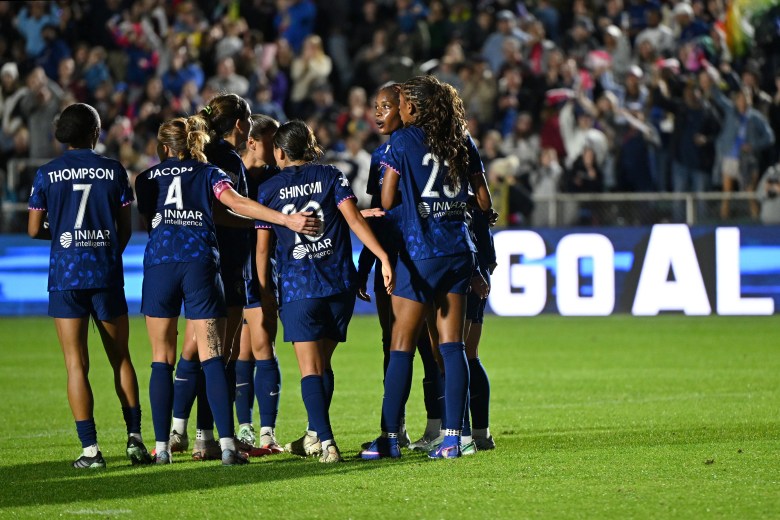
Perhaps nothing exemplifies the North Carolina Courage’s season better than the way their last game of the year ended. The score was 0-0 when the referee awarded four minutes of stoppage time and in the last minute, Denver scored an own goal. That would’ve sent them to the playoffs if not for the fact that Seattle already booked the last ticket through Jordyn Bugg’s goal, leaving North Carolina empty-handed.
In a season of near misses, the team and league’s top goalscorer, Ashley Sanchez, came close to making history in the same game once more. She looked to have scored her 21st goal with a chip only for the offside flag to take it away. As a result, she finished her season tied with Temwa Chawinga’s 20-goal mark established in 2024.
Although Sanchez’s achievement is remarkable, it was also frustrating. After all, this will be only the second time the NWSL Golden Boot has missed the playoffs after Sam Kerr missed it with Sky Blue in 2017. How did the team ultimately fall short of qualifying for the postseason?
Mak Lind’s initial vision
After the club parted ways with Sean Nahas midseason last year and finishing out the campaign as Nathan Thackeray in the interim, they appointed Mak Lind as head coach in January. Having previously coached BK Häcken, he wanted the Courage’s playing style to be more direct and aggressive. He wanted his players to be aggressive in the counterpress, willing to take on opponents in 1v1s, and if they had possession, to launch quick, dangerous attacks.
On the field, that translated to a midfield built to move the ball and make combinations. Manaka Matsukubo advanced on the left, Riley Jackson on the right, dropping into influential attacking roles. Shinomi Koyama stayed deeper to provide balance and Evelyn Ijeh dropped in either channel, connecting with the midfielders and wingers.
The players built triangles across the pitch and gave players such as Jackson more opportunities to influence attacks closer to goal. At the heart of all of that was Manaka, the 2025 NWSL Midfielder of the Year.
Nonetheless, after the summer break, the Courage had a big problem on their hands. Manaka had signed with Chelsea, leaving a huge gap to fill; the Japanese was one of the most important players in Lind’s attacking structure.
What was the solution? It wasn’t as simple as bringing another midfielder. After all, players like Manaka are rare. So, Lind decided to redistribute responsibilities across the team.
By that point in the season, Sanchez was already showing signs of becoming a prolific goalscorer. Therefore, Lind decided she was going to be the focal point of the attack and gave her greater freedom to influence the final third. Jackson took on additional progression and attacking responsibilities. Koyama kept providing balance in the midfield, and helped to connect and stabilize it. Felicitas Rauch contributed in more advanced positions. And Ijeh and Ally Schlegel offered additional attacking options.
Listen now to The IX Sports Podcast and Women’s Sports Daily
We are excited to announce the launch of TWO new podcasts for all the women’s sports fans out there looking for a daily dose of women’s sports news and analysis. Stream on Spotify, Apple Podcasts or anywhere you listen to podcasts, and make sure to subscribe!
The post-Manaka plan worked, at first
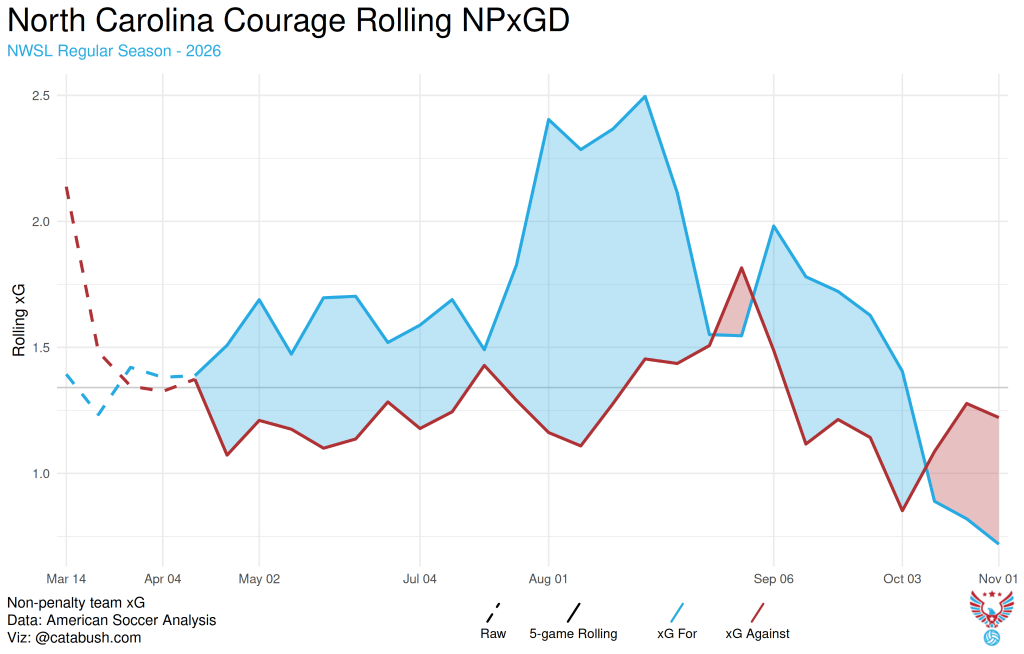
The data available and the results in the post-Manaka era seem to indicate the tactical adjustments worked just fine. If we take a look at the non-penalty expected goals (NPxG) produced by the Courage and their opponents in a six-game sample from July 31 to August 29, North Carolina averaged 2.33, compared to 1.73 for their opponents. Lind’s team was creating dangerous enough and good-quality opportunities.
Who carried whom?
The tactical changes as a result of Manaka’s departure benefited Sanchez, and in turn her 20 goals helped the team tremendously. As aforementioned, Sanchez became the focal point of attack, which helped her peak in late August and early September. During that stretch, she scored eight goals, including a hat-trick against Chicago on September 6, putting her only two goals away from the league’s single-season record.
However, as the team’s momentum faded, the striker’s scoring pace slowed. After her hat-trick, she found the back of the net against San Diego and Utah but was unable to score in the last four games of the season.
The fact that Sanchez was still approaching the league scoring record obscured how much the team’s broader attacking momentum had declined by that point. Ijeh, who scored four goals in July and another four in August, ran cold after the first week of September, when she tallied her last goal of the season against the Chicago Stars.
The end-of-season decline
Attacking data maps throughout the year also illustrate the decline the team suffered at the end of the season in shot creation.
There was a reduced attacking volume, especially in Zone 14. The team recorded 106 entries between June 1 and September 6, compared with 80 from September 7 to the end of the season.

The xG also declined. Going back to the six-game sample already mentioned, the Courage went from an average of 2.33 to 1.18 in the next six matches following the 6-0 win against Chicago. However, their opponents’ average xG also declined, going from 1.73 to 1.33.

The shots maps above provides more evidence of the reduction in attacking volume. The decline coincided with Sanchez’s scoring drought and reduced availability for key players, including Schlegel, Rauch, and Jackson. But injuries or managing minutes don’t explain the problem: It became increasingly difficult to turn their buildups into dangerous opportunities. They also struggled to break defensive structures with their passes as they did earlier in the season.
This was evident in Ijeh’s production. Earlier in the season, the striker arrived in the penalty area to finish after combining with teammates in the midfield or the half spaces. However, as the season went on she dropped deeper and deeper with the passing games to help with the buildup. As a consequence, her touches and shots inside the box became less frequent.
North Carolina’s decline isn’t reduced to a single factor, then. It cannot be attributed solely to injuries, to Ballon d’Or nominee Manaka leaving, or to Sanchez returning to the mean in her goalscoring production. The data suggests it was the team’s collective attacking structure that became less and less productive over time.
Lind restructured and adapted his team after the loss of a very important player, and was successful at first. However, that adaptation was not enough to sustain a playoff push.
What’s next for the Courage?
The Courage’s failure to clinch a playoff spot is evidence enough that there’s a stark difference between individual brilliance and a consistently productive team.
While Sanchez established herself as one of the most productive and dangerous attackers in the NWSL, the team’s late-season struggles show more is needed. They must sustain their attacking threat across the season by ensuring that their attacking structure provides enough opportunities for the rest of the team to find the back of the net when Sanchez is not doing so.
As the Courage prepares to face this challenge during the shortest off-season in the history of the league, they already have a solid foundation to build on. Lind found a way to move forward without Manaka. Now it’s time to find a way for that solution to last.
Rep The IX Sports at your next game!

Shop the logo collection or special “Women’s Sports are Front Page News” collection now on Shopify.