
An elite striker influences a game not only by how frequently she finds the back of the net, but also by how she shapes the attack when the ball is nowhere near her.
Khadija “Bunny” Shaw and Ewa Pajor have established themselves as two of the most prolific goalscorers in women’s football in recent years. Both spearhead their teams’ attack, capable of turning low xG chances into goals and forcing opposing defenses to adapt.
Yet, their approaches are not the same.
For Manchester City FC, Shaw combines her physical presence with intelligent positioning, the ability to hold off defenders, and an instinct for finding goalscoring opportunities. Pajor offers a different profile for FC Barcelona, relying on movement, timing, and the ability to exploit spaces inside the penalty area.
Their different styles illustrate that there’s not just one blueprint for the modern striker.
Different ways to beat defenders
Shaw’s ability to establish a physical presence against opposing center backs is one of her most recognizable characteristics of her game. The Jamaican’s height and strength allow her to compete for deliveries inside the box, protect the ball, and provide a central reference point for City’s attack. Moreover, Shaw identifies spaces between defenders and anticipate crosses, and uses great positioning inside or near the box to find scoring opportunities.
Pajor is diferent. She frequently adjusts her positioning around defenders, searching for opportunities to attack the space between the center backs or move into dangerous areas before a pass arrives. Inside the box, the Polish attacker doesn’t rely on her physical advantage but appears to use positional adjustment to react to loose balls or rebounds.
That doesn’t mean she’s faster than Shaw, but it does illustrate how both strikers take different approaches when trying to create opportunities. While City’s forward can use her reach and physical presence to compete for space, Barcelona’s uses timing and movement.
Finishing’s not everything
Although both players’ scoring ability is their most obvious trait, their statistical profiles reveal different dimensions of their attacking contributions.
During Pajor’s 2025/26 Champions League campaign, she scored 11 goals, averaging 1.34 goals per minutes across 738 minutes played. She was highly efficient in front of goal, with a 38% shot conversion rate. The Polish striker showed she’s a penalty-box finisher, with all 11 goals coming from inside the box.
At a domestic level, Pajor scored 16 tallies from a 12.47 xG across 1,563 minutes, outperforming that stat by 3.53 in the 2025/26 Liga F season.
On the other hand, Shaw didn’t compete with Manchester City in the Champions League last season, but at a domestic level, she had an incredible run. She tallied 21 goals, averaging 0.96 goals per 90 minutes across 1,958 minutes played. And just like Pajor, all her goals came from inside the box.
Listen now to The IX Sports Podcast and Women’s Sports Daily
We are excited to announce the launch of TWO new podcasts for all the women’s sports fans out there looking for a daily dose of women’s sports news and analysis. Stream on Spotify, Apple Podcasts or anywhere you listen to podcasts, and make sure to subscribe!
This season, Manchester City’s main striker has already scored 13 goals in 11 games, outperforming her 10.62 xG in the Women’s Super League. In the Champions League, she’s scored three goals in four appearances, averaging 0.8 goals/game.
However, one notable difference between the two strikers lies in their creative output. While Shaw is more goal-scoring prone, Pajor has increasingly contributed as a provider. Last season, she recorded five league assists and eight big chances. Moreover, the Polish striker has already surpassed her assists total in both domestic and European competition this campaign, recording three for the Champions League and nine for Liga F. Thus, Pajor’s creative output has become a more prominent feature of her game in the current season.
The importance of the fitting the system
No matter how skillful, a striker never operates alone. The systems Shaw and Pajor operate in are very different.
Manchester City usually uses left winger Lauren Hemp to carry the ball and pass to Shaw in the final third, or just capitalize on Shaw’s physical attributes by using her as the main striker inside the box, allowing her teammates around her, including Hemp, to exploit spaces generated by her presence.
Barcelona, on the other hand, can benefit from Pajor’s mobility and ability to find space within a system built around positional play and attacking combinations, with the most common formed between the Polish player and right winger Caroline Graham-Hansen. The Blaugranas are benefiting from years of chemistry initially developed at Wolfsburg, where they played together.
Despite the departure of several pivotal players from Barcelona, including Alexia Putellas, Pajor’s fundamental role doesn’t appear to have changed significantly. Her positioning and shot distribution still reflect her penalty-box striker nature.
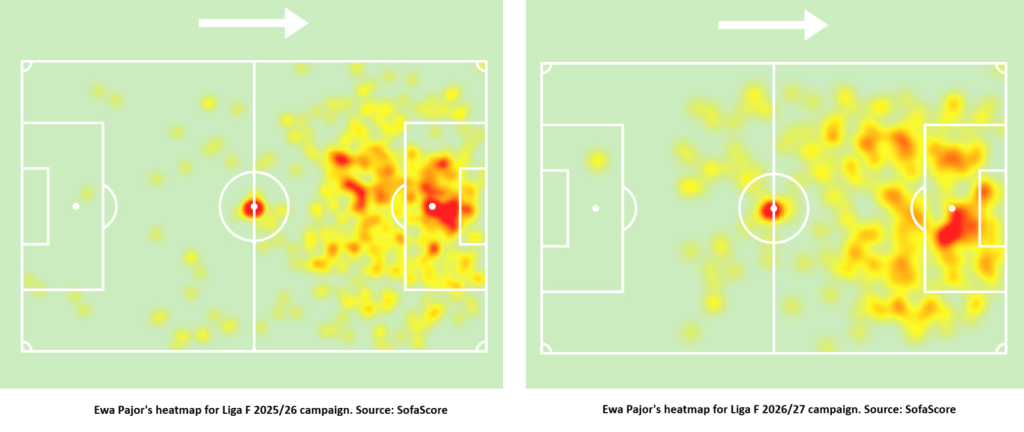
Nonetheless, her increased involvement in attacking sequences, her higher number of touches and key passes per game suggest that Barcelona are also benefiting from other aspects of her game. It remains to be seen if that trend will continue through the end of the season.
On the international stage
Club performances aside, both players will have the chance to prove their importance with their national teams in the upcoming international window. After scoring twice, including the winning goal in extra time, in the key second leg Poland played against Belgium, Pajor will be once again pivotal in her national team’s pursuit of a historic first World Cup qualification when they face the Republic of Ireland twice in the span of five days.
Meanwhile, Shaw will join Jamaica against Costa Rica in the Concacaf W Championship quarterfinals. A ticket for a third consecutive World Cup appearance and a potential historic first Olympic berth are on the line. After scoring nine goals in the Concacaf W Qualifiers, Shaw became the competition’s all-time leading goalscorer with 40 goals. After such an impressive campaign, City’s striker has the chance to lead her national team to achieve their goals once again.
Different styles, same goal
Shaw and Pajor’s different styles demonstrate there’s no single blueprint for an elite modern striker. Their contrasting physical and technical profiles allow them to solve similar attacking problems in different ways.
Goals remain the most obvious measure of a striker’s success, but understanding how they complement their teammates and meet the tactical demands of their systems provides a more complete picture of their game.
Ultimately, what makes Shaw and Pajor two of the most effective strikers in the world is not how much their styles resemble one another but how effectively they use their own strengths to make their systems work.
Rep The IX Sports at your next game!

Shop the logo collection or special “Women’s Sports are Front Page News” collection now on Shopify.